WORLD
WORLD
Ares
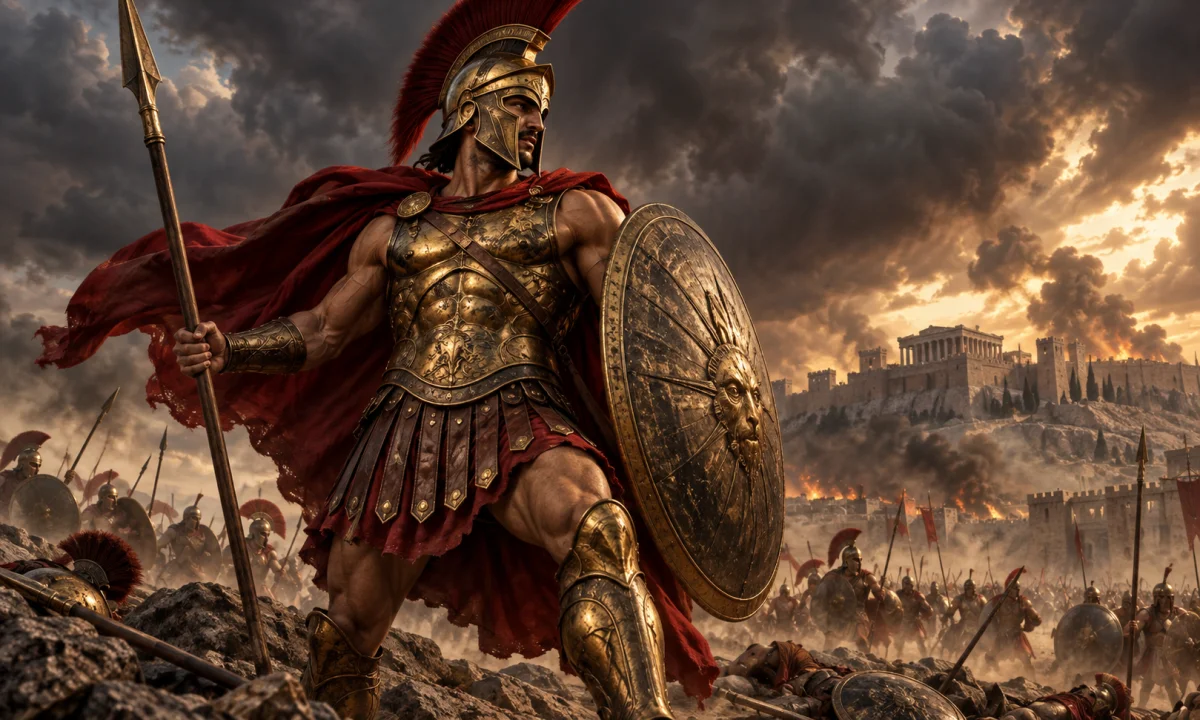
Ares is the Greek god of war, especially its violence, confusion and destructive force. He belongs to the religious and mythological traditions of ancient Greece, where warfare was both a practical necessity and a source of profound danger. Ares is not simply a divine patron of military victory. Greek poetry often presents him as a powerful but unstable figure associated with bloodshed, panic and the loss of control that accompanies battle.
Origins and cultural setting
Ares was worshipped as one of the Olympian gods and was generally regarded as the son of Zeus and Hera. In most familiar genealogies he is their legitimate divine child, although Greek mythology does not always preserve a single consistent family history for every god. His role developed within a culture in which warfare was central to the life of city-states, yet Greek communities did not all understand war in the same way.
Greek religious tradition distinguished several aspects of military life. Strategy, discipline, civic defence and the orderly protection of a community could be associated with Athena. Ares represented a more immediate and frightening dimension: the clash of armies, the frenzy of combat, the courage that borders on recklessness, and the suffering caused by armed conflict. This contrast is especially important in Homeric poetry, where Athena and Ares can appear as opposing divine models of warfare.
Ares was strongly connected in Greek imagination with Thrace, a region north of the Greek world that Greek authors often portrayed as rugged, warlike and culturally distinct. This connection does not mean that Ares originated straightforwardly as a Thracian god, nor that all Thracian religious traditions worshipped the same figure. It reflects the way Greek writers associated him with a foreign and martial landscape. His worship also existed in Greek communities, including parts of Boeotia, Attica and the Peloponnese.
The surviving evidence for Ares comes from several different kinds of material: epic poetry, hymns, drama, mythographic traditions, inscriptions, religious sites and visual art. These sources do not form one complete biography. They preserve different local practices and literary interpretations, so Ares may appear as a major divine force in one work and as a relatively secondary figure in another.
Name and identity
The name Ares is ancient Greek, but its exact etymology is uncertain. Ancient writers sometimes connected it with words for destruction or ruin, while modern scholars have proposed several explanations. No single derivation is universally accepted. The name should therefore not be treated as proof of a simple original meaning such as “war” or “slaughter.”
Ares is a distinct divine figure, although Greek texts sometimes use related names and titles for martial powers. Enyalius, for example, can function as a separate war deity in some contexts and as an epithet or aspect associated with Ares in others. The relationship varies by period and source. It is safer not to assume that every appearance of Enyalius refers to exactly the same religious figure as Ares.
His Roman counterpart is usually called Mars, but Ares and Mars should not be treated as identical in character. Roman religion gave Mars an especially important civic and ancestral role. He was connected with the protection of Rome, agriculture and the Roman people, as well as with warfare. Greek Ares, by contrast, is more often portrayed in literature as the dangerous excitement and devastation of battle. The Romans identified Mars with Ares in broad translation, but the two gods developed within different religious cultures.
Appearance and attributes
In art, Ares is commonly shown as an armed warrior. His equipment may include a helmet, spear, shield, sword, cuirass or greaves. Like many Greek gods, he could also be represented as an idealized nude or partially nude male figure, with weapons identifying his divine function. His appearance varies according to artistic period and context rather than following one fixed canonical design.
Ares is associated with the chariot, the spear and the shield. His horses and the noise of armed movement reinforce his connection with the battlefield. He is also linked with the personifications Phobos and Deimos, whose names mean fear and terror. In mythological genealogies these figures are often described as his sons by Aphrodite. Whether understood as literal divine children or as poetic embodiments of battle’s emotional effects, they express the panic that surrounds Ares.
Other creatures may accompany Ares in literature or art, including dogs and vultures. These animals evoke the aftermath of combat and the bodies left on a battlefield. Such imagery is not always a fixed attribute in the way Athena’s owl or Hermes’ winged sandals are. It belongs to a broader symbolic vocabulary of war, death and predation.
Ares possesses great physical strength and divine resilience, but he is not consistently portrayed as invincible. In epic stories he can be wounded, restrained, outmanoeuvred or humiliated. This vulnerability is part of his literary character. War is powerful, but it is also unpredictable, and even a war god may suffer defeat.
Ares in Homeric poetry
The Iliad presents Ares as a fearsome participant in the Trojan War. He is associated with the Trojans and fights on their side for part of the conflict, although divine loyalties in the poem are complicated and can shift. His presence on the battlefield brings terror, but Homer does not portray him as the ideal military commander.
Ares is repeatedly contrasted with Athena. Athena represents tactical intelligence, disciplined force and the ability to guide a warrior toward a particular objective. Ares embodies the tumult of combat itself. The opposition is not simply one between courage and cowardice. Instead, it contrasts different ways of understanding war: planned action and uncontrolled violence.
In one important episode, the Greek hero Diomedes attacks Ares with the assistance of Athena. Diomedes is granted the ability to perceive the gods, and he wounds the war god with a spear. Ares cries out in pain with a voice compared to the combined shouting of thousands of warriors. He then withdraws to Olympus and complains to Zeus. Zeus responds harshly, telling him that Ares is the god he hates most because of his delight in quarrelling and fighting.
This scene does not mean that Ares is powerless or that the Greeks rejected him as a god. It reflects the moral tension within Greek ideas of warfare. Ares is necessary to the battlefield, but the violence he represents can be condemned as destructive, irrational and difficult to control. The poem’s treatment of him is therefore both fearful and critical.
Ares also appears in the Odyssey in a famous story concerning his affair with Aphrodite. Aphrodite was married to Hephaestus, the divine smith, but she and Ares met secretly. Hephaestus constructed an invisible or extremely fine net and trapped the lovers together. He then summoned the gods to witness their humiliation. The episode is comic and exposes Ares to ridicule, showing that even an Olympian god of war can be defeated by craft and technical skill.
The story also creates a symbolic contrast between Ares and Hephaestus. Ares represents force, physical aggression and desire, while Hephaestus uses planning, workmanship and invention. The stronger figure in a direct confrontation is not necessarily the one who controls the outcome.
Family and relationships
Ares and Aphrodite are among the most famous divine lovers in Greek mythology. Their relationship appears in epic and later mythological traditions, but the details are not identical in every source. Their children commonly include Harmonia, the goddess associated with concord and, in some traditions, the mother of the Theban royal line. They are also often named as the parents of Phobos and Deimos.
Some traditions attribute other children to Ares and Aphrodite, but ancient genealogies are inconsistent. Ares is also named as the father of various heroes, kings or local figures through relationships with mortal women or other divine beings. These genealogies often served to connect a city, dynasty or heroic family with a powerful god. They should not be combined into one uniform family tree without noting their local or literary differences.
Ares is connected with the Amazons in several later Greek traditions. Some myths describe the Amazons as his descendants or place them under his special protection. The most famous Amazon queen, Hippolyta, is sometimes said to possess a belt belonging to Ares. Heracles’ recovery of this belt becomes one of his labours. The exact form of the story varies, and the Amazons are not simply female versions of Ares; they have their own complex place in Greek storytelling.
Another important myth concerns the murder of Halirrhothius, a son of Poseidon. According to Athenian tradition, Halirrhothius attempted to assault Alcippe, a daughter of Ares, and Ares killed him. Poseidon brought the matter before a divine tribunal, but Ares was acquitted. The court was said to have met on the hill later known as the Areopagus, or “Hill of Ares,” in Athens.
The Areopagus story links Ares with both violence and the formal control of violence through law. The myth does not present every act of force as equally acceptable. Instead, it imagines a divine trial in which the circumstances of bloodshed must be examined. The Athenian court called the Areopagus later became associated with serious legal matters, especially homicide, although its historical functions changed over time.
Ares in other myths
Ares appears in the stories of Heracles, including a confrontation over Cycnus, a violent son of Ares who attacked travellers. In versions of the myth, Heracles fights Cycnus and then faces Ares, who attempts to defend his son. Heracles wounds the god, and Ares is forced to retreat. The story reinforces a recurring pattern: divine martial power can be confronted by heroic strength and courage.
Ares also has a role in the foundation myths of Thebes. In one tradition, Cadmus kills a dragon sacred to Ares after the creature guards a spring. Cadmus then sows the dragon’s teeth, from which the armed Spartoi, or “sown men,” emerge. Cadmus must make peace with Ares, and he later marries Harmonia, who is presented as the daughter of Ares and Aphrodite. Through this marriage, Ares becomes connected to the complicated ancestral history of Thebes.
These myths do not make Ares the founder of every warlike people or the source of all heroic violence. Rather, they place him at points where communities confront bloodshed, inherited conflict and the need to establish social order after violence. His divine family can therefore represent both the destructive force of war and the political structures that emerge from conflict.
Worship and religious significance
Ares was not merely a literary villain. He received religious honours, although his cult appears to have been less widespread and less publicly prominent than those of Zeus, Athena, Apollo or Dionysus. Ancient communities could honour a god whose power was dangerous, just as they worshipped other deities associated with plague, storms, the sea or death. Ritual often aimed not only to celebrate a power but also to secure its favour and prevent its harm.
Greek communities did not all worship Ares in the same manner. He had particularly strong associations with regions that Greek authors considered martial, and he was honoured in various local sanctuaries. Sparta, a society famous in later tradition for military discipline, had religious connections with Ares, but Spartan warfare should not be reduced to the worship of a single war god. Athena, Artemis and other deities also had important places in Spartan religion.
Ares could be invoked under titles emphasizing his role as a defender, warrior or destroyer. His worship may have involved sacrifices and prayers for success in conflict, protection of a community or the defeat of enemies. The surviving evidence is not sufficient to reconstruct one universal “cult of Ares.” Local practice, historical period and political circumstance all mattered.
His relative absence from some major civic festivals has sometimes led to the mistaken belief that the Greeks disliked or ignored him. A better interpretation is that Greek religion held two truths together: warfare was unavoidable and could be honoured, yet uncontrolled violence was morally and socially dangerous. Ares occupied precisely that uneasy territory.
Meaning and interpretation
Ares is often described as the god of “brute force,” but that phrase is incomplete. He represents the emotional and physical intensity of war: rage, panic, bloodlust, shock and the pressure to fight. He can also signify courage, competitive aggression and the willingness to enter danger. What distinguishes him from Athena is not that he alone is violent, but that his violence is less governed by calculation and civic purpose.
His myths repeatedly make violence answerable to something beyond violence. Diomedes and Athena defeat him through coordinated skill. Hephaestus traps him through craftsmanship. A divine court examines his killing of Halirrhothius. Heracles withstands him through heroic strength. These stories suggest that martial power is real, but it does not automatically confer wisdom, legitimacy or victory.
The relationship between Ares and Aphrodite is also more than a simple romance. Desire and war are both disruptive forces, and their union produces figures associated with harmony, fear and terror. Greek myth often places seemingly opposed powers together in order to explore how human experience is interconnected. Love may lead to conflict, conflict may create political alliances, and harmony may emerge from unstable beginnings.
Ares and modern popular culture
Modern fiction frequently uses Ares as a straightforward villain or as the embodiment of war itself. Films, novels, comics and video games may give him powers, motives or family relationships that belong to modern invention rather than ancient Greek tradition. He is often portrayed as seeking endless conflict or attempting to overthrow the other gods, but no single version of this character represents all Greek mythology.
Modern adaptations also commonly merge Ares with the Roman Mars or with a general concept of a universal war god. Such treatment can be effective for storytelling, but it obscures important differences. The Greek Ares of epic and myth is a god of terrifying battle energy, vulnerable to defeat and frequently criticized by other gods. He is not simply a heroic champion of soldiers, nor is he the complete equivalent of the later Roman Mars.
In traditional Greek mythology, Ares remains most distinctive as the divine force of war’s immediate violence: powerful, necessary, frightening and difficult to govern.