WORLD
WORLD
Asteria
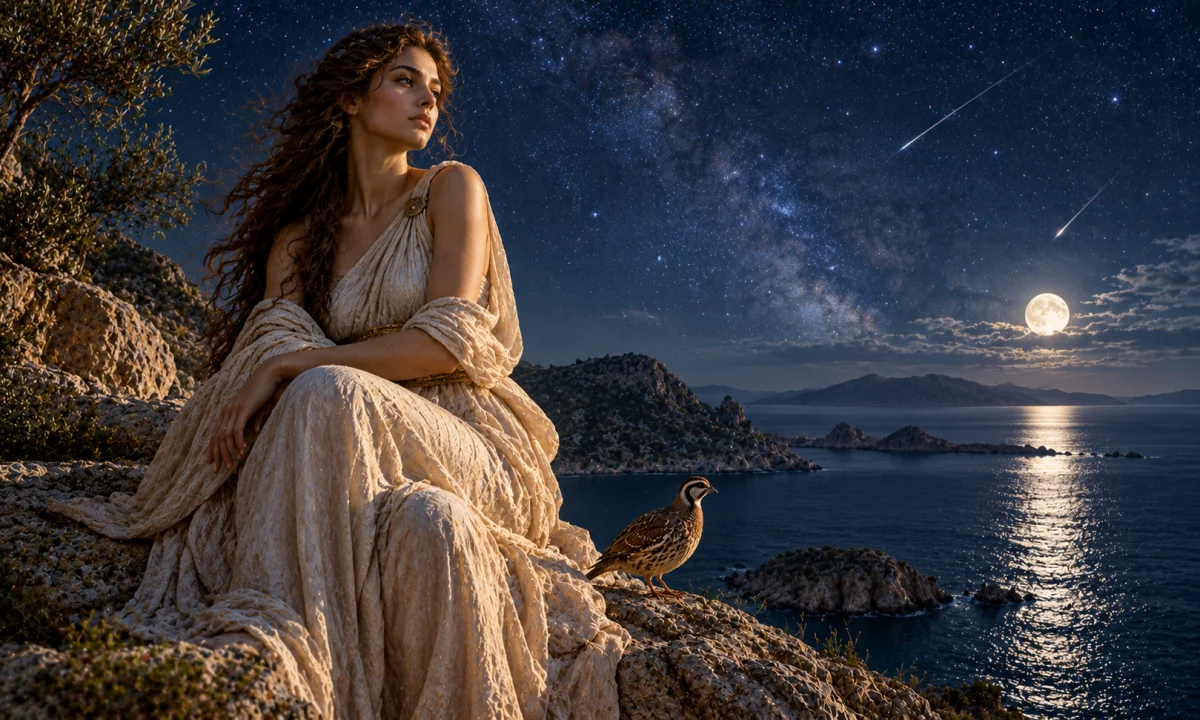
Asteria is a Titaness in Greek mythology, best known as the daughter of the Titans Coeus and Phoebe, the sister of Leto, and the mother of Hecate. Her name is connected with stars and the night sky, although the earliest surviving sources do not give her a large independent cult or a clearly defined sphere of power. Asteria becomes especially important in later myths as the woman who escaped Zeus by transforming herself and becoming the island associated with Delos.
Origins in Greek mythology
Asteria belongs to the generation of divine beings commonly called the Titans. In the Theogony attributed to Hesiod, Coeus and Phoebe have two daughters: Leto and Asteria. This genealogy places Asteria within the older divine family that precedes Zeus and the Olympian gods.
Her father, Coeus, is one of the twelve Titans who are children of Uranus, the sky, and Gaia, the earth. His name has been interpreted in different ways, sometimes in connection with intelligence, inquiry or the celestial axis, but the surviving myths provide little narrative about him. Phoebe is associated by name with brightness and prophecy, and later traditions connect her with the oracle at Delphi through her grandson Apollo. These associations help place Asteria within a family strongly linked to the sky, celestial order and prophetic knowledge, though they do not establish a specific original function for Asteria herself.
Asteria's sister Leto is the mother of Apollo and Artemis by Zeus. The relationship between the two sisters becomes important in the story of Asteria's transformation and in the later mythology of Delos. Asteria is also described as the wife or consort of Perses, a son of the Titan Crius and the sea goddess Eurybia. Their daughter is Hecate, the goddess associated with crossroads, liminal spaces, night, magic and the dead in some Greek religious traditions.
The name Asteria
The name Asteria is related to the Greek word astēr, meaning “star.” It can therefore be understood as “starry,” “of the stars” or “star-like.” The name is appropriate for a figure connected by family and later interpretation with night, celestial signs and the heavens.
It is important, however, not to treat the meaning of the name as proof that Asteria originally had a fully developed role as a star goddess. Greek divine names often preserve imagery or poetic associations without providing a complete description of a deity's worship. Hesiod names Asteria and records her family relationships, but does not give her a long list of powers, titles or rituals.
Later writers and interpreters have connected her with nocturnal visions, astrology, falling stars and prophetic dreams. Some of these associations arise from her name, her daughter Hecate, or the story of her transformation into an island. They should be distinguished from the more limited information supplied by the earliest genealogical poetry.
Asteria and Perses
In the traditional genealogy, Asteria marries Perses. Perses is a Titan associated with destruction or devastation by the meaning of his name, although he has little independent mythology. He is the son of Crius and Eurybia and is therefore a member of the same broad Titan family as Asteria.
Asteria and Perses are chiefly remembered as the parents of Hecate. Hesiod presents Hecate as a powerful goddess whom Zeus honours greatly. She has influence over the earth, sea and sky and may grant success in assemblies, contests, warfare, pastoral life and seafaring. This portrait is notably broader than the later popular image of Hecate as exclusively a goddess of witchcraft or the underworld.
The maternal connection between Asteria and Hecate has encouraged later interpretations of Asteria as a goddess of night and hidden knowledge. In ancient sources, however, Asteria's own identity remains distinct from Hecate's. She should not automatically be given every attribute later associated with her daughter.
The pursuit by Zeus
The most famous story about Asteria concerns the pursuit of her by Zeus. Like several women in Greek mythology, Asteria is approached or pursued by the king of the gods. The surviving versions differ in detail, but the central theme is her attempt to escape Zeus's unwanted attention.
One influential mythographic tradition says that Asteria transformed herself into a quail and fled through the air. She then threw herself into the sea and became an island. In this account, the island was first called Asteria, after the transformed goddess. It later became known as Delos.
The transformation has several layers of meaning. Asteria's name suggests the starry heavens, while her fall into the sea connects the celestial figure with a small, isolated landform. The myth also gives a divine explanation for an island's name and unusual status. Her transformation is not presented simply as a punishment: it is an act of escape and self-preservation, allowing her to avoid Zeus.
Some traditions use the name Ortygia, meaning “quail island,” in connection with the place where Asteria was transformed. The relationship between Asteria, Ortygia and Delos is not completely uniform across ancient sources. In some accounts, Ortygia is an earlier name for Delos; in others, it is associated with a separate island or with the island's earlier identity. The names can therefore overlap without being identical in every version of the myth.
From Asteria to Delos
Delos is best known as the birthplace of Apollo and Artemis. According to the widely known myth, Leto became pregnant by Zeus and was pursued by Hera's hostility. Because Leto could find no safe place on which to give birth, the wandering island eventually received her. Apollo and Artemis were born there, after which Delos became one of the most important sacred places in the Greek world.
The relationship between Asteria and Delos varies according to the source. In one version, Asteria herself becomes the island and later receives Leto. This makes the island the transformed body or renewed form of Leto's sister. In other traditions, Delos is described as a floating or wandering island without the full story of Asteria's transformation. The name Asteria may also be preserved as an earlier name or poetic designation rather than as a separate island in every account.
The myth creates a close bond between the two sisters. Asteria escapes Zeus's pursuit, while Leto later seeks refuge on the island connected with Asteria. The island's role as the birthplace of Apollo and Artemis gives Asteria indirect importance in the ancestry of two of the most prominent Olympian gods.
Some versions also say that Delos was once unstable or moved across the sea before being fixed in place. This feature reflects the island's unusual religious and geographical character. Delos was a small island in the Cyclades, but it held enormous sacred importance because of its association with Apollo and Artemis. Myths of a wandering or floating island helped express that exceptional status.
Asteria in ancient literature
Hesiod's Theogony is the principal early source for Asteria's genealogy. It identifies her as the daughter of Coeus and Phoebe, the sister of Leto, the wife of Perses and the mother of Hecate. The poem does not narrate her pursuit by Zeus or describe her transformation into an island in detail.
Later Greek poets and mythographers develop the connection between Asteria and Delos. Hymns and poetic works about Delos focus on the island's importance as the birthplace of Apollo, and their accounts may preserve different stages of the island's mythic identity. Mythographers also record the quail transformation and the name Asteria, but they do not always agree about the sequence of events or the relationship between Asteria, Ortygia and Delos.
These differences are normal within Greek mythology. Greek myths were transmitted through poetry, local religious traditions, drama, art and later compilations rather than through a single authoritative scripture. A figure's genealogy may be stable in one tradition while her narrative, symbols or place of worship vary elsewhere.
Attributes and symbolic associations
Asteria does not have a consistently described appearance in the surviving ancient literature. Artistic representations specifically identified as Asteria are difficult to distinguish from depictions of other divine women, and no universally recognized set of objects or physical features belongs to her.
Her main symbolic associations arise from four elements:
- Stars and the night sky: her name derives from the Greek word for “star,” giving her a celestial character.
- Escape and transformation: the story of her flight from Zeus presents her as a figure who resists divine pursuit through metamorphosis.
- The sea and islands: her transformation into an island links her with the Aegean landscape and with the sacred geography of Delos.
- Hecate's ancestry: as Hecate's mother, she belongs to a lineage associated in later tradition with night, thresholds, magic and hidden forces.
Some modern descriptions call Asteria a goddess of falling stars, dreams or astrology. These descriptions can be useful as later symbolic interpretations, but they should not be presented as a complete ancient religious profile. The earliest evidence identifies her more securely through her family and transformation than through an independent portfolio of powers.
Asteria and similar names
Asteria should not be confused with Asteria the daughter of Deioneus, a different figure in Greek genealogical tradition. That Asteria is associated with Phocus, a son of the hero Aeacus, and is named as the mother of Panopeus and Crisus in some accounts. She does not have the Titaness's relationship to Coeus, Phoebe, Leto, Perses or Hecate.
The names Asteria, Asterie and Asterion are related in form and may appear with varying transliterations in English. Asterion is usually a masculine name and belongs to several different figures, including a Cretan king or river god in different traditions. Similar spelling does not indicate that these characters are versions of the same being.
Asteria is also distinct from Artemis, Selene and Nyx. Artemis is the Olympian goddess of hunting and the moon in later interpretations; Selene is the personification or goddess of the moon; and Nyx is the primordial goddess of night. Asteria may share nocturnal or celestial imagery with them, but she is not simply another name for any of these figures.
Religious and cultural significance
Asteria's importance lies less in evidence for a widespread independent cult than in her position within Greek mythic genealogy and sacred geography. Through Perses and Hecate, she belongs to the ancestry of a goddess whose worship continued in various forms across the Greek world. Through Leto and Delos, she is connected indirectly with the birthplaces and cults of Apollo and Artemis.
The story also reflects a recurring pattern in Greek mythology: a place in the landscape is explained through the transformation of a divine or heroic figure. Such myths do not function only as stories about personal identity. They help connect geography, family memory and ritual importance. Delos is not merely an island in these narratives; it is a participant in the divine history of Apollo and Artemis.
Asteria's escape also differs in tone from stories in which transformation is imposed by a god as punishment. Although ancient myths do not frame the episode in modern terms of individual rights, the narrative clearly gives Asteria an active response to Zeus's pursuit. Her metamorphosis changes her status and location, but it also enables her to evade the power of an Olympian god.
Later reception
Asteria has received renewed attention in modern retellings of Greek mythology, particularly because of her connection with Hecate and her transformation into Delos. Contemporary writers may portray her as a star goddess, a protector of fugitives, or a figure of independence and resistance. These interpretations draw on genuine elements of her ancient myths, but they often expand a relatively brief figure into a more fully characterized protagonist.
Modern fantasy, novels, games and online mythology often combine Asteria's name with attributes belonging to Hecate, Selene, Artemis or Nyx. Such combinations may be creative adaptations rather than evidence for ancient belief. In traditional Greek mythology, Asteria is most securely identified as the Titaness of Coeus and Phoebe, the mother of Hecate, the sister of Leto and the transformed island associated with Delos.