WORLD
WORLD
Armisael
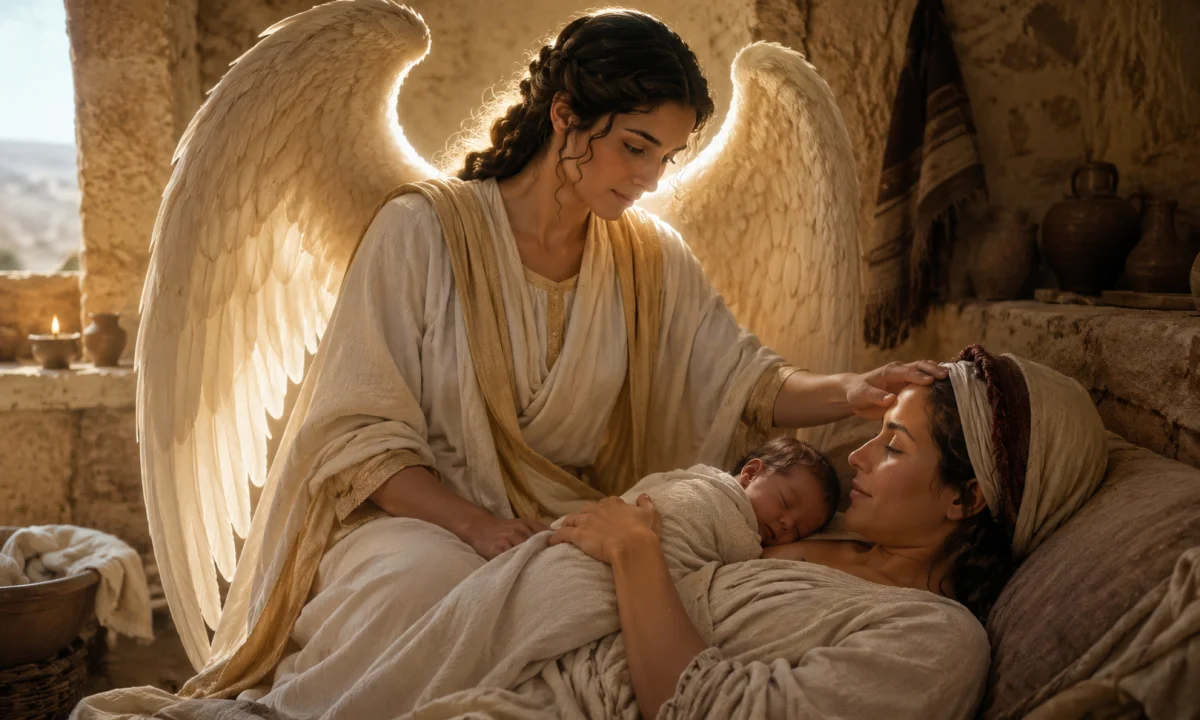
Armisael is a little-known angelic name associated in later angelological and occult traditions with the womb, pregnancy, and protection against miscarriage. Unlike Michael, Gabriel, Raphael, or Uriel, Armisael does not have a clearly established role in the principal biblical books or in the best-known Jewish apocryphal writings. The name survives mainly through later lists and compilations of angels, where its spelling, identity, and precise function are not entirely consistent.
Origins and religious setting
Armisael belongs to the broad world of Jewish and Christian angelology, but the surviving evidence for the figure is sparse. Jewish religious tradition contains many named angels outside the Hebrew Bible. These names appear in apocalyptic literature, rabbinic discussions, mystical writings, liturgical material, magical texts, and medieval compilations. Some angels have detailed narratives and stable identities, while others occur only in a single list or in a later work whose relationship to earlier tradition is difficult to establish.
Angel names were often preserved through copying and translation. A name written in Hebrew or Aramaic could be transliterated into Latin, Greek, German, English, or another language in several different ways. Copyists could also confuse similar letters or adapt an unfamiliar name to the spelling conventions of their own period. For that reason, a name such as Armisael cannot automatically be treated as evidence of a fully developed ancient figure.
The association of Armisael with pregnancy reflects a wider interest in angels who govern particular stages of human life. In Jewish tradition, conception, gestation, birth, illness, death, and the formation of the soul could all be connected with spiritual beings. Such ideas do not always belong to one unified system. They may occur in rabbinic stories, mystical speculation, protective prayers, or later occult catalogues, each with its own terminology and theological assumptions.
The name Armisael
The meaning of Armisael is uncertain. The name is sometimes given in variant forms such as Armisaël, but there is no universally accepted ancient etymology. It is tempting to divide the name into familiar elements associated with Hebrew angelic names, especially the ending -el, meaning “God” or “of God.” That ending is common in names such as Michael, Raphael, Gabriel, and Uriel. However, the presence of -el does not by itself establish a precise translation or prove that the name originated in a particular biblical passage.
Modern reference works and esoteric dictionaries sometimes repeat the name without identifying a single early manuscript or authoritative tradition behind it. In these contexts, Armisael may be listed among angels connected with childbirth or the protection of expectant mothers. Such references are evidence for the later reception of the name, but they should not be confused with proof that Armisael had a major role in ancient Jewish worship or scripture.
The uncertainty is especially important because Armisael can be confused with other names that have a similar sound. A similar spelling does not necessarily indicate the same angel. The names may belong to different texts, languages, or historical traditions.
Armisael and the womb
The most common attribution associated with Armisael is guardianship of the womb. In later angelological descriptions, the angel is said to watch over pregnancy, protect the developing child, or assist in preventing miscarriage. These claims are generally presented in brief form rather than through a surviving narrative in which Armisael performs a specific miracle or receives a detailed commission from God.
This association fits a broader pattern in Jewish folklore and mystical thought. Human development in the womb was often imagined as occurring under divine supervision. A well-known rabbinic teaching describes an angel accompanying the embryo and teaching it wisdom before birth, although the angel in that tradition is not Armisael. The same teaching says that the unborn child is made to forget this knowledge at birth. It is therefore important not to assign every traditional belief about prenatal angels to Armisael.
Another figure associated with conception and pregnancy in Jewish lore is Lailah, whose name is often interpreted in connection with “night.” In later accounts, Lailah may be described as an angel involved in conception, gestation, or the child’s formation. Lailah and Armisael should not be treated as different names for one established being. Their roles arise from separate strands of angelic tradition, and the sources that mention one do not necessarily mention the other.
Armisael’s alleged protective function may also reflect the practical use of angelic names in amulets and protective formulas. Pregnancy and childbirth were dangerous experiences in many historical societies, and religious communities developed prayers, charms, and rituals intended to safeguard mother and child. An angel connected with the womb could therefore have served as a devotional or magical name even without possessing a large literary mythology.
Sources and textual status
Armisael is not one of the principal named angels in the canonical Hebrew Bible. The name is also not among the prominent archangels of the Book of Tobit, where Raphael plays an important role, or the familiar angelic figures of the Book of Daniel and the New Testament. Nor is Armisael one of the principal angels named in the surviving sections of 1 Enoch.
This point matters because modern lists sometimes place Armisael under the heading of “Enochian angels” or imply that the name comes directly from the Book of Enoch. The standard forms of 1 Enoch name angels such as Uriel, Raphael, Raguel, Michael, Saraqael, Gabriel, and Phanuel. They also contain other names connected with the Watchers and heavenly beings. Armisael is not generally recognized as one of the named angels in that principal Enochic text.
Nor should Armisael be automatically identified with Armaros, a Watcher mentioned in 1 Enoch. Armaros is associated in the Enochic material with teaching forms of enchantment or the loosening of spells. The resemblance between the two names may encourage confusion, especially in modern occult writing, but there is no secure basis for treating Armisael and Armaros as the same figure.
The name’s exact textual home is difficult to establish from the brief descriptions that circulate today. Some modern accounts connect it generally with Jewish mystical or magical literature, while others place it in broad lists of protective angels. These accounts should be read cautiously, particularly when they offer an exact hierarchy, a fixed colour, a celestial sphere, a sacred seal, or a detailed translation without identifying an early tradition that supports those claims.
Attributes and representation
Armisael has no stable traditional appearance. There is no widely recognized biblical or rabbinic description of the angel’s clothing, wings, face, weapons, or position in heaven. Modern illustrations may depict Armisael as a winged guardian standing beside a pregnant woman or cradling an infant, but such imagery is interpretive rather than inherited from a well-established ancient iconographic tradition.
Likewise, there is no securely traditional animal, plant, gemstone, colour, planetary sphere, or distinctive emblem belonging to Armisael. Occult systems often assign these attributes to angelic names in order to create a complete correspondence between angels, days, planets, zodiacal signs, letters, or ritual instruments. If such associations appear beside Armisael, they should be identified as products of a particular later system, not as universal features of the angel.
The symbolism most plausibly connected with the name is protective rather than martial. Armisael’s reported sphere is the hidden and vulnerable space of gestation. In that symbolic role, the angel represents divine care before birth, the boundary between bodily and spiritual life, and the hope that a fragile pregnancy will reach a safe delivery.
Relationships with other angels
No widely accepted traditional genealogy places Armisael among the children, servants, companions, or subordinate officers of a better-known archangel. Lists that assign Armisael to a particular order of angels may reflect the organizing habits of later writers rather than an ancient doctrine shared across Judaism or Christianity.
The figure is also not one of the four or seven archangels commonly emphasized in Jewish, Christian, or Islamic traditions. The number and names of archangels vary between communities, but Armisael is not normally included among their central figures. In particular, the angel should not be presented as an alternative name for Raphael, whose traditional roles include healing and, in the Book of Tobit, protection during a journey and the removal of a harmful spirit.
Nor is Armisael equivalent to Gabriel simply because Gabriel is sometimes associated in later Christian devotion with announcements of birth. Gabriel’s role as a messenger is distinct from the uncertain protective role attributed to Armisael. Similar themes do not establish identity.
Religious and cultural significance
The interest surrounding Armisael illustrates how angelic traditions develop at the edges of formal scripture. Religious communities have often named spiritual guardians for circumstances not fully covered by canonical narratives. Pregnancy, labour, disease, travel, sleep, and death could all inspire prayers to divine protectors or the use of sacred names. Some of these names became widely known; others remained confined to a small textual or devotional tradition.
Armisael’s reported connection with miscarriage is particularly significant in this context. Before modern medical care, pregnancy and childbirth carried severe risks, and miscarriage could be understood through religious, medical, or supernatural explanations. Invoking an angelic protector could provide emotional support and express trust in divine care. At the same time, historical traditions about supernatural protection should not be treated as medical advice or as evidence that an angelic name can prevent a medical condition.
The figure also demonstrates the difference between angelology and mythology in the narrow sense. Armisael does not possess a substantial cycle of stories, heroic adventures, or conflicts comparable to those associated with many gods, saints, or legendary beings. Its significance lies more in the attributed function of the name than in a developed narrative biography.
Later occult and popular reception
In modern occult and esoteric writing, Armisael may appear in catalogues of angels connected with specific human concerns. Such works often arrange angels according to functions such as healing, childbirth, protection, dreams, or spiritual transformation. The presentation can make Armisael seem like a standard member of a large and carefully organized celestial bureaucracy, even though the historical evidence for that organization is uneven.
Some contemporary websites and popular books repeat descriptions of Armisael as “the angel of the womb” without distinguishing between ancient texts, medieval folklore, modern occult classification, and information copied from earlier reference works. The repeated appearance of a claim does not necessarily make its origin ancient or its details historically secure.
Armisael has not become a major figure in mainstream Christian doctrine, Jewish liturgy, Islamic angelology, or widely known folklore. It occasionally appears in fantasy, paranormal fiction, role-playing material, and online lists of angels, where authors may expand its powers or give it a dramatic personality. Those portrayals are modern adaptations. They may use the traditional association with pregnancy as inspiration, but they do not establish new historical facts about the figure.
Distinguishing Armisael from similar names
- Armaros: A Watcher named in 1 Enoch, associated with teaching enchantments or the removal of spells. The similar spelling does not demonstrate that Armaros and Armisael are the same being.
- Lailah: A figure in Jewish lore associated in some accounts with conception, pregnancy, or the child before birth. Lailah belongs to a different strand of tradition.
- Raphael: A major healing angel in the Book of Tobit and later Jewish and Christian traditions. Raphael’s healing role should not be transferred to Armisael merely because both may be invoked for protection.
- Gabriel: A prominent divine messenger in Jewish, Christian, and Islamic traditions. Gabriel’s association with announcements and revelation is distinct from Armisael’s uncertain connection with the womb.
Armisael is therefore best understood as a minor and uncertain angelic figure preserved chiefly through later angelological tradition. The safest description is that the name has been associated with the protection of pregnancy and the womb, while its original language, earliest source, rank, appearance, and broader mythology remain unclear. Treating those limits as part of the subject’s history is more accurate than supplying a detailed identity that the surviving tradition does not securely provide.