WORLD
WORLD
Bazazath
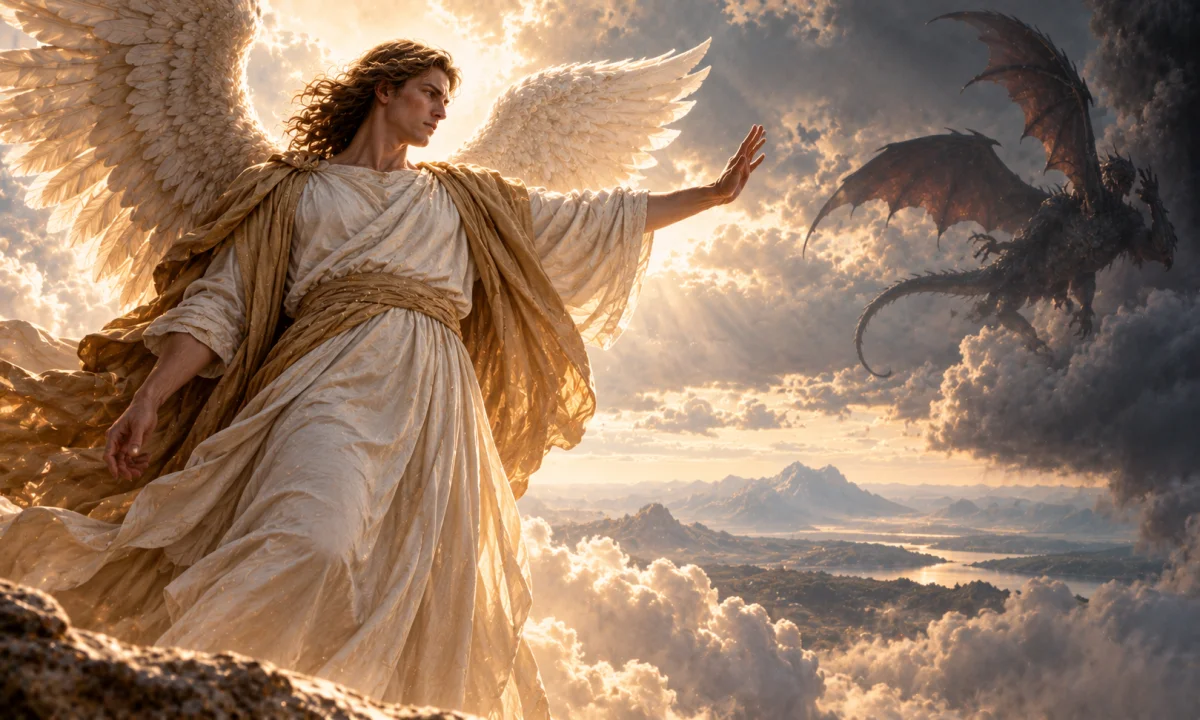
Bazazath is an obscure angelic name found in some later occult and angelological name lists. Unlike Michael, Gabriel, Raphael, or other well-attested angels, Bazazath does not possess a clearly established identity in the Bible, the Qur’an, or the major bodies of Jewish and Christian religious literature. The name is therefore best treated cautiously: it belongs to the history of esoteric angelology, but its origin, meaning, attributes, and religious status remain uncertain.
Origins and religious setting
Angel names have been transmitted through many different kinds of material. Some occur in canonical scriptures, some in apocryphal writings, mystical texts, liturgical traditions, magical handbooks, amulets, astrological systems, and later encyclopaedic compilations. These categories are not interchangeable. A name appearing in an occult catalogue does not necessarily represent an angel recognized by a synagogue, church, mosque, or other established religious institution.
Bazazath appears to belong to the less clearly documented part of this tradition. It is associated with lists of angels and other supernatural beings rather than with a substantial narrative, prayer, vision, or theological discussion. There is no widely accepted ancient account explaining when Bazazath was created, which community first used the name, or what role the figure was originally believed to perform.
The name is not a prominent figure in the Hebrew Bible or the New Testament. Nor is Bazazath a standard named angel in the Qur’an or in the best-known Islamic angelological traditions. It is also not one of the principal angels of early Jewish mystical literature whose names and functions are discussed at length. This absence does not prove that the name has no history, but it does mean that claims presenting Bazazath as a universally recognized biblical or traditional angel are misleading.
The name Bazazath
The meaning of Bazazath is uncertain. Its spelling does not have a securely established translation from Hebrew, Aramaic, Greek, Arabic, or another classical language. As with many rare angelic names, the form may have been affected by copying errors, transliteration from another alphabet, changes in pronunciation, or the attempt of a later writer to reproduce an unfamiliar name.
Variants are especially important when dealing with obscure supernatural names. A single letter can make two names appear related even when they developed independently. Conversely, several spellings may represent the same name after transmission through different languages. Without an early manuscript or a reliable chain of transmission, it is difficult to determine whether Bazazath is an original form, a corrupted spelling, or a modern reconstruction based on an older but different name.
No secure etymology should therefore be assigned to the name. Interpretations based only on a superficial resemblance to words such as Azazel, Baraqiel, or other angelic names are speculative. Similar sounds do not demonstrate a shared identity, genealogy, or function.
Identity and classification
Bazazath is generally classified as an angel because the name has been preserved in angelic or occult catalogues. That classification reflects the context in which the name is found, not a universally agreed theological status. In some systems, a named spirit may be called an angel simply because it appears in a list of celestial beings. In another system, the same kind of figure might be classed as a spirit, intermediary, planetary intelligence, or demon.
There is no stable evidence that Bazazath belonged to a particular choir of angels, such as the seraphim, cherubim, thrones, virtues, powers, principalities, archangels, or angels. The familiar ninefold hierarchy associated with Pseudo-Dionysius is a Christian theological scheme, and an obscure name cannot automatically be placed within it merely because it is described as angelic in a later source.
Likewise, Bazazath should not automatically be identified as a guardian angel, archangel, fallen angel, or angel of a particular nation. Those classifications require evidence from a specific tradition. In the case of Bazazath, the surviving information is too limited to support a confident assignment.
Attributes and powers
Reliable traditional descriptions of Bazazath are difficult to establish. There is no broadly accepted physical appearance, emblem, colour, animal form, celestial rank, sacred number, or planetary association attached to the name. Nor is there a well-known prayer, invocation, feast, protective formula, or devotional practice dedicated to Bazazath in mainstream religious use.
Some modern lists may attach functions or symbolic meanings to the name. Such lists often arrange supernatural beings according to the days of the week, planets, zodiacal divisions, hours, elements, virtues, or types of magical operation. These systems can be elaborate, but their details do not necessarily preserve an ancient tradition. They may reflect the preferences of a particular occult author, the rearrangement of older names, or the circulation of information from one unsourced reference work to another.
For that reason, statements that Bazazath governs a particular natural force, protects a certain group of people, controls a specific hour, or possesses a defined magical power should be presented as claims from an individual esoteric system rather than as established facts. At present, no single set of attributes has become authoritative across Jewish, Christian, Islamic, or broader comparative angelology.
Stories and relationships
Bazazath is not associated with a widely preserved myth or scriptural episode. There is no established account of a birth, rebellion, heavenly office, encounter with a prophet, or relationship with a major angelic figure. This distinguishes Bazazath from named beings such as Michael, whose appearances and roles are developed across several religious and literary traditions, and from figures such as Raphael, whose story is central to the Book of Tobit.
There is also no secure basis for describing Bazazath as a companion, subordinate, rival, or servant of another angel. Rare names are sometimes placed into invented genealogies or hierarchies by later writers, especially when a catalogue attempts to give every name a place within a complete cosmic system. Such arrangements may be meaningful within that particular work, but they should not be projected backward into ancient religion without evidence.
The lack of narrative material is itself significant. It suggests that Bazazath was transmitted primarily as a name rather than as a character with a developed mythology. A name can survive in a list for centuries while losing the context that originally explained it. Alternatively, it may have been created or reshaped by a later compiler who intended to complete an existing catalogue.
Bazazath and the study of obscure angel names
Obscure angelic names are especially vulnerable to confusion because religious and magical manuscripts were frequently copied by hand. A scribe might misread an unfamiliar character, omit a letter, combine two names, or alter a foreign word to make it resemble a familiar language. Translators could also make different decisions about vowels and consonants, producing several forms of the same name.
Later printed dictionaries and occult manuals introduced another difficulty. Once a rare name appeared in a reference work, subsequent writers sometimes repeated it without checking its earliest source. Over time, repetition could give an uncertain name the appearance of an ancient and widely recognized tradition. A modern internet list may therefore preserve a chain of copying rather than independent historical evidence.
Historical study requires separating at least three questions:
- Where does the name first appear in surviving evidence?
- Does the source call the being an angel, or has that classification been added by a later compiler?
- What attributes are actually present in the earliest source, rather than in later summaries?
These questions are difficult to answer for Bazazath because the name is not connected to a large, well-documented textual tradition. The most responsible description is consequently a limited one: Bazazath is a rare angelic name of uncertain provenance, preserved mainly through later esoteric or reference-list traditions.
Distinguishing Bazazath from similar names
Bazazath should not be confused with Azazel. Azazel is a much older and more extensively discussed figure whose identity varies among biblical, Jewish, Christian, and later demonological traditions. The resemblance between the two names is not sufficient evidence that Bazazath is a spelling of Azazel or a related form.
It should also be distinguished from Barachiel or Baraqiel, names associated in different traditions with an angel of blessing or with celestial and meteorological imagery. Their similar consonants do not establish a connection with Bazazath. The same caution applies to other names beginning with Baz-, Bar-, or Az-.
Nor should Bazazath be treated as another spelling of a demon simply because some occult catalogues place angels and demons alongside one another. Magical literature often organizes many kinds of beings within a single system. Inclusion in such a list does not by itself determine whether a figure is benevolent, hostile, fallen, neutral, or divine.
Religious and cultural significance
The significance of Bazazath lies less in a developed mythology than in what the name reveals about the transmission of angelic lore. Religious cultures have repeatedly expanded their lists of celestial beings through interpretation, visionary writing, mystical speculation, ritual practice, and literary invention. These processes produced a wide range of names, many of which never gained broad communal recognition.
For believers, an obscure name may still acquire personal meaning through prayer, meditation, or private esoteric practice. That use can be religiously important to an individual or group without making the name part of an ancient or universal tradition. Historical description should preserve this distinction: personal devotion, occult practice, literary invention, and inherited communal worship are different forms of cultural evidence.
Bazazath therefore illustrates why angelology cannot be reduced to a single definitive catalogue. Jewish, Christian, Islamic, magical, mystical, and modern popular traditions use the word angel in related but different ways. A name’s classification depends on the source, period, language, and religious setting in which it appears.
Later reception
Bazazath has no major established presence in widely known novels, films, games, or television franchises. When the name appears in modern occult websites, supernatural fiction, role-playing material, or encyclopaedic lists, those uses should be understood as later reinterpretations unless they can be connected to a specific older source.
Modern creators may give Bazazath a dramatic appearance, a defined personality, a celestial rank, or a set of powers. Such portrayals can make the name more familiar, but they do not resolve the historical uncertainty surrounding it. The traditional evidence remains limited, and the figure should not be presented as a canonical angel merely because a modern work uses the name.
In historical terms, Bazazath is best described as an uncertain and sparsely documented angelic name. Its exact origin, linguistic meaning, classification, and attributes remain unsettled, and any detailed profile belongs to a particular later system rather than to a universally shared religious tradition.