WORLD
WORLD
Briathos
Briathos is a highly obscure name associated in some modern angelological and occult compilations with an angelic or celestial being. Unlike Michael, Gabriel, Raphael, or Uriel, Briathos does not have a clearly established role in the Bible, the Qur’an, the major bodies of Jewish rabbinic literature, or the principal early Christian angelic traditions. The name’s spelling, origin, classification, and supposed attributes vary considerably, and the surviving evidence is too limited to support a single authoritative description.
Origins and cultural setting
Angelic names have been transmitted through several different kinds of religious and esoteric literature. Some belong to scripture or early theological writing; others occur in prayers, mystical texts, magical handbooks, astrological systems, or later lists assembled by occult writers. These traditions often overlap in vocabulary while differing greatly in purpose and reliability.
Briathos appears to belong to the second category: a name preserved, if at all, through relatively late and specialized angelological material rather than through a major sacred narrative. The name is not connected to a well-known biblical episode, prophetic vision, or canonical account of an angelic messenger. Nor is there a broadly accepted liturgical cult or long-standing popular devotion centred on Briathos.
The absence of a clear ancient source is important. A name may look Hebrew, Greek, Latin, or otherwise traditional without actually being traceable to those languages or to an ancient manuscript. Occult lists sometimes preserve corrupted names, combine material from different systems, or reproduce earlier printed lists without explaining their origins. As a result, the presence of Briathos in a modern catalogue does not by itself demonstrate that the name belonged to an ancient religious tradition.
The name and its spelling
The spelling Briathos is not sufficiently well documented to permit a secure translation. The ending -os can give a name a Greek-looking appearance, but appearance is not proof of Greek origin. Similarly, the opening element may invite comparison with words from Hebrew or other languages, yet no universally accepted etymology establishes what “Briathos” means.
Variant spellings are especially likely in names transmitted through occult books. A name copied by hand, transliterated from another alphabet, or reprinted from a damaged or inconsistent source may acquire several forms. Small changes in vowels and consonants can produce apparently separate angels, while two different names may be mistakenly treated as variants of one another.
For Briathos, a responsible description should therefore preserve the uncertainty rather than assign a confident meaning. Claims that the name translates as a particular divine quality, or that it conceals a specific Hebrew phrase, require a documented linguistic and textual basis. No such interpretation is generally established.
Classification as an angel
Briathos is commonly placed under the broad heading of angels, but that classification should be treated cautiously. In Jewish, Christian, and Islamic usage, “angel” generally refers to a supernatural messenger or servant of God, although the details differ between traditions. Angels may announce divine decisions, protect individuals, interpret visions, carry out judgement, praise God, or participate in the ordering of the cosmos.
In later esoteric systems, the word “angel” can be used more broadly. It may refer to a spirit assigned to a day, hour, planet, direction, element, zodiacal sign, or magical operation. Such a being may not have the same status as an angel in scripture or formal theology. A name can also appear in an occult list without a narrative, prayer, theological explanation, or independent tradition attached to it.
There is no widely accepted evidence that Briathos belongs to one of the classical angelic choirs described by later Christian writers, such as seraphim, cherubim, thrones, dominions, virtues, powers, principalities, archangels, or angels. Assigning Briathos to a particular choir would therefore go beyond the secure evidence unless a specific source makes that assignment.
Attributes and appearance
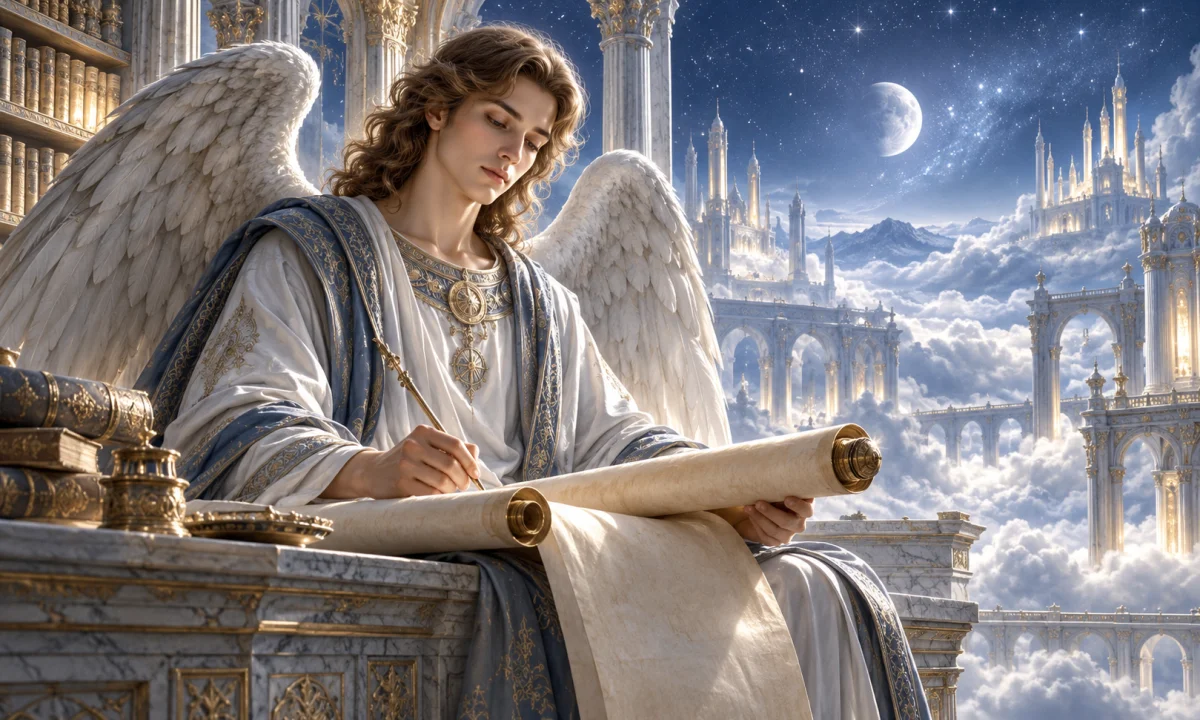
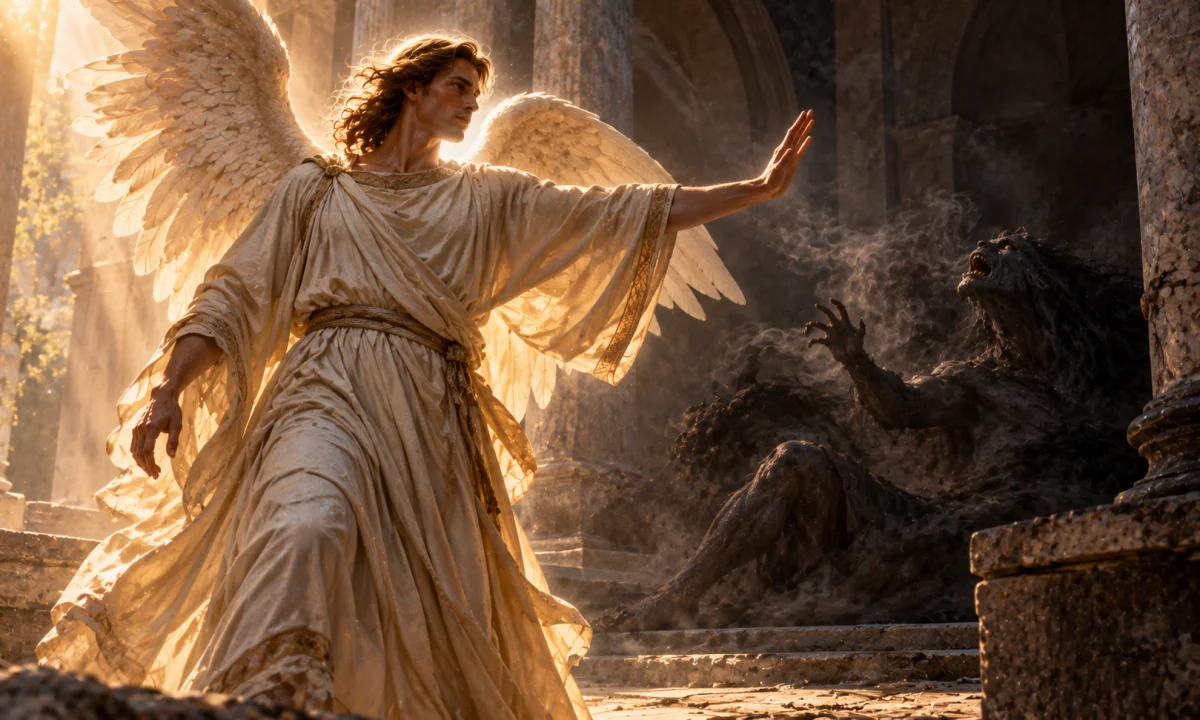
No stable traditional description of Briathos’s appearance survives. There is no well-established account giving the figure wings, a halo, a distinctive garment, a weapon, a colour, or a particular animal form. Images found in contemporary occult or fantasy settings should not be mistaken for evidence of an older Briathos tradition.
The same caution applies to supposed powers and offices. Some online lists and modern reference works attach detailed functions to obscure angelic names, such as protection, healing, divination, hidden knowledge, dreams, or celestial governance. These assignments are often repeated without a traceable early source. Unless a role can be connected to a specific textual tradition, it is more accurate to call it a later attribution than an established traditional characteristic.
Briathos has no securely documented sacred symbol, associated gemstone, planet, weekday, direction, colour, or animal. Such correspondences are common in ceremonial magic, but they belong to particular systems and cannot automatically be transferred from one list to another. A planetary or astrological association, for example, would reflect the structure of the system in which it appears rather than a universal belief about Briathos.
Stories and relationships
Briathos is not known for a surviving narrative comparable to the stories of Gabriel announcing the birth of Jesus, Raphael accompanying Tobias, or Michael battling the dragon in Christian scripture and later tradition. There is likewise no broadly recognized account of Briathos’s creation, rebellion, appointment, encounter with a prophet, or relationship with another named angel.
Because the name lacks a stable narrative setting, attempts to place Briathos among the angels of a particular biblical book or apocalyptic vision are speculative. The figure should not be identified with an unnamed angel merely because the roles appear superficially similar. An angel mentioned without a name in a sacred text does not thereby become Briathos.
Nor should Briathos automatically be classified as a fallen angel or demon. Modern occult and fictional writing sometimes treats unfamiliar angelic names as belonging to rebellious or morally ambiguous spirits, but obscurity is not evidence of a fall from heaven. In the absence of a source describing rebellion, punishment, or opposition to God, such a classification remains unsupported.
Religious significance and interpretation
The limited evidence surrounding Briathos illustrates an important feature of angelology: the category contains names with very different levels of authority. A name found in scripture has a different religious status from one found in a medieval mystical text, a Renaissance magical handbook, a nineteenth-century occult compilation, or a modern website. Treating all named angels as equally ancient and equally canonical obscures the history of the traditions involved.
In established religious traditions, angels are generally understood in relation to divine sovereignty. They are not independent gods, and their powers are not normally presented as self-generated. Even when an angel has a distinctive personality or office, the being remains part of a larger theological order involving God, creation, revelation, judgement, protection, and worship.
By contrast, later occult systems often organize supernatural beings according to practical or symbolic schemes. An angelic name may function as a label within a ritual hierarchy, a mnemonic device, or a component of a cosmological map. The value of the name in such a system does not prove that it was known to ancient worshippers. It shows how later authors arranged and interpreted supernatural names.
Briathos is therefore most usefully approached as a marginal or uncertain angelological name, rather than as a major figure shared across Judaism, Christianity, and Islam. Its significance lies less in a rich body of mythology than in the way obscure names are preserved, altered, and reinterpreted as they pass through esoteric literature.
Distinguishing Briathos from similar names
Unusual angel names are particularly vulnerable to confusion. A similar-looking spelling may represent a different being, a transcription error, or an unrelated term. Briathos should not be merged with other figures merely because they share the letters Br, an ending in -os, or an association with angels.
It should also be distinguished from Berith, a name associated in some demonological traditions with a demonic figure. Berith and Briathos are not established as the same being, and resemblance between the names is insufficient evidence for a relationship. They belong to different streams of later supernatural literature unless a particular source explicitly connects them.
Likewise, Briathos should not be treated as a variant of a recognized archangel such as Michael, Gabriel, Raphael, or Uriel. Those figures have extensive textual and devotional histories, even though their attributes also vary between traditions. Briathos has no comparable body of evidence.
Sources of uncertainty
Several factors may account for the uncertain status of the name. It may have been copied from an obscure magical manuscript, altered during transliteration, confused with another name, or introduced by a relatively recent compiler. It may also be a name that circulated in a narrow esoteric environment without acquiring a larger religious tradition.
Printed occult literature frequently presents lists of spirits and angels with little explanation. A name may appear beside a brief title or correspondence, then be repeated by later writers as though the entry were ancient. Over time, the repeated association can create the impression of a continuous tradition even when the available evidence ultimately leads back to a single late source.
This does not make every late or occult attribution meaningless. Religious and esoteric traditions continue to develop, and later practitioners may attach genuine spiritual importance to names absent from older scripture. The distinction is historical: a modern or early modern interpretation should be identified as such, rather than projected backward into antiquity.
Briathos in modern culture
Briathos has little established presence in widely known popular culture. The name may appear in contemporary fantasy, role-playing material, occult-themed fiction, or online catalogues of angels and demons, where its lack of a fixed traditional identity allows creators considerable freedom. Such portrayals may give Briathos a body, personality, powers, enemies, or a detailed biography.
Those imaginative depictions belong to modern reception, not to a securely documented ancient mythology. A fictional Briathos may be a guardian, warrior, oracle, fallen angel, or cosmic ruler depending on the needs of the work. None of these roles should be presented as traditional without evidence from an identifiable religious or historical source.
The most accurate description of Briathos remains modest: the name is associated with obscure angelological material, but its origin, meaning, status, attributes, and history are uncertain. It should be discussed separately from well-attested angels and from similarly named demons or spirits, with any specific modern interpretation clearly labelled as a later development.