WORLD
WORLD
Arion
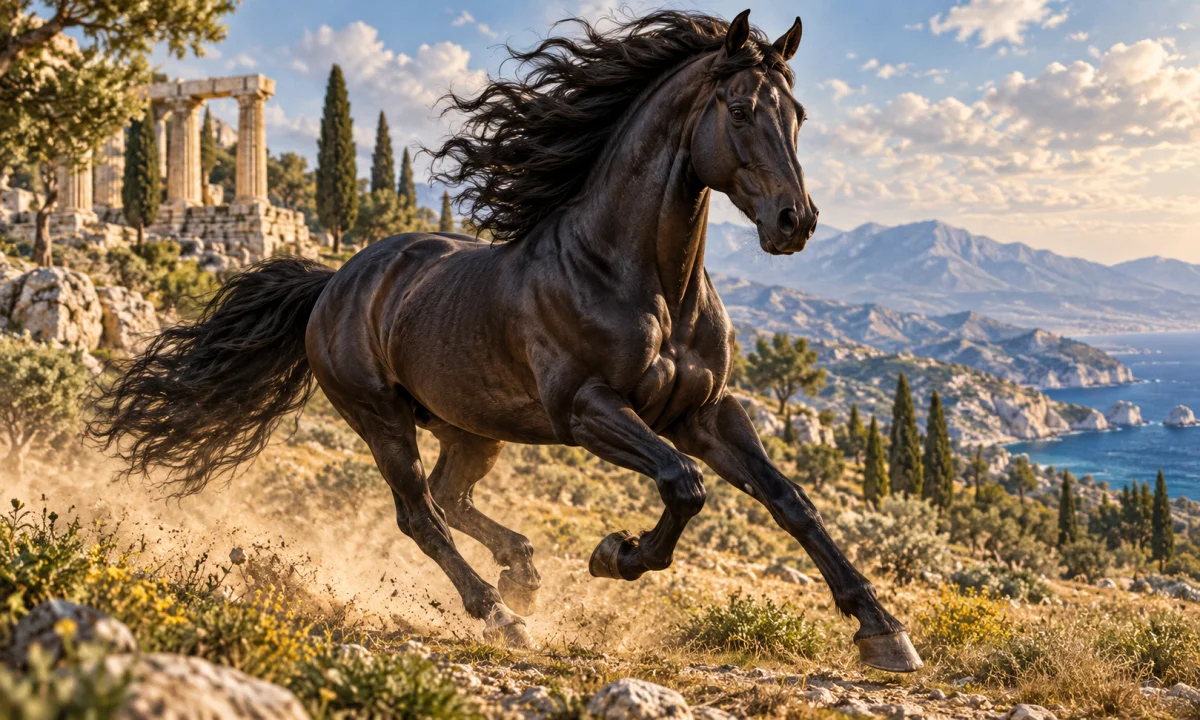
Arion, also spelled Areion in transliterations of the Greek name, is a miraculous horse in Greek mythology. He is best known as the exceptionally swift and often immortal horse associated with the hero Heracles and the Argive king Adrastus. In Arcadian tradition, Arion had an unusual divine origin: he was born from the union of Poseidon and Demeter after both gods took equine form. His story connects heroic warfare with older religious ideas concerning horses, fertility, the underworld and the powers of the natural world.
Arion in Greek mythology
Arion belongs to the wider group of extraordinary animals found in Greek myth. Such creatures are not simply impressive versions of ordinary animals. They often have divine parentage, exceptional speed or strength, and a close relationship with gods and heroes. Arion is particularly associated with Poseidon Hippios, “Poseidon of Horses,” and with an Arcadian form of Demeter whose worship included secretive and underworld-related aspects.
The best-known surviving account of Arion’s birth appears in the Description of Greece by the second-century CE writer Pausanias. Pausanias recorded traditions connected with Arcadian sanctuaries and local religious history. His account preserves material that was considerably older than his own time, although the exact age and original form of every element cannot be established.
Arion also appears in epic tradition as the horse of Adrastus, one of the leaders in the legendary war of the Seven Against Thebes. Homer mentions him in the Iliad, describing him as a remarkable horse of divine or exceptional lineage. Later poets and mythographers expanded or rearranged details of his genealogy and career.
Name and identity
The Greek name is commonly rendered in English as Arion, although Areion is a more literal transliteration of the form often used for the horse. The name is related in appearance to Greek words associated with being better, stronger or more excellent, but its precise etymological significance in the myth is uncertain.
There is an important distinction between the mythical horse Arion and Arion of Methymna, the celebrated archaic Greek poet and musician. The poet, traditionally associated with Lesbos and Corinth, is a different figure with a different name form in Greek. Stories about the poet’s rescue by dolphins should not be attributed to the divine horse.
Arion is also distinct from the many later fictional horses named “Arion.” Modern writers, games and fantasy works may use the name for an enchanted or heroic horse, but those uses do not necessarily preserve details from the ancient myth.
Divine birth in Arcadian tradition
According to the Arcadian tradition recorded by Pausanias, Demeter was wandering in search of her daughter Persephone. In this version, Demeter attempted to conceal herself by taking the form of a mare. Poseidon, pursuing or desiring her, changed himself into a stallion. Their union produced two unusual offspring: a daughter whose name was treated as secret and a horse named Arion.
The daughter was known to later readers as Despoina, meaning “the Mistress,” although her personal name was not openly revealed to the uninitiated in the religious tradition associated with her sanctuary. Despoina was worshipped in Arcadia, especially at the sanctuary of Lycosura. Her cult was closely connected with Demeter and with sacred mysteries.
The myth is not merely a comic transformation story about gods behaving like animals. It reflects a local religious setting in which Demeter and Poseidon possessed powerful, sometimes unsettling connections with the land, water, fertility and the forces beneath the earth. Demeter’s title Erinys, “the Furious” or “the Vengeful,” emphasizes the dangerous side of the goddess in this Arcadian tradition. Poseidon, meanwhile, was not only ruler of the sea but also a god of horses, earthquakes and subterranean power.
The union of Demeter and Poseidon therefore brings together two divine forces that could be associated with fertility and instability. The horse born from that union, Arion, is an appropriate mythic product of this relationship: he is a creature of the wild and the heroic world, but also one marked by divine power.
Appearance and extraordinary qualities
Ancient accounts focus more on Arion’s origin and speed than on a fixed physical description. He is consistently presented as a horse of exceptional quality, capable of carrying a famous warrior when ordinary horses would fail. His most important attribute is his extraordinary swiftness.
Some later retellings give Arion unusual coloring or other distinctive features, but these details are not equally well supported across the ancient tradition. There is no single universally accepted ancient description comparable to the fixed iconography of creatures such as the Minotaur or Pegasus. Arion should therefore not be assigned a standard appearance beyond that of a magnificent, divinely descended horse.
Arion is sometimes described as immortal or as possessing a nature beyond that of ordinary animals. The exact wording and implications vary among sources. In epic poetry, divine ancestry can indicate extraordinary status without establishing a complete biography or a detailed set of supernatural powers. His speed, lineage and ability to survive the violence of heroic warfare are the central features of the tradition.
Arion and Heracles
In the Arcadian account, Arion first belonged to Oncus, a local king associated with the region around Thelpusa. Heracles later acquired the horse. Pausanias connects Arion with Heracles’ campaigns, although the surviving tradition does not provide one single, fully developed narrative of their partnership.
Heracles was famous for using remarkable animals and weapons in his labours and wars. A divine horse suited the heroic image of a warrior who overcame kings, monsters and armies. Arion’s role in Heracles’ story appears to have been that of a prized war-horse rather than an independent character with extended speeches or personal motives.
Different ancient and later accounts may place Arion in relation to different conflicts. The most secure tradition is that the horse eventually passed from Heracles to Adrastus. Claims that Arion had a major role in every campaign associated with Heracles go beyond what the surviving evidence establishes.
Arion and Adrastus
Arion’s most significant heroic association is with Adrastus, king of Argos and leader of the expedition known as the Seven Against Thebes. The war belonged to the Theban cycle of legends, which also included the conflict between the brothers Eteocles and Polynices and the doomed attack on Thebes.
Adrastus joined the expedition after supporting Polynices’ claim to the throne. The campaign ended disastrously for the attackers. Most of the Seven were killed, and the expedition became a famous example of heroic courage overwhelmed by fate, poor judgment and divine hostility.
Adrastus was the principal leader to escape alive. According to the epic tradition, Arion carried him away from the battlefield. The horse’s speed allowed Adrastus to survive when the other leaders had fallen. In this context, Arion is not merely a symbol of military prestige: he is the immediate means of escape from a catastrophic defeat.
Homer refers to Arion in the context of athletic and heroic excellence, presenting him as a horse of outstanding lineage and performance. Later accounts make the connection with Adrastus more explicit and preserve the tradition that Arion had previously belonged to Heracles. This sequence gives the horse a chain of heroic ownership: from a local Arcadian ruler, to Heracles, and then to Adrastus.
The association with Adrastus also explains why Arion became particularly important in stories of Thebes. He represents the one successful escape from an otherwise fatal expedition. Yet his survival does not erase the disaster. Adrastus lived to mourn the dead and to participate in later attempts to recover their bodies, making Arion part of a larger cycle of grief and remembrance.
Sources and development of the tradition
Arion is not the subject of one complete surviving ancient narrative. Knowledge of him comes from scattered references and later accounts that preserve earlier poetry and local traditions.
- Homer’s Iliad refers to Arion in connection with Adrastus and the horse’s exceptional status.
- Antimachus’ Thebaid, now lost, was an important source for the Theban war traditions. Pausanias referred to this poem when discussing the birth and history of Arion.
- Pausanias’ Description of Greece provides the fullest surviving account of Arion’s Arcadian genealogy, including the union of Poseidon and Demeter and the horse’s connection with Oncus, Heracles and Adrastus.
- Later Greek and Roman poets continued to use the Theban cycle and its heroic figures, but their versions can emphasize different aspects of Arion’s speed, lineage or role.
Because the earliest poems about the horse are lost or survive only in fragments and quotations, it is difficult to determine which details belong to an old shared tradition and which were developed by later poets. The myth should therefore be understood as a group of related traditions rather than as a single fixed story.
Religious and cultural significance
Arion’s genealogy provides a glimpse of Arcadian religious ideas that differ from the more familiar Olympian family stories. In many popular retellings, Demeter is presented mainly as the grieving mother who causes the seasonal cycle through the loss and return of Persephone. Arcadian worship could give her a darker and more elemental character. She could be associated with wild animals, the earth’s hidden powers and the dangerous consequences of divine anger.
Poseidon’s identity was equally broad. His role as god of the sea is dominant in later popular understanding, but ancient worship also connected him with horses. The epithet Hippios was especially important in regions where horses, chariot warfare and equestrian culture had strong social significance. Poseidon’s horse form in the Arion story is therefore consistent with a well-established aspect of his divine character.
The horse itself held an ambiguous place in Greek culture. Horses represented wealth, speed, aristocratic status and military power. At the same time, they were associated with wildness and with divine forces that humans could not fully control. A horse born from gods could embody both sides: the disciplined animal of the warrior and the untamed creature of the sacred landscape.
Arion’s role in saving Adrastus gives this symbolism a heroic form. He is the perfect war-horse, but he is also a reminder that survival may depend on forces beyond human strength. Adrastus is a powerful king and commander, yet his life is preserved through the speed of a divinely descended animal.
Arion and other famous horses
Arion is sometimes confused with Pegasus, the winged horse born from the blood of Medusa in the best-known versions of that myth. The two horses are both divine or semi-divine and both are linked with heroic figures, but they belong to different traditions. Pegasus is winged and is especially associated with Bellerophon and Zeus’s thunderbolts in later tradition. Arion is a land-bound horse of extraordinary speed, connected with Poseidon, Demeter, Heracles and Adrastus.
Arion is also different from the horses of Achilles. Those horses, including the immortal Xanthus, belong to the Trojan War tradition and are linked with the hero Peleus and the sea-god’s divine gifts. Their stories include prophecy and grief, whereas Arion’s most prominent function is to carry Adrastus from the defeat at Thebes.
Nor should Arion be identified with every ancient horse described as immortal, prophetic or capable of speech. Greek mythology contains several exceptional horses, and details that belong to one may be transferred to another in modern summaries. The safest defining features of Arion are his Arcadian divine birth, his extraordinary speed and his connection with Adrastus.
Later reception
Arion has never had the same broad modern profile as Pegasus, but the name remains attractive for fantasy fiction, games, novels and other works that use mythological horses. Modern adaptations often turn him into a talking horse, a winged horse, a companion with a human-like personality or a mount belonging to a newly invented hero. These additions may be imaginative developments rather than elements of the ancient tradition.
In retellings that remain close to Greek mythology, Arion works best as a figure linking several layers of myth: the local religion of Arcadia, the divine and dangerous aspects of Poseidon and Demeter, the heroic world of Heracles, and the doomed expedition against Thebes. His fame rests less on a long series of adventures than on the concentrated power of a single image: the divinely born horse whose speed carries Adrastus out of a battlefield where nearly every other hero has perished.