WORLD
WORLD
Argus
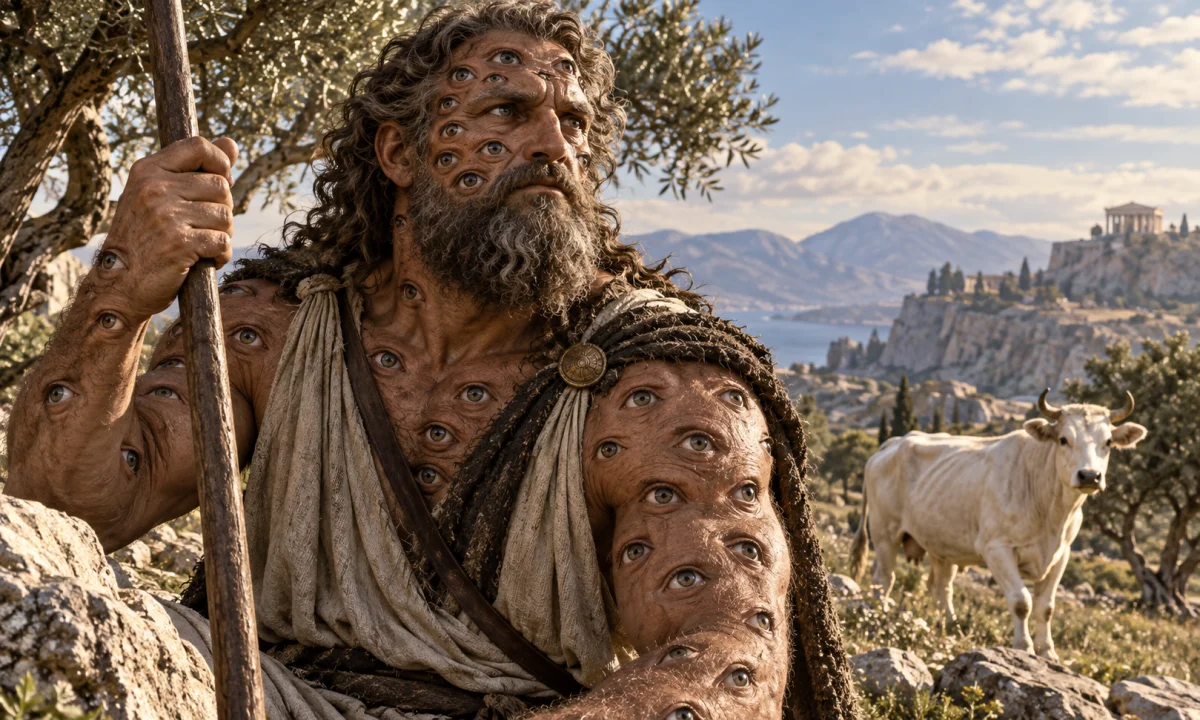
Argus is a name shared by several figures in Greek mythology, but it is most famously associated with Argus Panoptes, the many-eyed guardian who served the goddess Hera. He appears in the story of Io, a mortal woman transformed into a cow and placed under divine surveillance. Argus is also the name of Odysseus’ loyal dog in the Odyssey, and of a craftsman connected with the ship Argo. These figures belong to different stories and should not be treated as a single mythological character.
Argus Panoptes: the all-seeing guardian
Argus Panoptes is generally described as a giant or exceptionally powerful watchman whose defining feature was his numerous eyes. The Greek epithet Panoptes means “all-seeing” or “the one who sees everything.” Later retellings commonly give him one hundred eyes, although the number and arrangement of his eyes vary among sources and artistic traditions.
His most important role is as the guardian of Io. In the myth, Zeus falls in love with Io, a young woman associated in different traditions with Argos and the worship of Hera. Zeus attempts to conceal the affair from Hera, but the goddess either discovers it or suspects what has happened. To protect Io from Hera’s anger, Zeus transforms her into a white heifer. Hera, however, asks for the animal as a gift and appoints Argus Panoptes to guard her.
Argus is an effective guardian because his eyes allow him to remain watchful even while resting. Ancient storytelling does not always present this ability in exactly the same way. Some accounts describe his eyes as distributed over his body, while later imaginative treatments emphasize the idea that only some eyes sleep at a time. The essential feature is not a fixed anatomy but constant vigilance: Argus is difficult to deceive because he is never wholly unaware of his surroundings.
Origins and surviving traditions
The ancestry of Argus Panoptes is not uniform across Greek mythology. He is often called the son of Arestor, but other genealogical traditions connect him with Inachus or with the early royal and heroic families of Argos. Such differences are common in Greek myth, where local traditions, poetic genealogies and later mythographers could preserve competing versions of the same figure.
His name is connected with the Greek world of Argos, although the exact relationship between the guardian, the city and other figures named Argus is not always clear. The name may be associated with ideas such as brightness or shining, but its etymology and the development of the various mythological figures called Argus should not be treated as settled facts. A shared name does not prove that all the characters originated as one being.
The story of Argus and Io survives in several forms. It was known to Greek poets and mythographers, including traditions represented in the Hesiodic poems, the mythological handbook commonly called the Bibliotheca, and dramatic treatments of Io’s suffering. The Roman poet Ovid gave the episode an especially influential literary form in the Metamorphoses. These accounts agree on the broad sequence but differ in details such as Argus’s ancestry, the method of his death and the precise role of Hermes.
The guarding of Io
Io’s transformation is part of a wider myth about the dangerous consequences of contact between mortals and gods. Zeus’s desire places Io in danger, while Hera’s response turns her into both a victim and an object of surveillance. As a cow, Io cannot easily explain who she is or defend herself. Hera then uses Argus to enforce her control.
Argus is sometimes portrayed as a monstrous being, but he is not necessarily evil. In the central story, he is carrying out a divine command. His many eyes represent an extraordinary capacity for observation rather than moral corruption. From Hera’s perspective, he is a reliable servant; from Io’s perspective, he is an instrument of imprisonment.
In some versions, Hera also sends a gadfly to torment Io. The insect drives her into a long wandering journey across different lands. The two punishments work together: Argus prevents escape, while the gadfly prevents rest. Io’s travels eventually become part of the mythic explanation for places, peoples and names, especially in regions around the eastern Mediterranean and Near East. Her story also leads toward the birth of Epaphus, a son of Zeus, and later genealogies that connect Io’s descendants with heroes such as Heracles and with the royal houses of Argos.
Hermes and the death of Argus
Zeus ultimately sends Hermes to rescue Io. Hermes approaches Argus in disguise, often as a shepherd or rustic traveler. His task is difficult because Argus’s vigilance makes a direct attack dangerous. Hermes therefore uses music, speech and patience rather than force alone.
In the account preserved in the Bibliotheca, Hermes plays a reed pipe and tells stories until Argus is gradually overcome by sleep. Hermes then kills him by striking him with a stone. In Ovid’s Roman version, Hermes is called Mercury and uses a sword after putting Argus to sleep. These are not minor differences in wording: they show how the same myth could be reshaped according to the style and interests of different authors.
After Argus dies, Hera commemorates her faithful servant by placing his eyes on the tail of the peacock, her sacred bird. This explanation belongs especially to the later classical tradition represented by Ovid. It is a mythic account of the peacock’s striking eye-like markings, not evidence that Greek worshippers literally believed the bird had received the eyes of a historical giant.
The episode creates a sharp contrast between Hermes and Argus. Hermes is associated with movement, deception, communication and clever improvisation. Argus represents fixed attention, guardianship and surveillance. Hermes succeeds not by becoming stronger than Argus but by exploiting the limits of even perfect watchfulness: a guard who must eventually sleep can be defeated by an intelligent trick.
Appearance and abilities
Argus Panoptes is usually imagined as a large human or giant-like figure covered with eyes. Ancient Greek art does not preserve one single standard image of him. Artists may show extra eyes on the head, shoulders, chest or limbs, while later painters often place a decorative pattern of eyes across his body.
- Many eyes: His most famous attribute is the ability to watch in several directions at once.
- Constant vigilance: His guard over Io depends on the belief that he is difficult to surprise or deceive.
- Service to Hera: He is an agent of the goddess rather than an independent rival of Zeus.
- Resistance to ordinary deception: Hermes must use a sustained performance involving music and storytelling to overcome him.
- Connection with the peacock: In later tradition, his eyes become the markings on Hera’s sacred bird.
The number one hundred is now strongly associated with Argus, but it should be understood as part of the developed tradition rather than an equally explicit feature in every surviving early account. “Many-eyed” or “all-seeing” is the more stable concept.
Symbolism and interpretation
Argus can be interpreted as a personification of surveillance. His body turns sight into a physical weapon: the more eyes he possesses, the harder it becomes for the guarded person to escape notice. The myth therefore dramatizes the oppressive power of observation, especially when it is backed by divine authority.
His role also reflects a recurring pattern in Greek mythology. A powerful god creates a problem through desire or deception, and a less powerful figure suffers the consequences. Zeus’s actions initiate Io’s ordeal, but Io is the one transformed, pursued and displaced. Hera’s anger is directed at the mortal woman and enforced by Argus, even though Zeus is the god who caused the betrayal. Argus is consequently part of a story about unequal power among gods, humans and divine servants.
The death of Argus can be read as a triumph of intelligence over brute vigilance. Hermes does not simply confront a guard at the height of his strength. He uses art, rhythm and language to alter Argus’s state of mind. This fits Hermes’ wider mythological character as a god of boundaries, travel, trade, thieves, messengers and clever speech.
The peacock episode adds another layer of meaning. Hera’s act of preserving Argus’s eyes transforms a defeated guardian into a permanent emblem. The eyes remain visible, but their function changes: they no longer watch over Io and instead become ornamental marks associated with the goddess. The story thus converts loss into divine remembrance.
Argus in the Odyssey
Argus the dog is a completely different figure. He appears briefly but memorably in Homer’s Odyssey. Odysseus returns to Ithaca after many years away, disguised as a beggar so that he can assess the situation in his household before revealing his identity. Near the palace, he sees Argus lying neglected in a pile of dung.
Argus had once belonged to Odysseus and had been trained as a hunting dog. Although the dog is old, weak and poorly cared for, he recognizes his master immediately. Odysseus cannot openly acknowledge him because his disguise must remain secret. He therefore passes by without embracing or greeting the animal.
As soon as Argus has seen Odysseus again, he dies. The scene is often understood as an example of loyalty and recognition, but it is also a quiet criticism of the disorder that has overtaken Ithaca. The dog, once valued, has been abandoned while the suitors consume Odysseus’s wealth and occupy his home. Argus’s death marks the completion of one small personal reunion before the larger confrontation with the suitors begins.
The dog has no connection in the Odyssey with the many-eyed guardian of Io. His name may evoke the region of Argos or the general meaning of brightness, but the shared name is not a reason to combine the two characters. Argus the dog is an animal companion and a symbol of faithful recognition, not a giant servant of Hera.
Argus and the ship Argo
Another Argus appears in stories about the Argonauts. He is commonly described as the builder of the Argo, the ship that carries Jason and the heroes in search of the Golden Fleece. In several traditions he is the son of Arestor, although genealogies and details vary.
Argus the shipwright should be distinguished from Argus Panoptes, even though some mythographers may have placed different figures with the same name within related genealogical settings. The craftsman’s importance lies in technical skill and construction. The Argo is not merely transport: it is a remarkable vessel capable of carrying a specially chosen band of heroes into a dangerous and partly unknown world.
Traditions about the Argo also give the ship a close relationship with the goddess Athena, who is sometimes said to have helped build it or contributed its prophetic piece of timber. Argus’s role in these stories belongs to the heroic age of Jason and the Argonauts, not to the myth of Io and Hera.
Other figures named Argus
Greek mythology contains additional men called Argus, especially in stories connected with Argos. One is associated with the early royal genealogy of the region and is sometimes presented as a son of Zeus and Niobe. Another tradition links a figure named Argus with heroic or local foundation stories. These accounts vary considerably and are not interchangeable with Argus Panoptes.
The name also appears in the epithet Argeiphontes, traditionally applied to Hermes. It is often translated as “slayer of Argus,” referring to the death of Argus Panoptes. The precise linguistic history of the epithet has been discussed by scholars, and its interpretation should not be confused with the simple presence of the name Argus in other myths.
These overlaps illustrate an important feature of Greek mythology: names could circulate through different local traditions, genealogies and poetic works. A mythological dictionary or later summary may place several figures side by side, but that does not mean that they were originally conceived as one character.
Later reception
Argus Panoptes remained an influential image in Roman literature and European art because his many eyes are immediately recognizable. Ovid’s account of the murder by Mercury and the transfer of the eyes to the peacock became especially important for later artists and writers. Paintings and emblem books often depict Hermes or Mercury standing over the sleeping Argus, with the peacock nearby as a sign of Hera or Juno.
In modern language, Argus is sometimes used as a symbol of intensive observation or an all-seeing authority. The name may appear in literature, fantasy, comics, games and other popular media, where the number of eyes, the peacock connection or the role of a watchman can be adapted freely. Such versions are modern reinterpretations rather than evidence about the ancient myth.
The most enduring traditional images remain distinct: Argus Panoptes, the many-eyed guardian defeated by Hermes; Argus the dog, who recognizes Odysseus after years of absence; and Argus the shipbuilder, associated with the Argo and the voyage of the Argonauts. Their shared name reflects the complexity of Greek mythological traditions rather than a single continuous biography.