WORLD

Andriamahilala
Andriamahilala is a poorly documented name associated with Malagasy mythology, the traditional religious and legendary traditions of Madagascar. Unlike better-attested figures such as Zanahary, Andriamanitra, Ibonia, or the ancestral dead known as the razana, Andriamahilala does not have a stable identity in the surviving body of Malagasy oral tradition and historical writing. Accounts that describe the figure as a god, spirit, hero, or ruler vary considerably, and many modern summaries provide no identifiable traditional narrative behind their claims.
Malagasy cultural and religious setting
Madagascar is home to numerous peoples and regional cultures, including the Merina, Betsimisaraka, Sakalava, Betsileo, Antandroy, Bara, Vezo, Tsimihety, Mahafaly, and others. Their traditions are related through shared Austronesian and African histories, but they are not a single, uniform mythology. Religious ideas, genealogies, ritual practices, and stories differ from one community to another and have changed over time.
Traditional Malagasy religion generally gives an important place to a supreme creator or highest divine power, often called Zanahary or Andriamanitra. These names and their meanings can vary by region and context. Alongside ideas of a high god are traditions concerning ancestors, sacred places, royal founders, spirits, nature, divination, healing, and ritual specialists. The ancestors, or razana, are particularly significant in many Malagasy communities. They may be understood as active members of a continuing family community rather than simply as figures from a distant past.
Stories were transmitted mainly through oral performance rather than through a single canonical scripture. Genealogical recitations, heroic narratives, proverbs, songs, ceremonies, and local histories could all preserve religious or mythic material. This makes it possible for a name to be important in one locality while being unknown, or understood differently, elsewhere. It also makes later transcription difficult: spelling, pronunciation, translation, and interpretation may differ between records.
The name Andriamahilala
The spelling Andriamahilala should not automatically be treated as definitive. Malagasy names have been written in several orthographic systems, especially in older European records and in works based on oral testimony. A name may therefore appear with altered spacing, punctuation, vowels, or consonants. However, without a clearly documented traditional passage or regional explanation, a similar-looking form should not be assumed to refer to the same being.
The element andriana appears in many Malagasy personal and royal names and is associated with nobility, lordship, or high status in several contexts. That linguistic element alone does not prove that Andriamahilala was a god. It may occur in the name of a ruler, ancestor, legendary person, or spirit. The remainder of the name is not enough, by itself, to establish a secure meaning or function.
Some modern lists classify Andriamahilala as a deity. Other presentations imply a more general supernatural being, but do not provide a consistent account of its powers, worship, or stories. These descriptions should be treated cautiously. There is no broadly recognized Malagasy canon in which Andriamahilala has a universally agreed position, genealogy, or domain.
Identity and classification
It is currently safest to describe Andriamahilala as a poorly attested Malagasy mythological name rather than assigning it a precise category. Calling the figure a god may reflect a modern compiler's classification rather than a term used by the community from which the tradition originated. In Malagasy contexts, the boundaries between deity, ancestor, spirit, sacred ruler, and legendary person are not always equivalent to categories used in European mythology.
A powerful ancestor may receive offerings or ritual respect without being considered a creator god. A legendary king may possess supernatural qualities without being a deity. A spirit connected with a river, forest, burial place, or royal lineage may be described differently by different narrators. These distinctions matter when interpreting an isolated name.
No secure evidence establishes that Andriamahilala was universally regarded as a creator, sky god, solar being, lunar being, sea spirit, underworld ruler, or guardian of a particular profession. Such classifications sometimes appear in unsourced retellings, but they should not be presented as established Malagasy tradition without a clear regional and textual basis.
Attributes and appearance
There is no consistently recorded traditional description of Andriamahilala's appearance. No stable set of attributes identifies the figure with a particular animal, weapon, plant, celestial body, natural force, or sacred object. Likewise, a fixed gender, family relationship, dwelling place, and ritual role cannot be securely established from the name alone.
This absence is significant. In a well-documented mythic tradition, a figure may be recognized through repeated features: a distinctive bodily form, a relationship with a named hero, an act of creation, a recurring ritual, or a particular sacred location. Information associated with Andriamahilala does not form such a coherent pattern in the readily circulating accounts that use the name.
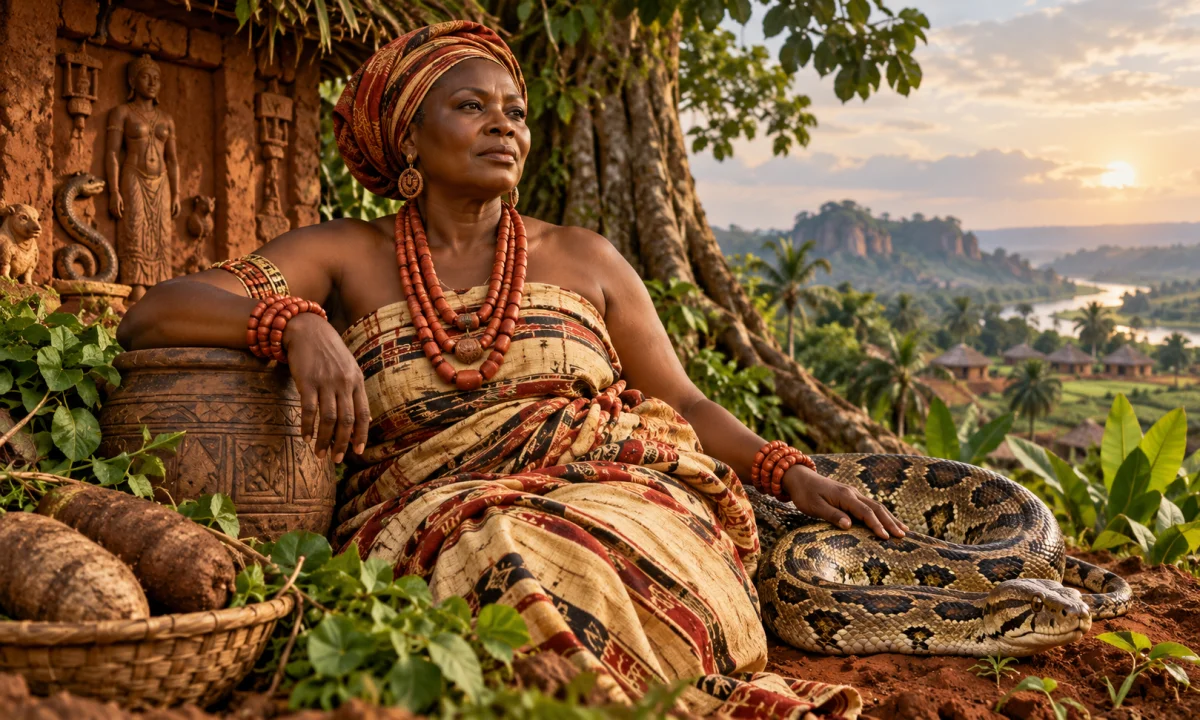
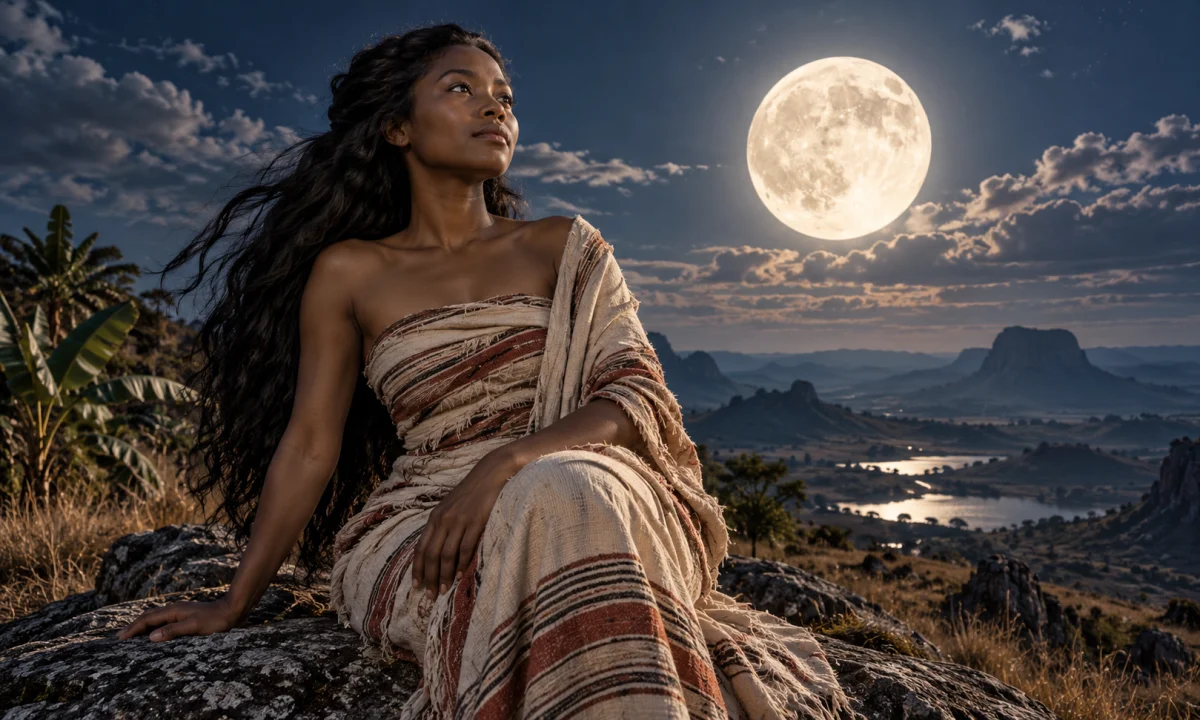
It is therefore misleading to illustrate or describe Andriamahilala as a horned spirit, an ancestral king, a giant, a celestial god, or a human-shaped guardian unless a specific tradition is being identified and the interpretation is clearly labelled as local, modern, or speculative. Artistic depictions may be imaginative rather than historically or religiously grounded.
Stories and relationships
No single, widely recognized cycle of myths about Andriamahilala survives in the same way that the Malagasy epic of Ibonia is known as a major heroic narrative. Nor is there a securely established genealogy linking Andriamahilala to Zanahary, Andriamanitra, the ancestors, or the legendary beings found in other Malagasy traditions.
The absence of a famous narrative does not prove that no community ever told stories about the name. Oral traditions can be local, private, restricted to ritual specialists, or preserved in forms that were never written down. A figure can also disappear from common use while surviving in a family tradition, place-name, song, or fragment of a historical account. The available evidence simply does not justify reconstructing a complete mythology for Andriamahilala.
Names from different Malagasy traditions should also not be combined merely because they are all described as supernatural. Ibonia belongs to heroic epic; Trimobe appears in stories associated with ogres or dangerous beings; Rapeto is a giant-like figure in Malagasy legendary tradition; and Zanahary and Andriamanitra are names connected with the highest divine power in different contexts. None of these figures should be made into relatives or companions of Andriamahilala without specific evidence.
Sources and transmission
Knowledge of Malagasy mythology comes from several kinds of material: oral narratives recorded by researchers, local genealogies, ritual speech, historical chronicles, linguistic evidence, ethnographic descriptions, and later literary retellings. Each type preserves different information. A missionary or colonial-era observer might translate a spirit's name according to European religious categories. A folklorist might record one regional version. A modern writer might then reproduce the name without the original context.
Translation creates additional problems. Words translated as “god,” “spirit,” “idol,” “ancestor,” or “demon” may not have identical meanings in Malagasy religious life. Older observers sometimes used familiar European terms for unfamiliar institutions, and later readers may mistake those translations for precise native classifications.
For Andriamahilala, the central historical question is not merely what the name is said to mean, but where and how it was recorded. A reliable identification would require information such as the community or region concerned, the original spelling, the language of the account, the type of narrative in which the name occurs, and whether local speakers recognize the figure. Without that context, claims about a specific function remain uncertain.
Cultural significance of uncertainty
Uncertainty should not be treated as evidence that Malagasy tradition is incomplete or less sophisticated than traditions with extensive written literature. Madagascar's religious and mythological heritage was preserved through living communities, performance, memory, ritual, and lineage. Written records cover only part of that heritage, and many records were produced by outsiders with their own assumptions.
The uncertainty surrounding Andriamahilala instead demonstrates the importance of distinguishing between documented tradition and later classification. A name repeated in several websites may look authoritative while ultimately deriving from one unexplained list. Repetition does not establish antiquity, regional origin, or religious importance. A careful account should preserve the possibility that the name was local, misspelled, misunderstood, or detached from its original setting.
It is also possible that Andriamahilala belongs to a historical or legendary naming tradition rather than to a pantheon of gods. Malagasy history contains many royal and noble names beginning with forms associated with status or authority. Without a narrative or ritual context, a name cannot be confidently assigned to mythology at all.
Distinguishing Andriamahilala from other Malagasy figures
- Zanahary: a major name for the supreme or creator power in Malagasy religious traditions. Andriamahilala should not be described as another name for Zanahary without evidence.
- Andriamanitra: a title or name associated in various contexts with the highest divine power. Similar elements in a personal name do not establish identity with Andriamanitra.
- Ibonia: the central hero of a well-known Malagasy epic tradition. There is no secure basis for treating Andriamahilala as a character from the Ibonia cycle.
- Rapeto: a legendary giant-like figure appearing in Malagasy storytelling. Similar treatment as a “mythical being” does not indicate a relationship between Rapeto and Andriamahilala.
- Razana: the ancestors, who occupy a major place in Malagasy religious life. A supernatural name should not automatically be classified as an ancestor or ancestral spirit.
Modern appearances and popular summaries
Andriamahilala is more visible in modern encyclopedic lists, mythology databases, and online compilations than in widely available narrative traditions. Such sources may present short descriptions without regional attribution or may repeat details from one another. Some may also place obscure names into familiar categories such as “god of the moon,” “god of the sea,” or “spirit of nature” because those categories make a list easier to organize. Unless a tradition is identified, these labels are best regarded as unverified modern interpretations.
Fantasy fiction, games, illustrations, and social-media posts may freely develop the name into a character with a defined appearance, powers, and mythology. Those creative treatments can give the name a new cultural life, but they should be separated from Malagasy religious tradition. An invented biography, symbol, or family tree is not evidence for the historical identity of Andriamahilala.
At present, the most responsible description is therefore limited: Andriamahilala is a name associated in some modern accounts with Malagasy mythology, but its origin, status, attributes, and traditional stories remain uncertain. Further identification would depend on a traceable regional tradition or an original record that preserves the context in which the name was used.