WORLD
WORLD
Amriel

Amriel is a name associated with an angel in some modern esoteric and occult classifications, especially lists that assign angels to the months of the year. Unlike Michael, Gabriel, Raphael, or other figures with well-established roles in Jewish, Christian, or Islamic traditions, Amriel has no widely recognised place in the major scriptural canons. The name’s identity, origin, meaning, and attributes therefore remain uncertain, and accounts of the figure vary considerably.
Origins and religious setting
Angelic traditions developed over many centuries within Judaism, Christianity, Islam, and later mystical and ceremonial systems. Some angels are named in scripture, while others appear in apocryphal writings, liturgical traditions, mystical texts, magical manuals, or later systems of classification. These sources do not all have the same religious authority or historical status.
Amriel belongs to the less securely documented part of angelic lore. The name is most often encountered in modern or relatively late occult lists rather than in the Hebrew Bible, the New Testament, the Qur’an, or the best-known early Jewish and Christian writings about angels. There is no generally accepted ancient narrative describing Amriel’s creation, appearance, mission, or relationship to other angels.
That absence is important. A name can sound Hebrew, appear in a modern angel encyclopedia, or be repeated across websites without possessing an ancient textual tradition. In Amriel’s case, the available material does not support a confident claim that the figure was a universally recognised angel of antiquity. The safest description is that Amriel is a minor and uncertain angelic name preserved mainly through later esoteric usage.
The name Amriel
The ending -el is common in angelic names. In Hebrew names, El can refer to God, and it appears in names such as Michael, Gabriel, Raphael, and Uriel. However, the presence of this element does not by itself establish a name’s age, language, or religious authenticity. Later writers frequently formed or interpreted angelic names according to Hebrew patterns.
The meaning of Amriel is not securely established. Some modern sources provide translated meanings, but these explanations are not consistent, and they are rarely accompanied by a clear ancient linguistic source. The name has sometimes been interpreted in terms such as “the power of God” or “God is my strength,” but such glosses should be treated as speculative rather than as settled translations.
Amriel is also easily confused with similar names, particularly Ambriel and Amiel. Similar spelling does not prove that these names refer to the same being. In many modern lists, Ambriel has a more recognisable place as an angel associated with Gemini or with part of the month of May and June. Amiel is another angelic name found in various traditions and lists. These figures should not be merged with Amriel without evidence from a specific source.
Amriel in month-based angel lists
The most frequent modern association of Amriel is with the month of May. Some occult and New Age sources describe Amriel as an angel governing, protecting, or symbolically representing May. The details differ from one list to another, and the name is not consistently included. In other systems, a similar role is assigned to Ambriel instead.
Lists of angels connected with the months are part of a broader practice of organising spiritual beings according to calendars, zodiac signs, planetary hours, seasons, or personal birth dates. Such systems became especially popular in Renaissance occultism and in later ceremonial, astrological, and esoteric writing. They should not be assumed to represent a single continuous tradition inherited unchanged from biblical or early Jewish sources.
When Amriel is linked with May, the association is usually understood symbolically. May is connected in the northern-hemisphere seasonal calendar with spring, flowering plants, renewal, and the movement from early growth toward summer. Writers who use Amriel in this setting may therefore describe the angel in terms of hope, vitality, fertility, awakening, or natural abundance. These qualities are interpretive associations, not securely documented ancient attributes.
The month-based classification also creates a problem of cultural perspective. The meaning of May depends on the calendar and climate of the society using it. In the southern hemisphere, May falls in autumn rather than spring. An angelic symbolism built around May as a season of flowering reflects a northern-European or northern-temperate framework, not a universal religious meaning.
Attributes and symbolism
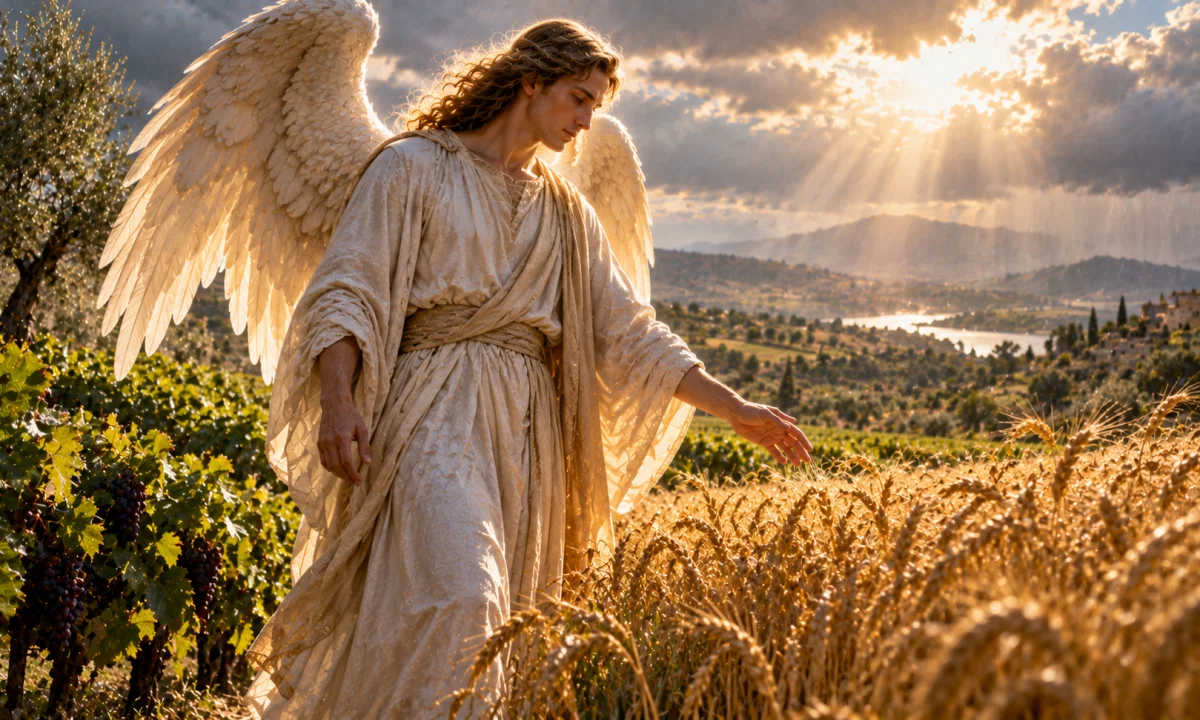
No standard traditional description gives Amriel a fixed physical appearance. There is no widely accepted account of distinctive wings, clothing, weapons, colours, animals, or celestial rank. Artistic depictions found under the name are therefore modern interpretations rather than illustrations of a stable iconographic tradition.
Where Amriel appears in contemporary esoteric material, the figure may be connected with several broad themes:
- seasonal change and the renewal of life;
- hope, growth, and emotional encouragement;
- the movement from intention to action;
- protection during periods of transition; and
- reflection on personal development or spiritual purpose.
These themes are plausible extensions of a May association, but they should not be presented as universally accepted powers. Different authors may assign Amriel different functions, and some may use the name without providing any explanation at all.
There is likewise no reliable basis for assigning Amriel a particular place in the hierarchy of angels. The figure is not generally identified as an archangel, seraph, cherub, throne, principality, or other formal order. Modern lists sometimes use the word “angel” broadly, but that does not establish a traditional rank.
Stories and relationships
Amriel does not possess a widely known body of legends comparable to the stories of Michael defeating the dragon, Raphael healing Tobiah, or Gabriel announcing divine messages. No major scriptural episode centres on an angel named Amriel, and there is no broadly recognised cycle of myths concerning the figure.
Some modern accounts may describe Amriel as a guide, guardian, or seasonal spirit, but these descriptions generally function as devotional or esoteric interpretations rather than retellings of an old narrative. They should not be treated as evidence of an ancient biography.
The same caution applies to claims about relationships with other angels. Amriel is not securely established as the companion, subordinate, rival, or counterpart of any major angelic figure. If a particular occult system places Amriel alongside other month angels, that arrangement belongs to the structure of that system. It does not demonstrate a relationship recognised across Jewish, Christian, Islamic, or historical angelological traditions.
Amriel and Jewish angelology
Jewish angelology includes named beings in biblical passages, Second Temple Jewish literature, rabbinic interpretation, mystical writings, and later magical traditions. The number and identity of angels vary across these sources. Names such as Michael, Gabriel, Raphael, and Uriel became especially influential, while many other names remain restricted to particular texts or schools.
Amriel is not among the best-attested named angels of Jewish scripture or mainstream Jewish liturgy. It is possible for a later writer to place the name within a Hebrew-flavoured angelic framework, but that does not make the name part of an ancient Jewish consensus. Claims that Amriel is a biblical or canonical angel are therefore misleading.
The distinction between Jewish tradition and later occult borrowing is particularly relevant because many European occult writers adopted Hebrew names, divine-name elements, and concepts from Jewish mystical texts. They often rearranged or expanded those materials to create systems of planetary, zodiacal, or calendrical correspondence. Such systems may be historically interesting, but they are not identical with Judaism.
Amriel and Christian traditions
Christianity inherited a large part of its angelic vocabulary from Jewish scripture and later developed additional teachings through theology, apocryphal literature, hymnography, art, and popular devotion. A few named angels became widely accepted, while many others remained outside official doctrine or were rejected as unreliable.
Amriel has no established role in standard Christian doctrine. It is not normally included among the angels named in the Bible, and it has no broadly recognised feast, prayer, liturgical office, or theological teaching. A Christian individual may choose to use the name devotionally, but that represents a personal or modern practice rather than a generally shared ecclesiastical tradition.
Distinguishing Amriel from Ambriel
The closest frequent source of confusion is Ambriel. Both names can appear in modern lists connected with the calendar or zodiac, and spelling variations may make them look like forms of one another. However, they should be kept separate unless a specific source explicitly identifies them.
Ambriel is more commonly associated in occult and astrological systems with Gemini, communication, or a period spanning part of May and June. Even these associations belong chiefly to later esoteric classifications rather than to a single ancient religious tradition. Amriel, by contrast, is often presented as a May angel, although that attribution is itself inconsistent.
The difference illustrates a wider problem in popular angel literature: names can be copied, altered, shortened, or combined as lists circulate. A spelling error in one publication may become a new entry in another. Over time, an uncertain name can acquire an elaborate biography that has no independent textual foundation.
Historical interpretation
From a historical perspective, Amriel is best understood as an example of how angelic naming systems continue to develop. Angelology is not limited to the figures preserved in ancient scripture. Medieval visionaries, mystical authors, occult philosophers, ceremonial magicians, devotional writers, and contemporary spiritual teachers have all contributed new names and classifications.
The appeal of a name such as Amriel may lie in its ability to give a personal focus to a season or an inner experience. A person seeking a symbolic guardian for May might find meaning in an angel connected with growth and renewal. That use can be spiritually significant for the individual even when the historical evidence for the figure is slight.
Researchers and readers should distinguish three different claims:
- Historical claim: Amriel appears in some later lists or modern esoteric materials.
- Traditional claim: Amriel is a recognised ancient or scriptural angel. This claim is not well supported.
- Symbolic claim: Amriel can represent renewal, hope, or a personal association with May. This is an interpretive or devotional use.
Keeping these categories separate allows the name to be discussed without either dismissing modern spiritual practice or presenting uncertain material as established religious history.
Modern use
Amriel is most relevant today in online angel directories, spiritual self-help material, astrology-oriented writing, and informal occult practice. Modern users may invoke the name in meditation, journalling, seasonal rituals, or personal prayers. The intended qualities often include renewal, courage, emotional support, and receptiveness to change.
There is no prominent, widely recognised role for Amriel in mainstream film, television, literature, or games. When the name appears in contemporary fiction or popular culture, the character may be invented for that work and should not automatically be treated as a representation of an older angelic tradition.
For historical accuracy, Amriel is therefore best described cautiously: a poorly documented angelic name, often linked by modern esoteric sources with May and with symbolic themes of renewal, but lacking a stable ancient identity, canonical status, or agreed set of stories and attributes.