WORLD
WORLD
St. Romuald
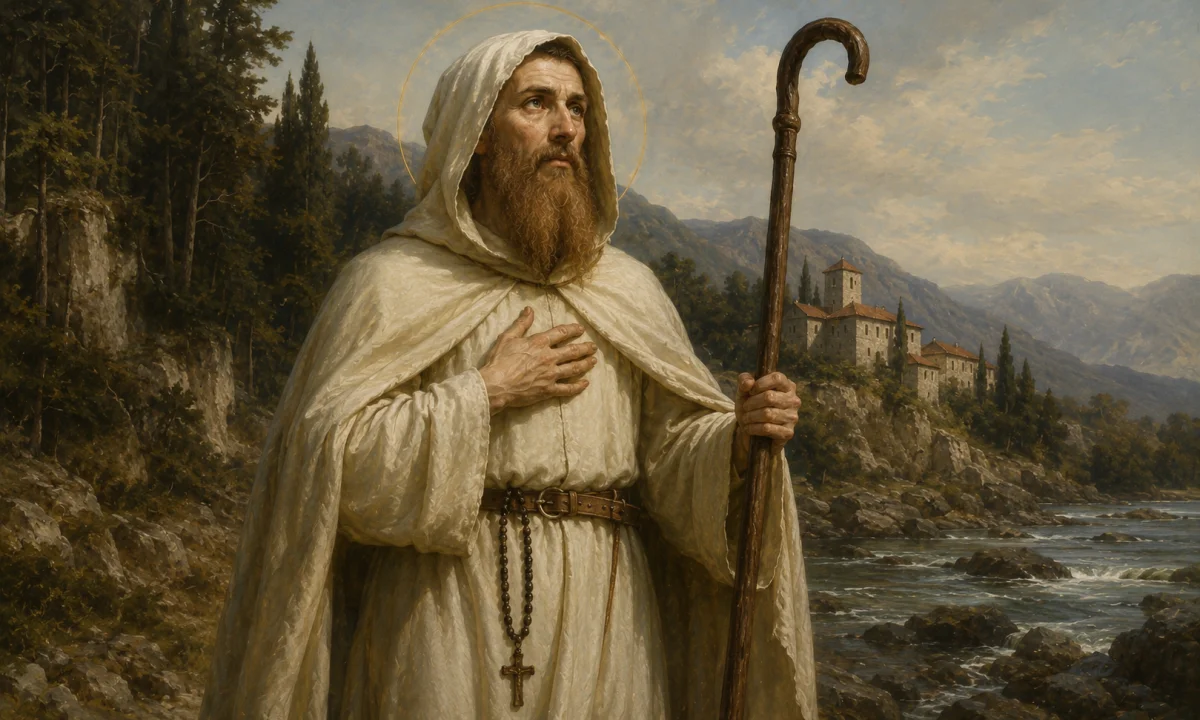
St. Romuald was an Italian Christian monk, hermit, and reformer who lived from about 951 to 1027. He is best known as the founder of the Camaldolese tradition, a branch of Benedictine monasticism that combines communal religious life with periods of solitary prayer. His memorial is generally observed on 19 June. Romuald belongs to the Christian tradition of saints, particularly to the history of medieval Western monasticism.
Historical setting
Romuald lived during a period when monasteries across Italy and other parts of Europe were being reformed. Some religious houses had become closely tied to aristocratic families, local political interests, or the management of large estates. Reformers sought to restore stricter observance of monastic discipline, regular prayer, manual work, and separation from worldly ambitions.
Two influential ideals shaped Romuald’s religious life. The first was the Rule of St. Benedict, which organized monastic life around prayer, obedience, stability, work, and life in community. The second was the older Christian ideal of the hermit, or solitary ascetic, who withdrew from society to devote himself more completely to prayer and spiritual struggle. Romuald’s distinctive contribution was to bring these ideals together rather than treating them as entirely separate forms of religious life.
Much of what is known about him comes through hagiography, especially the Life of St. Romuald written by St. Peter Damian in the eleventh century. Peter Damian knew members of the reform movement and presented Romuald as an exemplary holy man. His work is an important early source, but it is also a religious biography designed to show sanctity. Miraculous episodes, visions, prophetic sayings, and dramatic moral tests should therefore be distinguished from details that can be established more securely through historical evidence.
Birth, family and conversion
Romuald was born around 951 in Ravenna, a city in northeastern Italy with a long Christian and imperial history. He came from a noble family and grew up within the privileges and responsibilities of the aristocratic world. His early life, according to traditional accounts, was not initially marked by the severe asceticism for which he later became famous.
A decisive event occurred when Romuald was about twenty years old. His father, Sergius, killed a relative during a dispute over property or family interests. The exact circumstances vary in the sources, but Romuald was deeply troubled by the violence. He entered the monastery of San Apollinare in Classe near Ravenna and undertook a period of penance for the crime committed by his father.
Traditional accounts say that Romuald spent approximately three years in penitential prayer. He eventually found the discipline of the monastery insufficiently strict for his spiritual ambitions and sought a more solitary form of life. This dissatisfaction should not necessarily be understood as a rejection of Benedictine monasticism itself. Rather, it reflected the tension between ordinary communal monastic practice and the more demanding asceticism that attracted many reformers of the period.
Life among monks and hermits
Romuald joined a stricter monastic community led by the Venetian hermit Marinus. Marinus followed a highly ascetic way of life, and Romuald learned from him the disciplines of solitude, silence, fasting, and constant prayer. The two men are important in the traditional account of Romuald’s spiritual formation, although details of their relationship are preserved mainly through later religious biography.
Romuald also spent time at the monastery of Sant’Apollinare in Classe, where he was made abbot for a period. His attempt to introduce stricter discipline met resistance. The episode illustrates a recurring feature of medieval monastic reform: a reforming abbot might be supported by church authorities while facing opposition from monks who did not wish to abandon established customs or privileges.
Rather than remaining permanently in an influential urban monastery, Romuald repeatedly withdrew to remote places. He established or encouraged small communities in which monks lived near one another but retained separate cells for solitude. This arrangement allowed the monks to gather for worship and communal needs while preserving the silence and personal discipline associated with hermits.
Romuald’s reputation for holiness spread beyond the communities where he lived. He attracted disciples, advised churchmen and rulers, and became associated with several monastic foundations. His life was not simply an uninterrupted retreat from society. Like other prominent medieval ascetics, he moved between solitude, reforming work, ecclesiastical affairs, and the training of followers.
The foundation of Camaldoli
Romuald’s most enduring foundation was at Camaldoli in Tuscany. The community was established in the early eleventh century, traditionally dated to about 1012, on land associated with a nobleman named Maldolo. The name Camaldoli is commonly connected with the Latinized form of “Maldolo’s field,” or Campus Maldoli.
A traditional story says that Maldolo dreamed of monks in white garments ascending a ladder toward heaven. Impressed by the vision, he gave the land to Romuald. This account belongs to the symbolic and hagiographic tradition surrounding Camaldoli. Whether or not the dream occurred historically, it expresses the spiritual purpose of the foundation: the monastery was imagined as a place through which human beings turned from earthly ambition toward God.
Camaldoli developed a form of monastic life that included a central monastery and a nearby hermitage. The monks followed the Rule of St. Benedict, but the arrangement gave unusual importance to solitary cells and extended periods of silence. The community therefore stood between two established patterns: the fully communal Benedictine monastery and the isolated life of a hermit living without a permanent organized group.
The tradition that grew from Camaldoli became known as the Camaldolese Congregation, later associated with the Order of Camaldolese Benedictine monks. Its members have generally preserved a combination of common liturgical life and eremitical practice. The exact organization changed over time, and the later Camaldolese institution should not be treated as identical in every detail to Romuald’s first community. Nevertheless, his ideal remained its central inspiration.
Religious identity and classification
Romuald is properly classified as a Christian saint, Benedictine monk, hermit, and monastic founder. He was not a separate pre-Christian deity, legendary nature spirit, or figure from classical mythology. His importance belongs to the religious history of medieval Latin Christianity, especially the reform of monastic institutions.
He is also described as a confessor. In Christian usage, a confessor is a saint who suffered for or publicly witnessed to the faith without being killed as a martyr. Romuald was not a martyr. His sanctity is associated instead with ascetic discipline, reform, spiritual instruction, prayer, and the establishment of a lasting religious community.
Romuald’s name appears in several forms. The Latin form is Romualdus, while Italian commonly uses Romualdo. English-language sources usually call him Romuald or Saint Romuald. These are variant forms of the same historical figure, not different saints. The name is Germanic in origin and is often connected with elements meaning fame or glory and rule, although the interpretation of early Germanic personal names can vary.
Appearance and symbols
There is no securely documented physical description of Romuald that can be treated as a historical portrait. In religious art, he is usually shown as an elderly or middle-aged bearded monk wearing a white habit. The white clothing reflects the later visual identity of the Camaldolese, whose members became associated with white monastic garments.
Common artistic attributes include a staff, a book, a skull, a cross, and a small hermit’s cell. The book represents the Rule of St. Benedict, sacred teaching, and the instruction of disciples. The skull symbolizes mortality and the meditation on death known in Christian asceticism as memento mori. The cell represents withdrawal from worldly distraction and the solitary prayer central to Romuald’s vocation.
Some images show him with a ladder or with monks ascending toward heaven. This imagery refers to the tradition of the vision connected with the founding of Camaldoli. It should be understood as a symbolic feature of his iconography rather than evidence that Romuald literally possessed a supernatural power to create a visible path to heaven.
Important stories and traditions
The reformer who sought solitude
One of the central patterns in Romuald’s life is his repeated movement away from comfort, status, and institutional prominence. He was born into nobility, became a monk, served as an abbot, and then returned to remote places. In hagiographic terms, this movement demonstrates humility and detachment. Historically, it also shows how reformers could use the authority gained in monasteries while resisting the wealth and social influence that came with office.
The vision of the ladder
The ladder vision associated with Maldolo’s gift of land is among the best-known stories connected with Camaldoli. Monks dressed in white are said to have climbed toward heaven in the dream. The image resembles a broader Christian symbol of ascent between earth and heaven, most famously represented by Jacob’s ladder in the Hebrew Bible.
Within the Camaldolese tradition, the vision conveys the purpose of the monastic foundation rather than functioning as a detailed account of institutional history. It associates the physical landscape of Camaldoli with spiritual ascent, disciplined prayer, and the hope of communion with God.
Travels and attempted foundations
Romuald is traditionally said to have travelled widely in Italy and to have attempted a mission among the Hungarians. His health reportedly prevented him from continuing that journey. He was also connected with reforming efforts in several monasteries and with the religious concerns of powerful rulers.
The surviving narratives often present him as possessing prophetic insight or supernatural knowledge. Such episodes are typical of medieval saints’ lives, in which a holy person’s ability to perceive hidden motives or future events confirms divine favor. The details are difficult to verify independently, and they should be read as part of the spiritual interpretation of Romuald’s life rather than as ordinary historical reports.
His final years and death
Romuald died on 19 June 1027, traditionally at the monastery of Val di Castro in the region of Marche. Accounts describe him dying in solitude, an ending that fits the image of the hermit he had cultivated throughout his life. The date is widely accepted in the tradition, while some details of his final circumstances are known chiefly through later accounts.
His cult developed among the communities associated with his foundations and gradually received wider recognition in the Western Church. The Camaldolese preserved his memory through liturgy, monastic observance, biographies, and images. His feast day is 19 June in the Roman Catholic calendar, although calendars and local observances may differ in wording or rank.
Spiritual meaning
Romuald’s importance lies less in a collection of spectacular miracles than in his model of disciplined religious life. He represented a Christian ideal in which solitude was not merely escape from society. The hermit withdrew in order to pray, fight personal temptation, and seek a deeper relationship with God; the resulting wisdom could then serve a wider community.
The Camaldolese synthesis also addressed a practical question in medieval Christianity: could a person live as a hermit without abandoning the stability, worship, and accountability of a monastery? Romuald’s answer was a structured combination of both forms. Monks could share a church, rule, and community while living much of their daily life in separate cells.
His tradition places strong emphasis on silence, penance, stability, contemplation, obedience, and simplicity. These themes are not unique to Romuald, but they received a particularly rigorous expression in the communities inspired by him. His life also demonstrates that medieval Christian holiness could be pursued through several different roles: penitent, monk, abbot, hermit, teacher, and founder.
Distinction from similar figures
Romuald should not be confused with other Christian saints whose names resemble his. He is different from St. Romulus, a name borne by several martyrs and bishops in Christian tradition, and from the legendary Romulus who, together with Remus, is associated with the foundation of Rome in Roman mythology. The similar sounds of Romuald, Romualdo, and Romulus do not indicate that these figures share an identity or origin.
He is also distinct from St. Bruno of Cologne, the founder of the Carthusian order. Both saints are associated with austere forms of monastic solitude, but they lived in different settings and founded different traditions. Romuald’s Camaldolese model developed from Benedictine monasticism and combined hermit cells with communal life, while the Carthusian tradition followed its own rule, history, and institutional development.
Later reception
Romuald remains especially important within Camaldolese communities, where his memory is tied to the continuing practice of combining communal worship with eremitical solitude. His story is also studied as part of the wider history of medieval monastic reform, alongside figures such as Peter Damian and other advocates of stricter religious discipline.
He has had little sustained presence in modern popular culture compared with more widely known saints such as Francis of Assisi or Benedict of Nursia. When Romuald appears in contemporary religious writing or art, he is generally presented through the themes already established in traditional sources: the nobleman turned penitent, the reforming monk, the solitary contemplative, and the founder of a community symbolized by a ladder rising toward heaven.