WORLD

Amma
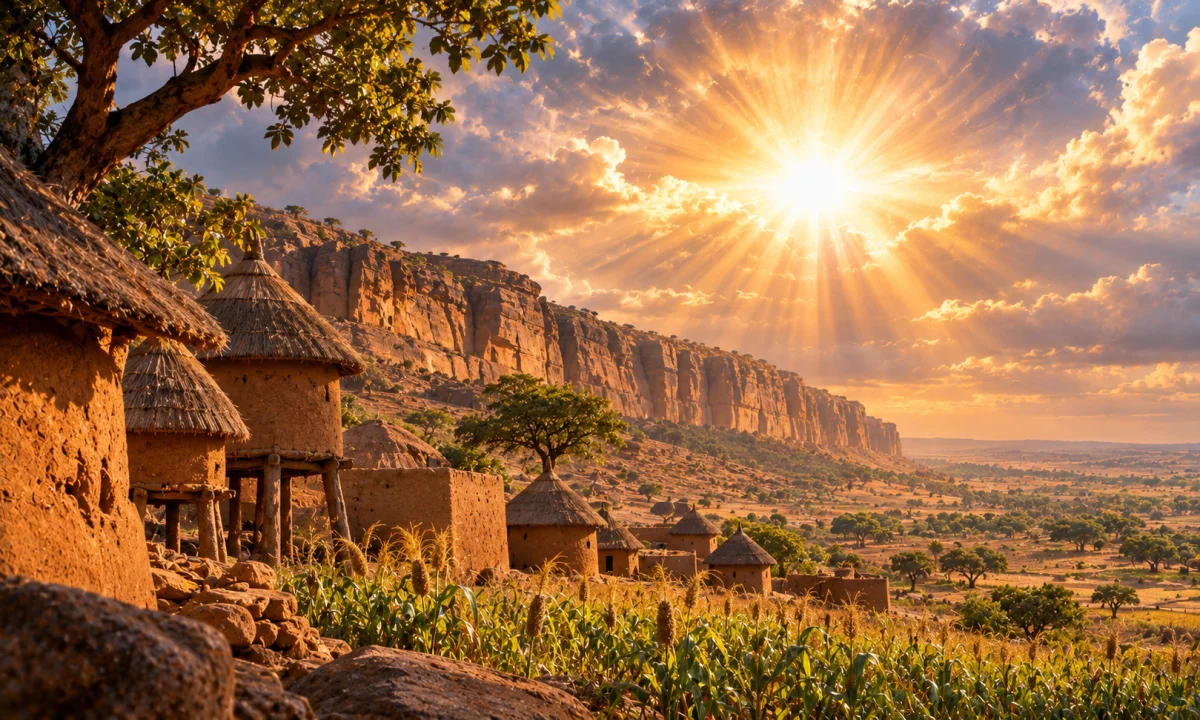
Amma is the supreme creator deity in the religious traditions of many Dogon communities in Mali. Dogon cosmology presents Amma as the source of the universe, the earth, living beings and the ordered pattern of existence. Amma is often described in English as a god, but the name refers to a creator whose nature does not fit neatly into modern categories of gender, personality or human-like appearance. Accounts differ between Dogon communities and between individual traditions, so no single version represents every Dogon understanding of Amma.
Amma in Dogon religious tradition
The Dogon are an Indigenous people of the central plateau and Bandiagara region of present-day Mali. Their communities have historically included farmers, blacksmiths, musicians, ritual specialists and hereditary religious authorities. Dogon religious traditions are expressed through oral teachings, initiation, masks, dances, funerary ceremonies, shrines and relationships with the landscape. They are not preserved in one universally authoritative scripture.
Amma occupies the highest position in many accounts of this religious world. The deity is associated with the creation and organisation of the cosmos rather than with one narrow natural domain. Amma is therefore commonly called the creator or supreme being. The name may also be rendered in slightly different ways in discussions of Dogon languages and traditions, although Amma is the most familiar spelling in English-language writing.
Much of what is known outside Dogon communities comes from twentieth-century French ethnographic work, especially the writings associated with Marcel Griaule and Germaine Dieterlen. Their interpretations presented a highly elaborate cosmology involving Amma, the primordial egg, the Nommo and the star Sirius. Later scholars have questioned how these accounts were collected, translated and interpreted. Some have argued that the published descriptions may reflect particular informants, changing conversations or the assumptions of the researchers rather than a single ancient system shared by all Dogon people.
The creator and the beginning of the cosmos
In well-known accounts, Amma existed before the ordered universe and brought creation into being from a primordial state. The image of a cosmic egg is especially important. This egg contains the potential forms of life and the structures that will later become the world. Within it are seeds, patterns or vital principles that must be arranged before creation can function properly.
The cosmic egg is not necessarily a simple object in the physical sense. It can be understood as a symbolic image of concentrated possibility: an enclosed beginning from which the universe unfolds. Amma's creative activity involves separating, organising and activating what is contained within this original state. Some accounts describe the cosmos as developing through movement, vibration, speech or the ordering of signs. These details vary according to the source and should not be treated as a fixed Dogon creed.
Dogon cosmological accounts often connect creation with a structured universe. The world is not merely made from raw matter; it is given relationships, directions, numbers, rhythms and distinctions. This emphasis on order reflects the importance of classification and balance in Dogon religious thought. Agriculture, the seasons, human generations, social obligations and ritual performance can all be understood as parts of a wider cosmic arrangement.
In some interpretations, Amma created the earth and then brought forth spiritual beings who would help establish life and order. The earth is sometimes represented through feminine imagery, while Amma is presented in masculine terms by some interpreters. These descriptions should be handled carefully. Dogon symbolic language does not always correspond to a fixed doctrine in which Amma is simply a male god and the earth is simply a female goddess. The meaning of sexual and bodily symbolism can change according to context, ritual and the speaker.
Amma, the earth and the first act of creation
One influential account describes Amma approaching or joining the earth in order to generate life. The earth may be represented as an anthill or mound, and the joining of creator and earth becomes a symbolic explanation for fertility and the production of living forms. Some versions contain sexual imagery, while others emphasise the earth's enclosure, resistance or incompleteness.
These stories are often interpreted as describing the transition from an undifferentiated cosmic state to a world capable of reproduction. They may also express the connection between agriculture and sacred order. Soil must be opened, planted and cared for before it produces crops; in a similar symbolic pattern, the cosmos must be properly arranged before life can flourish.
Some published interpretations give great importance to the earth's supposed clitoris or to a termite mound as a bodily and cosmic symbol. Such readings have become well known in discussions of Dogon mythology, but they are not neutral summaries of an uncontested tradition. They depend heavily on particular ethnographic translations and interpretations. It is more accurate to say that bodily, agricultural and architectural images can overlap in Dogon cosmological symbolism than to present one anatomical explanation as universally accepted.
The Nommo and the work of ordering life
The Nommo are among the most important beings associated with Amma. The word can refer to a group of ancestral or aquatic beings, although its meaning and grammatical use vary in different accounts. Nommo figures are commonly connected with water, fertility, speech, life and the restoration of cosmic balance. They are sometimes described as children or creations of Amma, but the number, identity and role of these beings differ between versions.
In the best-known cosmological narrative, Amma creates or generates a pair of Nommo. These beings represent a properly ordered and fertile principle. Through them, life can be established and transmitted. Nommo are frequently associated with water because water is essential to agriculture, birth and the continuity of living things. Their aquatic character does not make them identical to mermaids or European water spirits. They belong to a specifically Dogon religious framework.
Nommo may also be connected with speech and communication. In Dogon thought, speech can be more than a means of transmitting information: it can carry power, social responsibility and creative force. The capacity to name, teach, remember and perform ritual language helps sustain the order of the world. Nommo are consequently sometimes understood as teachers or civilising beings, although this terminology reflects interpretation rather than a single universally used Dogon title.
One Nommo figure is sometimes said to sacrifice or transform itself for the benefit of creation. Accounts vary, but the theme is one of restoration: disorder is confronted through a being that gives itself so that the world can be repaired. This pattern helps explain why Nommo imagery appears in discussions of sacrifice, water, renewal and the return of balance.
Yurugu and the problem of disorder
Another major figure in accounts of Dogon creation is Yurugu, also known in some sources as the Pale Fox. Yurugu is not another name for Amma and should not be merged with the creator. He is generally portrayed as a rebellious, incomplete or disorderly being whose actions disturb the arrangement of creation.
Some narratives describe Yurugu as emerging prematurely from the cosmic egg. He seeks his female counterpart, sometimes identified as his twin or as a part of the original creative pair, but his action violates the proper pattern of creation. The result is impurity, imbalance or the mixing of forms that should have remained distinct. Yurugu's failure helps explain why the created world contains imperfection, conflict and uncertainty.
The Pale Fox is also associated with divination. In some Dogon divinatory practices, marks made by a fox or fox-like animal are read as signs. The animal's movements across disturbed earth can be interpreted by a diviner, who uses the pattern to answer questions. This practice gives Yurugu a continuing presence in religious life, not merely a place in a remote origin story.
The figure's colour and name can create confusion. “Pale Fox” is an English translation used in ethnographic and popular writing, not a universal Dogon name for every fox or trickster figure. Yurugu also should not automatically be identified with Anansi, Eshu, Loki or other tricksters from unrelated traditions. Although these figures may share themes of disruption or ambiguity, their histories and religious meanings are different.
Amma, speech and cosmic order
Amma's creative power is often represented as an act of ordering rather than the manufacture of objects in a modern mechanical sense. The universe becomes intelligible through distinctions: sky and earth, wet and dry, living and dead, male and female, human and non-human, wild and cultivated. These oppositions are not always absolute, and ritual often seeks to regulate their relationship rather than eliminate one side.
Numbers and geometric patterns also appear in published accounts of Dogon cosmology. Some interpreters have linked numerical structures to the arrangement of the universe, the organisation of settlements or the design of ritual objects. These associations can be meaningful within Dogon symbolic systems, but claims that every number has one fixed interpretation should be avoided. The significance of a number may depend on the ceremony, object, language or tradition in which it occurs.
Creation is therefore not only an event in the distant past. It provides a model for maintaining the world in the present. Agricultural work, initiation, marriage, funeral rites, mask performances and the transmission of knowledge can all be understood as activities that preserve relationships established at creation. Amma may be distant from everyday human affairs, while other beings, ancestors and ritual authorities mediate more immediate religious concerns.
Sources, transmission and scholarly debate
Knowledge of Amma comes primarily through oral traditions and ethnographic records rather than through a canonical sacred book. Oral traditions can preserve very old themes while also changing in wording, emphasis and interpretation. Different speakers may explain the same being in different ways, especially when addressing outsiders, ritual initiates or members of another Dogon community.
The publications of Marcel Griaule and his collaborators made Dogon cosmology widely known in Europe and North America. Their accounts presented detailed teachings about Amma, the Nommo, the cosmic egg and astronomical knowledge. These works had a major influence on anthropology, African religious studies and popular discussions of ancient astronomy.
Several aspects of those accounts remain disputed. Critics have questioned whether the interviews were sufficiently independent, whether French translations preserved important distinctions in Dogon languages and whether the researchers encouraged particular forms of explanation. The famous claim that Dogon people possessed detailed knowledge of Sirius and its unseen companion before modern astronomy is especially controversial. Astronomers and anthropologists have pointed out that the evidence for a pre-contact Dogon tradition of this kind is not secure.
For that reason, Amma should not be used as proof that the Dogon received advanced astronomical information from extraterrestrials, lost civilisations or visitors from outside Africa. Such ideas belong to modern speculation and popular pseudoarchaeology, not to established evidence about Dogon religion. The religious importance of Amma does not depend on extraordinary astronomical claims.
Appearance and representation
Amma is not generally known through one standard human-shaped image comparable to an ancient Greek statue or a Christian icon. The deity is more often conveyed through verbal teaching, cosmological symbolism and the sacred relationships that structure Dogon life. Representations of related beings, ancestors and spiritual forces may appear in masks, sculptures or ritual objects, but these should not automatically be labelled images of Amma.
Descriptions of Amma as invisible, spherical, egg-like, male, female or beyond physical form can all be found in discussions of Dogon tradition, but they do not carry equal authority. Some are translations of symbolic language; others are modern attempts to classify a being that is not represented in a single consistent way. It is safest to describe Amma as a transcendent creator whose attributes are expressed through changing cosmological images rather than through a fixed iconography.
Distinguishing Amma from other figures and names
Amma should be distinguished from the Nommo, who are associated with life, water, speech and restoration; from Yurugu, whose rebellion introduces disorder; and from ancestral or local spiritual beings involved in particular communities and rituals. These figures may belong to the same broad Dogon cosmological framework, but they are not interchangeable.
The name Amma can also cause confusion outside Dogon studies. Similar spellings may appear in other African religious, linguistic or personal-name contexts, but a shared spelling does not establish a shared deity. In particular, Amma should not be automatically equated with creator figures from Akan, Yoruba, Fon, Kongo or other African traditions. Each tradition has its own languages, histories and systems of religious meaning.
Continuing significance
Amma remains important as a symbol of Dogon cosmological identity and of the relationship between creation, fertility, knowledge and social order. The figure is best understood within Dogon cultural contexts rather than as an isolated “African god.” Dogon communities are diverse, and contemporary religious life may include Indigenous practices alongside Islam, Christianity, formal education and other influences. The continuing meaning of Amma can therefore vary between families, villages, ritual specialists and generations.
In modern popular culture, Amma is sometimes reduced to a mysterious alien-linked deity because of sensational interpretations of Dogon astronomy. That portrayal obscures the central religious themes: the creation of an ordered world, the danger of imbalance, the role of water and fertility, the power of speech and the responsibility to preserve relationships between human society and the wider cosmos. Those themes belong to a living and debated tradition, not merely to a catalogue of ancient myths.