WORLD
WORLD
Alcyone
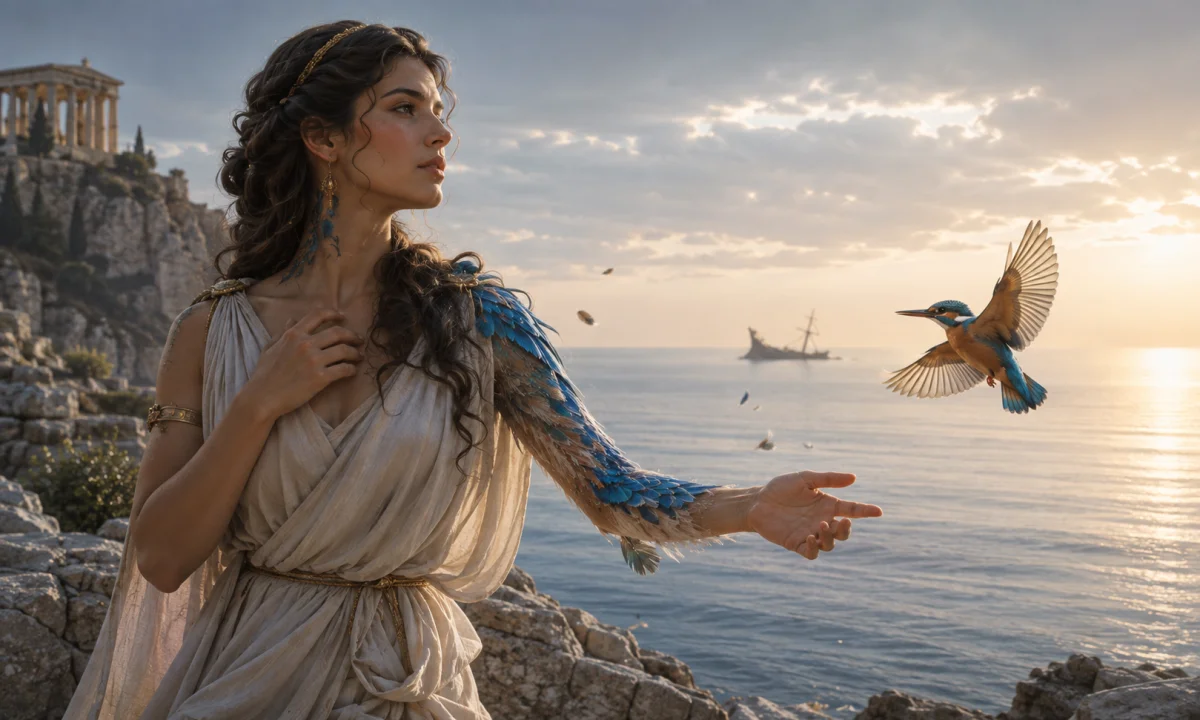
Alcyone is a figure of Greek mythology best known as the devoted wife of Ceyx, whose grief after his death leads to the transformation of both spouses into seabirds. Their story belongs to the ancient Greek tradition of metamorphosis, in which exceptional love, pride, mourning or divine punishment can alter a human body and reshape a life. Alcyone is also the name of one of the Pleiades, however, and these two figures should not be treated as the same character.
Alcyone, wife of Ceyx
The most widely remembered Alcyone is the daughter of Aeolus and the wife of Ceyx. The identity of her father varies in significance between ancient accounts. He is usually presented as Aeolus, a mythic king and ancestor of the Aeolid family. This Aeolus is related to the heroic genealogies of Thessaly and surrounding regions and should not automatically be equated with the later literary image of Aeolus as the ruler or keeper of the winds.
Ceyx is commonly described as the son of Eosphorus, the personification of the morning star, although his parentage also varies. He ruled at Trachis, a city in central Greece associated with several heroic stories. Alcyone and Ceyx are portrayed as an unusually loving married couple. Their affection is so complete that they compare themselves with Zeus and Hera, the divine husband and wife who stand at the head of the Olympian order.
That comparison is the central offence in the traditional story. The precise details differ, but the essential idea is that mortal happiness becomes entangled with divine status. Alcyone and Ceyx do not necessarily intend to challenge the gods in a deliberately rebellious way. Their language may express marital affection and mutual admiration rather than a formal claim to godhood. Nevertheless, ancient mythology often treats the adoption of divine titles or comparisons by mortals as dangerous hubris. Zeus and Hera, or the gods more generally, punish the couple.
The voyage and the dream
Ceyx eventually decides to leave Alcyone and travel by sea to consult an oracle. In the fullest surviving literary version, he wants guidance concerning the fate of a relative or the troubles affecting his household. Alcyone is terrified by the voyage and begs him not to go. She knows the dangers of the sea and asks to accompany him, but Ceyx refuses because he believes the journey will be too hazardous for her.
His ship is caught in a violent storm. The sea breaks the vessel apart, and Ceyx is thrown into the water. As he struggles, he thinks of Alcyone. He asks the gods, if any divine power still cares for him, to let his body reach her so that she may bury him. The scene combines physical disaster with emotional isolation: Ceyx dies far from home, while his wife remains unaware of what has happened.
Alcyone continues to pray for her husband and to imagine his safe return. In the most influential version of the narrative, the gods send a dream to reveal the truth. The god of sleep, Somnus, instructs Morpheus to appear in the form of Ceyx. Morpheus tells Alcyone that her husband is dead and describes the wreck. The dream is so convincing that she wakes in profound grief and goes to the shore to search for his body.
She eventually sees what she believes to be Ceyx floating in the water. In some tellings, the body is carried close enough for her to recognise it. Alcyone throws herself into the sea, either in an attempt to reach him or as an act of despair. The gods then transform both husband and wife into birds. Ceyx becomes a male halcyon, while Alcyone becomes the female bird associated with the same species.
The metamorphosis changes the ending from a story of separated lovers into one of permanent companionship. The pair can remain together on the sea, though no longer as human beings. Their transformation is sometimes presented as an act of divine mercy after their punishment, rather than as an additional penalty. Their love survives, but in a form governed by nature and the sea.
The halcyon and the “halcyon days”
The Greek word alkyōn referred to a sea bird, traditionally identified with the kingfisher. The connection between Alcyone’s name and the bird is ancient, but the exact identification of the bird in ancient natural history is not completely certain. Greek and Roman writers described the halcyon through a mixture of observation, inherited lore and mythic explanation. The modern common name “kingfisher” is therefore useful but should not be treated as an exact certainty about every ancient reference.
Ancient tradition claimed that the halcyon nested or laid its eggs during a calm period in winter. The winds and waves were said to become quiet while the bird was breeding. This led to the expression halcyon days, meaning a peaceful interval in the midst of difficult conditions. The length and timing of this calm vary in ancient and later accounts. Some traditions place it around the winter solstice, while others describe a limited number of calm days before and after it.
The story of Alcyone and Ceyx provides a mythic explanation for this natural-history belief. Because the transformed couple must raise their young on or near the sea, the gods hold back the winds for a short period. In this form, the tale explains both the bird’s association with the water and the rare calm that sailors may observe during winter.
The expression “halcyon days” eventually developed a broader meaning in English. It can refer to a peaceful or happy time, especially a remembered period from the past. That modern expression preserves the atmosphere of the myth, although it is usually used without any reference to Alcyone, Ceyx or ancient Greek religion.
Ancient sources and variations
The story survives most fully in the Roman poet Ovid’s Metamorphoses. Ovid presents the tale as part of a long sequence of transformations and gives particular attention to the couple’s emotional attachment, the storm, the dream sent by the gods and Alcyone’s discovery of the body. His account became especially influential in later European literature and art.
Earlier Greek traditions also knew Alcyone and Ceyx, but they did not necessarily preserve every detail in the same form. References in mythographical and poetic sources indicate that the story circulated with variations in genealogy, divine motivation and the precise circumstances of the transformation. Ancient authors do not always agree about whether the gods punish the couple for their comparison with Zeus and Hera, whether only Ceyx makes the comparison, or whether the transformation is primarily an act of compassion.
Some accounts give Ceyx a different ancestry or associate him with other heroic genealogies. The name Aeolus also creates potential confusion because Greek mythology contains more than one figure called Aeolus, and later writers sometimes connect separate traditions. It is therefore safer to describe Alcyone as the daughter of an Aeolus in the relevant heroic genealogy rather than to assume that every account refers to one uniform mythic biography.
Ancient natural philosophers and encyclopaedic writers discussed the halcyon independently of the tragic story. Their descriptions helped establish the bird’s reputation for nesting during calm weather, while poets used the myth to give that belief a personal and emotional explanation. Myth and natural history were not always sharply separated in antiquity. A statement about an animal’s behaviour could carry religious, poetic and explanatory meanings at the same time.
Character and symbolism
Alcyone is primarily defined by loyalty to her husband and by the intensity of her grief. She is not usually portrayed as a warrior, ruler or independent divine power. Her importance comes from the way her emotional experience connects several traditional themes:
- Marital devotion: Alcyone and Ceyx are presented as lovers whose attachment continues beyond death and bodily transformation.
- The danger of mortal happiness: Their joy becomes vulnerable when it resembles the status of the gods too closely.
- The sea as a boundary: The voyage separates the couple, while the final transformation allows them to share the same maritime environment.
- Grief and recognition: The dream and the discovery of Ceyx’s body turn private mourning into the central action of the story.
- Mercy after punishment: The gods do not simply destroy the couple. Their final change preserves their relationship in another form.
- Seasonal calm: The quiet sea during the halcyon period becomes a natural sign of the couple’s continued presence.
Her story also explores the limits of human knowledge. Alcyone does not know what has happened to Ceyx until the dream reveals it. The living world, the world of dreams and the realm of the gods overlap, but none offers complete security. Her prayers cannot prevent the voyage, and her love cannot overcome death in human form. Transformation provides a different kind of survival rather than a restoration of ordinary life.
Alcyone and the Pleiades
A second important mythological figure named Alcyone is one of the Pleiades, the seven daughters of the Titan Atlas and the sea-nymph Pleione. The Pleiades are represented in Greek myth as sisters who are eventually placed among the stars. Their stories are connected with pursuit, loss and celestial transformation, but they belong to a different mythic tradition from the tale of Ceyx and the halcyon.
The Pleiad Alcyone is sometimes associated with Poseidon. Different ancient genealogies name her as the mother of figures such as Hyrieus, although the details are not consistent across sources. The Pleiades themselves also have varying parentage and individual relationships in ancient literature. These variations do not make the Pleiad identical with the wife of Ceyx.
The two figures are easy to confuse because they share the same Greek name, usually written Alkyone in a transliteration that reflects the Greek spelling. The name is connected with the ancient term for the halcyon bird, but a shared name does not prove that the myths originally concerned one person. Greek mythology frequently preserves different local and poetic traditions under the same personal name.
Name and classification
In English, the name appears as Alcyone, Alkyone or occasionally Halcyone. “Alcyone” is the conventional Latinised spelling used in many translations and reference works. “Alkyone” is closer to a direct transliteration of the Greek Ἀλκυόνη. The spelling “Halcyone” reflects the influence of the Latin form halcyon and later associations with the bird.
Modern classifications can also be misleading. Alcyone is often called a goddess of the sea or a goddess of the halcyon, but the surviving mythology does not consistently present her as an established goddess with an independent cult. She is more accurately described as a mortal woman who undergoes divine transformation. The Pleiad Alcyone, by contrast, is a daughter of divine or semi-divine beings who becomes a star. Neither identity should be expanded into a fully defined deity without evidence.
Later reception
Ovid’s version of the story became particularly important in medieval and early modern European culture, when tales from the Metamorphoses were retold in poetry, manuscripts, paintings and moralised mythography. Writers often treated Alcyone’s grief as an example of marital fidelity, while the storm and transformation provided opportunities for reflections on fortune, death and the instability of human happiness.
The name Alcyone has also been used for stars, ships, literary characters and other cultural works. The brightest star in the Pleiades is commonly called Alcyone, but that astronomical name refers to the Pleiad rather than to the wife of Ceyx. In modern usage, the adjective “halcyon” is more familiar than the myth itself, especially in phrases describing peaceful days or an idealised past.
Modern retellings may combine the two Alcyones, simplify the divine punishment, or present the couple’s transformation as a straightforward romantic miracle. Such versions can be meaningful adaptations, but they should be distinguished from the ancient traditions, which vary in genealogy, motive and detail. The enduring image of Alcyone remains that of a grieving wife whose love is carried from the human world into the calm waters and seasonal lore of the halcyon bird.