WORLD
WORLD
Ajok
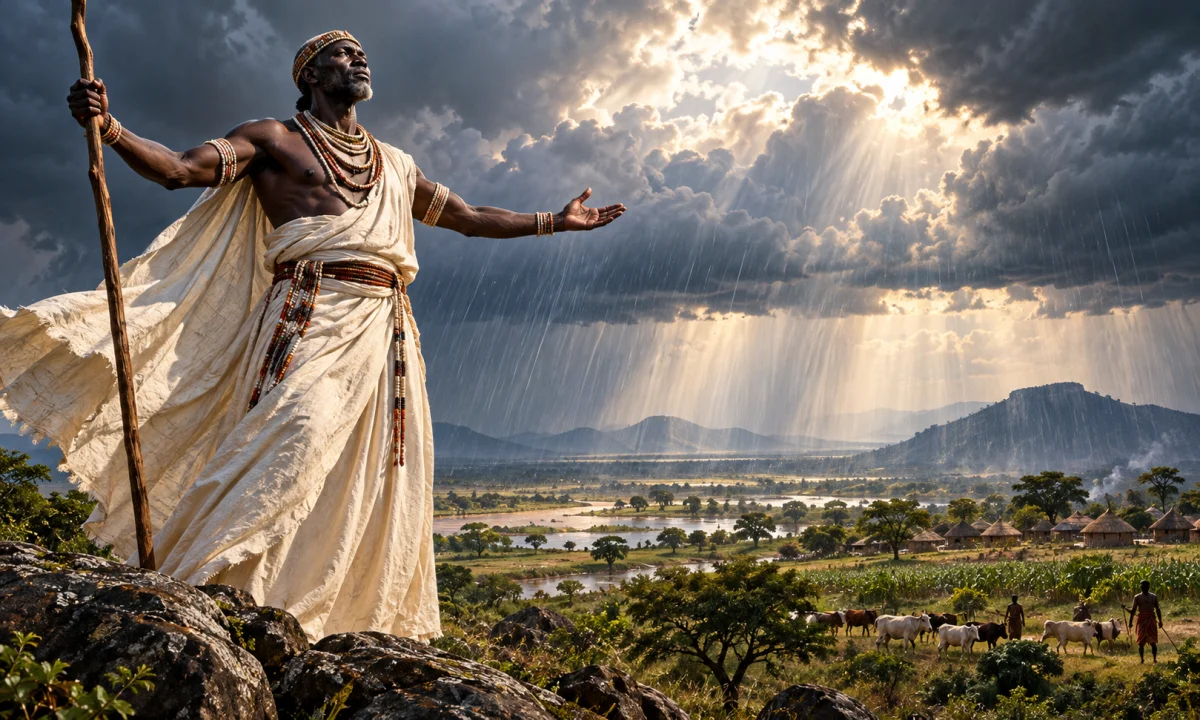
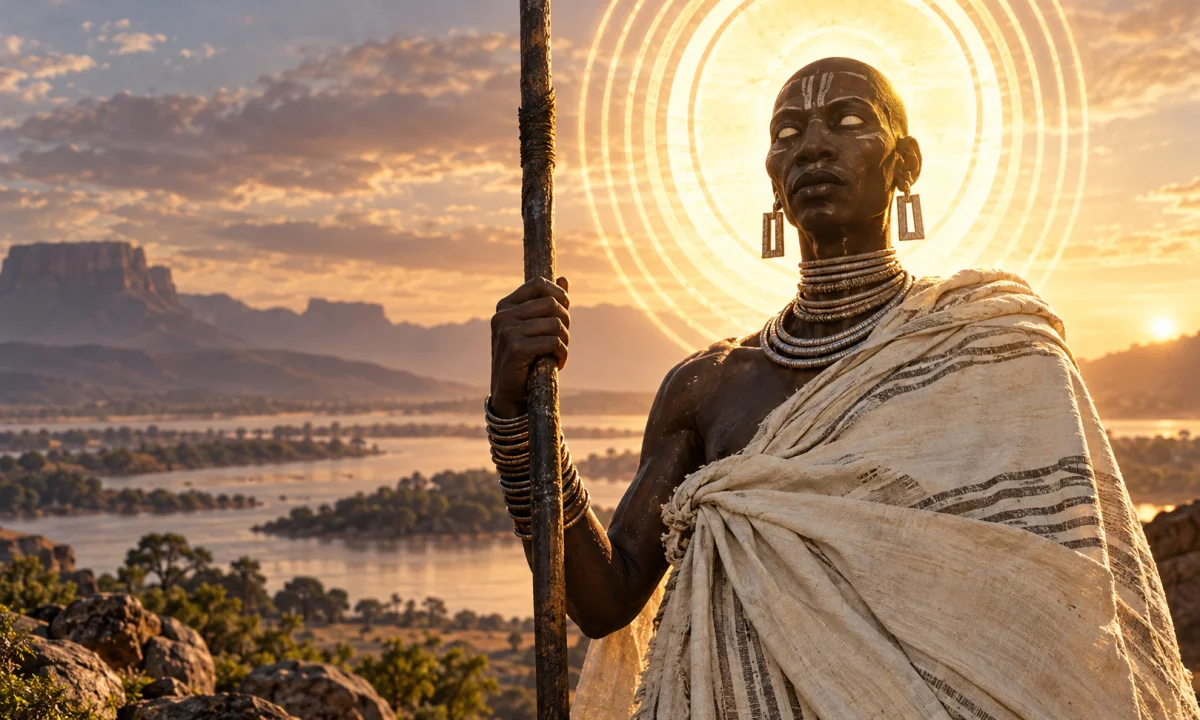
Ajok is a name associated with traditional religious ideas among the Acholi people of northern Uganda and neighbouring parts of South Sudan. In accounts of Acholi belief, Ajok is often described as a high or supreme divine power connected with creation, rain, fertility and the well-being of human communities. The name is also closely related to jok, a broader term for spiritual powers or beings. Because Acholi religious traditions were transmitted mainly through oral practice rather than a single sacred scripture, descriptions of Ajok differ between sources and communities.
Origins and cultural setting
The Acholi are a Luo-speaking people whose historical homeland lies mainly in northern Uganda, with related communities across the border in South Sudan. Their religious traditions developed within an agricultural society in which rainfall, fertility, health, cattle, family continuity and relations with the land were matters of profound importance. Religious knowledge was preserved through ritual, oral teaching, family traditions, songs, stories and the work of ritual specialists.
Within this setting, Ajok is commonly presented as a powerful divine being above ordinary human affairs. Some descriptions identify Ajok with a creator or sky-associated god, while others treat the name as part of a wider vocabulary for spiritual forces rather than as the name of a single figure with a fixed personality. These differences are important. There is no universally accepted Acholi scripture that defines Ajok's character, genealogy, appearance or activities in the manner of a literary mythology.
Much of what is known about Acholi religion was recorded by outsiders, including missionaries, colonial administrators and later anthropologists. Such records are valuable but not neutral. They often translated local religious concepts into terms such as “god,” “spirit,” “devil” or “ancestor,” even though these categories may not correspond exactly to Acholi distinctions. Christian influence, colonial descriptions and changes in local religious practice have also affected the way Ajok and related beings are discussed today.
The meaning of the name
The spelling Ajok should not automatically be treated as evidence of a single, clearly bounded mythological character. In Acholi religious vocabulary, jok can refer to a spirit, spiritual power or divinity. The plural is often given as jogi. Depending on context, a jok may be associated with a natural feature, a locality, a community, a particular family or a specific form of misfortune and healing.
Some writers use Ajok as the name of a supreme or creator deity, while others give greater prominence to Jok as a general category. Differences in spelling are partly connected with the challenges of representing Acholi sounds in European writing systems. The forms Ajok and Jok may therefore be related, but they should not be treated as interchangeable in every context.
The term also belongs to a wider linguistic and cultural environment. Related Luo-speaking peoples have religious terms resembling jok, although the meanings and religious systems are not identical from one community to another. A deity or spirit described with a similar word in another Luo tradition should not automatically be assumed to be Ajok of Acholi belief.
Ajok as a creator and high deity
In summaries of Acholi mythology, Ajok is often identified as the power responsible for creation or for the ordering of the world. This description places Ajok at the highest level of the religious universe, above human beings and local spiritual powers. The creator aspect is sometimes expressed in general terms: Ajok is the source of life, the origin of the world or the power on which the continued existence of the community depends.
There is no single canonical creation narrative that can be confidently presented as the definitive story of Ajok. Accounts may differ concerning whether creation was a direct act, whether the world was shaped through other spiritual beings, and how human beings came to occupy it. Some descriptions focus less on a sequence of creation events and more on Ajok's continuing authority over life, nature and human fortune.
For this reason, it is more accurate to speak of a religious role than of a fixed mythological biography. Ajok is not consistently represented in surviving descriptions as a character who travels, marries, fights rivals or undergoes a series of adventures. The available tradition is more concerned with divine power, moral order, protection and the conditions necessary for communal life.
Rain, fertility and prosperity
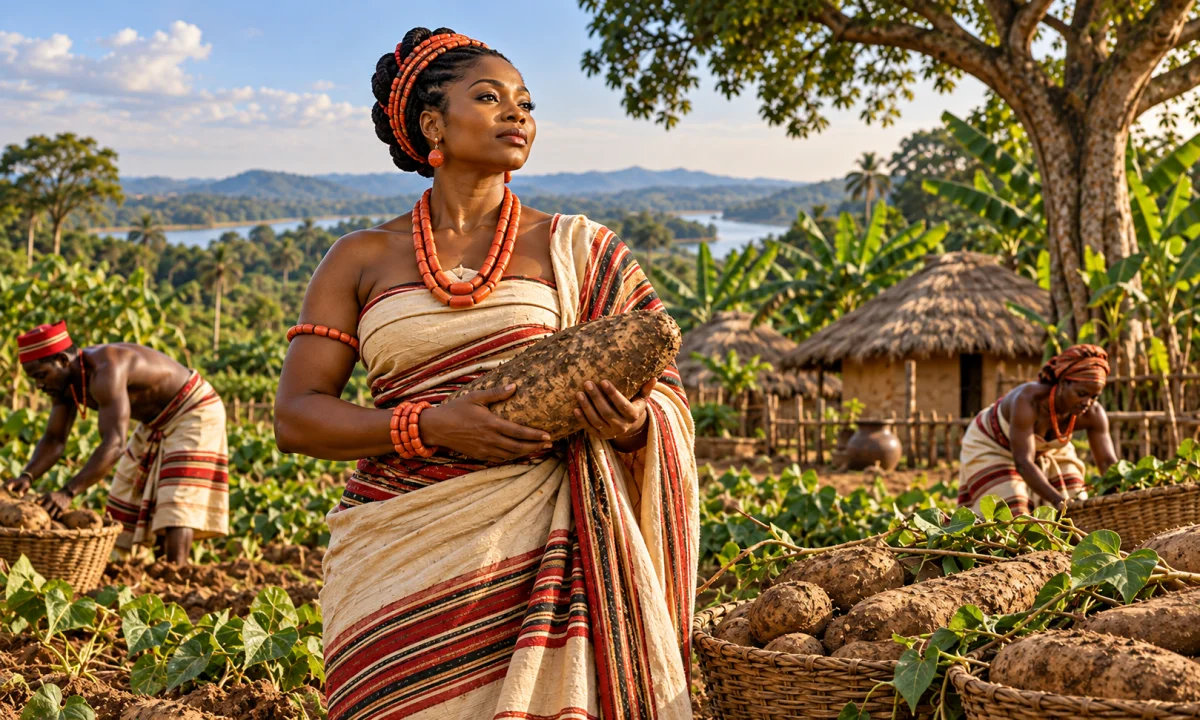
Ajok is frequently associated with rain and fertility. In an agricultural society, rain was not merely a natural event but a condition of survival. It determined whether crops would grow, whether animals would thrive and whether a community would face hunger or abundance. A high deity connected with rain therefore represented the dependence of human life on powers beyond human control.
Fertility can refer to several related ideas: the fertility of fields, the reproduction of livestock, the birth of children and the continuing strength of the lineage. References to Ajok's fertility often combine these meanings rather than limiting the concept to human reproduction. Prayers or ritual actions directed towards divine powers could seek healthy families, productive land and protection from disease or calamity.
It would be misleading to describe Ajok simply as a “rain god” in the narrow sense used for a specialised weather deity in some mythologies. Rain may be one expression of a larger creative and sustaining power. Likewise, surviving accounts do not provide a uniform catalogue of ceremonies devoted specifically to Ajok. Ritual practice varied by locality, historical period and the particular spiritual powers recognised by a community.
Ajok and the world of the jogi
Acholi religious thought includes a range of spiritual beings and forces, often described through the term jok or its plural jogi. These powers could be associated with natural phenomena, places, ancestors, clans or particular forms of illness and misfortune. Their influence might be beneficial, dangerous or ambivalent. A spiritual power that protected one group might be feared by another, and a being regarded as powerful in one locality might have little importance elsewhere.
Ajok, when treated as a supreme deity, occupies a different position from these more local or specialised powers. The distinction is not always sharply drawn in external descriptions, however. Some accounts speak of “God” and “spirits” as separate categories, while others use jok in a way that places divine and spiritual beings within a connected field of power. The terminology reflects a religious system in which the world is understood as permeated by relationships between human beings, ancestors, natural forces and spiritual agencies.
Ancestors also held an important place in many Acholi communities, but Ajok should not be reduced to an ancestor. An ancestor is connected to a particular family or lineage and remains part of the history of that community. Ajok, by contrast, is described in broader accounts as a transcendent or creator power. The two categories may both be involved in protection, morality and ritual life, but they are not identical.
Moral authority and punishment
Some modern descriptions portray Ajok as benevolent and as a source of health, harvests and prosperity. Other accounts emphasise divine punishment for serious wrongdoing. These ideas reflect a widespread religious understanding that prosperity and disaster may have moral as well as natural dimensions. Dishonest, antisocial or ritually dangerous conduct could threaten relationships within a family or community and disturb relations with spiritual powers.
Claims that Ajok “punishes sinners” should be treated with care. The word “sin” comes from a religious vocabulary shaped strongly by Christianity and may not accurately represent every traditional Acholi concept of wrongdoing. Traditional ideas of moral danger could involve broken obligations, disrespect, harmful behaviour, ritual pollution, violations of kinship responsibilities or disturbance of relations with ancestors and spirits.
In some settings, illness or repeated misfortune might be interpreted through spiritual explanations, while in others practical, social and spiritual causes could be considered together. Ritual specialists, elders and healers played roles in diagnosing problems and restoring balance. These practices were not necessarily directed to Ajok alone; they could involve local jogi, ancestors or other recognised powers.
Stories and the absence of a fixed mythology
Ajok does not have a large, stable cycle of stories comparable to the Greek myths of Zeus or the Norse stories of Odin. This does not mean that the figure lacked religious importance. It reflects the nature of the evidence and of the tradition itself. Oral religions often preserve theological ideas through ritual language, proverbs, songs, origin accounts and customary practice rather than through a single set of written narratives.
Stories about the origin of death, the separation between humans and the divine, the arrival of rain or the consequences of disobedience may be linked in general interpretation to a high creator power. Yet versions can differ considerably, and it is unsafe to assign every story about a creator or sky power to Ajok without evidence from the particular community or source.
For the same reason, lists of Ajok's supposed family members, enemies, spouses or offspring should be viewed sceptically. Such details are not consistently established in the better-known descriptions of Acholi religion. They may result from confusion with another tradition, an overly literal reading of oral material or the tendency of modern mythology websites to give every divine figure a fully developed character profile.
Religious change and interpretation
Christianity has had a major influence in northern Uganda and surrounding regions. Many Acholi people today identify as Christian, while religious ideas connected with ancestors, spirits, healing and customary practice may continue in altered, contested or blended forms. The meaning of Ajok can therefore vary according to whether it is being discussed as a traditional deity, a translation of the Christian God, a term from pre-Christian religion or a concept remembered through family and cultural history.
Missionaries sometimes translated indigenous high gods as “God,” and this could create both useful comparisons and misleading equivalences. Ajok may share certain features with the Christian creator God, such as supreme authority and the source of life, but the two belong to different religious systems. A traditional account should not be rewritten as if it were simply an incomplete version of Christian theology.
Modern scholarship generally treats Acholi religion as internally varied rather than as a single, unchanging system. Local histories, political disruption, displacement, warfare, conversion and urbanisation have all affected religious expression. Descriptions of Ajok should therefore acknowledge both continuity and change instead of presenting one rigid set of beliefs as universally shared by all Acholi people.
Distinguishing Ajok from similar names
Ajok should not be confused with every African creator deity, sky god or rain spirit. Africa contains thousands of religious traditions, and similar functions do not prove a shared identity. Figures such as Katonda among the Baganda, Nyasaye in some Luo traditions, Mulungu in several eastern and central African traditions, and the many creator powers recognised elsewhere belong to different cultural and linguistic contexts.
Nor should Ajok automatically be equated with a local jok or with a spirit named in another Luo-speaking community. The shared or related terminology points to historical and linguistic connections, but religious meanings are shaped by particular societies. When a source uses “Jok” as a general word for spirit and another uses “Ajok” as a name for a supreme deity, the difference may reflect context rather than a contradiction.
Cultural significance
Ajok is significant because the figure illustrates how Acholi religious thought can connect divine power with the practical foundations of life: rain, crops, fertility, health, morality and communal continuity. The concept also demonstrates why African mythologies should not be judged only by the presence of elaborate written narratives. A deity may be central to a religious worldview even when the tradition preserves few standardised stories about that being.
The most responsible description of Ajok is therefore a qualified one. Ajok is commonly associated with an Acholi high deity or creator power, often linked with rain, fertility and human welfare. The name exists within the wider religious vocabulary of jok and jogi, and its exact meaning varies according to source, locality and religious context. Treating those variations as part of the tradition, rather than smoothing them into a single invented biography, gives a more accurate picture of Ajok and of Acholi spiritual history.