WORLD
WORLD
Aigamuxa
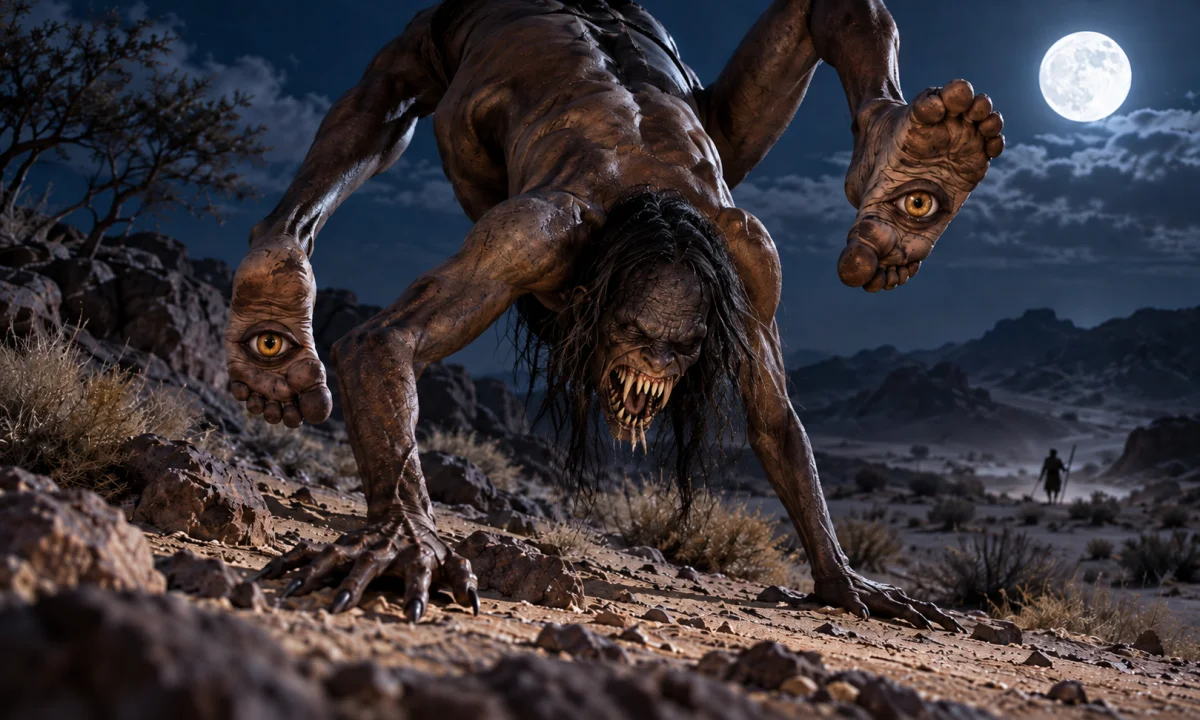
Aigamuxa is a monstrous being associated chiefly with Khoekhoe—historically called Khoikhoi—folklore from southern Africa. It is commonly described as a predatory humanoid or ogre whose eyes are located in the soles or insteps of its feet. To see its surroundings, the creature must raise a foot above its body or bend down in an awkward position. This unusual anatomy makes the Aigamuxa frightening but also vulnerable, since its attention is easily disrupted while it tries to locate its prey.
The Aigamuxa is not a god, ancestor or universally defined spirit. In the traditions and written records in which it appears, it belongs more closely to the category of a dangerous monster or cannibalistic ogre. Details vary considerably, and the surviving information comes largely through accounts written down by outsiders rather than through a single authoritative Khoekhoe text. Its name, spelling, geographical distribution and precise identity are therefore not completely certain.
Origins and cultural setting
The Aigamuxa is connected with the indigenous peoples of the southwestern regions of Africa, especially communities historically identified as Khoekhoe in what is now South Africa and Namibia. “Khoekhoe” is a modern form used for a people whose language and cultural traditions were often described in older European sources by the term “Hottentot.” That older label is now generally avoided because of its colonial history and derogatory associations.
Khoekhoe traditional culture included stories about animals, ancestral figures, dangerous beings and supernatural powers associated with the landscape. Such stories were transmitted orally, and their forms could change between communities, storytellers and periods. European missionaries, travellers and ethnographers began recording parts of these traditions during the colonial era, but their descriptions were shaped by translation, the expectations of the recorder and the limited context in which stories were collected.
There is no known sacred scripture or single canonical mythology that fixes one official account of the Aigamuxa. A description in one collection should not automatically be treated as a belief shared by every Khoekhoe community. Some accounts may also preserve fragments of older stories whose original setting, language or meaning is no longer recoverable with confidence.
The name and identity of the being
The name appears in several spellings, including Aigamuxa and forms such as Aigamuchab. Variations are partly the result of attempts to represent Khoekhoe sounds through European writing systems. The exact meaning of the name is not securely established in general reference material, and proposed explanations should be treated cautiously.
Older accounts sometimes use broad categories such as “monster,” “giant,” “ogre” or “man-eater.” These labels are convenient in English but do not necessarily correspond to a precise indigenous category. Calling the Aigamuxa an ogre conveys its threatening and predatory character, yet it can obscure the fact that traditional classifications of supernatural beings do not always match European folklore categories.
The Aigamuxa should also not be assumed to be a single, fully standardized character. In one retelling it may be a solitary creature encountered in the wilderness; in another, the name may refer more generally to a kind of dangerous being. Because the evidence is fragmentary, it is safer to describe the Aigamuxa as a figure in Khoekhoe-related folklore rather than as a universally defined mythological personage.
Appearance and unusual eyes
The most distinctive feature of the Aigamuxa is the position of its eyes. They are usually said to be located on the soles, undersides or insteps of the feet. The creature cannot see normally while standing or running. Instead, it must lift one leg high, turn the foot toward its face or lower its body in order to look through the eyes.
This image creates a striking combination of horror and absurdity. The Aigamuxa is dangerous because it hunts people, but its body is poorly suited to ordinary movement and observation. A person being pursued may gain time whenever the creature has to stop, raise a foot and search for its direction. The monster’s strange anatomy thus supplies both the central threat and the means by which a clever human may escape.
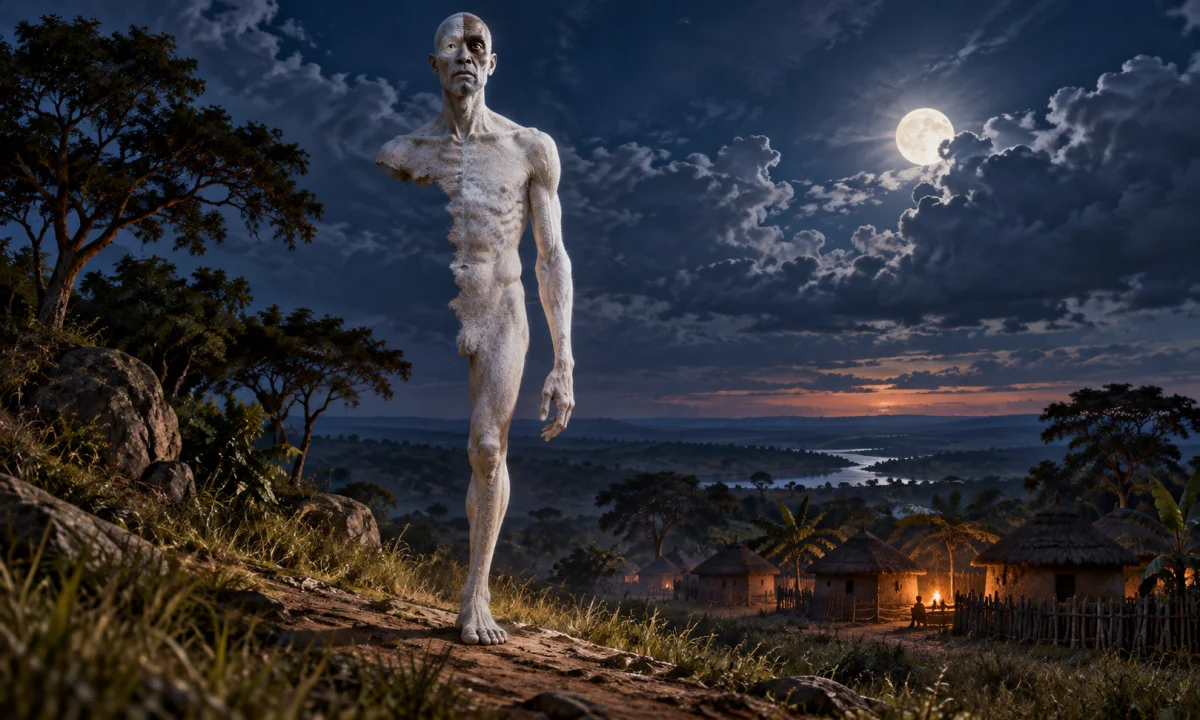
Descriptions of the rest of its body are less consistent. It is commonly treated as humanoid, large or physically formidable, but details such as hair, claws, teeth, clothing and exact size differ between retellings and later summaries. Modern illustrations often give it the exaggerated proportions of a giant or demon, although those visual details should not be mistaken for stable features of the older tradition.
Predatory role and behaviour
The Aigamuxa is generally portrayed as hostile to human beings and capable of devouring them. Its danger belongs to the same broad narrative world as other folklore monsters that inhabit remote places, travel at night or prey on people who become isolated. It is not normally presented as an object of worship or as a being approached for protection.
The creature’s eyesight is central to its behaviour. It may pursue a person by running or searching, then halt to raise a foot and inspect the surrounding ground. Since the eye is in the foot, the monster’s method of seeing exposes it to deception and delay. A target who understands the creature’s weakness may hide, change direction or use the moment of confusion to escape.
Some retellings emphasize the Aigamuxa’s appetite and physical threat more strongly than its comic weakness. Others make the poor vision the main point of the story. These differing emphases may reflect the normal flexibility of oral storytelling, but they may also result from later summaries that have condensed longer narratives into a single memorable image.
Stories and narrative patterns
The best-known narrative pattern involves a human traveller or group encountering the monster and realizing that it cannot see in an ordinary way. The Aigamuxa pursues its victims, but must repeatedly lift a foot to locate them. The people survive by taking advantage of this limitation rather than by overpowering the creature.
Exact story details are not sufficiently consistent to establish one definitive Aigamuxa legend. In particular, claims about a fixed habitat, a named enemy, a specific family relationship or a single standard method of killing the creature should be treated with caution unless tied to a clearly identified version. General summaries often combine material from different retellings or expand a brief ethnographic description into a complete adventure.
The landscape associated with the creature is often imagined as open, dry or difficult terrain, consistent with the environments of the Khoekhoe cultural region. However, the Aigamuxa should not be assigned a single permanent lair merely because later illustrations place it in a desert or among sand dunes. The broad association with dangerous wilderness is more secure than any precise map location.
Symbolism and interpretation
The Aigamuxa’s backward or misplaced eyes make it a powerful image of defective perception. It possesses a sensory ability, but that ability is inconveniently located and cannot be used without interrupting movement. The monster can therefore be understood as a figure of confusion: it is strong and threatening, yet unable to understand its surroundings in a practical way.
Its weakness also gives the stories a strong element of intelligence overcoming brute force. A person faced with a larger and more powerful being does not need superior strength. Careful observation of the monster’s habits is enough to create an opportunity. This pattern is common in folklore throughout the world, but the Aigamuxa’s foot-eyes give it a particularly vivid form.
The creature may also represent the danger of unfamiliar places. A wilderness story does not need to define the monster as a religious demon in order to express real concerns about travel, isolation, darkness and vulnerability. The Aigamuxa turns those concerns into a memorable bodily image. Its unusual anatomy makes the threat recognizable while preserving the possibility of survival through alertness.
Interpretation should nevertheless remain modest. There is no single established symbolic explanation that can be applied to all versions. It is possible to discuss themes of perception, cleverness and danger without claiming that every storyteller intended the Aigamuxa as an allegory for one particular social or religious idea.
Relationship to other Khoekhoe beings
The Aigamuxa is sometimes confused with other beings from Khoekhoe and neighbouring southern African traditions, especially figures described in English as giants, cannibals or monsters. Similarity in translation does not prove identity. A creature that is a dangerous ogre in one story may be a distinct figure from a monster with a different name, body or narrative function.
One figure frequently mentioned in discussions of southern African mythology is Ga-gorib, also rendered in other spellings. Ga-gorib is associated with a separate monster tradition and should not automatically be treated as another name for the Aigamuxa. Both may be described in broad English terms such as “man-eating monster,” but their distinguishing features and stories are not interchangeable.
Nor should the Aigamuxa be merged with every African being that has unusual eyes or a predatory nature. African mythologies contain many distinct traditions, and the continent is not a single cultural system. The Aigamuxa belongs to a specific southern African context, even though the figure has sometimes been presented in modern fantasy as a generic “African monster.”
Sources and limits of the surviving record
Knowledge of the Aigamuxa comes primarily from oral tradition as recorded in colonial and later reference works. This creates several interpretive problems. A collector may have translated a local term into a familiar European category, omitted ritual or narrative context, or recorded only the features that seemed unusual to an outside audience. Spellings could also vary because Khoekhoe sounds were represented inconsistently.
The written record should therefore be distinguished from the original living tradition. A nineteenth-century description is evidence that a name or story was recorded at a particular time; it is not proof that every Khoekhoe community recognized the same being, or that the recorded form had remained unchanged for centuries. Modern encyclopaedia entries frequently repeat a short description, which can give the Aigamuxa an appearance of certainty that the underlying evidence does not fully support.
There is also a difference between cultural continuity and modern classification. A traditional community may preserve, reinterpret or discontinue a story without fitting it into the categories used by mythology websites or fantasy bestiaries. The label “African mythology” is useful for organizing information, but it should not conceal the local and historically specific setting of the figure.
Modern reception
The Aigamuxa’s unusual anatomy has made it attractive to modern fantasy writers, illustrators and role-playing games. In these settings, the figure may be turned into a combat opponent with standardized abilities, statistics, a fixed habitat or a detailed life cycle. Such adaptations often preserve the foot-eyes while adding features that are not securely documented in Khoekhoe folklore.
These modern versions belong to popular culture rather than to the traditional record. They can introduce the name to new audiences, but they should not be used as evidence for the creature’s original religious or cultural meaning. The traditional Aigamuxa is best understood as a dangerous folkloric being whose memorable weakness is inseparable from its threat: it hunts humans, yet can see only by placing a foot where an eye ought to be.