WORLD

Aethalides
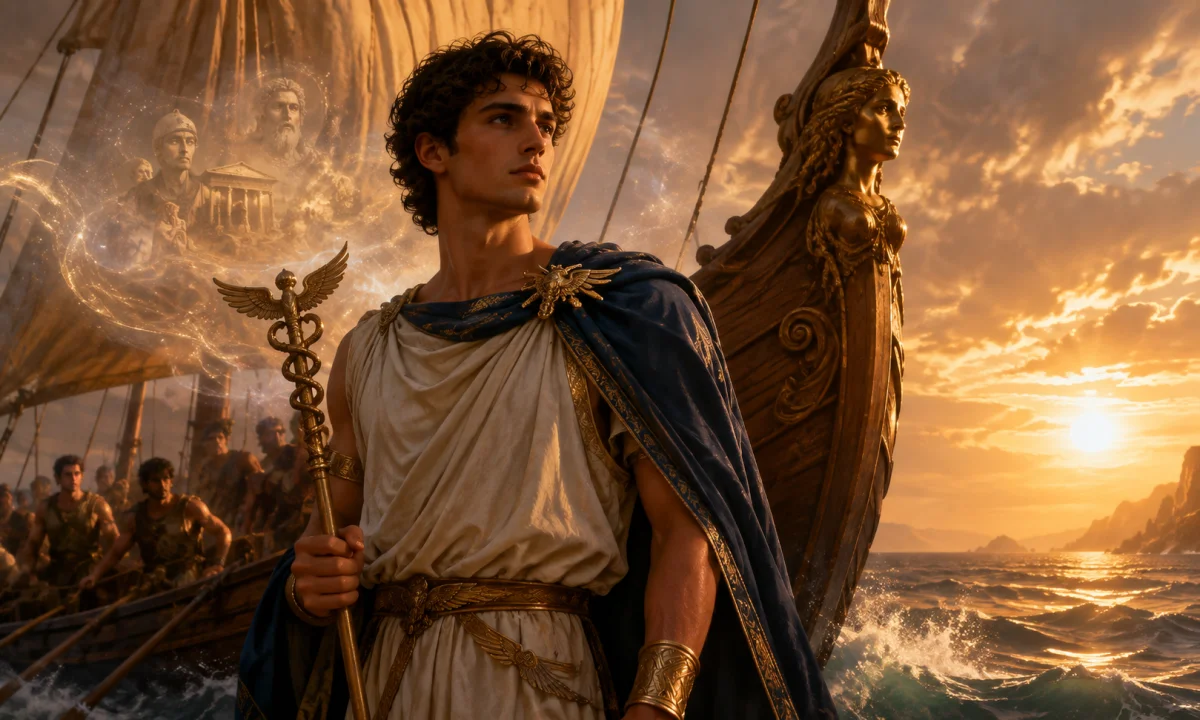
Aethalides is a minor but distinctive figure in Greek mythology, best known as an Argonaut and as the possessor of extraordinary memory. He was regarded as a son of the god Hermes and a mortal woman, and his exceptional ability allowed him to remember events even after death. In later Pythagorean tradition, Aethalides became the first in a succession of incarnations that eventually led to the philosopher Pythagoras.
Unlike many famous Argonauts, Aethalides is not primarily remembered as a great warrior. His importance lies in his role as a herald, his connection with Hermes, and the unusual idea that personal memory could survive death and continue across different lives. The surviving accounts are brief, and some details vary between mythological and philosophical traditions.
Origins and family
Aethalides was said to be the son of Hermes, the god associated with communication, travel, trade, boundaries, cunning and the movement of souls between the worlds of the living and the dead. His mother was usually named Eupolemeia, a mortal woman connected with Thessaly. Some accounts describe her as the daughter of Myrmidon, the ancestor of the Myrmidons, although the exact details of her genealogy and the location of Aethalides’ birth are not entirely consistent.
His divine father helps explain his later position as a herald. In Greek myth, children of gods are not automatically immortal or fully divine. Aethalides appears instead as a mortal heroic figure with a remarkable inherited quality. His association with Hermes does not make him a second Hermes, and the ancient traditions do not present him as a god with an independent sphere of worship.
The fullest surviving account of Aethalides as an Argonaut appears in the Argonautica of Apollonius Rhodius, a Hellenistic epic about Jason and the voyage of the Argo. The poem draws on older heroic traditions, but it is the principal narrative source for Aethalides’ part in the expedition. Later mythographers and writers concerned with Pythagoras preserve or develop other aspects of his story.
Name and identity
The name is commonly written Aethalides in English, although Aithalides and other transliterations also occur. The ancient Greek name is sometimes connected with words associated with smoke, soot or burning. That proposed meaning may explain the form of the name, but it does not produce a clear mythological attribute. Aethalides is not described as a fire spirit, a smoky demon or a being made of ash.
He should be understood as a single heroic figure whose story later became connected with the doctrine of reincarnation. In the Argonautic tradition, Aethalides is a mortal son of Hermes and a member of the expedition. In Pythagorean tradition, the name identifies an earlier existence remembered by the soul that later became Pythagoras. These traditions overlap, but they should not be treated as if they were originally one fully developed biography.
Aethalides among the Argonauts
Aethalides joined Jason and the other heroes on the voyage of the Argo. The expedition was undertaken to retrieve the Golden Fleece from Colchis, on the eastern shores of the Black Sea. The crew included figures such as Heracles, Castor and Polydeuces, Orpheus, Peleus and Telamon, although the membership of the Argonaut group varies between ancient lists.
In the Argonautic account, Aethalides served as the expedition’s herald. A herald was more than a person who made public announcements. Heralds carried messages, communicated formal demands or agreements, and helped preserve order during assemblies and diplomatic encounters. Their work involved speech, memory, protocol and movement between different groups. These responsibilities were especially appropriate for a son of Hermes.
The ancient poem does not give Aethalides a long sequence of individual adventures. He is not assigned the central tasks given to Jason, nor is he presented as a champion comparable to Heracles. His presence in the crew is nevertheless meaningful. The Argonauts required not only fighters but also sailors, prophets, musicians, craftsmen, interpreters and messengers. Aethalides represents the communicative and diplomatic skills necessary for a large heroic undertaking.
His most important characteristic is introduced in connection with his role. Aethalides possessed a memory that did not fail. This quality allowed him to retain what he had seen and heard, making him an ideal herald. In an oral culture, where information was transmitted through speech and performance, extraordinary memory had practical and almost sacred significance. It could preserve agreements, genealogies, instructions and accounts of distant events.
The gift of unforgetting memory
According to the best-known version of the myth, Aethalides asked Hermes for the ability to remember everything. The request did not make him immortal. Instead, it gave him memory that continued beyond the ordinary limits of mortal life. He could remember what had happened while alive and could retain awareness even after entering the realm of the dead.
This distinction is important. Aethalides did not escape death, and he was not transformed into an immortal god. His extraordinary gift concerned continuity of memory, not freedom from mortality. The story therefore treats death as a change of condition rather than the complete destruction of personal knowledge.
Greek mythology often portrays the dead as deprived of ordinary identity or knowledge. In many traditions, the underworld is a place where the dead exist in diminished form, and forgetting can be associated with death. Aethalides presents an unusual reversal of that pattern. His identity remains active because he remembers. The gift granted by Hermes makes him exceptional not through physical strength but through the preservation of consciousness.
The connection with Hermes adds further significance. Hermes was associated with boundaries and transitions, including the passage between the living world and the underworld. Aethalides’ ability to retain memory across death places him symbolically close to those transitions, although the ancient texts do not describe him as a psychopomp or as an independent guide of the dead.
Aethalides and reincarnation
Aethalides became especially important in later accounts of Pythagoras. Pythagorean tradition taught, or was commonly said to teach, that the soul could pass from one body into another. This process is often called metempsychosis, meaning the transfer or movement of a soul from one body to another. Ancient writers associated this doctrine with Pythagoras and with certain earlier religious and philosophical traditions.
In stories about Pythagoras’ memory of previous lives, Aethalides was described as the soul’s first remembered existence. After the death of Aethalides, the same soul was said to have appeared in other forms. The sequence most often associated with the tradition includes Euphorbus, a Trojan warrior; Hermotimus of Clazomenae; and Pyrrhus, before the soul became Pythagoras.
The sequence is not a universally accepted part of Greek mythology, and ancient accounts differ in their presentation. It belongs particularly to later philosophical and biographical traditions concerning Pythagoras. The identification of Aethalides with the earlier life of Pythagoras should therefore be described as a Pythagorean claim or legend, rather than as an uncontested belief shared by all Greek mythographers.
The story depends on Aethalides’ original gift. If the soul could retain complete memory, then a later incarnation could recognize or report its earlier identities. In most beliefs about reincarnation, previous lives are forgotten. Aethalides is unusual because his continuity across lives is defined precisely by remembering them.
Euphorbus and the Trojan connection
One of the best-known later identities associated with Aethalides is Euphorbus, a Trojan fighter who took part in the Trojan War. In the Iliad, Euphorbus is connected with the death of Patroclus and is later killed by Menelaus. Pythagorean tradition claimed that Pythagoras recognized the shield or identity of Euphorbus and declared that he had once been that warrior.
This does not mean that Euphorbus and Aethalides are two versions of the same character in the ordinary Trojan and Argonautic narratives. Within the Trojan epic, Euphorbus is a mortal Trojan warrior with his own family and battlefield story. The connection between him and Aethalides is created by the later theory of a soul passing through multiple bodies.
That distinction also prevents confusion between two different kinds of myth. The Argonautic story explains who Aethalides was and why he had extraordinary memory. The Pythagorean story uses that memory to support a philosophical claim about the persistence and migration of the soul. The second tradition reinterprets the first rather than simply repeating it.
Attributes and symbolism
Memory
Memory is Aethalides’ defining attribute. It is not merely a convenient skill but the central feature of his identity. His memory makes him effective as a herald, preserves his knowledge after death, and enables the later accounts of reincarnation. He is one of the clearest figures in Greek tradition through whom memory becomes a supernatural power in its own right.
The story also reflects the importance of memory in ancient heroic culture. Before widespread literacy, knowledge depended heavily on trained recollection. A person able to remember names, promises, routes and events could serve as a living record. Aethalides turns this practical function into a metaphysical one: the reliable memory of a herald becomes memory that crosses the boundary of death.
Speech and mediation
As a herald, Aethalides belongs to the world of formal speech and mediation. He stands between individuals or communities and carries information from one place to another. This role has a natural relationship with Hermes, whose powers include communication, travel and boundary crossing.
The surviving sources do not provide a fixed visual appearance, special weapon or unique emblem for Aethalides. It is therefore unsafe to assign him the winged sandals, herald’s staff or other standard attributes of Hermes as though they were specifically his. His connection with those symbols is thematic and genealogical, not a securely recorded description of his own appearance.
Mortality and continuity
Aethalides represents a tension between mortality and persistence. He dies like other heroes, yet his memory remains intact. In the Pythagorean development of the story, even the body changes while the remembered identity continues. This makes him relevant to ancient questions about what constitutes the self: the body, the soul, memory or an unbroken chain of experience.
The myth does not offer a systematic theory of reincarnation. It is better understood as a legendary example later used in discussions of the soul. Philosophers and biographers could point to Aethalides as a memorable figure through whom the possibility of surviving death with personal awareness could be imagined.
Interpretation and cultural significance
Aethalides is a small figure in the broad landscape of Greek mythology, but his story links several important themes. His divine parentage connects him with Hermes; his public role connects him with the social importance of heralds; and his exceptional memory connects heroic legend with philosophical speculation.
His story also shows how Greek myths could be adapted to different intellectual settings. In the Argonautic epic, Aethalides is part of a heroic crew and is characterized by a useful supernatural gift. In Pythagorean tradition, he becomes evidence for the survival and migration of the soul. The same figure can therefore function both as a participant in an adventure story and as an example in a theory of personal identity.
Modern interpretations sometimes describe Aethalides simply as an immortal or as an early incarnation of Pythagoras. Both descriptions require qualification. He was not immortal in the usual Greek sense, since he died. His continuing existence depended on memory and, in later philosophical tradition, on the movement of the soul into other bodies. The Pythagorean identification is an ancient interpretive tradition, not a universally established feature of the Argonaut myth.
Distinguishing Aethalides from similar figures
- Aethalides and Hermes: Aethalides is the mortal son of Hermes in the principal tradition. He is not another name for Hermes and does not possess the full divine status or range of powers of his father.
- Aethalides and Euphorbus: Euphorbus is a Trojan warrior in the Iliad. The two are connected only through the later Pythagorean claim that the same soul inhabited both bodies.
- Aethalides and Pythagoras: Pythagoras is the historical Greek philosopher traditionally associated with metempsychosis. The claim that he had previously been Aethalides belongs to ancient biographical and philosophical legend.
- Aethalides and other Argonauts: He is not usually a principal fighter or leader of the expedition. His recognized function is that of herald, supported by his exceptional memory.
- Aethalides and fire or smoke beings: The possible meaning of his name does not make him a fire deity, elemental spirit or demon. No established myth gives him a smoky appearance or fire-based powers.
Later reception
Aethalides has had little independent presence in modern popular culture compared with Jason, Medea, Heracles or Orpheus. When he appears in modern discussions, he is usually mentioned in connection with Pythagoras, reincarnation or ancient ideas about memory. His story is therefore more significant in the history of Greek religious and philosophical thought than in modern fictional adaptation.
The figure remains valuable because his myth preserves an unusual idea: a herald whose message is not merely carried from one person to another, but carried from one existence to the next. In Aethalides, the ancient traditions make memory the power that links heroic life, death and the possibility of another body.