WORLD
WORLD
Adonis
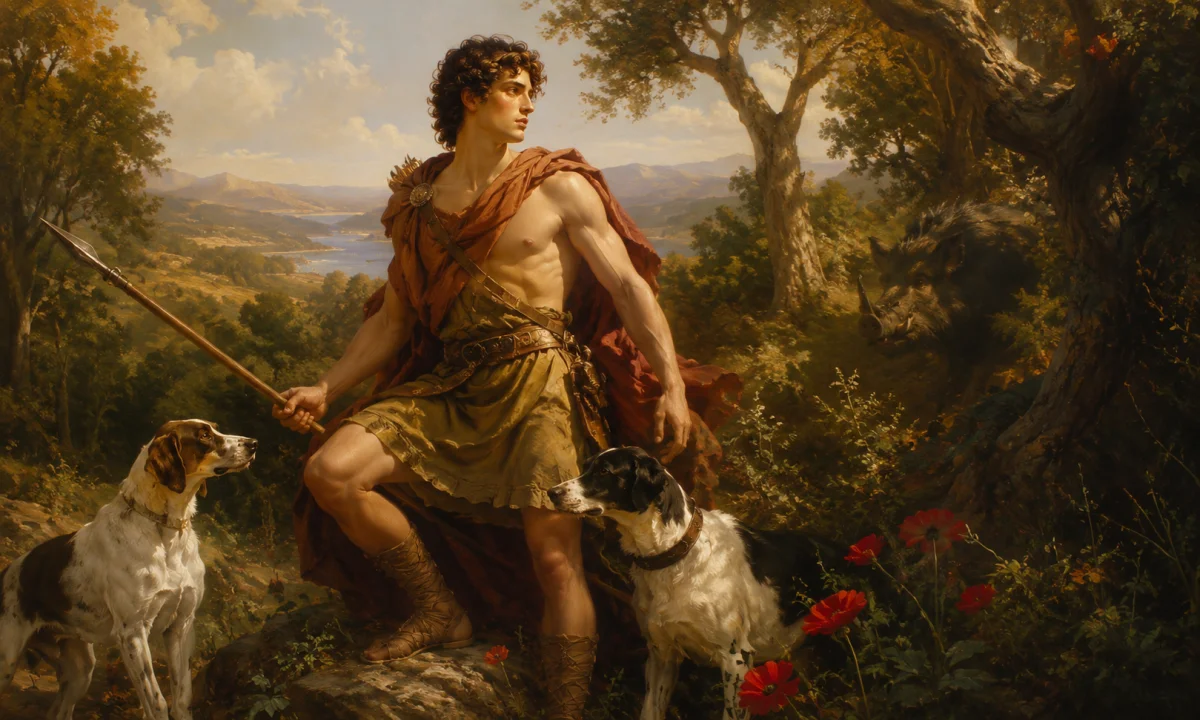
Adonis is a figure of Greek mythology associated with extraordinary beauty, erotic desire, hunting and untimely death. His story became especially influential in Greek and Roman literature, but his name and some features of his cult point toward older traditions from the eastern Mediterranean and the Near East. In surviving Greek versions, Adonis is primarily a beautiful young hunter loved by Aphrodite, the goddess of desire, whose death causes profound mourning.
Origins and cultural setting
Adonis belongs to a group of myths shaped by contact between Greek-speaking communities and the cultures of the Levant. The name Adonis is generally connected with the Northwest Semitic word ’adōn, meaning “lord.” In ancient Semitic religious language, related forms could function as titles for gods, not necessarily as the personal name of one specific deity. The Greek form Adōnis appears to have developed from this eastern title or name.
Greek traditions present Adonis as an individual in a mythic genealogy, while his wider cultural background is more complex. Some scholars have compared him with the Mesopotamian god Dumuzi, known in Akkadian as Tammuz, and with other Near Eastern figures connected with mourning, seasonal change and divine or royal death. These comparisons are historically important, but Adonis should not simply be treated as Tammuz under a Greek name. The surviving evidence comes from different cultures and periods, and the similarities do not prove that all these figures were identical.
The earliest surviving Greek references to Adonis are fragmentary. The poet Sappho refers to the mourning of Aphrodite for Adonis, showing that the story or cult was known on the Greek island of Lesbos by the archaic period. Later literary accounts preserve more complete versions, especially the Bibliotheca attributed to Pseudo-Apollodorus, Ovid’s Metamorphoses and the Greek poet Bion’s Lament for Adonis. These sources do not form one fixed canonical account. Details of Adonis’s birth, his relationship with the gods and the cause of his death vary between traditions.
The name and identity of Adonis
In Greek mythology, Adonis is usually described as a mortal youth rather than an Olympian god. His beauty is so remarkable that Aphrodite becomes deeply attached to him. In some literary and religious contexts, however, his death and ritual mourning give him a significance that reaches beyond the role of a handsome mortal character.
The word “Adonis” was also used in Greek and later European languages as a common comparison for an exceptionally attractive man. This figurative use comes from the mythic image of the beautiful youth, not from a separate ancient being. It should not be confused with Adonai, a Hebrew form of address for God. The words are related linguistically through the Semitic root for “lord,” but they belong to different religious and linguistic contexts.
Nor was Adonis simply a god of beauty. Ancient sources associate him with desire, fertility and death, but they do not consistently assign him one narrowly defined function. Modern descriptions sometimes call him a “dying-and-rising god,” yet this formula must be used carefully. In the best-known Greek accounts, Adonis dies and is mourned; he is not clearly described as returning permanently to life in the manner implied by some modern summaries.
Birth and the myrrh tree
One of the most widespread Greek stories explains Adonis’s unusual birth through a woman named Myrrha, also called Smyrna in some versions. She is usually described as the daughter of Cinyras, king of Cyprus, although the names and relationships differ among sources. Through divine punishment, deception or an overwhelming passion, Myrrha becomes involved in an incestuous relationship with her father. The story is tragic and disturbing, and ancient authors present it as a transgression rather than a model of human conduct.
In Ovid’s account, Myrrha’s desire is brought about by divine influence connected with Venus, the Roman counterpart of Aphrodite. Myrrha disguises herself and visits her father without revealing her identity. When the truth becomes known, she flees in shame and terror. The gods transform her into a myrrh tree. After a period of pregnancy, the infant Adonis emerges from the tree, often with the help of a divine figure or by the opening of the trunk.
Other Greek accounts give different explanations for the birth. Some connect the child with a conflict between Aphrodite and another woman, or with the pride of Adonis’s mother. These versions share the image of birth from a tree or plant but do not always agree on the mother, father or exact cause of the transformation. The myrrh tree is significant because myrrh was a valuable aromatic substance used in ritual, medicine and burial practices. Its association with Adonis links his birth to both sensual luxury and mortality.
Adonis is sometimes said to have been raised by Aphrodite, who hid him in a chest or container and entrusted him to Persephone, queen of the underworld. When Persephone saw the child’s beauty, she did not wish to give him back. The dispute between the two goddesses required a judgment by Zeus or, in some versions, by another authority. The solution divided Adonis’s time between Aphrodite and Persephone. Later retellings differ over the exact length and arrangement of these periods.
Aphrodite and the love of Adonis
As he grows, Adonis becomes the beloved of Aphrodite. Their relationship is one of the most recognizable elements of the myth, but it is not merely a romantic story. Aphrodite represents sexual attraction, beauty and generative desire, while Adonis represents youthful physical perfection that is vulnerable to sudden destruction.
Aphrodite warns Adonis against dangerous animals, especially those that might attack him while hunting. In some versions, she asks him to avoid the boar because she knows that his courage and love of the chase may place him in danger. Adonis nevertheless goes hunting. The warning may be ignored because of youthful confidence, because Aphrodite is absent, or because a hostile divine power has arranged the attack.
Some traditions say that the boar was sent by Ares, the god of war and Aphrodite’s other lover, who was jealous of Adonis. Other versions identify the animal with Apollo, or do not explain its origin at all. The idea that Ares became a boar is famous in later retellings, but it is not a universal feature of the ancient myth.
The death of the hunter
Adonis is fatally wounded by a boar during the hunt. The animal may gore him with its tusks or tear him with its teeth, depending on the version. Aphrodite arrives too late to save him and mourns over his body. In Ovid’s narrative, she transforms the blood of Adonis into the anemone flower. The delicate flower’s brief life and vulnerability to wind make it an appropriate emblem of beauty that cannot endure.
Other versions connect the blood of Adonis with red flowers more generally, and later writers do not always preserve the same botanical identification. The Greek word used in some accounts has been interpreted in different ways, and ancient plant names do not map neatly onto modern botanical categories. The important mythic point is the transformation of death into a short-lived bloom.
Aphrodite’s grief is central to the story. She injures herself on thorns while rushing to Adonis, and the myth explains the red colour of roses by associating it with her blood. This detail belongs particularly to later poetic elaboration and should not be assumed to be present in every ancient form of the tale.
Because Persephone has a claim on Adonis from the time of his childhood, the dead youth is linked once more with the underworld. Some accounts say that he spends part of each year with Persephone and the rest with Aphrodite. This arrangement creates a mythic rhythm of absence and return, but the sources do not all describe it in the same way. The division of Adonis’s time may help explain why later interpreters connected him with seasonal cycles, although ancient evidence does not support reducing the whole myth to a simple allegory of vegetation.
The cult of Adonis
Adonis was honoured in the Adonia, a mourning festival observed in parts of the Greek world. Women played a prominent role in the rites described by ancient writers. The ceremonies included lamentation for the dead youth, displays of small rapidly growing plants and expressions of grief that emphasized the shortness of life and desire.
These plants are often called the “gardens of Adonis.” Seeds were placed in shallow containers, baskets or fragments of pottery and encouraged to sprout quickly. Because the plants grew rapidly and then withered, they provided a vivid ritual image of Adonis’s brief life. The gardens should not automatically be interpreted as a universal symbol of resurrection. Their rapid growth and decay may instead have emphasized transience, erotic longing and the unstable nature of human prosperity.
Ancient descriptions of the Adonia suggest that the festival could involve music, lamentation, processions and the carrying of images or symbols associated with the dead youth. The exact form of the rites varied by place and period. Evidence for the festival is stronger in literary and historical references than in a single, complete ritual description, so details should not be treated as identical across all Greek communities.
The cult was especially associated with women’s religious activity, although this does not mean that it was exclusively or uniformly practiced by women everywhere. Some ancient male authors describe the festival with curiosity or disapproval, reflecting their own social assumptions. Their accounts are valuable but must be read as observations shaped by gender, class and cultural perspective.
Adonis and Near Eastern traditions
The connection between Adonis and the Near East is clearest in the name and in the prominence of mourning rites. The Greek world had longstanding contact with Cyprus, Phoenicia, Syria and other regions of the eastern Mediterranean. Cyprus, in particular, was an important centre of Aphrodite’s worship and is frequently connected with Adonis in mythic genealogies.
Adonis is often compared with Tammuz, a Mesopotamian god whose death was mourned in ancient rituals. Tammuz himself belongs to a much older and distinct religious tradition involving the goddess Inanna or Ishtar, the underworld and the loss of a divine or semi-divine consort. The comparison may reflect the movement and adaptation of religious ideas across the Near East and Mediterranean, but it does not establish that Greek Adonis and Mesopotamian Tammuz were the same figure.
Similar caution applies to comparisons with Attis, a figure associated with the Phrygian and later Roman cult of Cybele. Attis, Adonis and Tammuz all became subjects of modern theories about dying vegetation gods, but their myths, rites and historical settings are not interchangeable. Ancient people could recognize resemblances among religious figures without treating them as identical, and modern scholarship continues to debate how much direct influence connected these traditions.
Symbolism and interpretation
Adonis’s myth brings together several tensions: desire and danger, youth and death, cultivated beauty and wild nature, and the rivalry between the upper world and the underworld. He is loved because he is beautiful, yet his beauty does not protect him. His skill and courage as a hunter expose him to the animal world, while his relationship with Aphrodite places him within a network of divine jealousy and competition.
The story also explores the limitations of divine power. Aphrodite is a goddess of desire, but she cannot preserve the mortal she loves. Persephone rules the dead, yet she cannot keep Adonis entirely for herself. Their dispute produces a temporary arrangement rather than a complete victory. The result is emotionally powerful because neither love nor divine authority can eliminate mortality.
Interpretations that describe Adonis as a symbol of vegetation or the seasonal year are influential, especially in older comparative studies of religion. They can illuminate the imagery of flowers, gardens and annual mourning, but they should not replace the evidence of the individual myths and rituals. Adonis is also a figure of erotic beauty, social performance, female religious expression and the cultural exchange between Greece and the Levant.
Adonis in later literature and art
Roman poets adapted the story under the name Adonis or through the Roman name Venus for Aphrodite. Ovid’s account in the Metamorphoses became particularly important in European literature because it combines the tragic birth of Adonis, his love affair with Venus, the warning about the hunt and the transformation of his blood into a flower. Medieval and Renaissance writers and artists often treated the myth as a story of beauty, desire and mortality.
In Renaissance and later European art, Adonis is commonly shown as a youthful hunter accompanied by hounds, with Venus attempting to restrain him or mourning beside his wounded body. These images often emphasize romantic love more strongly than the ancient festival tradition. The familiar visual type of the handsome, nearly idealized young man derives from classical art and later artistic conventions rather than from one consistent ancient description of his appearance.
Modern language retains the name as a metaphor for a very handsome man. Contemporary novels, paintings, films and other adaptations may also reinterpret Adonis as a symbol of male beauty, doomed youth or the conflict between erotic desire and mortality. Such uses draw on the classical tradition but are not themselves evidence for ancient beliefs about his cult or character.