WORLD
WORLD
Abe Mango
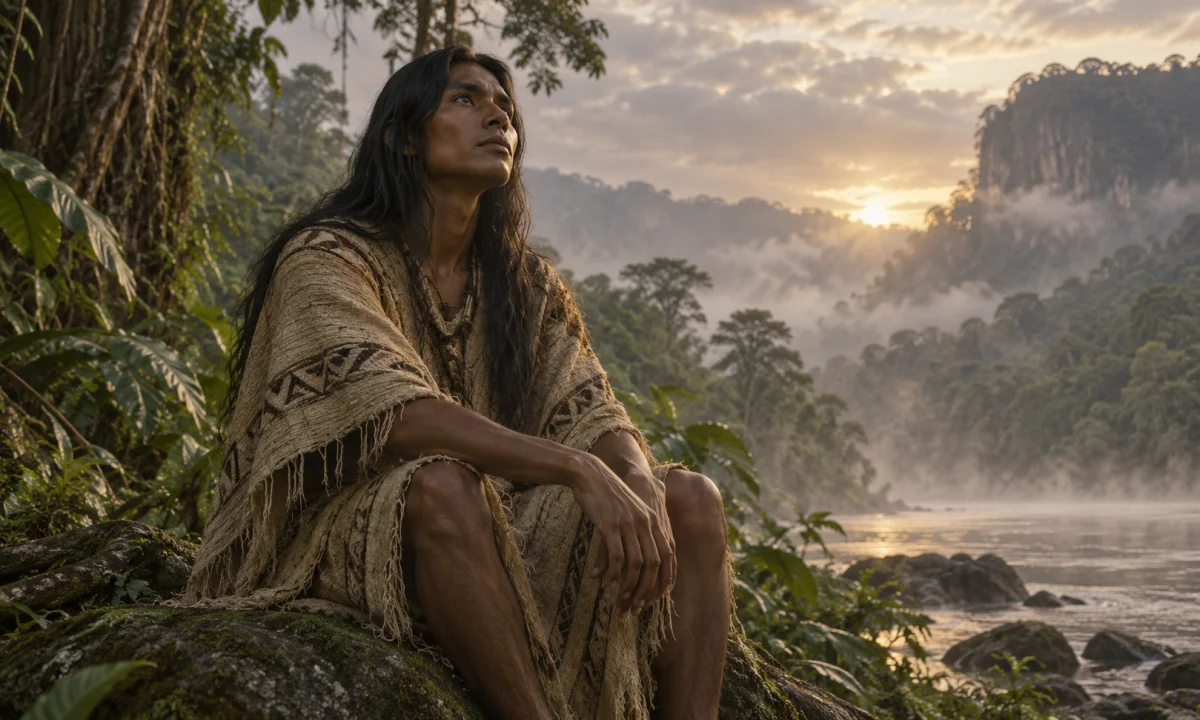
Abe Mango is an obscure and uncertain name associated in some modern lists with South American mythology. Unlike well-attested figures such as Yúcahu, Bochica, Makunaima or Supay, Abe Mango does not have a clearly documented identity in the major bodies of Indigenous myth recorded by historians, ethnographers and linguists. The name’s cultural origin, traditional spelling, community of worship and mythological role therefore remain unverified.
That uncertainty is important. South America contains hundreds of Indigenous nations and many oral traditions, most of which were recorded unevenly and often through colonial languages. A name may be altered when it is written down, translated, copied between reference works or detached from the community in which it was used. At the same time, a name appearing on a modern mythology website is not automatically evidence of an ancient deity. In the case of Abe Mango, the available information is too limited to establish a secure traditional biography.
Origins and cultural setting
No specific Indigenous people can be identified with confidence as the original custodians of a figure called Abe Mango. The name is sometimes placed broadly under South American mythology, but that regional label is not the same as a documented cultural attribution. South America is not a single mythological system: the traditions of the Andes, Amazonia, Guianas, Chaco, southern cone and Caribbean coast have different languages, histories and religious concepts.
Traditional knowledge in these regions was usually transmitted orally. Stories belonged to particular communities, ritual specialists, families or ceremonial contexts rather than to a single continent-wide catalogue of gods. Missionaries, colonial administrators and later folklorists often recorded names according to the spelling conventions of Portuguese or Spanish. A name could consequently acquire several forms, while an original word might be treated as a personal name even when it referred to a place, an animal, a spirit, a title or an event.
For Abe Mango, no securely attributable narrative, prayer, ritual description or Indigenous-language explanation is widely established. There is also no reliable basis for assigning the figure to a particular language family, such as Arawakan, Cariban, Tupian, Chibchan or Quechuan. Claims that present Abe Mango as a major creator, sun god, fertility deity or ancestral hero should therefore be treated cautiously unless they can be tied to a named community and a verifiable tradition.
The name “Abe Mango”
The spelling itself is uncertain. Forms such as Abe Mango, Abé Mango or Abe Mangó may appear in secondary material, but variation in accent marks does not establish that these are genuine traditional forms. It is also not known whether “Abe” and “Mango” are separate words in an Indigenous language, a personal name and epithet, or a transcription produced by a modern writer.
The word mango creates an additional difficulty. The mango plant originated in South Asia and reached the Americas after European maritime expansion. In many American languages, words for the fruit were therefore borrowed during the colonial or post-colonial period. That does not prove that Abe Mango is a recent invention: a traditional name could have been translated, adapted or reinterpreted later. It does mean that the apparent English or Spanish association with the fruit cannot by itself be used to identify an ancient pre-Columbian agricultural deity.
Nor should the name be interpreted automatically as “mango father,” “mango spirit” or “lord of the mango.” Such translations are speculative without grammatical evidence from the relevant language. Indigenous names frequently contain meanings that are invisible in a European transcription, and similar-looking syllables can have entirely different origins in unrelated languages.
Identity and classification
Abe Mango cannot presently be classified securely as a god, demon, ancestor, culture hero, nature spirit or legendary human. These categories are themselves imperfect when applied to Indigenous religions. A being may be treated as an ancestor in one context, a powerful spirit in another and a character in a sacred narrative in a third. European writers often used the word “god” for any supernatural figure, even when the community concerned had no equivalent category.
There is likewise no established evidence for a fixed appearance, gender, residence or domain. Descriptions sometimes repeated in unsourced summaries—such as a connection with creation, the forest, fruit, fertility or the sun—cannot be regarded as securely traditional merely because they sound compatible with common mythological themes. Similar roles occur throughout world mythology, and generic motifs are especially vulnerable to being attached to poorly documented names.
A careful classification is therefore uncertain or unattested in the surviving record. This does not demonstrate that no community ever used the name. Oral traditions may be known locally without appearing in academic publications, colonial archives or widely circulated collections. It does mean that a confident account of Abe Mango’s powers or stories would go beyond the evidence currently available.
Stories and attributes
No specific myth about Abe Mango can be securely identified as an established South American narrative. There is no dependable cycle of stories describing the figure’s birth, deeds, enemies, family or death, and no well-known ritual tradition that can be connected to the name without qualification.
It is consequently inappropriate to assign Abe Mango a standard set of attributes. The figure should not automatically be described as:
- a creator of the world or of humankind;
- a ruler of the dead or an underworld spirit;
- a deity of agriculture, rain, the sun or the moon;
- a guardian of mango trees or tropical forests;
- a hero who introduced fire, food or social customs; or
- a monstrous being who punishes people for breaking taboos.
All of these are familiar patterns in South American and wider mythology, but familiarity is not evidence. Assigning them to Abe Mango would turn a possibility into a false certainty. Where the name is discussed, the most accurate description is that its mythological role has not been adequately established.
Possible confusion with other names
The unusual form of the name makes confusion especially likely. It should not be merged with similarly spelled figures from other traditions. One possible source of confusion is Abaangui, also written in forms such as Abáangui in discussions of Guaraní mythology. Abaangui is a separate name belonging to a different and better-known body of material. Similar initial sounds do not demonstrate that Abe Mango is a variant of Abaangui.
Abe Mango should also not be confused with Indigenous figures whose names have been translated into terms such as “Father,” “Old Man,” “Lord of the Forest” or “Mango Spirit.” Translation can conceal major differences between traditions. A common descriptive phrase may be mistaken for a proper name, while a proper name may later be translated as though it were a title.
Nor is there a basis for identifying Abe Mango with major Caribbean or northern South American figures such as Yúcahu, Atabey, Guabancex, Bochica, Chiminigagua or Makunaima. These beings belong to distinct cultural and linguistic settings, and their stories are documented independently of the uncertain name Abe Mango.
Why uncertain figures appear in mythology lists
Modern catalogues of mythology often combine oral tradition, colonial records, folklore collections, popular encyclopedias and unsourced web material. Once an unusual name enters such a list, later writers may repeat it without checking its spelling or origin. A short description can then expand into a detailed profile, even though the added attributes were inferred rather than documented.
This process is particularly common for traditions outside Europe and the classical Mediterranean. A brief missionary note may be treated as a complete religious system, while the name of a local spirit may be presented as though it were the central deity of an entire people. The result is a misleading impression that every entry in a mythology catalogue has the same level of historical support.
The absence of a securely documented record for Abe Mango should not be used to dismiss Indigenous oral culture. Instead, it highlights the need to distinguish between community tradition, historical documentation, scholarly reconstruction and modern compilation. These categories overlap, but they are not interchangeable. A locally preserved story may be genuine even when it has not been published; conversely, a widely repeated internet description may have no identifiable traditional source.
Cultural significance of the uncertainty
Names with uncertain origins still reveal something about the modern circulation of mythology. They show how religious and folkloric material can be detached from its original language and setting, then reorganised into broad regional categories such as “South American mythology.” That process can make diverse traditions appear more uniform than they are.
In responsible cultural interpretation, uncertainty is not a weakness to be concealed. It protects against attributing beliefs to an Indigenous community without evidence and avoids turning a possible transcription error into a supposedly ancient doctrine. It also leaves room for future clarification if an Indigenous-language source, archival record or community-based account establishes what the name originally meant.
For now, Abe Mango is best treated as an unverified or very poorly documented mythological name, rather than as a securely identified South American deity. No definite origin, appearance, powers, relationships or canonical stories can be stated without risking invention. Any future account should begin by identifying the community, language and source behind the name before assigning it a place within a religious tradition.