WORLD
WORLD
Amana

Amana is commonly described in modern references as a rain goddess associated with Indigenous traditions of South America, especially the Tupian cultural world of Brazil and neighbouring regions. The identification is not as securely documented as better-known South American figures such as Pachamama, Viracocha or Tupã. Amana appears mainly in brief mythological summaries, while detailed traditional narratives, historical records and widely agreed descriptions are difficult to establish.
Origins and cultural setting
The name Amana is generally connected with Indigenous peoples whose languages and cultures belong to the wider Tupian sphere. “Tupian” does not refer to one single people or religion. It describes a large family of related languages and a broad cultural zone extending through much of Brazil and into parts of Bolivia, Paraguay, Peru and other neighbouring areas. Communities within this world have had distinct histories, beliefs and ritual practices, so a figure associated with one group should not automatically be treated as a universal Tupian deity.
Rain has profound importance in the religious traditions of tropical South America. It sustains crops, replenishes rivers, supports forest life and can also arrive as a destructive storm. For agricultural communities, the coming of rain is not merely a natural event but part of a larger relationship among humans, animals, plants, spirits and powerful beings. A rain-associated figure such as Amana therefore belongs to a religious context in which weather may be understood through moral, ritual and cosmological relationships.
Most surviving information about Indigenous South American religions was recorded by missionaries, colonial officials, travellers, ethnographers and later folklorists. These records are uneven and often describe beliefs through European categories such as “goddess,” “god,” “spirit” or “myth.” Oral traditions also change over time and differ between communities. As a result, an entry describing Amana as a single, clearly defined goddess may simplify material that was originally more varied.
The name Amana
The spelling Amana is not always used consistently. Related forms such as Amaná and Amanaci may appear in discussions of Indigenous rain traditions, although similar names should not automatically be assumed to refer to the same being. Differences in spelling can result from Portuguese or Spanish transcription, differences between Indigenous languages and the attempt to represent sounds that have no exact equivalent in European alphabets.
Some popular accounts connect the name with a word for rain or with a rain-bearing power. That interpretation is plausible in the context of the figure’s usual classification, but a precise etymology should not be treated as settled without identifying the language and community involved. A word that has one meaning in a particular Tupian language may have a different meaning, pronunciation or religious association elsewhere.
Amana is therefore best presented as a rain-associated mythological figure in some modern accounts of South American Indigenous tradition, rather than as a universally recognised goddess of all Indigenous peoples of the continent. The evidence does not support assigning her a single fixed genealogy, appearance or set of sacred titles across South America.
Role and religious significance
Where Amana is identified as a rain goddess, her central function is the provision or regulation of rainfall. This role places her within a system of seasonal dependence. Rain may make gardens fertile, fill streams, encourage the growth of forest plants and determine the success of hunting, fishing and agriculture. A being connected with rain could consequently represent both abundance and uncertainty.
Rain-making traditions in Indigenous South America often involve ritual specialists, songs, dances, offerings, sacred objects or appeals to powerful beings. It is not safe, however, to say that all such practices were directed specifically to Amana. There is no single continent-wide ritual system devoted to her, and available descriptions do not establish one standard ceremony associated with the name.
In a general symbolic interpretation, Amana may be understood as expressing the dependence of human life on forces beyond human control. Rain is generous when it comes at the right time, but excessive rain can damage crops, flood settlements or make travel dangerous. The religious meaning of a rain power is therefore not simply “fertility.” It can also involve balance, timing, danger and the need to maintain respectful relations with the non-human world.
The category “goddess” can itself be misleading. Many Indigenous traditions do not divide the sacred world according to the same categories used in classical European mythology. A powerful being may be treated as an ancestor, spirit, personified natural force, owner of a species or inhabitant of another level of the cosmos. Calling Amana a goddess is convenient for a comparative mythology catalogue, but it does not prove that the communities associated with the name understood her in precisely that way.
Appearance and powers
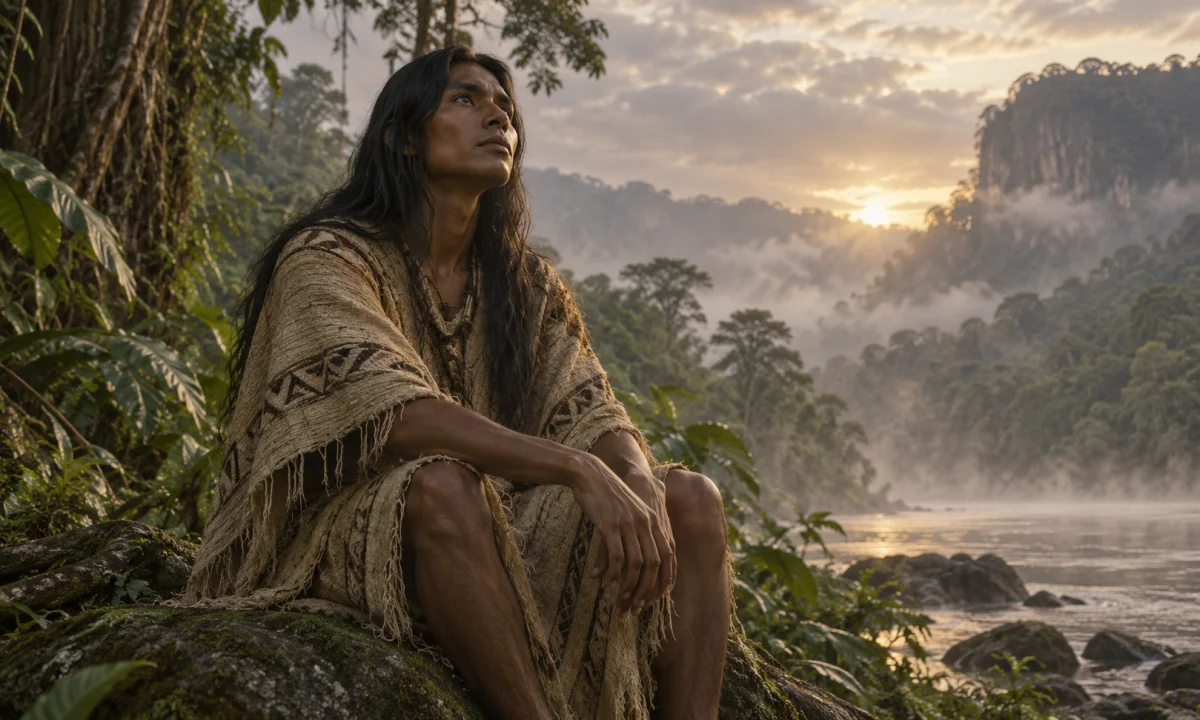
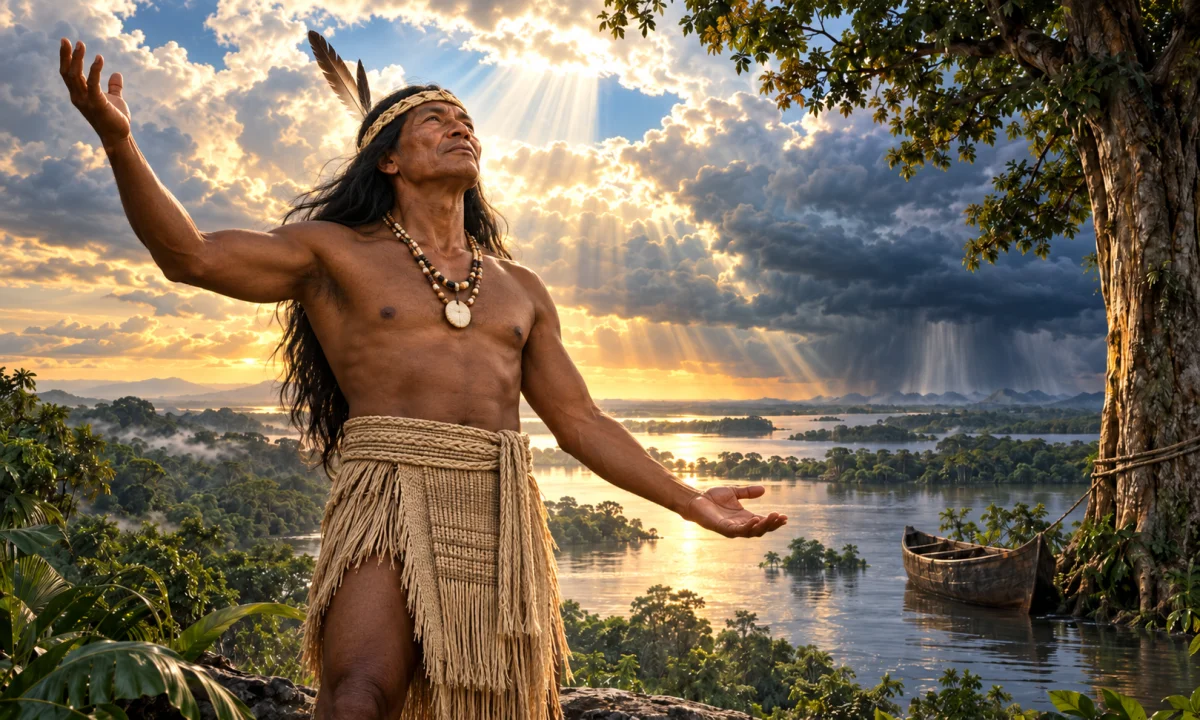
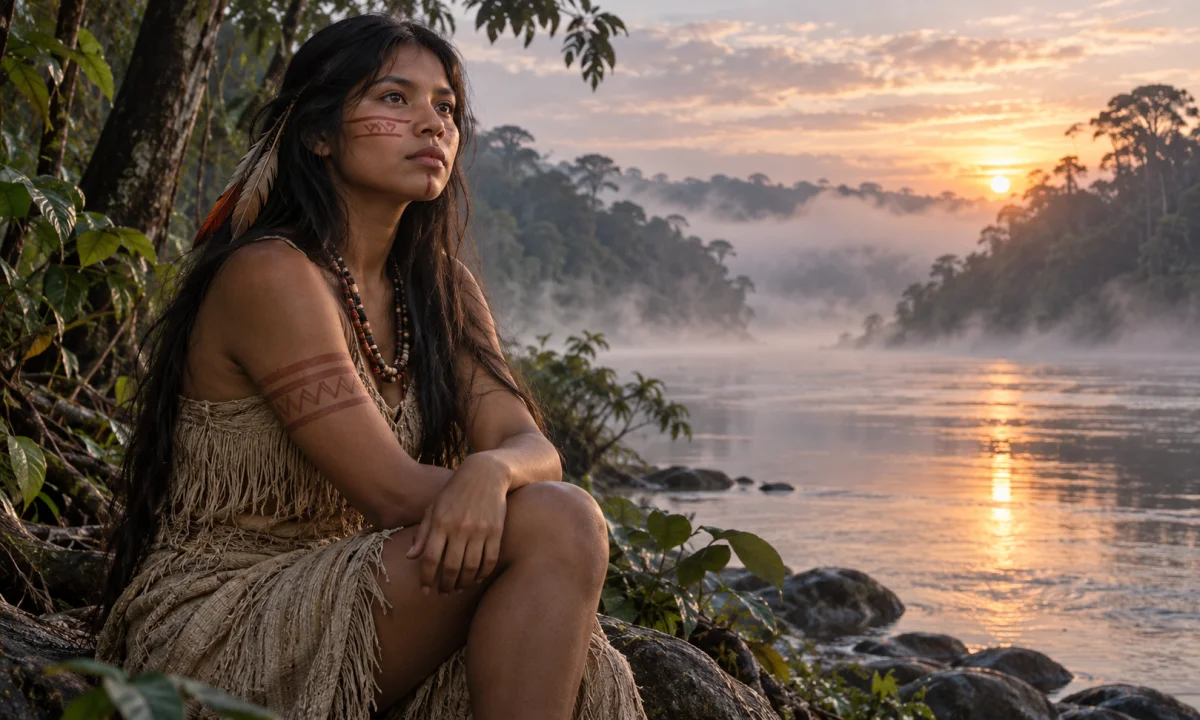
There is no widely agreed traditional description of Amana’s physical appearance. Modern illustrations may portray her as a woman surrounded by clouds, water, green vegetation or falling rain. Such imagery reflects the function assigned to her and the conventions of contemporary mythological art; it should not be presented as a documented Indigenous description.
Likewise, claims that Amana controls thunder, lightning, storms, rivers or fertility need to be treated carefully. Rain, thunder and lightning are often related in South American religious systems, but they are not necessarily controlled by the same being. A community may distinguish between a rain power, a thunder being, a storm spirit and the master or owner of a particular river or forest. Adding all these powers to Amana creates a composite figure unsupported by clear evidence.
The safest description is that Amana is associated with rainfall and the life-giving effects of water. More elaborate attributes belong either to particular local traditions that must be identified separately or to later summaries that have expanded a short description into a complete character.
Stories and relationships
No single canonical cycle of myths about Amana is securely established. There is no generally accepted account of her birth, marriage, children, conflict with another deity or role in the creation of the world. Stories sometimes repeated in online lists may be unattributed, heavily retold or assembled from motifs belonging to other Indigenous traditions.
This absence of a standard narrative is significant. Many well-known mythological figures have become familiar through written epics, colonial transcriptions or extensive collections of oral literature. Amana does not have an equivalent body of widely authenticated stories in English. A short catalogue entry can preserve a name and a general function while leaving the original narrative context unknown.
Rain-related beings in South America are often connected, in different traditions, with creator figures, thunder powers, serpents, birds, mountains, rivers or ancestral beings. These associations should not be transferred to Amana without evidence. In particular, the presence of rain symbolism in one tradition does not demonstrate a relationship between Amana and Tupã, Viracocha, Pachamama or any other major South American figure.
Amana and related names
Amanaci
Amanaci is sometimes listed alongside Amana as a rain-associated Indigenous figure. Because the names resemble one another and both are linked in popular sources with rain, they are frequently merged. Their relationship is uncertain. They may represent variant spellings, related linguistic forms, separate figures or a modern attempt to expand a short name into a more recognisable mythological identity. Amanaci should therefore be discussed separately unless a particular tradition clearly equates the two.
Tupã
Tupã is widely known in accounts of Guarani and related traditions as a powerful figure associated in different sources with thunder, storms or the sky. Missionary writings and later popular retellings have influenced the way Tupã is represented, and his role varies between sources. Amana should not be treated as Tupã’s wife, daughter, consort or feminine counterpart without specific evidence. The two names may be brought together in modern summaries simply because rain and thunder are natural phenomena, not because a traditional genealogy connects them.
Pachamama
Pachamama belongs primarily to Andean religious traditions and is associated with the earth, fertility, cultivation and the reciprocal relationship between humans and the land. She is not another name for Amana. Although both figures may be described in modern writing as nature goddesses, their cultural settings and documented religious histories are different. Treating every female figure connected with fertility or nature as the same goddess erases important distinctions among Indigenous traditions.
Amaru and other water beings
The Andean Amaru, often represented as a great serpent or dragon-like being, is associated in different traditions with water, rivers, rain, fertility and the powers of the earth. Amaru and Amana have different names and cultural contexts. Their shared connection with water does not indicate that they are variants of one figure. Similar caution applies to river spirits, aquatic monsters and water owners recorded among Amazonian and other South American peoples.
Sources, transmission and uncertainty
The limited information about Amana illustrates a broader problem in the study of Indigenous mythology. Oral traditions were not preserved in one standard form, and many early written records were produced by outsiders who selected, translated or reorganised what they heard. Names could be altered in transcription, while local beings could be recast as “gods” according to European expectations.
Later encyclopaedias, websites and lists of mythology often repeat one another. A brief statement that Amana is a rain goddess may circulate widely without a clear indication of which people used the name, in which language it was recorded or whether the information derives from a traditional narrative, a modern compilation or a speculative reconstruction. Repetition does not by itself make an uncertain identification historically secure.
The absence of detailed evidence does not mean that rain lacked religious importance for the communities linked with the name. It means that the surviving record does not allow a confident reconstruction of one complete biography for Amana. Responsible interpretation should preserve that distinction rather than filling the gaps with invented stories, family relationships or visual details.
Cultural significance
Amana’s importance, insofar as the identification can be established, lies in the way the figure represents water as a condition of life. Rain connects the sky with soil, forest, crops, animals and human communities. It also reminds people that prosperity depends on forces that cannot be permanently controlled. A rain deity or spirit can therefore embody reciprocity: people seek water and abundance while remaining obligated to respect the beings, places and practices through which those gifts are understood to arrive.
That significance should be kept within its cultural setting. Amana is not evidence for a single unified “South American mythology,” and the label should not be used to combine unrelated traditions from Brazil, the Andes, the Guianas and the Caribbean. South America contains hundreds of Indigenous nations and many different religious systems. The most accurate account of Amana remains a cautious one: a rain-associated figure preserved in modern descriptions, probably connected with a Tupian context, but lacking a universally agreed mythology and securely documented canonical tradition.