WORLD
WORLD
Aiomun Kondi
Aiomun Kondi is a name associated in modern reference works with an Indigenous creator or supreme being of the Guianas, in the northern part of South America. The identification is not entirely secure: spellings differ, the name is attributed to different Indigenous groups in different compilations, and detailed traditional narratives are difficult to verify. Aiomun Kondi should therefore be treated as a figure preserved through fragmentary ethnographic and mythographic records rather than as a deity documented in a single, standard sacred text.
Origins and cultural setting
The name is usually placed within the cultural world of the Guianas, a region encompassing Guyana, Suriname, French Guiana, and adjoining parts of Venezuela and Brazil. This area is home to many Indigenous peoples whose languages and religious traditions are distinct, although neighbouring communities have also exchanged stories, ritual practices, and names over long periods.
Reference works have variously connected Aiomun Kondi with Cariban-speaking peoples and, more broadly, with Indigenous communities of the Guiana Shield. Some accounts use broad labels such as “Carib” or “Arawak,” terms that may reflect older colonial classifications rather than a precise identification of the community that preserved the name. The name has also been linked in secondary sources with the Makushi, or Macushi, although the available summaries do not establish a universally accepted account.
That uncertainty matters. Indigenous religions in the Guianas were not organized around one shared mythology, and a deity recorded under one spelling may not be identical to a figure described under a similar name elsewhere. Aiomun Kondi should not automatically be combined with Makunaima, Wanadi, or other creator beings from neighbouring traditions simply because they have comparable roles.
The name and its uncertain identity
The name appears with several forms, including Aiomun Kondi, Aimon Kondi, and hyphenated versions such as Aiomun-Kondi. Variations are common when Indigenous names are recorded by outsiders. A written form may reflect the spelling conventions of a missionary, traveller, administrator, or later compiler rather than the pronunciation or orthography used by the community itself.
The meaning of the name is also not securely established in widely available English-language sources. Some popular summaries treat it as a personal name for a creator god; others present it almost as a title for a high god or “great spirit.” These interpretations may not represent the original grammatical or religious sense of the term. Without a reliable description in the relevant Indigenous language, translating the name with confidence would be misleading.
For the same reason, Aiomun Kondi is better described as a creator or supreme-being figure in Guianan Indigenous mythology than as a precisely defined god with a fixed genealogy, iconography, and biography. The surviving record does not support the level of detail available for better-documented figures from ancient Greece, Egypt, or Mesoamerica.
Religious context
Many Indigenous traditions of the Guianas understand the world as a connected field in which humans, animals, plants, ancestors, spirits, and powerful beings interact. The boundary between “god,” “spirit,” “ancestor,” and “culture hero” is not always equivalent to the categories used in European comparative mythology. A being responsible for creation may also be a guardian, lawgiver, distant ruler, or source of ritual knowledge.
Creation in these traditions is not necessarily a single event carried out once in the distant past. It may involve the shaping of the land, the separation of sky and earth, the establishment of human communities, the ordering of seasons, or the introduction of fire, agriculture, hunting customs, and ceremonial practices. A creator can therefore be important not only because of what was made, but because creation establishes the proper relationships between people and the rest of the living world.
Descriptions of Aiomun Kondi are too limited to determine which of these functions belonged specifically to the figure. It is safest to say that the name has been used for a high creative power, while recognizing that the surviving summaries do not provide a complete theology.
Attributes and powers
Aiomun Kondi is generally characterized as a creator being. In mythological catalogues, this may mean the maker of the world, the originator of living beings, or the highest power responsible for the existence and order of the cosmos. Some descriptions also call the figure a supreme god, but that label should be understood cautiously because “supreme god” is often an interpretive category imposed by outsiders.
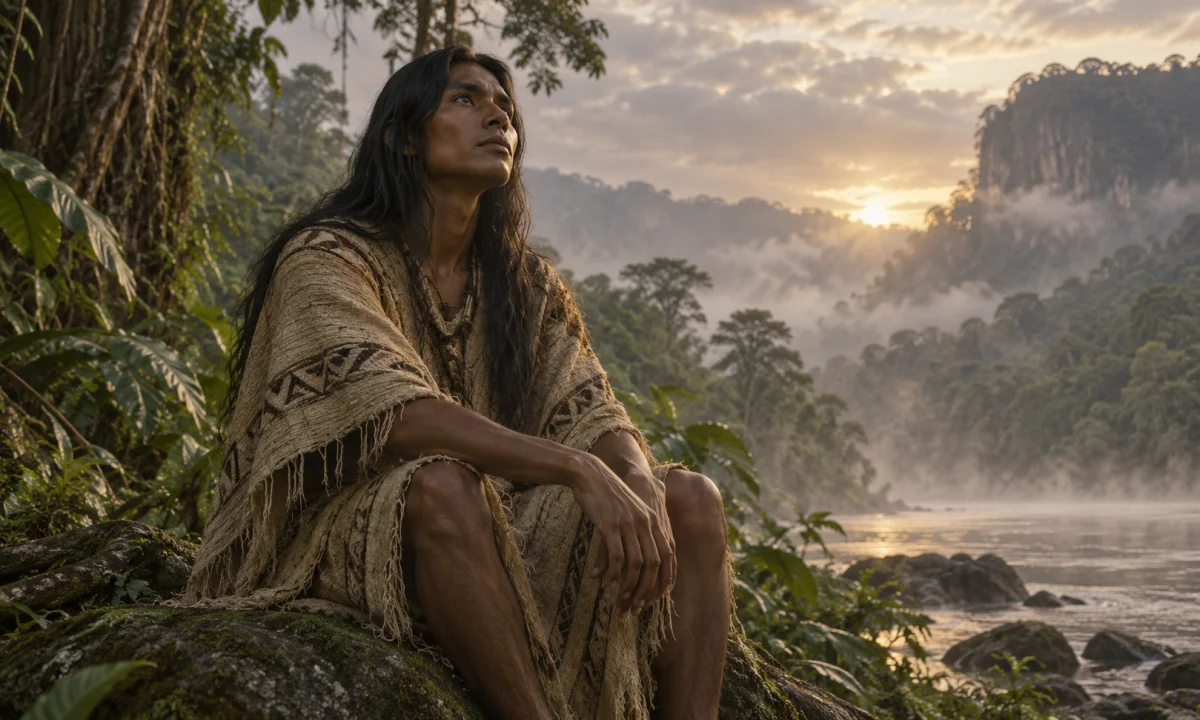
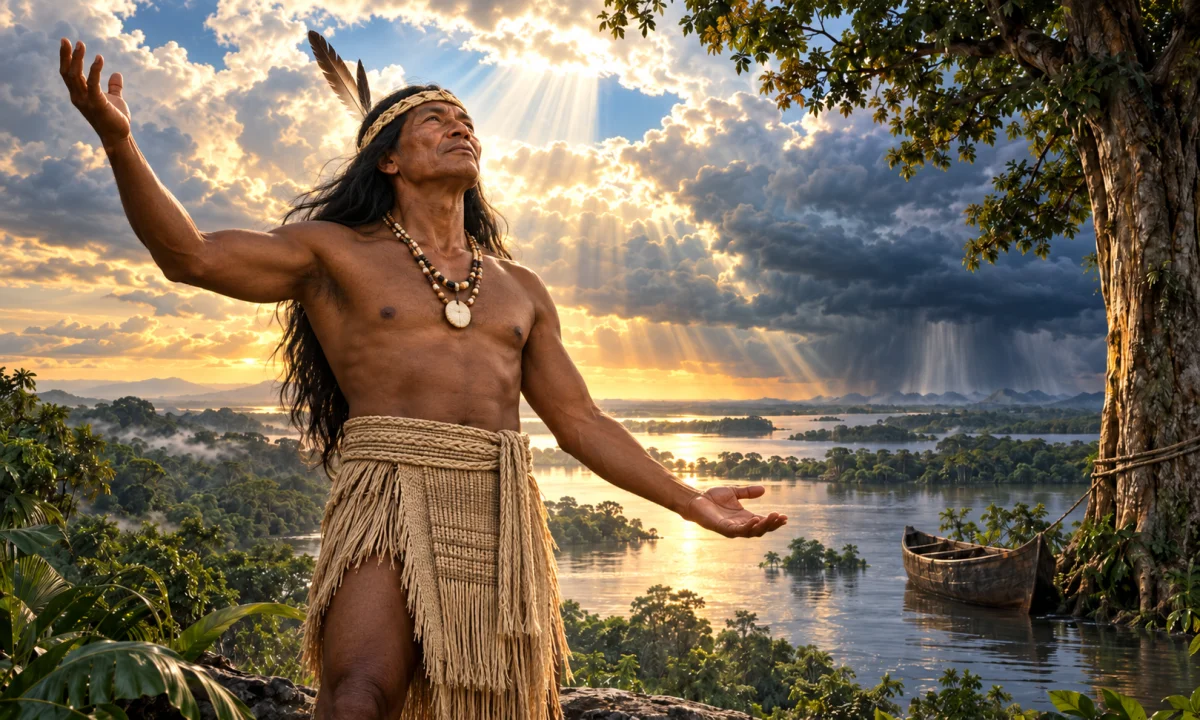
There is no well-established traditional portrait of Aiomun Kondi. The figure is not consistently described as a human-shaped deity, an animal, a sky-being, or an ancestral ruler. Nor is there a stable set of attributes such as weapons, sacred animals, colours, or distinctive clothing. Images sometimes produced for encyclopedias, websites, or modern fantasy projects should not be mistaken for traditional Indigenous representations.
Similarly, no dependable set of powers can be assigned beyond the broad creative role found in secondary descriptions. Claims that Aiomun Kondi specifically controls thunder, rain, death, fertility, warfare, or the underworld should be treated as unverified unless tied to a clearly identified community and oral or ethnographic source.
Stories and surviving tradition
Unlike some mythological figures known through extensive written epics, Aiomun Kondi is not associated with a widely preserved cycle of stories in English translation. Short catalogue entries often name the figure and assign a creative function without recording a full narrative. As a result, it is not possible to present a securely established sequence of birth, conflict, marriage, descent, or disappearance.
This lack of narrative detail does not imply that the figure was unimportant. Oral traditions are transmitted through performance, ritual, kinship, language, and the authority of particular knowledge holders. They are not always intended to be separated from the social and ceremonial settings in which they are told. Colonial observers frequently recorded only brief summaries, and some religious knowledge was not shared with outsiders.
Written records concerning Indigenous religions in the Guianas were also shaped by missionary activity and colonial assumptions. European observers sometimes grouped very different beings under terms such as “god,” “devil,” “spirit,” or “idol.” They could also interpret a local creator through Christian categories, presenting a distant high god as evidence of a concept resembling the Christian God. Such records remain useful, but they require careful separation between Indigenous testimony and the recorder’s interpretation.
Aiomun Kondi and creation mythology
When Aiomun Kondi is included in comparative mythology, the figure usually represents the idea that the world has an intentional or sacred origin. This does not necessarily mean that creation is imagined as manufacture by a single individual. In Guianan traditions more generally, the origin of the world may be described through transformations, emergence, the actions of culture heroes, or the establishment of communication between different realms.
A creator figure can also stand at a considerable distance from ordinary human life. In many religious systems, the highest power creates the world but leaves daily affairs to other spirits, ancestors, ritual specialists, or personified natural forces. It would therefore be inaccurate to assume that Aiomun Kondi was worshipped in the same manner as a local guardian spirit or invoked for every practical need.
The available evidence does not establish whether Aiomun Kondi was approached through a particular shrine, sacrifice, prayer formula, festival, or priestly office. No specific ritual practice should be attributed to the figure without stronger documentation.
Cultural significance
The importance of Aiomun Kondi lies partly in the way the name reveals the difficulty of preserving Indigenous religious traditions in written form. A brief entry in a mythological dictionary can make a complex tradition appear to consist of a single god with a simple function. In reality, the name may have belonged to a linguistic, regional, or ceremonial context that the surviving record no longer fully captures.
Creator figures in the Guianas are often connected, directly or indirectly, with questions of human responsibility. The world is not merely a stage on which people act; it is a network of relationships requiring respect. Animals may possess agency, the landscape may contain memory, and ritual knowledge may be treated as a responsibility rather than private property. These broader regional patterns provide context for interpreting Aiomun Kondi, but they should not be presented as specific teachings of the figure unless the relevant tradition is clearly identified.
It is also important not to reduce Aiomun Kondi to an Indigenous equivalent of a familiar European creator god. Similar functions do not prove identical beliefs. The meaning of a creator is shaped by language, ecology, social organization, ritual practice, and the community’s understanding of personhood and the living world.
Distinction from other Guianan creator beings
Aiomun Kondi is sometimes confused with other powerful beings from South American Indigenous traditions. These figures belong to different cultural and linguistic contexts and should not be merged merely because they are described as creators.
- Makunaima or Makunaíma is a major culture hero associated especially with the Pemon and other Cariban-speaking peoples of the Guiana region. Stories about Makunaima include transformations, adventures, and the shaping of the human world. Makunaima is not simply another spelling of Aiomun Kondi.
- Wanadi is a central creator and culture hero in the mythology of the Ye'kwana of Venezuela and neighbouring regions. Wanadi belongs to a distinct tradition with its own detailed narratives and religious concepts.
- Amalivaca is a creator or culture hero in traditions associated with the Tamanaco of Venezuela. Accounts of Amalivaca have been heavily filtered through colonial writers, but the name nevertheless refers to a different figure.
- Warao creator beings belong to the traditions of the Warao people of the Orinoco Delta. Warao mythology includes several important spiritual figures, and these should not be identified with Aiomun Kondi without specific evidence.
The use of the broad term “Carib” can create further confusion. It may refer to a linguistic family, a historical population label, or a loose category used by older writers. It does not demonstrate that all Cariban-speaking peoples shared one mythology or recognized Aiomun Kondi under the same name.
Sources, transmission and scholarly caution
Information about Aiomun Kondi is largely found in secondary mythological compilations and brief encyclopedic references rather than in a clearly identifiable sacred narrative. Such works can preserve names that might otherwise be overlooked, but they often omit the community, language, locality, date of collection, and original wording of the source.
The figure’s classification should therefore remain provisional. A responsible description distinguishes between what is repeated in modern reference works and what can be demonstrated from a documented Indigenous tradition. The broad association with creation is reasonably consistent in summaries, while the exact people, meaning of the name, appearance, relationships, rituals, and stories remain uncertain or insufficiently recorded.
Later reception
Aiomun Kondi has not become a major figure in global popular culture. The name occasionally appears in online mythology lists, comparative religion discussions, and modern projects seeking lesser-known deities from South America. These appearances generally repeat the creator-god classification and may add invented visual details or personality traits.
Such reinterpretations can introduce the name to new audiences, but they are modern uses rather than evidence for traditional belief. A fantasy illustration, game entry, or fictional biography should not be presented as an authentic representation of Indigenous religion. The most accurate modern treatment preserves the name’s association with a Guianan creator or high being while acknowledging the fragmentary and disputed nature of the available record.