WORLD
WORLD
Aluberi

Aluberi is a creator figure associated in modern reference works with the Arawak peoples of northern South America and the Caribbean. The name is usually presented as belonging to a supreme or primordial being responsible for the creation of the world, although the surviving information about Aluberi is extremely limited. Unlike better-documented figures from Indigenous American traditions, Aluberi is not supported by a large, consistently recorded body of traditional narratives. Claims about the figure’s appearance, family, exploits and exact religious status should therefore be treated cautiously.
Cultural setting
“Arawak” is a broad and sometimes imprecise term. It may refer to the Lokono, an Indigenous people of Guyana, Suriname, French Guiana and parts of Venezuela, or more generally to peoples who speak, or historically spoke, languages belonging to the Arawakan language family. These peoples have never formed a single culture with one uniform mythology. Arawakan-speaking societies have included the Lokono, Taíno, Warao neighbours, and many other communities with distinct histories and religious traditions.
Aluberi is most often labelled an “Arawak god” in brief mythological compilations. That label does not by itself identify a particular community, region or set of ceremonies. It may reflect an attempt by later writers to compress information from a large and diverse cultural area into the category of “Arawak mythology.” The name should not automatically be treated as a pan-Arawakan religious title shared by every Arawakan-speaking people.
The northern coast of South America was a region of extensive movement, trade, intermarriage and cultural exchange. Indigenous communities encountered European colonists, missionaries, enslaved Africans and one another over several centuries. As a result, names and stories could be recorded through translation, altered spelling or broad ethnic labels. This historical background helps explain why a figure may appear in modern mythological dictionaries without a clearly traceable cycle of traditional stories.
Origins and surviving evidence
Information about Aluberi is sparse. The figure is generally mentioned in secondary summaries rather than in a widely known, continuous corpus of Indigenous narrative. Such summaries commonly identify Aluberi as a creator deity, but they do not consistently preserve a detailed creation account, a ritual context or a body of prayers and songs connected with the name.
This lack of detail is important. It does not demonstrate that Aluberi was unimportant to the people whose tradition used the name. Indigenous religious knowledge was often transmitted orally, and much knowledge was never written down by outsiders. In addition, early colonial records were selective and frequently interpreted Indigenous beliefs through Christian categories such as “God,” “devil,” “idol” or “creator.” A short entry in a modern reference work may therefore be the end result of several layers of translation and classification.
At the same time, the absence of strong documentation means that elaborate accounts should not be presented as established tradition. There is no secure basis for assigning Aluberi a fixed physical form, a spouse, a group of divine children, a sacred animal or a detailed sequence of cosmic events unless a specific community’s source clearly provides those details. Popular lists sometimes expand brief descriptions into full mythic biographies, but those additions are not necessarily traditional.
Name and classification
The spelling Aluberi is the form most often encountered in English-language mythological references. The name’s precise linguistic derivation and original pronunciation are not securely established in the commonly available material. It is therefore unwise to assign it a definite meaning without a reliable linguistic or community-based source.
Aluberi is usually classified as a god or creator spirit. “Creator deity” is a convenient description, but it may not reproduce the categories used within the relevant Indigenous tradition. Many religious systems do not divide supernatural beings into exactly the same categories as “gods,” “spirits,” “ancestors” and “heroes.” A being described in English as a god may instead be understood as an ancestral power, a culture-bringing presence or a remote force associated with the ordering of the world.
Nor is it certain that Aluberi was imagined as a ruler in the same way as a king or chief. The title “supreme god,” sometimes applied in general summaries, may reflect a comparison with the monotheistic God familiar to European writers. It is safer to say that Aluberi is associated with creation and cosmic origins than to claim a fully defined hierarchy of heaven and earth.
Aluberi as a creator figure
Descriptions that identify Aluberi as a creator generally connect the name with the beginning or arrangement of the world. In this broad role, Aluberi represents the power through which the ordered universe, the natural environment or living beings came into existence. The available accounts do not establish one universally accepted version of what was created first, how creation occurred or whether the process involved other beings.
Some general summaries attribute the creation of the earth, celestial bodies, animals and human beings to Aluberi. These statements may be useful as an indication of how the figure has been classified, but they should not be mistaken for a complete, securely documented Lokono or Arawakan creation narrative. The details vary in quality from one reference to another, and many are repeated without an identifiable traditional text behind them.
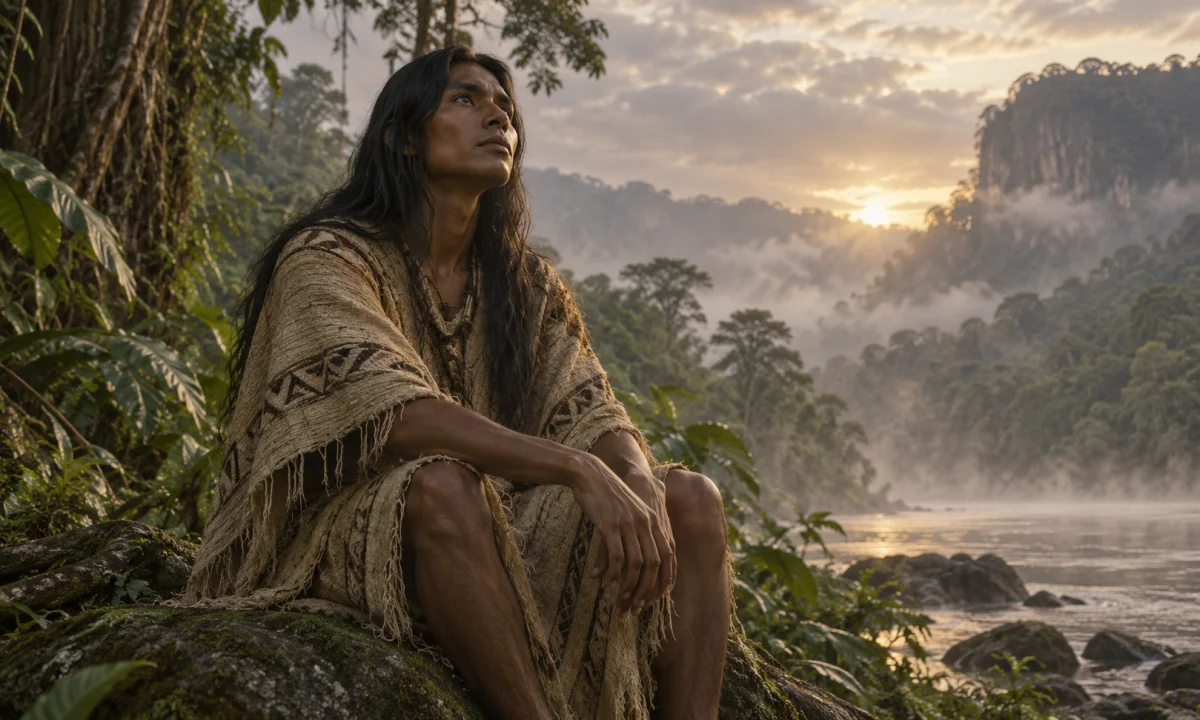
There is also no reliable basis for treating Aluberi as an anthropomorphic character with a standard appearance. Illustrations that portray the figure as a bearded man, a crowned sky god or a luminous heavenly being are modern artistic interpretations. They may help communicate the idea of a creator, but they do not constitute evidence about Indigenous visual tradition.
Possible religious significance
If the creator description accurately reflects an Indigenous tradition, Aluberi’s importance would lie less in a sequence of heroic adventures than in the relationship between cosmic order and human existence. Creator figures often provide a way of expressing why the world has its present structure, why people belong to a particular land and how the visible world is connected to powers that cannot be seen.
In an Indigenous South American context, creation is not necessarily a single event followed by divine withdrawal. Cosmological traditions may connect the origins of people, animals, rivers, forests, celestial bodies and social customs. The same narrative may explain both how the world began and how human beings should live within it. However, no sufficiently detailed account of Aluberi is available to define these themes specifically for the figure.
It is therefore better to discuss Aluberi as a possible expression of creator power than to attach a long list of symbolic meanings to the name. There is no firm evidence that Aluberi was specifically a god of the sun, the moon, agriculture, war, death, rain or a particular animal. Those attributes should not be inferred merely because creator figures in other traditions possess them.
Stories and relationships
No single, widely attested mythic cycle about Aluberi is known in the way that the stories of many better-documented figures are known. The surviving references do not provide a stable account of a birth, conflict, marriage, death or transformation. Nor is there a securely established list of companions, enemies or descendants.
This is a significant distinction. A creator figure may appear in a tradition without being the protagonist of numerous dramatic tales. Some religious beings are known principally through names, ritual references, genealogies or cosmological statements. Others were recorded only when missionaries or collectors asked questions that fitted European expectations about “mythology.” The limited record for Aluberi may reflect the history of documentation rather than the full scope of the original belief.
Aluberi should consequently not be merged with famous culture heroes or creator beings from neighbouring traditions. Northern South America has many distinct cosmological figures, including beings associated with the creation of people, the acquisition of fire, the formation of landscapes and the establishment of social customs. Similar functions do not prove that these figures are versions of Aluberi.
Distinguishing Aluberi from related figures
The name is particularly vulnerable to confusion because “Arawak mythology” is often used as a loose heading in encyclopaedias and online lists. An entry under that heading may combine material from the Lokono, Taíno or other peoples without identifying the community concerned. Aluberi should not automatically be identified with a Taíno supreme deity or with every creator figure described in the Guianas.
Aluberi is also not simply another name for the Taíno creator or high gods known from Caribbean historical sources. Taíno religion had its own vocabulary, sacred beings and historical context. The Taíno and Lokono were connected through regional interaction and related language histories, but relationship and cultural contact do not make their religious figures interchangeable.
Likewise, Aluberi should not be confused with figures from the mythologies of the Carib- or Cariban-speaking peoples, the Tupi-Guarani peoples, or Andean and Amazonian traditions. Broad geographical proximity is not enough to establish identity. When a reference gives no community, language or source for its description of Aluberi, the information should be regarded as provisional.
Problems of recording Indigenous traditions
The uncertainty surrounding Aluberi illustrates a wider problem in the study of Indigenous American religions. Much traditional knowledge was transmitted orally and could be restricted to particular families, ritual specialists or communities. Colonial observers often recorded only what they considered relevant to conversion, administration or ethnographic comparison. Names were written according to European spelling systems, and concepts were translated into words that carried assumptions from Christianity and classical mythology.
Later mythological dictionaries sometimes removed those original contexts. A local figure could become “the Arawak god of creation,” while distinctions between a personal name, a title and a descriptive phrase disappeared. Repeated entries then give an impression of certainty even when they all derive from one short, poorly contextualized report.
Responsible discussion should preserve that uncertainty rather than fill the gaps with invented detail. The most defensible description of Aluberi is that the name is associated in secondary English-language accounts with an Arawak or Arawakan creator figure, while the exact community, original context and narrative tradition remain insufficiently documented in the material commonly available.
Modern reception
Aluberi has little established presence in widely known novels, films, games or popular religious movements. The figure appears mainly in encyclopaedic lists, websites devoted to mythology and generalized discussions of Indigenous deities. In these settings, the name is often used as a compact example of an Arawak creator god.
Modern illustrations and fictional expansions may portray Aluberi as a cosmic architect, sky ruler or ancestral guardian. Such portrayals can be creative responses to a very brief traditional reference, but they should be identified as modern interpretation rather than presented as recovered mythology. A respectful treatment avoids giving invented stories the same status as community-preserved tradition.
For now, Aluberi is best understood as a poorly documented creator figure associated with broad Arawak classification, not as a fully reconstructed deity with a settled mythology. The name points toward the religious importance of creation and cosmic order in Indigenous South American thought, while the precise tradition behind the figure remains uncertain and requires more specific, community-based documentation.