WORLD
WORLD
Abassi
Abassi is a creator and supreme deity associated primarily with the traditional religion of the Efik people of southeastern Nigeria and the adjoining Cross River region. In English-language references, the name is also written Abasi or in other transliterated forms. Abassi is generally described as the highest divine power, connected with the creation of human beings and with the ordering of life, work, reproduction, social relations and death.
Information about Abassi comes mainly from oral traditions recorded by outsiders and from later descriptions of Efik religious beliefs. These accounts do not form a single sacred canon comparable to the Bible, Qur'an or a continuous written mythology. As a result, details of the stories differ between sources and may reflect both local variation and the way European observers interpreted Efik concepts. Abassi should therefore be understood within Efik religious culture rather than as a universally standardized “African god.”
Cultural setting
The Efik are a Cross River people whose historic homeland lies around the lower Cross River and the coastal areas of present-day southeastern Nigeria, particularly the region associated with Old Calabar. Their communities have long maintained relationships with neighboring peoples, including the Ibibio and other groups of the Cross River cultural zone. Religious ideas, names and stories could consequently overlap across linguistic and cultural boundaries, although overlap does not mean that all traditions are identical.
Traditional Efik religion recognized a supreme creator as well as a range of spiritual beings, ancestors and powers connected with particular places or human concerns. The supreme deity was not necessarily approached in the same manner as every lesser spirit. As in many African religious systems, everyday religious life could involve respect for ancestors, observance of prohibitions, ritual specialists and attention to the spiritual consequences of social behavior. Accounts of Abassi therefore belong to a wider religious world rather than to an isolated set of creation tales.
Missionary activity, colonial administration, commercial contact and the spread of Christianity significantly affected the recording and interpretation of Efik religion. Some older beliefs continued in transformed forms, while others became less publicly practiced or were described through Christian categories such as “God,” “devil” or “pagan deity.” Modern descriptions must take care not to assume that these translated categories perfectly match Efik ideas.
Name and identity
The spelling Abassi is common in English-language accounts of Efik mythology, while Abasi is also used. English spellings of African names were often influenced by the orthographic conventions of missionaries, colonial writers and later reference works. The variation does not by itself indicate separate deities. However, it is also unwise to treat every figure called Abasi or Abassi in the wider Cross River region as automatically identical. Local languages and traditions may use related names in distinct ways.
Abassi is usually classified as a creator god or supreme god. He is associated with the origin of human life and with the authority that governs the human condition. He is not normally presented as a heroic character who undergoes a long series of adventures. Instead, the most important traditions about him explain why human beings live apart from the divine realm, why they must work for food, and why conflict and death exist in the human world.
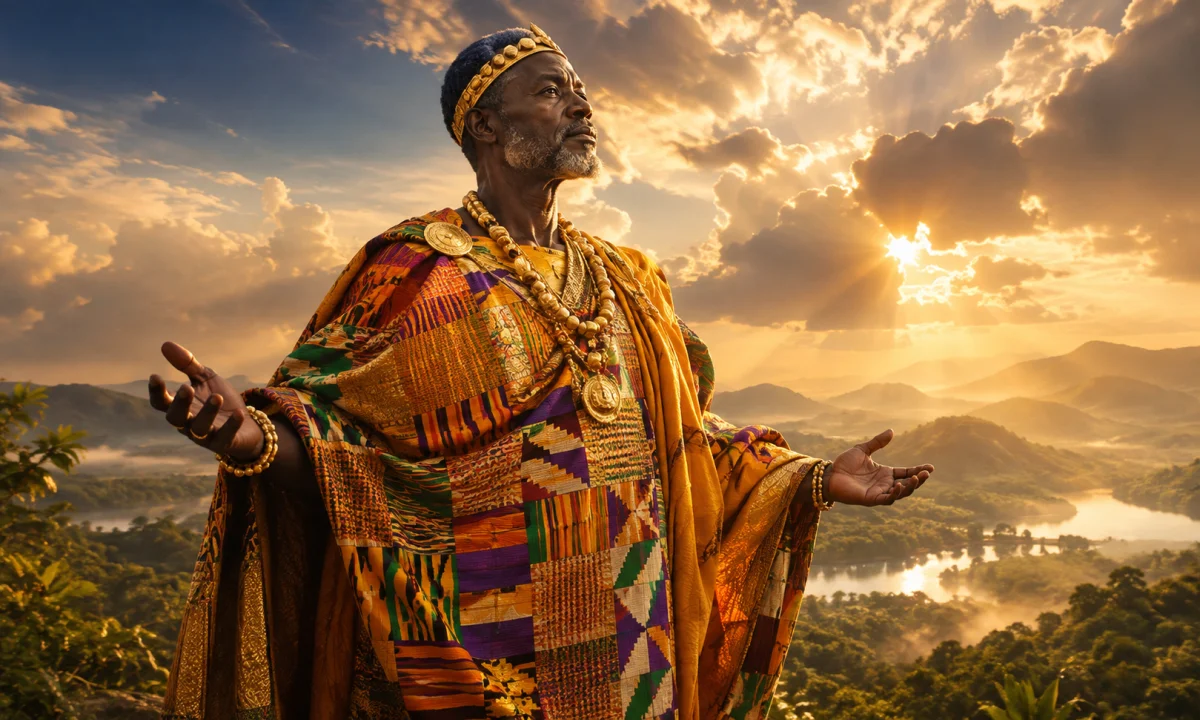
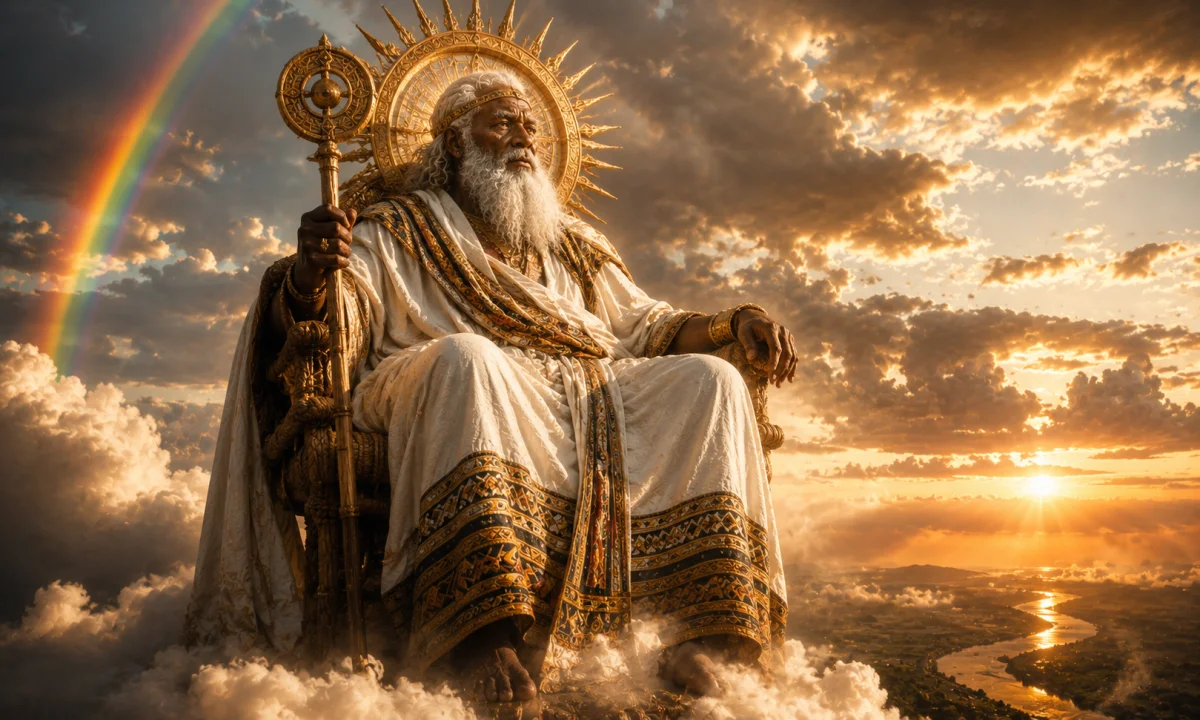
Descriptions of Abassi’s physical appearance are scarce. Traditional accounts generally emphasize his divine status and decisions rather than a detailed anthropomorphic form. Artistic images produced for modern books, websites or popular illustrations may show him as a bearded man, a king or a sky deity, but these visual conventions should not be mistaken for a consistent traditional portrait.
Abassi and the creation of human life
A widely repeated Efik story presents Abassi as the power responsible for placing human beings in the world. In some versions, he initially kept humans close to the divine realm or did not permit them to inhabit the earth independently. His wife, Atai, persuaded him to allow human beings to live on earth. The decision established the basic relationship between the gods and humanity: people could exist in the world, but they remained subject to divine limits.
The story is told in several forms, and the precise sequence is not consistent. In one common version, Abassi provided humans with food or made it unnecessary for them to cultivate the land. He wanted them to remain dependent on him rather than develop an independent livelihood. Human beings were not expected to farm, accumulate resources or organize their lives without divine provision.
This arrangement was eventually challenged. A woman began to cultivate the land, or otherwise discovered that humans could produce their own food. Her husband followed her example. Once people could grow crops and sustain themselves, they no longer depended entirely on Abassi. The story thereby explains agriculture as both a gift and a breach of a divine restriction. It also presents human initiative as a force that can alter the original relationship between humanity and the supernatural world.
Some retellings add a prohibition against sexual relations or reproduction. In these versions, Abassi feared that human beings would increase in number, become powerful and rival the gods. Other accounts focus mainly on the ban against farming. Because the available records are not uniform, it is safer to describe these as related variants rather than as details belonging to one fixed canonical story.
Atai, human disobedience and death
Atai is central to the best-known narratives about Abassi. She is commonly described as his wife and as the divine figure who influenced his decision to permit human settlement on earth. Her role is not merely that of a passive consort. In the stories, she acts as an intermediary between Abassi and humanity, and later becomes associated with the consequences of human disobedience.
When human beings began to cultivate the land, Abassi is said in some versions to have sent Atai to stop them. One widespread retelling states that she caused the deaths of the first man and woman, thereby ending their attempt to establish an independent human order. In another form of the story, Atai became associated with death and discord among later people. Her intervention explains why human communities experience mortality, quarrels and social disruption.
Atai’s position in these traditions is complex. She can appear as a guardian of divine authority, a bringer of punishment, a force of disorder or an explanation for the presence of death. These interpretations are not necessarily mutually exclusive. Mythic figures often embody several aspects of existence at once, especially when a story explains both the origin of a social practice and the origin of suffering.
The story should not be reduced to a simple claim that women are blamed for human misfortune. The surviving versions are shaped by particular social ideas about agriculture, marriage, labor and authority, but they also show a woman as the person who negotiates with the supreme god and carries out a decisive cosmic action. The narrative reflects tensions surrounding dependence, autonomy and the division of human work rather than offering a single uncomplicated moral lesson.
Work, agriculture and dependence
One of the most significant themes connected with Abassi is the necessity of work. The prohibition against farming, where it appears, sets up a contrast between an imagined earlier condition of effortless provision and the later human condition of labor. Agriculture becomes a symbol of independence: people can feed themselves, but they must also accept toil, risk and responsibility.
The story may be read as an account of why people cannot simply expect the divine world to provide everything. It expresses a familiar mythic pattern in which humans once lived under special protection but lost that privilege after breaking a divine command. At the same time, the human act of cultivation is not merely negative. Farming demonstrates ingenuity and creates the basis for settled community. The myth therefore holds together two opposing ideas: human self-reliance is a form of disobedience, but it is also the foundation of ordinary life.
These themes would have had particular force in communities where farming, fishing, trade and other forms of labor shaped social identity and survival. The tale is not an agricultural instruction or a historical account of the invention of farming. It is a religious explanation of why human beings must work and why life is marked by limits that were not present in the earliest imagined state.
Relationships with other divine beings
Atai is the only companion of Abassi who appears consistently in the widely circulated accounts of his mythology. She is sometimes labeled a goddess of discord or death in modern reference works, but such labels should be treated as descriptive summaries rather than evidence of a formal Efik pantheon organized according to classical Greek categories.
There is also a danger in assuming that Abassi’s relationship with Atai resembles the marital relationships of gods in Mediterranean mythology. The surviving stories do not provide a large divine genealogy or a detailed account of a court of gods. Abassi’s importance lies primarily in his status as creator and supreme authority, while Atai’s importance lies in her role within the transition from divine provision to human mortality and labor.
Other Efik spiritual beings, ancestors and supernatural powers should not automatically be described as children, servants or rivals of Abassi. The available accounts do not justify constructing an extensive divine family around him. Where a source gives additional relationships, those claims require attention to the specific local tradition from which they come.
Religious meaning and interpretation
Abassi can be interpreted as a figure of divine sovereignty. He establishes the conditions under which humanity exists, controls access to abundance and determines the boundaries between the human and supernatural realms. His actions also raise questions about whether human prosperity should come through dependence on divine generosity or through independent effort.
The myths associated with him address several fundamental concerns:
- Creation: human beings exist because of a supreme creative power rather than by accident.
- Separation: humanity lives in a world distinct from the divine realm and cannot return to an effortless original condition.
- Labor: the need to cultivate food and sustain life is connected with a break in the original divine-human arrangement.
- Mortality: death and suffering are given a place in the sacred history of the world.
- Social order: disobedience, independence and conflict have consequences for the whole community, not only for individuals.
Interpretations vary depending on whether the story is approached as theology, social commentary or comparative mythology. A Christian-era writer might describe Abassi as equivalent to a single creator God, while a comparative mythologist might emphasize parallels with stories about lost immortality, forbidden knowledge or the origin of agriculture. Neither approach fully replaces the Efik context. Similar motifs appear in many cultures, but resemblance does not prove that the stories share an origin or identical meaning.
Sources, variation and historical caution
There is no single ancient Efik manuscript containing the complete mythology of Abassi. Much of what is known was transmitted orally and later written down by missionaries, colonial officials, travelers, ethnographers and other observers. Such records are valuable, but they are not neutral transcripts. They may simplify local distinctions, assign fixed names to fluid roles or interpret Efik religious ideas through European theological concepts.
Differences between versions may concern whether Abassi created the first humans directly, whether humans were forbidden to farm or to reproduce, and whether Atai caused the death of the first couple or introduced discord more generally. The name of the supreme deity may also be spelled differently. These variations are normal for an oral tradition and should not be treated as evidence that one version is automatically authentic while all others are inventions.
Modern summaries often present the story in a short, polished form: Abassi creates humans, forbids them to farm, humans disobey, and Atai brings death. That outline captures an important narrative pattern, but it can conceal the uncertainty of the evidence and the wider religious setting. It also risks making Efik mythology appear more uniform than the historical record supports.
Abassi in modern reference culture
Abassi now appears mainly in encyclopedic lists, books and websites devoted to African mythology, comparative religion and legendary beings. These presentations often use the spelling most familiar to their intended audience and may describe him simply as an African creator god. Such descriptions can make the figure accessible, but they may also detach him from the Efik people and from the Cross River region.
There is no widely established modern popular-culture portrayal of Abassi comparable to the treatment of major figures such as Anansi, Isis or Odin. When he appears in contemporary fiction, games or visual art, creators may expand his appearance and powers beyond the limited traditional descriptions. A modern depiction of Abassi as a storm god, warrior, monarch or character in a large pantheon is therefore an adaptation unless it can be tied to a particular Efik tradition.
The most responsible understanding of Abassi keeps both parts of his identity in view: he is a supreme creator figure in Efik religious tradition, and he is also a subject whose surviving descriptions are filtered through oral transmission, regional variation and later documentation. His stories are especially concerned with the difficult boundary between divine provision and human independence, a boundary represented by agriculture, social conflict and death.