WORLD
WORLD
Yama-no-kami
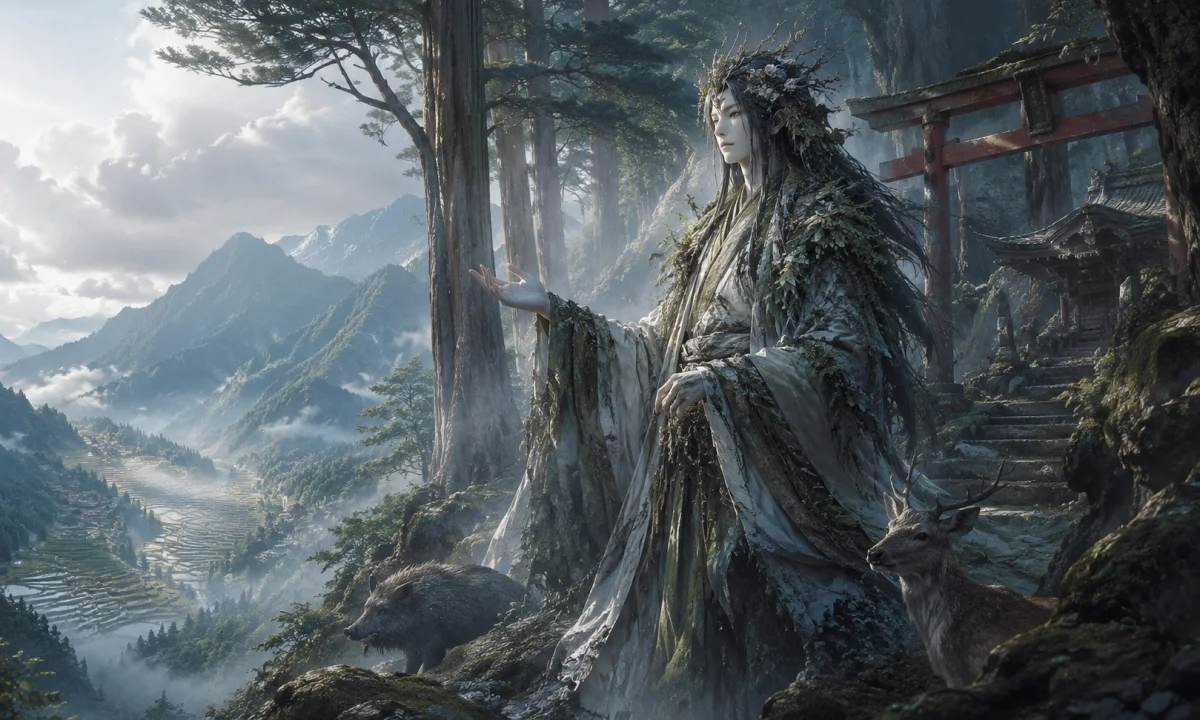
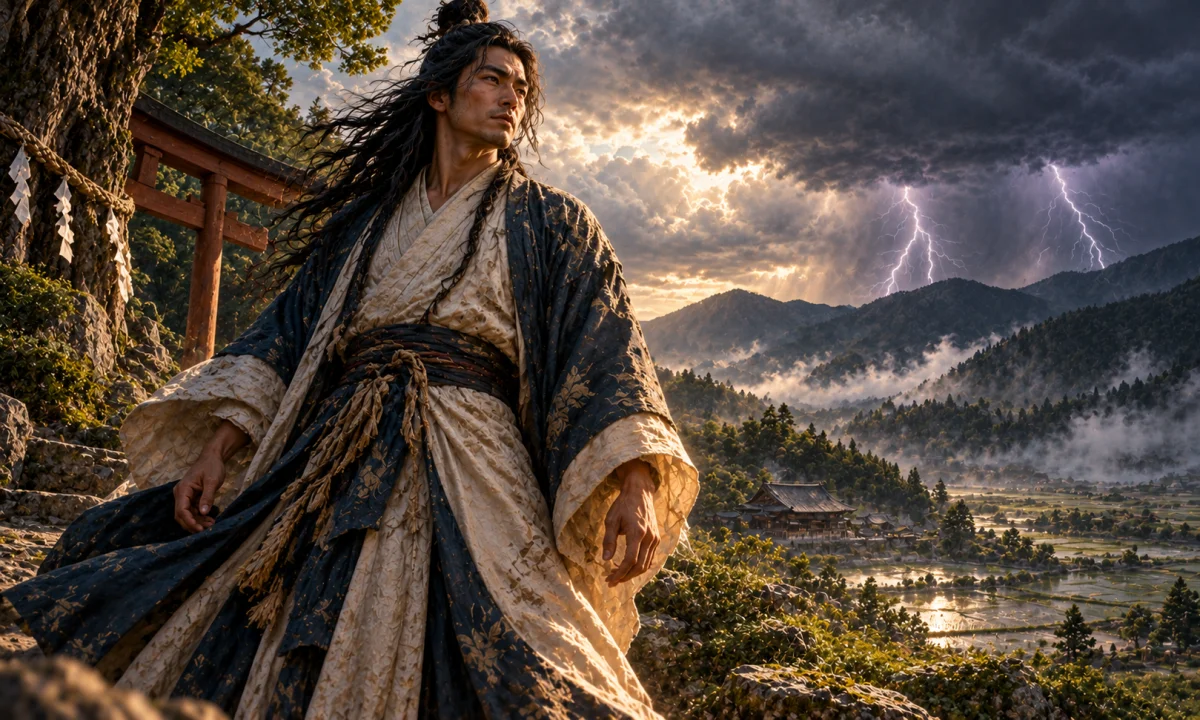
Yama-no-kami is a Japanese mountain deity or mountain spirit associated with wild uplands, hunting, forestry, agriculture, and the shifting boundary between human settlement and untamed nature. The name is written simply as “mountain kami,” but the figure is not a single fixed god with one universally agreed identity. Across Japan, yama-no-kami can refer to local tutelary deities of mountains, spirits believed to descend into villages and fields, and in some regions a deity linked to rice cultivation and fertility as well as to danger in the mountains.
Because Japanese religious tradition developed through long interaction among indigenous beliefs, shrine worship, Buddhism, and local custom, the meaning of yama-no-kami varies by region and by historical period. In some places the deity is primarily protective; in others the mountain kami is feared as a being that can cause misfortune if offended. The figure belongs above all to the religious world of folk Shinto and local practice, rather than to one single canonical scripture.
Origins and cultural setting
Japanese mountains have long been understood as sacred and powerful places. They provided timber, water sources, game, plants, and a route to the divine or the dangerous. At the same time, mountains could be home to predators, avalanches, storms, sickness, and spirits that were not safely under human control. Within that worldview, the mountain was not simply landscape; it was a living presence. Yama-no-kami expresses that relationship between people and the mountain environment.
In traditional rural life, the mountain and the paddy field were often treated as connected realms. In many local beliefs, the mountain deity was thought to descend from the hills in the spring to bless cultivated land, then return to the mountain after the harvest. This seasonal movement made yama-no-kami important not only to hunters and woodcutters but also to farmers. In some regions, the deity was regarded as a guardian of fertility and crops; in others, the emphasis remained on the wilderness and the hazards of entering it.
The surviving evidence for yama-no-kami comes less from a single sacred text than from a mixture of shrine traditions, local rituals, ethnographic records, oral custom, and later folklore collections. Because of that, the deity is best understood as a broad religious type rather than a fully standardized mythological personage.
Name, identity, and classification
The name yama-no-kami means “mountain kami” or “god of the mountain.” In Japanese usage, kami can mean deity, spirit, sacred presence, or divinity, and the word does not always map neatly onto “god” in the Western sense. This flexibility is important. A mountain kami may be imagined as an ancestral being, a local guardian, a manifest force of nature, or a being worshipped at a shrine.
There is no single universally accepted appearance or genealogy for yama-no-kami. In some local traditions the mountain deity is female, while in others it is male, and in still others the gender is undefined or changes with context. Some communities have identified the mountain deity with a specific historical or mythological figure, while others treat it as an unnamed presence. The identity is therefore variable, and claims about one fixed form should be treated cautiously.
Because the term is generic, it can also overlap with other mountain-related figures in Japanese religion. That overlap has led to confusion in popular writing, but yama-no-kami should not automatically be equated with every other mountain god or mountain spirit in Japan. Local names, shrine histories, and ritual functions differ widely.
Roles and symbolic functions
Yama-no-kami is often associated with three major spheres: the mountain itself, the resources taken from it, and the transition between mountain and village. This makes the deity both protective and potentially dangerous.
- Guardian of mountains — protecting a region’s forests, ridges, game, and sacred places.
- Patron of hunting and forestry — governing whether hunters find prey and whether woodcutters may work safely.
- Fertility and agriculture — in many local traditions, descending to the fields in seasonal cycles and blessing rice cultivation.
- Boundary spirit — marking the social and spiritual line between the cultivated village and the untamed mountain world.
- Source of danger — causing illness, accident, or failed hunts if neglected or offended.
This combination of blessing and threat is characteristic of many Japanese folk deities. A kami is not necessarily benevolent in a simple sense. It may be honored because it controls powers people need, not because it is harmless. The mountain deity especially embodies this ambiguity: mountains sustain life, but they can also take it away.
Appearance and imagined character
Traditional beliefs do not give yama-no-kami one standardized appearance. In some local storytelling, the deity may appear as an elderly man or woman, a noble mountain presence, or a hidden force expressed through signs in the natural world. In other cases, the kami is not visualized as a human-like being at all. Instead, the mountain itself is the manifestation of sacred power.
Some folk accounts connect mountain deities with animals such as wild boar, deer, birds, or snakes, depending on local ecology and belief. Such associations do not mean that the deity literally is one animal across Japan; rather, animals may be seen as messengers, manifestations, or companions of the mountain presence. In a few local traditions, a mountain spirit might be linked to a particular tree, spring, rock, or summit.
Because the tradition is locally rooted, descriptions can differ even between neighboring villages. A figure honored as a kindly mountain guardian in one region might be feared elsewhere as a capricious or jealous spirit. That variation is a defining feature of yama-no-kami worship.
Seasonal movement and village rituals
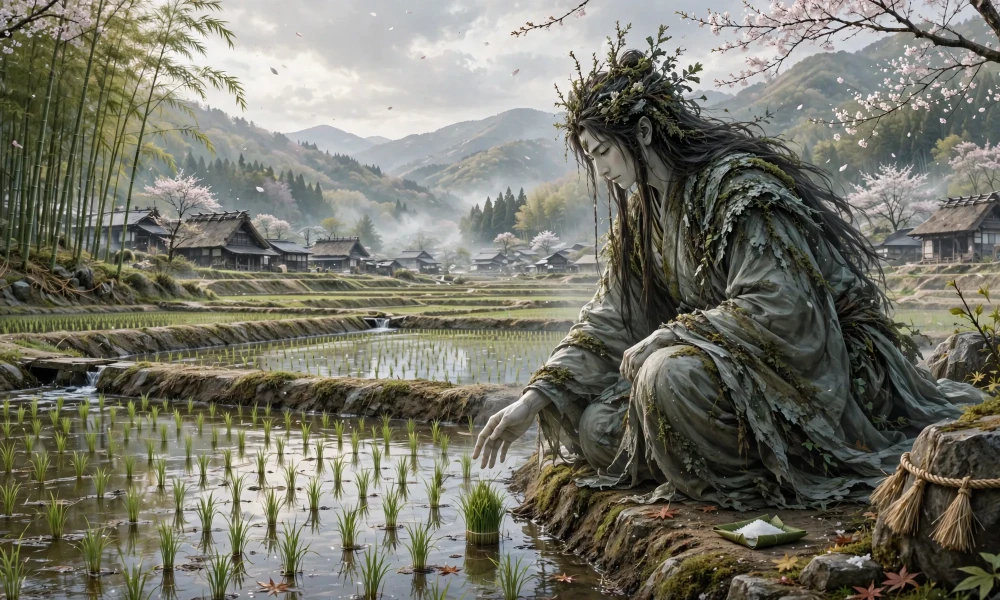
One of the most important patterns associated with yama-no-kami is the seasonal alternation between mountain and village. In many traditions, the mountain kami is believed to come down from the mountain in late winter or spring and become connected with agricultural work. After the harvest, the deity returns to the mountain. This rhythm reflects a broader East Asian agrarian understanding in which divine presence helps ensure the growth and safe gathering of rice.
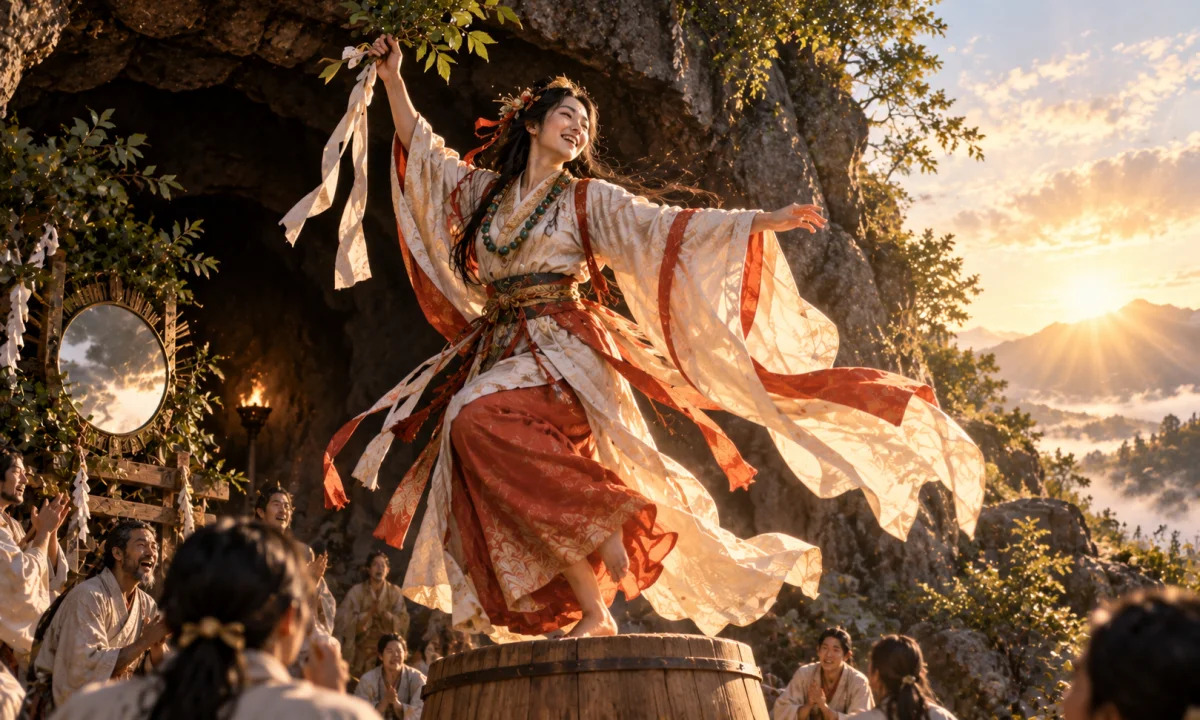
Rituals marking this movement vary by locality. Communities may have offered food, sake, branches, or other symbolic gifts to invite the deity’s protection. In some places, people avoided entering the mountain on certain days, believing the kami to be resting, hunting, or especially active. In others, festivals expressed gratitude for safe hunting or abundant harvests. The precise forms are local, but the underlying idea is consistent: the mountain deity’s favor must be maintained through correct conduct.
Some traditions also connect yama-no-kami with domestic and family well-being. Because the deity’s domain touches both uplands and fields, it can stand for the continuity of life from wild nature to the human settlement. In that sense, the mountain kami is not simply a nature spirit but part of the moral and ritual order of the village.
Association with hunting, forestry, and danger
For hunters and woodcutters, mountains were working places as well as sacred places. Entering them required skill, endurance, and ritual caution. Yama-no-kami often presides over this difficult relationship. A successful hunt may be understood as a gift from the deity; a poor one, or an accident in the forest, may be blamed on displeasure, disrespect, or improper behavior.
Traditional accounts often portray the mountain realm as one where ordinary rules are suspended. People who enter it can become lost, meet strange beings, or return changed. The mountain deity thus functions as a guardian of order in a realm that is not fully human. This is one reason why offerings and taboos matter so much in the tradition.
In some areas, hunters observed prohibitions on speaking carelessly, taking too much, or disturbing particular trees and rocks. Such customs could be understood both religiously and practically. They reinforced restraint in dangerous terrain and expressed respect for the mountain as a living power.
Relationship to agriculture and fertility
Although the name emphasizes the mountain, yama-no-kami is often tied to rice agriculture. This may seem surprising, but it fits a common pattern in Japanese folk religion: the power of the mountains is believed to feed the fields through water, seasonal cycles, and divine favor. In some local traditions, the deity descends to the village in spring and is welcomed as a ta-no-kami, a field deity, before returning to the mountain after harvest.
This relationship should not be flattened into a single nationwide doctrine. Rather, it reflects an overlapping set of rural beliefs. Some communities distinguished sharply between mountain and field deities; others treated them as different modes or seasonal aspects of the same power. The exact relationship is therefore debated and variable.
The connection to fertility is especially important because it shows that yama-no-kami was not only a remote spirit of wilderness. The deity participated in the practical life of rice-growing communities and in the protection of human continuity, livestock, and household prosperity.
Local variation and regional names
There is no single “correct” regional form of yama-no-kami. Across Japan, local communities preserved distinct mountain deity traditions with different ritual calendars, shrines, offerings, and legends. In some places, the deity was worshipped at an individual mountain shrine; in others, at roadside stones, household altars, or special sites within the village.
Because the name is descriptive rather than uniquely identifying, it can be used broadly for many local mountain gods. That means scholarly discussions often focus less on one universal mythology and more on patterns of belief. When reading about yama-no-kami, it is important to ask which region and which tradition are being described. A single statement about the deity rarely applies everywhere in Japan.
This local character also means that oral tradition is crucial. Some stories never entered written literature at all, yet remained meaningful within a specific community. For that reason, the mountain kami should not be judged only by what appears in well-known classical texts.
Distinction from other Japanese deities and spirits
Confusion often arises because Japanese religion includes several similarly named or overlapping beings. Yama-no-kami should be distinguished from the following, even when some regional overlap exists:
- Ta-no-kami — a field or rice-paddy deity, often associated with agriculture; in some local traditions, related seasonally to yama-no-kami but not identical by default.
- Yama-uba — a mountain crone or witch-like figure from folklore, which is a different legendary being and not simply another name for the mountain deity.
- Mountain ascetics and sacred mountain cults — religious practitioners such as yamabushi and traditions centered on sacred peaks; these are worship systems or social practices, not the deity itself.
- Particular shrine kami with mountain associations — local gods tied to a specific shrine or mountain may be called by other names and should not automatically be merged with the generic mountain kami.
This distinction matters because the word yama-no-kami is broad. In folklore writing, it is easy to overgeneralize and treat all mountain-related beings as one. In reality, Japan’s religious landscape contains a dense network of related but separate traditions.
Historical and scholarly interpretation
Scholars generally interpret yama-no-kami as part of Japan’s long tradition of local kami worship grounded in landscape, labor, and seasonal life. The mountain deity is often understood as a product of agrarian society, where mountains were essential to water supply, wood, game, and ritual imagination. The deity’s dual role as provider and threat reflects the practical reality that mountains sustained communities while also placing them at risk.
Historically, local kami beliefs were influenced by broader religious developments. Over time, shrine practice, Buddhist concepts, and regional folklore interacted in complex ways. In some settings, mountain deities became connected with Buddhist figures or with mountain worship traditions. In others, older local understandings remained dominant. Because of this layered history, it is not accurate to treat yama-no-kami as purely “Shinto” in a narrow modern sense, even though the figure is commonly discussed in relation to Shinto-derived folk religion.
Modern scholarship also emphasizes that there is no single ancient “original” form of the deity that can be cleanly recovered. What survives is a set of practices and beliefs shaped by village life, regional custom, and changing religious systems. Claims of a single origin should therefore be treated with caution.
Later reception and modern relevance
In modern Japan, belief in specific local mountain kami has often declined in everyday life, especially in urban settings. Yet the idea of a sacred mountain remains culturally powerful. Festivals, shrine visits, place names, local histories, and environmental awareness can all preserve traces of the older tradition. Some communities continue to honor mountain deities through annual observances and shrine rites, even when the older cosmology is no longer fully shared by everyone.
Yama-no-kami also appears in modern popular culture, folklore reference works, and media that draw on Japanese supernatural motifs. When this happens, the figure is often simplified into a generic mountain god or spirit. Such portrayals can be imaginative, but they usually blur the regional diversity of the original tradition. Traditional belief is more varied and less neatly personified than many modern adaptations suggest.
In contemporary environmental and cultural discussions, the mountain deity can also serve as a symbol of human dependence on landscape. The traditional respect accorded to mountains, forests, and water sources reflects a worldview in which nature was not inert property but a sacred relationship. That does not make yama-no-kami an environmental concept in a modern sense, but it helps explain why the figure remains resonant.
Key characteristics in tradition
- Tradition: Japanese folk religion, especially local mountain worship and agrarian custom.
- Core meaning: a mountain kami who governs the life, danger, and sacred power of mountains.
- Typical associations: hunting, forestry, fertility, rice cultivation, seasonal change, and village protection.
- Form: variable; often not fixed to one gender, image, or genealogy.
- Nature: both benevolent and dangerous, depending on respect, ritual, and local belief.
- Context: usually understood through regional custom rather than a single authoritative myth.
Because yama-no-kami is a locally flexible sacred presence rather than one standardized character, the most accurate way to approach the figure is through the landscape and community that worshipped it. The mountain kami belongs to the living relationship between people and the hills they depended on, feared, and revered.