WORLD
WORLD
Uba
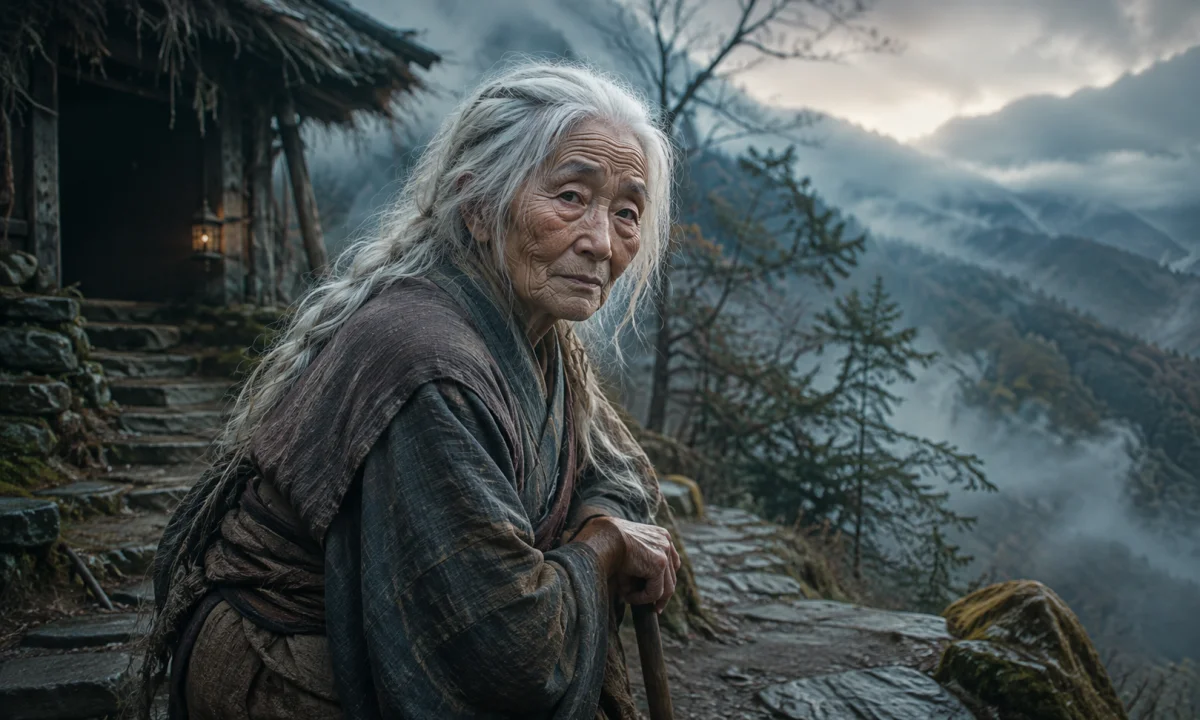
Uba is a figure found in Japanese folklore and folk-religious tradition, usually understood as an old woman or crone-like presence rather than a major deity with a fixed mythological biography. In Japanese storytelling, the name can refer to a type of elder female figure, and its meaning may overlap with other local terms for old women, attendants, spirit-like women, or supernatural beings associated with age, wisdom, labour, and the threshold between the human world and the uncanny. Because the name and role vary by region and source, Uba is best treated as a flexible folkloric figure rather than a single standardized mythic character.
In the broader context of Japanese mythology, folklore, and religious imagination, old women often appear in several different forms: as respected elders, servants in legendary households, witches or yama-uba in mountain tales, protective figures, or eerie beings whose age itself marks them as close to otherworldly power. Uba belongs within that wider cultural landscape. The term can be difficult to define precisely because Japanese oral tradition frequently preserves local variations, and the same word may be used differently from one story or region to another.
Origins and cultural setting
The word uba is commonly connected with the idea of an old woman, and in some contexts it may simply mean “old woman” or “crone.” In folklore, however, such terms often become personified and take on special roles. Japan has a long tradition of attributing spiritual significance to old age, especially in figures who have lived long enough to accumulate knowledge, ritual skill, or supernatural associations. At the same time, ageing can also be treated ambivalently, and old women in folklore may be seen as both beneficial and unsettling.
Uba should be understood against the backdrop of Japan’s rich body of oral narrative, local beliefs, temple and shrine customs, and later literary retellings. Unlike gods of major shrines or well-documented Buddhist protectors, Uba is not known from a single canonical scripture. Instead, the figure survives through storytelling, regional customs, theatrical references, and broader folkloric motifs. That means the available tradition is uneven: some references treat Uba as a specific being, while others use the name as a generic or descriptive label.
In Japanese folklore, female elder figures often occupy liminal roles. They may be linked with childbirth, weaving, domestic work, caregiving, mountain paths, or the passing down of knowledge. In some traditions, they guard the boundary between ordinary life and sacred space. In others, they become uncanny, especially when connected to abandoned places, remote mountains, or the fear that old age brings one closer to death and the spirit world. Uba belongs to this spectrum of meanings.
Name and identity
The name Uba can be translated broadly as “old woman,” but that translation should not be taken to mean that every occurrence of the term refers to the same being. Japanese folklore often preserves names that function both as personal names and as category terms. As a result, some stories may present Uba as an identifiable character, while others use the word more generally.
Because of this, Uba is sometimes difficult to classify neatly. She may be described as a human elder, a spirit-like figure, or a folkloric type. In some contexts, she may be grouped with other old-woman figures in Japanese tradition, including mountain women and crones associated with supernatural tests or household labour. In other contexts, she may be closer to a legendary attendant or local guardian figure than to a monster or demon.
It is important not to confuse Uba with similarly named figures from other traditions or with later popular reinterpretations. Japanese folklore contains several old-woman beings whose names and functions overlap, and outside specialist discussion these can easily be merged incorrectly. Uba is not a single universal “witch” figure, nor should she automatically be identified with more famous mountain crones unless a particular source makes that connection explicitly.
Appearance and characteristics
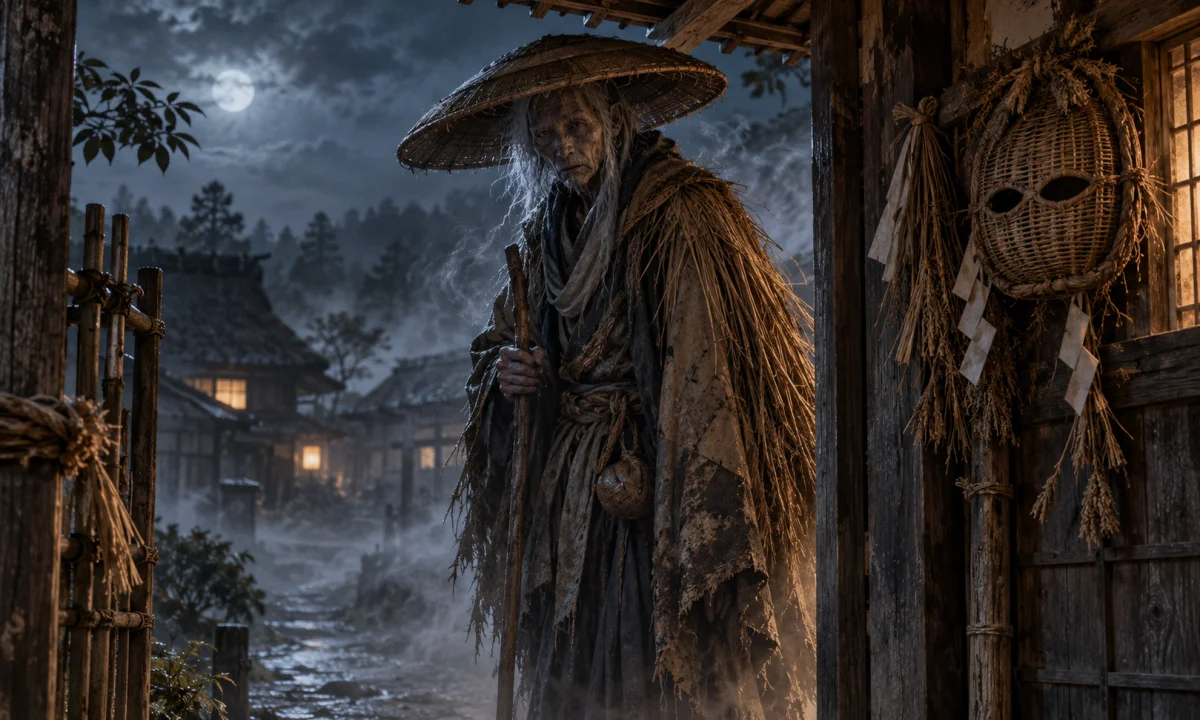
Traditionally, Uba is imagined as an elderly woman. The emphasis is less on a fixed visual form than on age, labour, and a presence shaped by experience. Folkloric old women may be portrayed as bent, white-haired, wrinkled, or dressed in plain clothing suitable for work or travel, but such descriptions are not consistent across all traditions. In some stories, the crone-like appearance is central; in others, the figure’s social role matters more than physical details.
Where Uba appears as a supernatural being, her powers are not standardized. She is not generally a cosmological creator or an all-powerful divine being. Instead, her importance lies in what she represents: endurance, elder knowledge, domestic work, the hidden force of age, and sometimes the unsettling nearness of death or the supernatural. In folklore, these qualities can generate either respect or fear.
Because Japanese folklore often places moral and symbolic weight on ordinary actions, Uba may be associated with tasks that appear humble but are culturally significant, such as spinning, weaving, carrying, caring for children, or maintaining a household. In some settings, such labour is not merely practical but symbolically tied to the continuity of family and community. When old women appear in tales, they may test virtue, reward kindness, or expose arrogance.
Roles in folklore
Uba’s role varies according to the tradition in which she appears. In some narratives, an old woman may be a helper figure who offers guidance, shelter, or crucial information to travellers or younger characters. In other tales, the old woman serves as an examiner of character, rewarding compassion and punishing selfishness. This pattern is common in Japanese folk narrative, where seemingly marginal figures often become agents of moral truth.
In other settings, an old woman may stand closer to the eerie side of folklore. Mountains, forests, abandoned houses, and isolated roads are frequent settings for supernatural encounters, and aged female figures in these places can evoke danger, secrecy, or spiritual ambiguity. Such stories do not necessarily portray the old woman as evil in a simple sense; rather, they dramatize the belief that places and people on the margins may hold hidden force.
In domestic or agrarian contexts, Uba may symbolize the deep continuity of life within the household or village. Elders preserve memory, ritual custom, and practical knowledge. A folkloric old woman can embody the accumulated experience of women’s work across generations. This symbolic dimension is important because it helps explain why old women in Japanese tradition are not merely background characters but often carry narrative weight.
Common folkloric functions
- Guide or helper: offering advice, hospitality, or supernatural aid.
- Tester of character: revealing whether a younger person is compassionate, greedy, or respectful.
- Household elder: representing memory, labour, and the continuity of family life.
- Liminal figure: appearing at roads, mountains, thresholds, or abandoned places.
- Symbol of age: embodying both wisdom and the uncanny force associated with old age.
Relationship to other Japanese old-woman figures
Confusion often arises because Japanese folklore includes several old-woman beings whose names overlap or whose stories share motifs. Uba should not automatically be equated with every elderly female supernatural figure in Japan. Some traditions distinguish between local guardian grandmothers, ritual attendants, mountain women, monstrous hags, and spirit-like old women. The same story pattern may be retold with different names depending on region or period.
One reason for this overlap is that folklore is often local and oral. A name like Uba may describe a type, a local figure, or a character in a particular legend, rather than a universally recognized being with fixed attributes. In scholarly discussion, this makes careful attention to context essential. A term used in one region may not carry the same meaning elsewhere, and later collectors of folklore may have recorded similar-sounding figures without fully standardizing them.
Another possible source of confusion is the tendency in modern retellings to merge several old-woman types into a single “witch” figure. That simplification does not reflect the diversity of Japanese tradition. Some old women are protective, some frightening, some comic, some tragic, and some simply human. Uba belongs to this broader and more nuanced range.
Symbolic meaning
Uba’s significance lies partly in the cultural meaning of old age. In many societies, and especially in rich oral traditions, an elder woman can symbolize accumulated wisdom, survival, and the visible marks of time. She may also represent the domestic and ritual labour that supports social life but is often overlooked in formal histories. Uba can therefore be read as a figure of female endurance.
At the same time, old age in folklore can become uncanny because it seems to stand close to transformation, death, or spiritual transition. In Japanese belief, the boundary between the everyday and the supernatural is often porous. A figure like Uba can cross that boundary, appearing ordinary at first and then revealing a hidden role. This ambiguity gives such figures narrative power.
From a cultural perspective, Uba may also reflect the tension between reverence and marginalization. Elders were not always celebrated in idealized terms; they could be socially vulnerable, especially in hard agrarian settings. Folklore gives shape to both esteem and anxiety. The old woman may be a bearer of wisdom, but she may also be feared because she knows too much, has outlived normal social expectations, or seems to belong partly to another world.
Historical evidence and interpretive limits
There is no single historical record that defines Uba in a standardized way. Surviving material is fragmentary and dependent on local folklore, later compilations, and interpretive retellings. That means claims about Uba must remain cautious. It is safer to speak of recurring motifs and regional uses of the name than to insist on one fixed mythology.
Scholars of Japanese folklore often note that many supposedly “mythological” beings are actually composites formed by oral tradition, local storytelling, and later literary codification. Uba likely belongs to this category. Some references may preserve a local spirit or character; others may use the name as a general term. The figure’s cultural reality lies not in a single authoritative text but in repeated appearance across traditional narrative forms.
This uncertainty is not a weakness of the tradition; it is part of how folklore works. Many Japanese beings are intentionally fluid, shaped by place, performance, and audience. Uba’s flexible identity allows the figure to serve different narrative purposes while retaining the core image of the old woman as a potent presence.
Later reception and modern relevance
In modern Japanese culture, folkloric old women continue to appear in literature, television, film, manga, and anime, often as wise elders, comic crones, or supernatural women. When a character named Uba appears in modern media, the portrayal may draw loosely on folkloric ideas of age and ambiguity, but it should not be assumed to reproduce any one traditional source exactly.
Modern adaptations often simplify or exaggerate older motifs. A folkloric Uba may be turned into a horror figure, a comic side character, or a symbolic guardian. Such reinterpretations can be creative, but they are distinct from traditional belief. Popular culture tends to crystallize fluid folklore into a single image, whereas traditional usage leaves room for regional variation and multiple meanings.
In contemporary discussions of Japanese mythology, Uba can also serve as a reminder that not all significant figures are gods, heroes, or famous demons. Folklore includes humble, local, and domestic presences whose influence is subtle but enduring. Uba belongs to that quieter realm of tradition, where age itself becomes a source of narrative and symbolic power.
Why Uba matters in Japanese tradition
Uba is important not because she has a universally fixed mythic story, but because she reflects a recurring Japanese understanding of the old woman as a figure of knowledge, labour, and liminality. She stands at the intersection of household life and the supernatural, of respect and fear, of local memory and storytelling. That ambiguity gives the figure lasting cultural value.
For readers approaching Japanese mythology, Uba offers a useful example of how folklore differs from formal pantheons. She is not a neatly bounded deity with a single shrine cult or a standard set of legends. Instead, she belongs to a living web of local stories in which human beings, spirits, and symbols overlap. Her identity remains partly unsettled, and that uncertainty is itself characteristic of the tradition.
Uba is therefore best understood as a folkloric old woman figure whose meaning changes with context. In one tale she may appear kindly; in another, unsettling. In one place she may be a local name for an aged woman; in another, a supernatural presence. That flexibility is not a problem to be solved, but a feature of Japanese folk imagination.