WORLD

Xbaquiyalo
Xbaquiyalo is a female figure in the K’iche’ Maya narrative preserved in the Popol Vuh. She is identified as the wife of One Hunahpu and the mother of the brothers Hunbatz and Hunchouen. Her role is important within the family history that leads from the first generation of heroic beings to the birth and adventures of the Hero Twins, Hunahpu and Xbalanque. However, the surviving account gives her very little individual description. Xbaquiyalo is not presented as a widely worshipped goddess with an extensive mythology, but as a member of a sacred and partly humanlike ancestral family.
Xbaquiyalo in K’iche’ Maya tradition
The name Xbaquiyalo is chiefly known from the Popol Vuh, the great K’iche’ Maya narrative recorded in the colonial period. The work recounts the creation of the world, the attempts to form successful human beings, the deeds of the gods and ancestors, and the history of important K’iche’ lineages. It is not a complete record of Maya religion as a whole. Rather, it preserves a particular K’iche’ tradition from the Guatemalan highlands, expressed through a complex mixture of myth, genealogy, ritual ideas and political ancestry.
The surviving K’iche’ text was written using the Latin alphabet after the Spanish invasion. A K’iche’ manuscript associated with the work was copied in the eighteenth century by the Dominican friar Francisco Ximénez, who recorded the Indigenous-language text and produced a Spanish translation. The narrative itself preserves older oral and cultural traditions, but the exact history of its composition and transmission is complicated. For that reason, details of names and relationships can vary between translations and modern spellings.
Xbaquiyalo belongs to the part of the story concerned with the family of One Hunahpu. One Hunahpu and his brother Seven Hunahpu are the sons of the elder ancestral pair commonly rendered as Xpiyacoc and Xmucane. These grandparents possess knowledge of divination and take part in the early ordering of the world. The narrative then follows the next generations, whose conflicts with the lords of Xibalba form one of the central dramatic structures of the Popol Vuh.
Name and identity
The spelling Xbaquiyalo is common in English discussions of the Popol Vuh, although readers may encounter different spellings or accents in translations and works using alternative systems for representing K’iche’ sounds. These differences do not necessarily indicate different characters. They may reflect the translator’s choices, the treatment of colonial orthography, or attempts to represent sounds more consistently in modern writing.
The meaning of the name is not securely established in a form that can be stated as a universally accepted translation. Some interpretations have attempted to divide the name into meaningful K’iche’ elements, but proposed translations should be treated cautiously. A name in a colonial transcription cannot always be interpreted reliably by matching it to modern dictionary forms, particularly when its historical pronunciation and context are uncertain.
Xbaquiyalo is best classified as a mythic ancestral woman or family figure rather than as a major goddess. The Popol Vuh does not give her a long list of divine titles, ritual functions or supernatural powers. Nor does it describe her in the manner of a separate cosmic deity associated with a particular natural force. Her importance comes from her place in the genealogy of the heroic brothers and from the transition between different generations of the story.
Family relationships
Xbaquiyalo is the wife of One Hunahpu, who is also called Hun Hunahpu in many English translations. One Hunahpu and Seven Hunahpu are brothers, and their family descends from Xpiyacoc and Xmucane. Xbaquiyalo and One Hunahpu have two sons:
- Hunbatz, one of the elder brothers in the generation before the Hero Twins.
- Hunchouen, the other son of Xbaquiyalo and One Hunahpu.
Hunbatz and Hunchouen are portrayed as accomplished but jealous older brothers. They are associated with artistic and intellectual skills, including music, writing or painting, and knowledge of crafts. Their talents do not make them morally admirable. They resent the younger Hero Twins, who eventually surpass them and expose their hostility.
The family structure is significant because the Hero Twins are not the direct sons of Xbaquiyalo. Hunahpu and Xbalanque are born later to Ixquic, who becomes pregnant after approaching the skull of One Hunahpu in Xibalba. This creates a complicated family connection: the Hero Twins are half-brothers of Hunbatz and Hunchouen through their father, One Hunahpu.
The story also connects the family to Xmucane. After the death of One Hunahpu and Seven Hunahpu, Xmucane remains an elder authority in the household. In accounts of the later events, she receives Ixquic with suspicion when Ixquic arrives pregnant. Xbaquiyalo, by contrast, is not an active participant in this confrontation. The narrative indicates that she has died by the time Ixquic appears, or otherwise removes her from the living household. Translation and edition details can affect how this part of the sequence is worded, but Xbaquiyalo does not raise the Hero Twins or act as their grandmother in the same direct way as Xmucane.
Her place in the story of the Hero Twins
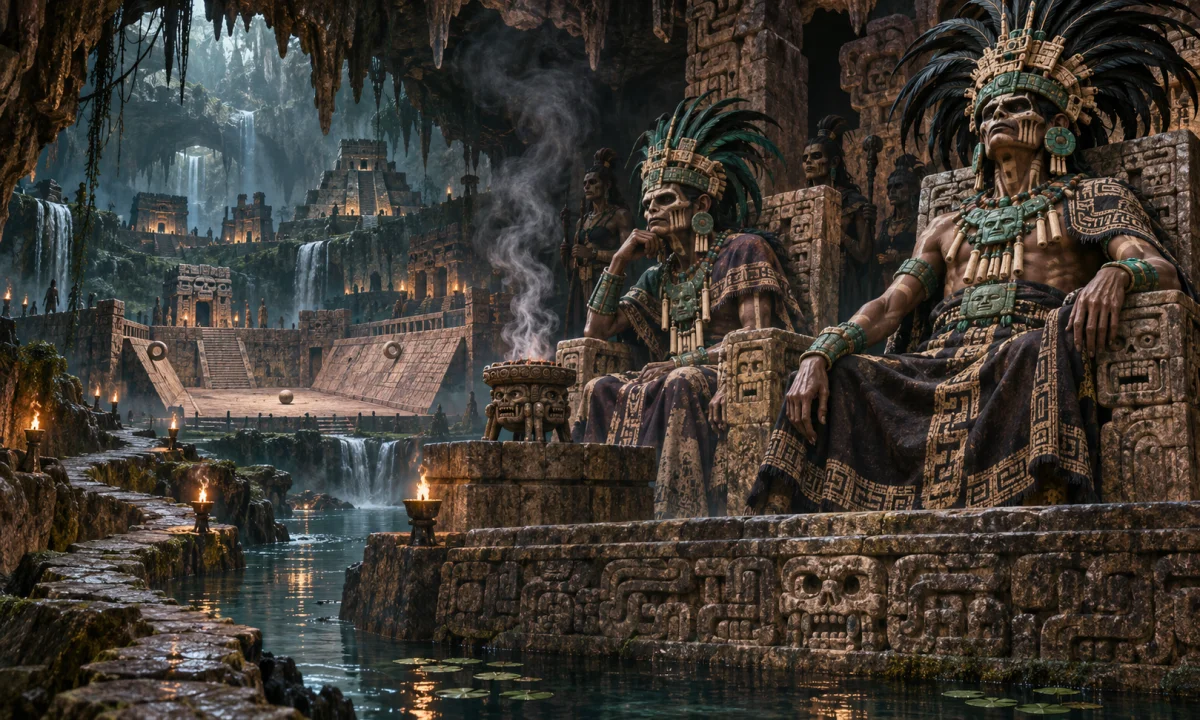
The principal story involving Xbaquiyalo is indirect. One Hunahpu and Seven Hunahpu become involved in a ball game with the lords of Xibalba, the underworld realm. The noise of their game provokes the rulers of Xibalba, who summon the brothers to their domain. Through deception and deadly trials, the underworld lords defeat and kill them.
One Hunahpu’s death does not end his role in the narrative. His head is placed in a tree in Xibalba, where it becomes an extraordinary object that speaks to Ixquic. When Ixquic approaches, the head causes her to conceive the Hero Twins. This episode establishes continuity between the dead father and the next generation. Xbaquiyalo’s connection to One Hunahpu therefore places her within the ancestral background of Hunahpu and Xbalanque, even though she is not present during their conception or adventures.
After their birth, the Hero Twins are treated with hostility by the older sons of One Hunahpu. Hunbatz and Hunchouen regard them as rivals and behave cruelly toward them. The younger brothers eventually trick the elder pair into climbing a tree. The tree grows beyond their control, and the older brothers are transformed into howler monkeys. In some translations, they later receive a more settled status as patrons or models of artistic performance, although the exact interpretation of this transformation varies.
Xbaquiyalo is not shown intervening in the rivalry between the brothers. Her absence is part of the story’s structure. The maternal and elder authority surrounding the household is represented chiefly by Xmucane, while the conflict between generations is carried by the sons themselves. This limited presence means that interpretations should not assign Xbaquiyalo actions or powers that the text does not give her.
Attributes and representation
The Popol Vuh does not provide a detailed physical description of Xbaquiyalo. There is no securely established account of her clothing, hairstyle, age, animal form, personal emblem or special bodily features. Artistic depictions that show her with elaborate regalia or supernatural symbols are modern interpretations rather than descriptions preserved in the narrative.
Her narrative attributes are relational. She is a wife, mother and member of a distinguished ancestral line. Through her sons, she is connected to the story of rivalry, transformation and the division between an older and a younger generation. These relationships matter in a tradition where genealogy is not merely a family record. Descent links people to sacred history, political legitimacy, knowledge and obligations to the community.
Her comparatively small role also illustrates an important feature of the Popol Vuh. Not every named figure is a deity with an independent cult or a complete set of myths. The text includes ancestors, rulers of supernatural realms, culture heroes, animals, transformed beings and members of extended families. A named woman may be essential to the genealogy while receiving only a brief mention. Xbaquiyalo should therefore not be expanded into a generalized “Maya mother goddess” without evidence from the K’iche’ text or from other specific traditions.
Xbaquiyalo and related female figures
Xbaquiyalo is sometimes confused with other women in the Popol Vuh, especially because the narrative contains several generations of mothers, grandmothers and ancestral beings. She should be distinguished from the following figures:
- Xmucane is the elder grandmother of the family and one of the pair Xpiyacoc and Xmucane. She is associated with ancestral wisdom and divination and plays a much more active role in the household after the deaths of One Hunahpu and Seven Hunahpu.
- Ixquic is the woman who conceives Hunahpu and Xbalanque after encountering the head of One Hunahpu in Xibalba. She is the mother of the Hero Twins, not their paternal grandmother or the wife of One Hunahpu.
- Ixbalamque, in traditions and translations where this name appears, belongs to the generation of the Hero Twins’ family and should not automatically be treated as another name for Xbaquiyalo. Similar-looking names in English transliteration can conceal different K’iche’ forms and characters.
It is also important not to identify Xbaquiyalo with a deity from another Maya tradition merely because both figures are female or connected with motherhood. Maya communities historically maintained distinct languages, local traditions and regional religious systems. A K’iche’ character from the Popol Vuh cannot automatically be equated with a deity known from Yucatec, Chontal, Tzotzil or other Maya sources.
Cultural significance and interpretation
Xbaquiyalo’s significance lies in the way the Popol Vuh constructs ancestry. The narrative moves through successive generations: primordial creators and diviners, the first heroic brothers, their descendants, and finally the Hero Twins whose actions defeat the powers of Xibalba. Xbaquiyalo occupies a quiet but necessary position in that chain. She is part of the family whose losses and conflicts make the later triumph possible.
Her sons’ transformation into howler monkeys has encouraged interpretations involving performance, artistic ability and the ambiguous boundary between human culture and animal life. Hunbatz and Hunchouen are not simply incompetent villains: they possess valuable skills but use them selfishly. Their fate suggests that talent without generosity or proper conduct can become a source of disorder. Xbaquiyalo herself is not blamed for their behavior, and the text does not explain her motherhood as the cause of their jealousy.
The story also shows that death does not remove a person from the sacred genealogy. One Hunahpu continues to affect events after his death, first through the talking head in Xibalba and later through the Hero Twins. Xbaquiyalo’s place beside him connects the household of the earlier generation to this continuing cycle of death, conception, revenge and transformation.
Later reception
Outside K’iche’ and broader Maya studies, Xbaquiyalo is far less familiar than Ixquic, the Hero Twins or the lords of Xibalba. She occasionally appears in retellings, genealogical charts and creative works based on the Popol Vuh. Such treatments may give her dialogue, visual characteristics or a larger role in the family drama, but these additions belong to modern interpretation rather than to the surviving traditional account.
Modern portrayals are most reliable when they preserve the distinction between what the Popol Vuh actually states and what an artist or writer has imagined. The traditional evidence identifies Xbaquiyalo as the wife of One Hunahpu and the mother of Hunbatz and Hunchouen. Beyond that, the record is brief, and her importance is best understood through her place in the K’iche’ ancestral narrative rather than through invented attributes or a broad classification as a Maya goddess.