WORLD

Xpiyacoc

Xpiyacoc is a primordial figure in K’iche’ Maya mythology, best known from the Popol Vuh, the great K’iche’ narrative of creation, ancestry and heroic history. Xpiyacoc appears together with Xmucane as an ancient pair associated with creation, divination and the ordering of the world. In many translations Xpiyacoc is treated as male and Xmucane as female, but the precise meaning of their names, identities and relationship is not completely certain.
The Popol Vuh does not present a single, systematic pantheon in the manner of a modern mythology handbook. It is a sacred and historical narrative in which divine beings, ancestral powers, rulers and heroic figures are connected through acts of creation and remembrance. Xpiyacoc belongs to the earliest layer of this story, before human beings have been successfully made. The figure is therefore less a character with a long independent biography than part of a primordial creative order.
The K’iche’ Maya setting
The K’iche’ are a Maya people whose traditional homeland lies in the Guatemalan highlands. Their language, K’iche’, belongs to the Maya language family, and their religious traditions developed within the wider cultural world of the ancient Maya while retaining distinctive local forms. Ideas about creation, sacred time, divination, maize and ancestral legitimacy are especially important in K’iche’ tradition.
The main surviving source for Xpiyacoc is the Popol Vuh. The work was written in K’iche’ using the Latin alphabet during the colonial period, probably preserving material from older oral and written traditions. The original manuscript is no longer known to survive. A K’iche’ text was recorded and translated by the Dominican friar Francisco Ximénez in the late seventeenth or early eighteenth century, and later translations have differed considerably in wording and interpretation.
Because of this history, the Popol Vuh is neither a simple transcript of an ancient pre-Columbian document nor a purely European invention. It is a K’iche’ work that preserves Indigenous religious and historical traditions in a colonial manuscript context. Its language, imagery and structure must be understood with care, especially when a modern translation gives a divine name a specific meaning or assigns a fixed gender and role.
Name and identity
The name is commonly written Xpiyacoc, although spelling varies between editions and translations. Forms such as Ixpiyacoc may also appear. The spelling reflects attempts to represent K’iche’ sounds through different orthographic systems. The name’s exact etymology is uncertain, and proposed translations should not be treated as established fact.
Xpiyacoc is usually paired with Xmucane. The pair is sometimes described as an old god and goddess, a creator couple, or primordial grandparents. In the Popol Vuh, they are addressed with titles and descriptions that connect them to wisdom, generation and sacred knowledge. They are also associated with divination: the other gods consult them when deciding how the world and its inhabitants should be made.
Some translations call Xpiyacoc the “grandfather” and Xmucane the “grandmother.” These terms can suggest biological ancestry, but they also express seniority, authority and primordial status. The pair should not automatically be imagined as elderly human-like deities in a fixed family tree. Their grandparental identity is part of a symbolic order in which older beings possess knowledge and creative authority.
Their classification is also debated. Xpiyacoc and Xmucane are sometimes called creator gods, but they do not perform every act of creation themselves. The opening of the Popol Vuh names a group of powerful beings, including Heart of Sky and other creative forces, whose roles overlap and are not always easy to separate. Xpiyacoc is best understood as one member of this primordial network rather than as the sole creator of the universe.
Role in the creation narrative
In the creation account, the world initially exists in a quiet, unfinished condition. The earth, sky and waters are not yet populated by living beings, and the creative powers deliberate about what should come next. The gods speak, consider and consult one another. Creation is presented as a process of thought, speech and decision rather than as a single instantaneous act.
Xpiyacoc and Xmucane are called upon as knowledgeable beings during this process. Their importance lies partly in their ability to determine what is appropriate through consultation and divination. The narrative suggests that creation requires discernment: the gods must discover what kind of beings can speak, remember and honour their makers.
The first animals are made to inhabit the world. They are assigned places and told to speak in praise of their creators, but they cannot respond in the desired way. The gods therefore decide that animals will have their own habitats and forms of life, but will not become the beings capable of fulfilling the highest religious purpose intended for humanity.
A first attempt to make human beings from mud or clay also fails. These creatures are weak, unstable and unable to reproduce or behave as the creators expect. They dissolve or collapse, demonstrating that physical form alone is not enough to create a true human person. The episode is not simply a story of technical failure; it explores what makes humanity distinct, especially speech, memory, understanding and ritual recognition.
The next attempt produces wooden people. These beings can move and reproduce, but they lack proper understanding and do not remember their makers. In the narrative, their failure has disastrous consequences. They are destroyed, and the story associates their punishment with a loss of moral and religious awareness. The wooden people are sometimes interpreted as an earlier stage in the formation of humanity, although modern explanations should not reduce the episode to a straightforward evolutionary sequence.
Xpiyacoc and Xmucane are most closely connected with the deliberative and divinatory dimensions of these attempts. The text does not give them a separate catalogue of physical powers or describe them as ruling a particular natural domain. Their authority is more fundamental and less narrowly specialized: they belong to the ancient generation of beings who help determine the proper form and purpose of creation.
Divination and sacred knowledge
Divination is central to the image of Xpiyacoc. In the Popol Vuh, the creative powers consult through a process involving counting or casting lots. The wording differs among translations, and the exact ritual procedure is not always clear. It is nevertheless significant that the gods do not rely only on force or command. They seek knowledge through a sacred method before making decisions about the world.
This association connects Xpiyacoc with a broader Mesoamerican understanding of divination as a means of interpreting hidden relationships and determining auspicious action. Maya religious specialists historically used calendars, signs, offerings and other practices to guide communal and personal decisions. The surviving evidence comes from different periods and regions, so it would be misleading to assume that every later or ancient Maya divinatory practice can be assigned directly to Xpiyacoc.
In the creation story, divination also gives the narrative a reflective quality. The gods must ask what kind of beings should exist and whether a proposed creation has fulfilled its purpose. Knowledge is therefore part of creation itself. The act of making is accompanied by evaluation, speech and the search for balance.
Relationship with Xmucane
Xpiyacoc and Xmucane are normally treated as a complementary pair. Their names appear together in important passages, and both are addressed as ancient authorities. Xmucane is often translated or interpreted as “grandmother,” while Xpiyacoc is often identified as “grandfather.” These labels are convenient but should not obscure the complexity of the original text.
The pair’s relationship is not described in the same detailed way as the relationships among later heroic figures. The Popol Vuh gives no extended domestic narrative about them, nor does it clearly define their marriage in terms familiar from modern mythological categories. Their pairing may express generative complementarity, ancestral seniority or a balanced dual structure within the creative order.
Xmucane later becomes particularly important in the genealogy surrounding the Hero Twins. She is the mother of Hun-Hunahpu and Vucub-Hunahpu and the grandmother of Hunahpu and Xbalanque. Xpiyacoc is associated with her in the primordial passages, but the text’s presentation of family relationships is not always uniform across translations. Readers should therefore avoid assuming that every appearance of an ancient “grandfather” refers to a single figure in exactly the same narrative role.
Connections with the Hero Twins
The first section of the Popol Vuh concerns creation, while later sections tell the story of the Hero Twins, Hunahpu and Xbalanque, and their struggle against the lords of the underworld. Xmucane remains directly involved in this later family history. Xpiyacoc, however, does not function as a central active character in the Hero Twins’ adventures.
It is therefore inaccurate to describe Xpiyacoc as one of the Hero Twins, one of the lords of Xibalba, or a principal opponent in the underworld episodes. The figure belongs primarily to the ancient creative and ancestral framework that precedes the heroic cycle. The connection with later generations is genealogical and thematic rather than a continuing storyline in which Xpiyacoc regularly intervenes.
The distinction matters because popular retellings sometimes combine several figures from the Popol Vuh into a single generalized “Maya god.” Xpiyacoc should remain separate from Hunahpu, Xbalanque, Hun-Hunahpu, Vucub-Hunahpu and the rulers of Xibalba. These figures occupy different places in the narrative and embody different kinds of power.
Attributes and symbolism
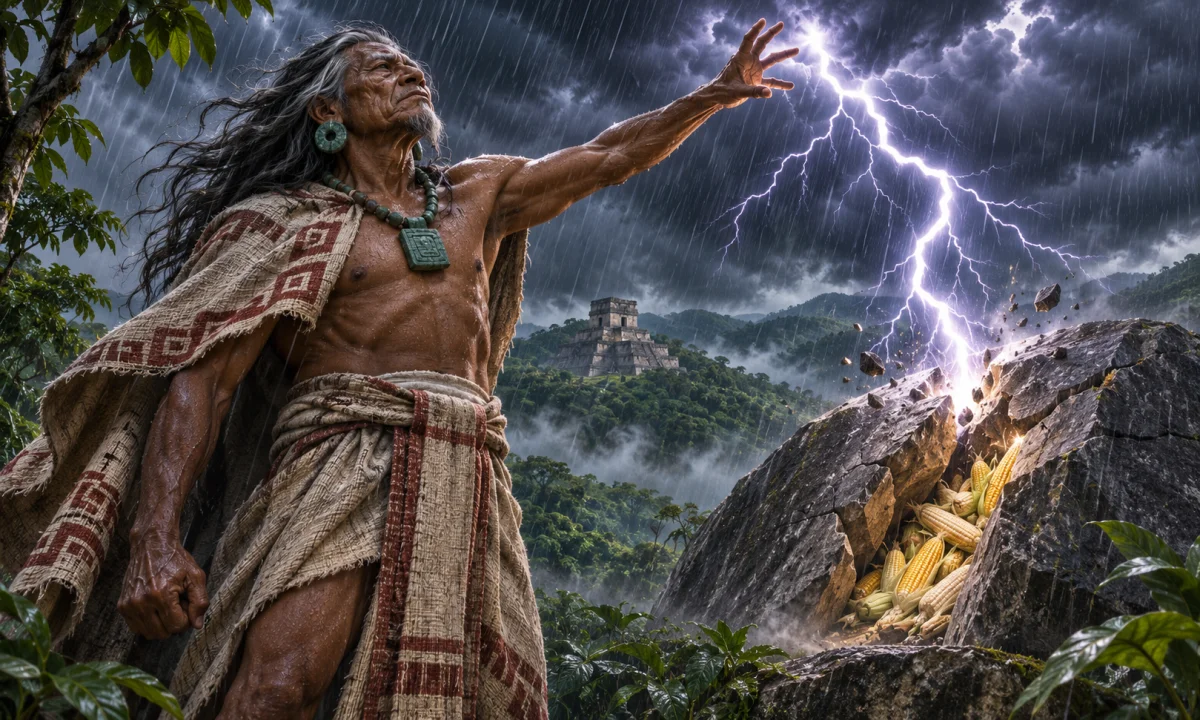
Traditional descriptions do not provide a universally agreed physical portrait of Xpiyacoc. The figure is not known from a single standard iconographic image comparable to the way some modern illustrations depict major gods from other mythological traditions. Images labelled with the name may reflect artistic interpretation, modern reconstruction or comparison with broader Maya visual materials rather than a securely identified ancient portrait.
Xpiyacoc’s most consistent attributes are conceptual:
- Primordial age: Xpiyacoc belongs to the earliest generation of creative beings.
- Grandparental authority: the figure represents seniority, ancestry and knowledge held by an older generation.
- Divination: Xpiyacoc participates in the sacred consultation used to decide how creation should proceed.
- Creative discernment: the figure is associated with judging whether attempts to make living beings have succeeded.
- Complementarity: Xpiyacoc’s role is closely linked with Xmucane rather than being presented as an isolated power.
These attributes support a reading of Xpiyacoc as a figure of wise creation. The creator must do more than produce bodies. A successful human being must possess speech, intelligence, memory and the ability to recognize obligations to the sacred powers. In the Popol Vuh, the repeated failures of creation reveal that personhood is tied to relationship and responsibility.
Maize and the completed creation of humanity
The final successful creation of human beings is made from maize, especially yellow and white maize dough. This episode is one of the most famous expressions of the central place of maize in Maya life and thought. Maize is not merely a crop or food; it is a substance connected with human identity, community and the continuation of life.
Xpiyacoc is not usually described as the exclusive creator of the maize people. The final making involves several divine powers, and the wording of translations varies. Nevertheless, Xpiyacoc’s earlier participation in the deliberations over humanity places the figure within the larger process that leads to the successful creation. The story links human existence to nourishment, agriculture, sacred speech and mutual obligations rather than to an abstract act of manufacture.
The maize creation also helps explain why a purely literal reading of Xpiyacoc as a “creator god” can be too narrow. The figure’s importance lies in the collective and consultative nature of the creation process. Different divine beings contribute to the making and ordering of a world in which humans are expected to remember, name and honour its sacred foundations.
Interpretations and uncertainties
Scholars have interpreted Xpiyacoc in several ways. Some emphasize the figure’s role as an ancestral creator and diviner. Others focus on the paired structure of Xpiyacoc and Xmucane, seeing it as an expression of generative duality or the importance of complementary powers. Another approach treats the pair as part of a complex network of older beings whose identities overlap in the narrative.
These interpretations are not mutually exclusive, but none should be presented as a final definition. The Popol Vuh is a layered work, and its terminology does not always correspond to modern categories such as “god,” “spirit,” “ancestor” or “mythological character.” Translation choices can also make a figure appear more clearly defined than the K’iche’ text itself requires.
It is equally important not to project the structure of the Aztec pantheon onto K’iche’ Maya tradition. Mesoamerica contained many related cultural patterns, but the peoples of the region did not share one uniform religion. Xpiyacoc is a K’iche’ figure known chiefly through the Popol Vuh, not a pan-Mesoamerican deity whose identity can be assumed across Maya and non-Maya cultures.
Modern reception
Xpiyacoc is less widely represented in popular culture than the Hero Twins or the name of Xibalba. The figure appears mainly in translations, retellings, academic discussions and contemporary artistic responses to the Popol Vuh. Modern illustrations may give Xpiyacoc an aged human form, priestly clothing or elaborate Maya-inspired ornament, but such details should be recognized as interpretation rather than universally attested traditional iconography.
For many readers, Xpiyacoc’s significance lies in the way the figure preserves a vision of creation as a communal, thoughtful and sacred process. The story does not treat humanity as complete merely because a body has been formed. Human beings must be capable of understanding, speaking, remembering and maintaining right relationships with the powers and community that sustain them. Within that wider vision, Xpiyacoc represents the ancient wisdom consulted before the world can become fully inhabited.