WORLD
WORLD
Wuni

Wuni is a figure associated with African mythology, especially in traditions from parts of the Sudan and the wider Nilotic cultural sphere, where details may vary by language group and by source. Because the name is not widely standardized in English-language reference works, its identity, spelling, and interpretation can be uncertain outside the communities where the tradition is preserved. In some accounts, Wuni is treated as a divine or culture-bearing being; in others, the name may appear in ways that are harder to separate from local oral tradition, translation choices, or later retellings. For that reason, careful treatment is important: Wuni belongs to living or remembered African religious and mythic traditions, but the surviving written record is limited and not always consistent.
In African mythology, figures like Wuni are often preserved primarily through oral tradition rather than through a single fixed scripture. That means stories can differ between tellers, villages, ritual contexts, and historical periods. A name may be rendered differently in colonial-era transcriptions, missionary records, ethnographic writing, or modern summaries. As a result, discussions of Wuni should be read with attention to local context rather than as a single unified mythological biography.
Origins and cultural setting
The cultural background of Wuni is linked to African religious traditions in which the world is understood through relationships among humans, ancestors, spirits, divinities, and the forces of nature. In many such traditions, a deity or spirit may be associated with creation, rain, fertility, morality, or social order. The exact role of Wuni depends on the community and the source. In some settings, the name may refer to a supreme being or sky-related power; in others, it may refer more broadly to a sacred or ancestral presence. Because the evidence is uneven, it is not always possible to give one definitive explanation that fits all reported uses of the name.
When Wuni is discussed in relation to African mythology, it is usually best understood against a background in which oral knowledge, ritual practice, and local language shape the meaning of divine names. Names in such traditions are rarely simple labels. They may carry meanings connected to speech, authority, holiness, or cosmology. A being’s name can also be a clue to how a community experiences the sacred: through weather, prosperity, social harmony, or the ordering of the universe.
Historical evidence for Wuni is limited compared with the better-known deities of Africa that have been recorded more extensively in print. Much of what can be said comes from ethnographic descriptions, oral accounts, and comparative interpretation. That does not make the tradition less significant; it simply means that the record is fragmentary and sometimes difficult to interpret with confidence.
Name and identity
The name Wuni may appear in different spellings or pronunciations depending on the source language and the person recording it. In African oral traditions, transliteration into English can flatten distinctions that matter in the original language. A single English spelling may conceal several possible pronunciations, or one community’s name may be recorded in a way that resembles another’s while referring to a different figure altogether. That is one reason caution is necessary when identifying Wuni.
In some interpretations, Wuni is treated as a creator or high god. In others, the name may not indicate a fully systematized creator deity in the style familiar from later comparative religion; instead, it may denote a powerful sacred presence whose influence is felt in the natural and moral world. Depending on the local tradition, Wuni may stand above other spirits, work through intermediaries, or be invoked in relation to the sky, rain, or cosmic order. None of these roles should be assumed universally without specific evidence from the relevant community.
It is also important not to merge Wuni with similarly named figures from other regions or languages simply because the names sound alike. African mythology is highly diverse, and similar-sounding names can belong to unrelated traditions. A responsible account must keep local identities distinct.
Roles, attributes, and symbolism
Where Wuni is understood as a divine or supreme being, the figure is associated with authority, distance, and overarching power rather than with a narrow set of human-like adventures. Such beings are often described less through appearance than through function. They may be credited with establishing the world, setting moral boundaries, or governing the conditions under which life continues. In traditions of this kind, the deity’s significance lies in maintaining order and blessing, not in possessing a fixed visual form.
If Wuni is linked to the sky or weather, that association carries symbolic weight. In many African cosmologies, the sky is not merely a physical expanse but a realm of power, visibility, and transcendence. Rain can signify life, renewal, and divine favor. A sky-related deity may therefore be invoked in relation to agriculture, fertility, and communal well-being. Such connections are common across many African religions, but the exact meaning in Wuni’s case depends on the tradition being discussed.
In moral terms, high gods in African traditions are often connected with justice, order, or the consequences of human conduct. They may be considered remote in ordinary life, yet still active in the structure of the universe. Wuni, where identified in this way, can be understood within that broader pattern: a sacred power that frames human existence, even if worship or ritual attention may be directed more often to ancestors, spirits, or local powers.
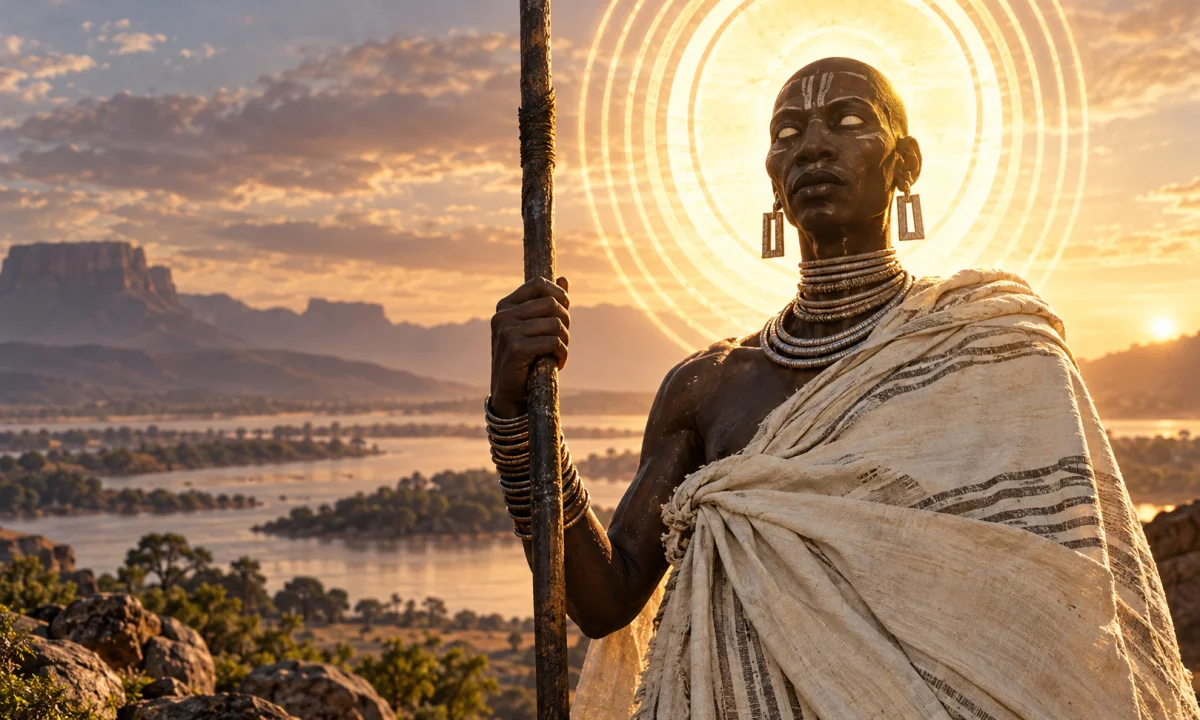
Because surviving traditions are limited, it is not safe to assign precise iconography to Wuni. No universally accepted description of the figure’s appearance should be assumed. In many African traditions, especially those centered on supreme beings, visual representation may be rare, indirect, or highly local. The emphasis is often on power, speech, and presence rather than on bodily depiction.
Stories and oral traditions
Specific myths involving Wuni are not consistently documented in a single canonical form. This is typical of oral traditions, in which stories may be remembered for different purposes: explaining the origin of customs, teaching social values, or situating humanity within a sacred cosmos. If Wuni is a creator or high deity in a particular community, stories may describe acts of ordering rather than dramatic conflict. Such accounts often explain how the heavens, earth, rain, or human society came into being, or why divine presence is perceived as distant.
Where creation stories exist, they may emphasize that the world was shaped through divine intention, separation of cosmic elements, or the institution of social and natural law. In many African mythic systems, the most powerful being is not always the most narratively active. The figure may be recalled more through consequences than through episodic adventure. That makes Wuni harder to summarize in the same way as a heroic trickster or warrior god.
Relationships with other beings, if reported, should also be handled carefully. Some traditions feature subordinate spirits, ancestral figures, or other divine entities that interact with a supreme being. However, unless a source clearly identifies such relationships in the specific tradition associated with Wuni, they should not be generalized from elsewhere. African mythologies are diverse, and shared patterns do not guarantee identical genealogies or hierarchies.
In some settings, oral tradition may preserve prayers, praise names, or ritual references to Wuni rather than elaborate narrative myths. These are valuable sources of meaning even when they do not take the form of a story. A name invoked in ritual can reveal far more about a community’s understanding of the sacred than a later outsider’s summary. Where that is the case, Wuni’s importance lies in lived religious practice as much as in mythic storytelling.
Religious and cultural significance
Wuni’s significance, where recognized, is rooted in the way African religious traditions connect cosmology with daily life. A divine or sacred figure is not merely “mythological” in the sense of being imaginary or decorative. Such a being may help explain why the world has order, why moral behavior matters, why natural events are meaningful, and how human beings relate to powers beyond themselves.
In traditions that honor a supreme being, that being is often not approached in the same way as ancestral spirits or local divinities. The supreme being may be acknowledged in prayer, invoked in oaths, or referred to in moral speech, while ritual attention is distributed among other sacred presences. If Wuni functions in this role, then the figure can be seen as part of a layered religious world rather than as the sole focus of devotion.
The cultural significance of Wuni also lies in the preservation of local identity. Names carried through oral memory often encode historical continuity and communal belonging. Even when written records are sparse, the endurance of the name suggests that it held meaning within a particular social and spiritual landscape. In that sense, Wuni is important not only as a mythic being but also as a marker of cultural memory.
Scholarly interpretation of such figures can be shaped by older assumptions that tried to classify African religions according to Western models. Earlier writers sometimes labeled African deities as “gods” in a broad and imprecise way, without respecting local distinctions between creator beings, spirits, ancestors, and ritual powers. Modern scholarship is more cautious, recognizing that translated terms can obscure as much as they reveal. Wuni should therefore be understood through the specific conceptual world of the tradition, not forced into an external template.
Possible confusion with similar names
Because the name Wuni is not globally standardized, confusion can arise with unrelated names from other African cultures or from modern contexts. Similar-looking spellings should not be taken as evidence of a shared origin. African languages contain many distinct naming systems, and transcribed English forms can hide important differences in pronunciation and meaning.
There is also a risk of confusing Wuni with generalized references to gods or spirits in African religion. Although comparative studies can be useful, they should not erase local specificity. A deity in one community may have a different status, gender, role, or cosmological function in another. If a source does not clearly identify Wuni’s cultural setting, any statement about the figure should remain tentative.
Another source of confusion comes from modern encyclopedic or internet retellings that may repeat one another without checking the original context. This can produce inflated certainty around uncertain details. With Wuni, the safest approach is to preserve the uncertainty rather than invent a neat profile where the evidence does not support one.
Modern reception and popular culture
Wuni does not appear to have a substantial presence in global popular culture, and there is no well-established modern fictional tradition centered on the figure comparable to those surrounding some better-known mythic beings. For that reason, modern adaptation is not a major part of Wuni’s reception history.
Where the name does appear today, it is more likely to be in discussions of African religion, folklore, or cultural heritage than in novels, films, or games. In those contexts, the main issue is often accuracy: whether a modern writer respects the original tradition or reduces it to a generic “African god” without local detail. That problem matters because African mythological traditions are often misrepresented as interchangeable when they are not.
Any modern reference to Wuni should therefore be read with care. If it comes from scholarship, it may reflect a cautious attempt to reconstruct a fragmentary tradition. If it comes from popular culture, it may be freely imaginative and should not be treated as evidence for the older belief system. Traditional material and modern reinvention are related, but they are not the same thing.
Why Wuni matters in the study of African mythology
Wuni is significant precisely because the figure illustrates how much African mythology depends on local memory, oral transmission, and careful interpretation. Not every sacred figure survives in abundant written form, and not every tradition fits neatly into the categories familiar from classical or biblical mythology. Some names survive in partial records, in community practice, or in scholarly notes that preserve only a glimpse of a much larger tradition.
The study of Wuni also shows why it is important to distinguish between tradition, scholarship, and modern retelling. Traditional meaning comes from the communities that preserve the figure. Scholarly interpretation tries to describe that meaning responsibly, often with gaps and uncertainties. Modern retellings may inspire interest but can also distort the record if they ignore local context.
In African mythology, divine figures are often embedded in a worldview where the sacred is present in nature, society, and memory. Wuni belongs to that broader pattern, even if the surviving information is incomplete. The figure’s importance lies not in a fixed universal profile, but in the particular tradition that preserves the name and in the cultural values that the name continues to represent.