WORLD
WORLD
Wishpoosh
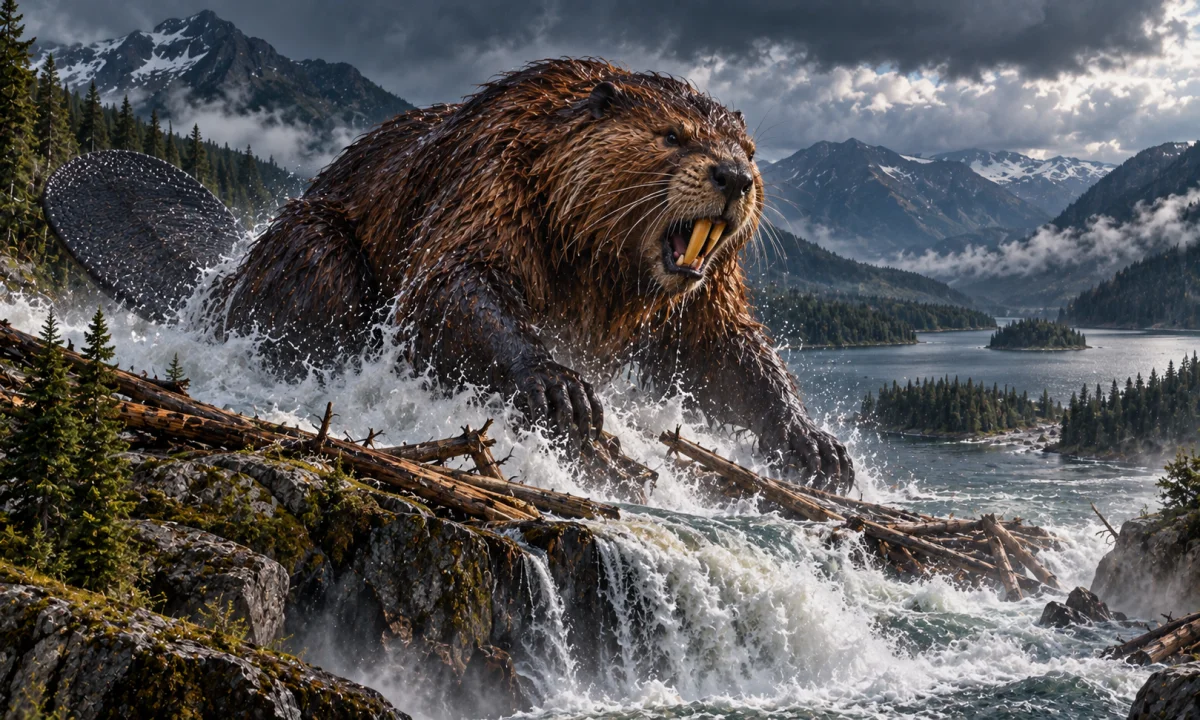
Wishpoosh is a giant beaver associated especially with traditional stories of the Columbia Plateau, including traditions connected with the Nimiipuu, commonly known as the Nez Perce, and neighboring Indigenous peoples of the Pacific Northwest. In these stories, Wishpoosh is not simply an unusually large animal. He belongs to a mythic age when powerful beings shaped the landscape, and his conflict with Coyote is linked in some versions to the formation of rivers, lakes, and other features of the Columbia River system.
The name and story do not represent one universally fixed figure shared by every Native nation. Oral traditions vary from community to community, and English-language retellings often combine details that may come from different tellers or regions. Spellings also differ, although Wishpoosh is the form most frequently encountered in modern discussions. The figure is best understood within the cultural setting of the Columbia Plateau rather than as a generic “Native American monster.”
Cultural setting
The Columbia Plateau lies between the Cascade and Rocky Mountains and includes the inland river country of what are now Washington, Oregon, Idaho, and parts of British Columbia. Many Indigenous nations have longstanding relationships with this region, including the Nimiipuu, Yakama, Umatilla, Warm Springs, Wasco, and other peoples. Their languages, histories, and narrative traditions are distinct, even where communities share themes, places, or figures.
Traditional stories from the Plateau frequently describe a time before the world had its present form. In that earlier age, animals and other beings could speak, act with extraordinary power, and take part in the transformation of the earth. Coyote is one of the best-known figures in this group of stories. Depending on the tradition and the particular narrative, Coyote may be a creator, transformer, culture hero, trickster, or dangerous and unpredictable traveler. These descriptions should not be treated as interchangeable labels: the meaning of Coyote changes according to the community and story.
Stories about beings such as Wishpoosh belong to a broader body of traditional knowledge about rivers, animals, places, human conduct, and the ordering of the world. They are not merely explanations invented to account for scenery. A narrative can preserve relationships with a landscape, express ideas about power and responsibility, and connect particular places with ancestral or sacred history.
Name and identity
Wishpoosh is generally described in English as a giant beaver. Some retellings call him a water monster, but that phrase can be misleading if it suggests a creature from a separate European-style monster tradition. His identity as a beaver is important. The beaver is a real and influential animal of the region, associated with waterways, ponds, dams, and the reshaping of habitats. Enlarged to supernatural scale, it becomes a being capable of changing the whole landscape.
The English spelling Wishpoosh reflects the difficulty of representing Indigenous names in another language. Historical publications used varying spellings and occasionally altered pronunciations according to the conventions of English-speaking collectors. A spelling found in one book should not automatically be assumed to be the only traditional form. The exact linguistic origin and preferred spelling may also depend on the community and language in question.
It is therefore more accurate to describe Wishpoosh as a figure found in certain regional traditions than to claim that all Native American peoples recognize him. The broad label “Native American mythology” is useful for classification, but it conceals the specific cultural and geographical setting in which the stories have meaning.
Appearance and powers
Wishpoosh is imagined as immensely larger and more powerful than an ordinary beaver. Descriptions in English retellings emphasize his size, strength, and command of the water. He may be portrayed as living in a lake or another deep body of water, where his movements disturb the surrounding country. The precise location and physical details vary, and not every account gives the same setting.
His powers are usually shown through action rather than through a formal list of magical abilities. Wishpoosh can move through the water with tremendous force, resist ordinary attempts to defeat him, and affect the course of rivers or shorelines. In some accounts, his struggle with Coyote causes violent changes in the terrain. These effects make him a being of landscape-scale power, not merely a large animal encountered by chance.
The beaver’s ordinary behavior also provides an important layer of meaning. Beavers alter watercourses by building dams and creating wetlands. A supernatural beaver who opens, blocks, or redirects waterways expands this familiar ecological activity into a mythic act of world-making. The story does not require the listener to separate nature from culture in the modern way. Animal behavior, geography, and sacred history can all be part of one account of how the world became as it is.
The conflict with Coyote
The best-known narrative involving Wishpoosh concerns his confrontation with Coyote. The details differ among retellings, but the central pattern is consistent: Coyote and the giant beaver become opponents, and their struggle is so powerful that it reshapes the land.
Some versions place Wishpoosh in a lake or large body of water and describe Coyote as provoking, pursuing, or attempting to overcome him. Other summaries emphasize a contest between two beings whose powers are difficult to control. The conflict may involve pursuit through connected waterways, violent movement across the country, or a battle in which Coyote ultimately gains the advantage. Because the tradition has been transmitted orally and later recorded by outsiders in English, it is unwise to treat one compact retelling as the definitive version.
The struggle is often connected with the creation or alteration of the Columbia River and its surrounding geography. Rivers, channels, lakes, and canyons may be presented as traces of the combat. In this sense, the story is a transformation narrative: a dramatic event in mythic time accounts for the shape and character of the living landscape.
Many modern summaries state that Coyote kills Wishpoosh. That ending appears in some versions and retellings, but the circumstances and consequences are not uniform. Some accounts focus less on a final death than on the contest itself and the changes it brings about. Details such as the exact lake, the route taken, the weapons used, or what happens to Wishpoosh afterward should be attributed only when a particular version clearly supports them.
Coyote and the meaning of the contest
Coyote’s opposition to Wishpoosh does not necessarily represent a simple battle between good and evil. Coyote is often a complicated transformer whose actions produce beneficial results through methods that can be reckless, comic, deceptive, or destructive. Wishpoosh, meanwhile, is not always presented as morally evil. His danger may arise from his immense power, his refusal to yield, or the threat that his actions pose to other beings.
The contest can be read as a meeting between different kinds of power. Wishpoosh represents the overwhelming force of deep water and animal strength. Coyote represents mobility, cunning, persistence, and the capacity to alter the conditions of a challenge. Yet this interpretation should remain modest. Indigenous stories do not need to be reduced to a single symbolic formula, and meanings can differ between tellers and communities.
The narrative also shows that creation may involve conflict rather than orderly construction. A river or canyon can be the result of struggle, danger, and loss. The resulting landscape is not disconnected from the beings who shaped it. Places retain narrative identity because the events associated with them continue to matter.
Landscape and cultural significance
Stories about Wishpoosh are closely tied to the waterways of the Northwest. The Columbia River and its tributaries have long supported fishing, travel, trade, ceremony, and community life. Salmon, in particular, occupy profound cultural importance for many Columbia Plateau peoples, although the exact traditions surrounding salmon differ among nations. A story about a powerful being in the water therefore takes place within a world where rivers are central to survival, history, and spiritual relationship.
The giant beaver’s connection with water also encourages attention to the agency of animals. In many Indigenous traditions, animals are not merely passive resources or decorative characters. They may be relatives, teachers, powerful persons, or participants in the moral and historical order of the world. It would be inaccurate to assign one general Native American doctrine to every tradition, but Wishpoosh can be understood as part of a narrative environment in which animal beings possess significance beyond their physical appearance.
The story’s association with geographic change does not make it a primitive geological theory. Such a judgment imposes a narrow modern standard on a different kind of knowledge. A traditional narrative may simultaneously connect people with a place, teach ways of thinking about power, preserve a history of relationships, and explain why a landscape is encountered as meaningful. Its importance is not exhausted by whether it resembles a scientific account of erosion or river formation.
Sources and transmission
Knowledge of Wishpoosh has reached wider English-speaking audiences through published collections of Pacific Northwest and Columbia Plateau legends, as well as through school materials, museum interpretation, websites, and contemporary retellings. Most such publications record a particular version told by a particular person or collected under specific historical circumstances. They should not be treated as complete records of a living tradition.
Collectors and editors often translated, shortened, rearranged, or retitled Indigenous narratives. Older publications may also use broad tribal labels, omit the name of the original teller, or present a story as if it belonged equally to all peoples of the region. These limitations matter when assessing statements about Wishpoosh. A careful account distinguishes between what a traditional community preserves, what an individual teller relates, and what a later editor has chosen to emphasize.
There is also a difference between a story’s traditional context and its status in contemporary community life. Some narratives remain part of living cultural knowledge, while others are primarily encountered through historical records or public retellings. Outsiders should not assume that a published legend provides permission to reproduce every cultural detail or to treat sacred knowledge as entertainment.
Distinguishing Wishpoosh from other water beings
Wishpoosh is sometimes confused with other powerful water figures from the Pacific Northwest. The region contains many distinct traditions concerning serpents, lake beings, river monsters, thunder beings, and other supernatural figures. Similarities in size, habitat, or danger do not make these beings versions of one another.
In particular, Wishpoosh should not automatically be identified with Native water serpents, with the Coast Salish žəɬgʷ or other culturally specific beings, or with the modern “lake monster” category. He is specifically associated in the relevant stories with a giant beaver and with the Coyote transformation cycle. Names that sound similar in English may also refer to unrelated figures, places, or words from different Indigenous languages.
Nor should Wishpoosh be confused with ordinary beaver folklore from Europe or with the North American cryptid tradition surrounding alleged lake creatures. The giant scale is supernatural, but the narrative framework is rooted in Indigenous stories of the Columbia Plateau rather than in modern cryptozoology.
Modern retellings
Wishpoosh appears today in educational discussions of Pacific Northwest mythology, regional storytelling, children’s retellings, and general collections of legendary creatures. These adaptations often highlight the dramatic image of a giant beaver battling Coyote and shaping the Columbia River. That imagery can introduce readers to an important regional tradition, but simplified versions may remove the story from its Nimiipuu and Columbia Plateau setting.
Modern popular culture also tends to classify figures as “monsters,” a category that can flatten differences between dangerous animals, sacred beings, culture heroes, and landscape-transformers. For Wishpoosh, the word is most useful when it refers to his enormous and threatening form, not when it implies that the traditional story is simply a tale of horror.
A respectful retelling keeps the geographical and cultural context visible, acknowledges variation, and avoids presenting one English version as the final or universal account. Wishpoosh is most significant not as a generic giant creature, but as a powerful beaver being whose encounter with Coyote belongs to a larger Indigenous understanding of animals, waterways, transformation, and the living history of the Columbia Plateau.