WORLD
WORLD
Weywot
Weywot is a figure associated with the traditional mythology of the Tongva, an Indigenous people of the Los Angeles Basin and the Southern Channel Islands in present-day California. In commonly circulated accounts of Tongva creation tradition, Weywot is a sky being brought into existence by the creator Quaoar. Weywot then takes part in the ordering of the world, often alongside Chehooit, an earth goddess. The surviving information about Weywot is limited, and different modern retellings do not always agree about his exact status, relationships, or role.
Cultural setting
The Tongva have also been known historically as the Gabrielino or Fernandeño, names connected with Spanish Catholic missions. Many people today use Tongva, although questions of community identity, naming, and historical terminology are complex. Their traditional homeland included what is now Los Angeles County, parts of Orange and Riverside Counties, the coast around San Pedro Bay, and islands such as Pimu, now commonly called Santa Catalina Island.
Tongva religious knowledge was transmitted primarily through oral tradition, ceremony, storytelling, and relationships with the landscape. It was not originally preserved in a single canonical scripture or a fixed mythology comparable to the sacred books of some literate religious traditions. Missionization, epidemic disease, forced settlement, land dispossession, and the suppression of Indigenous practices severely affected the transmission of Tongva cultural knowledge.
As a result, accounts of Weywot usually appear in brief summaries of Tongva or Gabrielino creation traditions rather than in a large, continuous body of traditional narratives. Some details may reflect later interpretation, imperfect transcription, or the attempt of non-Indigenous writers to express Indigenous concepts through categories such as “god,” “goddess,” or “creator.” Those terms can be useful for orientation, but they should not be assumed to reproduce the full meaning of Tongva religious ideas.
Name and identity
The name is commonly written Weywot, though spelling can vary in English-language sources. Such variation is not unusual when Indigenous names were recorded by outsiders using different orthographies or through languages that did not share the original sound system. The available material does not establish one universally accepted English spelling or a single detailed biography.
Weywot is generally described as a sky being or sky deity. In many modern summaries, he is called the son of Quaoar. Other accounts describe him more cautiously as a being created or produced by Quaoar. The difference matters because the relationship may not have been intended as a simple biological parent-child relationship. In creation narratives, words such as “son,” “child,” or “offspring” can be attempts to translate a relationship of emergence, succession, kinship, or dependence.
Weywot should not be treated as a universally defined “sky god” with a standardized set of attributes. The short accounts that survive do not provide a consistent physical description, personal genealogy, list of powers, or calendar of festivals. His importance comes mainly from his place in a creation sequence associated with Quaoar and the formation of the ordered world.
Weywot in creation tradition
The best-known outline begins with Quaoar, who is represented as a powerful creator. In widely repeated versions, Quaoar creates or sings and dances Weywot into existence. Creation here is not necessarily portrayed as manufacture by a craftsman working with pre-existing materials. Song, dance, speech, and movement are presented as active forces through which beings and cosmic structures come into being.
Weywot is then associated with the sky. Some retellings state that he creates Chehooit, the earth goddess, while others describe the two as cooperating in the creation or arrangement of the world. Their relationship is therefore often presented as complementary: Weywot represents the upper or celestial realm, while Chehooit represents the earth. This pairing gives the creation story a structure based on the interaction of different cosmic domains rather than on a single creator acting alone.
Accounts commonly continue by saying that Weywot and Chehooit, or the successive divine beings, bring forth or establish the sun, moon, stars, and other features of the cosmos. The exact order varies. Some summaries also mention animals or other beings, but the surviving popular accounts are not sufficiently consistent to support a single authoritative sequence.
It is important not to turn this outline into a complete fixed cosmogony. The story has often been reduced to a few sentences in reference works, and the reduction can make the tradition appear more uniform than the evidence permits. Oral traditions may contain multiple versions, and a short written record may preserve only one portion of a much larger body of knowledge.
Attributes and cosmic role
The sky
Weywot’s principal association is with the sky. This role places him within a layered or relational understanding of the cosmos, in which the sky, earth, celestial lights, animals, humans, and other beings have connected origins and functions. The sky is not merely a location above the earth; in the creation narratives, it is part of the active formation of the world.
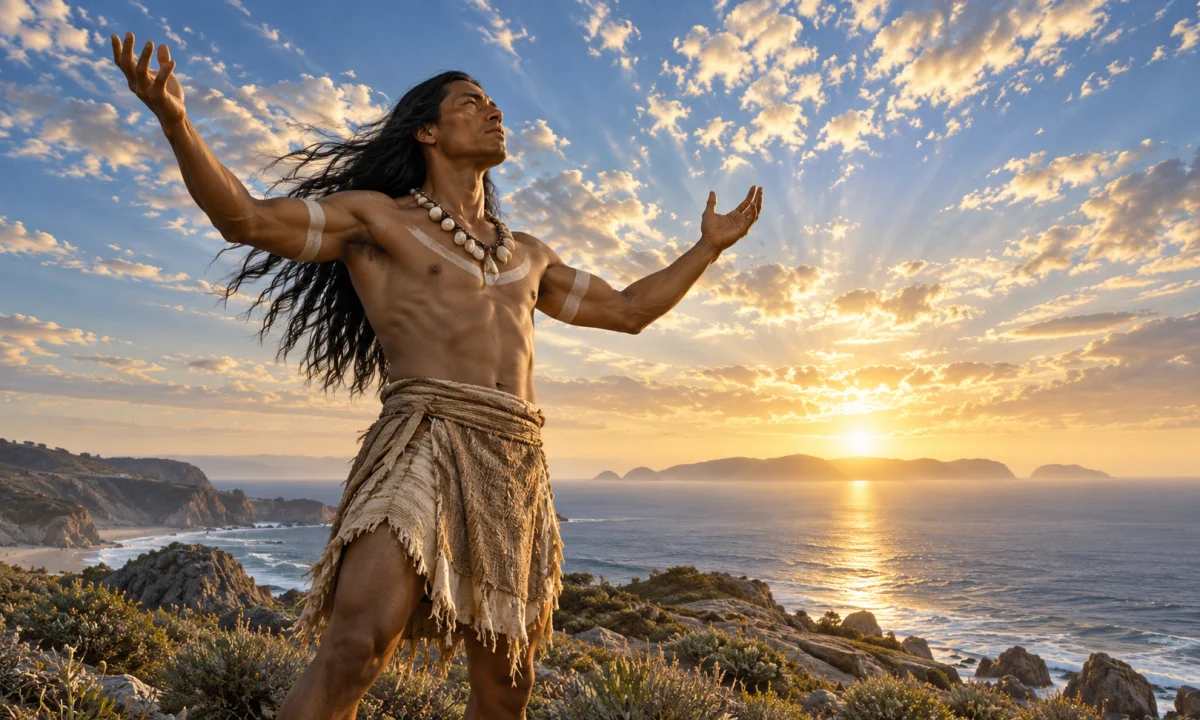
Descriptions of Weywot do not usually provide a detailed anthropomorphic appearance. He is not consistently portrayed with particular clothing, weapons, animals, colors, or emblems. Illustrations that give him a definite visual form are therefore modern artistic interpretations rather than established features of the traditional record.
Creation through song and movement
The association of creation with singing and dancing is one of the most notable features of the Quaoar cycle. In this setting, Weywot’s emergence is part of a process in which sound and movement have generative power. The idea should not be treated simply as decorative storytelling. It suggests that performance, rhythm, and ceremonial action can express or participate in the maintenance of cosmic order.
Because the available summaries are brief, it is difficult to determine exactly how Weywot’s role related to ceremonial practice in different Tongva communities. There is no sound basis for assigning him a specific ritual office, temple, priesthood, or set of prayers without additional evidence. His mythological association with the sky is clearer than any detailed account of his worship.
Relationship with Chehooit
Chehooit is often identified in modern accounts as an earth goddess connected with Weywot. Their pairing is sometimes interpreted as a union of sky and earth, with the two participating in the creation of celestial bodies and the wider world. This interpretation is reasonable as a broad description of the narrative structure, but it should not be expanded into an elaborate marriage myth or fertility cult unless a particular tradition clearly supports those details.
The names and descriptions of other beings in the creation sequence also vary. Some sources present Quaoar, Weywot, and Chehooit as successive creators; others emphasize a collective process in which different beings contribute to the establishment of the world. These differences may result from variations in oral tradition, translation, or the way later writers organized the material.
Quaoar and the problem of simplified genealogies
Weywot is most often encountered through accounts of Quaoar. In those accounts, Quaoar is sometimes called the creator god of the Tongva and is described as singing and dancing the world into existence. Weywot’s place immediately after Quaoar has led many reference works to describe him as Quaoar’s son.
That genealogy should be read with care. “Son” is a convenient English label, but it may impose a familiar family structure on a creation relationship that was understood differently in the original cultural context. It also gives the impression that Weywot possesses a large, clearly recorded divine family, when in fact only a small number of connected names are regularly preserved in modern summaries.
Neither Quaoar nor Weywot should automatically be equated with a single all-powerful creator in the theological sense used by European Christianity. Such comparisons can obscure the distinctive character of Tongva cosmology. The available accounts instead describe a world brought into being through a sequence of relationships, transformations, and acts of creative performance.
Sources, transmission, and uncertainty
The written record for Weywot is much thinner than the records for many figures from better-documented mythological traditions. Information about Tongva religion was collected under colonial conditions, often by missionaries, travelers, ethnographers, or later compilers. These records may preserve valuable fragments, but they can also omit ceremonial context, simplify Indigenous concepts, or render names inconsistently.
Modern websites and popular reference works frequently repeat a compact creation story: Quaoar creates Weywot; Weywot creates Chehooit; and the succeeding beings establish the sun, moon, stars, and world. This outline is useful, but repetition does not by itself prove that every detail was preserved in the same form across all Tongva communities.
There is also a difference between traditional knowledge and modern mythographic reconstruction. A modern writer may arrange several names into a neat genealogy or assign each figure a single domain, such as “sky god” or “earth goddess.” That arrangement can clarify the story for general readers, while still being less precise than the original oral and cultural context. Claims about Weywot should therefore distinguish between what is broadly repeated and what is securely documented.
Distinction from similar names
Weywot should not be confused with the Wiyot, an Indigenous people and language traditionally associated with the northern California coast, particularly the Humboldt Bay region. The similarity of the English spellings does not indicate that Weywot belongs to Wiyot mythology. Weywot is generally associated with Tongva or Gabrielino traditions of Southern California.
Weywot also should not be merged with unrelated sky beings from other Native American traditions. “Sky god,” “creator,” and “earth goddess” are broad comparative labels used across many cultures, but they do not establish identity or common origin. Indigenous peoples of North America have distinct languages, histories, ceremonies, and cosmologies, even when their traditions contain themes that appear superficially similar.
Modern reception
Weywot received a notable modern scientific association when the small natural satellite of the trans-Neptunian object Quaoar was named Weywot. The naming reflects the connection between the astronomical object Quaoar and the Tongva creation figure. In the mythological relationship, Weywot is linked with Quaoar; in astronomy, the name identifies a moon orbiting the dwarf-planet candidate commonly known as Quaoar.
The astronomical use of the name has increased Weywot’s visibility beyond discussions of Tongva tradition. It does not, however, add new information about the traditional figure’s mythology. Nor should the moon’s physical characteristics be treated as symbolic attributes of Weywot. The name is a modern scientific commemoration based on a traditional figure, not evidence for additional ancient beliefs about planetary bodies.
For the traditional material, the most responsible approach is to preserve Weywot’s connection with Tongva creation narratives while acknowledging the limits of the surviving record. He is best understood as a sky-associated being in a creation cycle involving Quaoar and Chehooit, rather than as a fully documented deity with a fixed appearance, extensive mythology, or universally agreed genealogy.