WORLD
WORLD
Utset
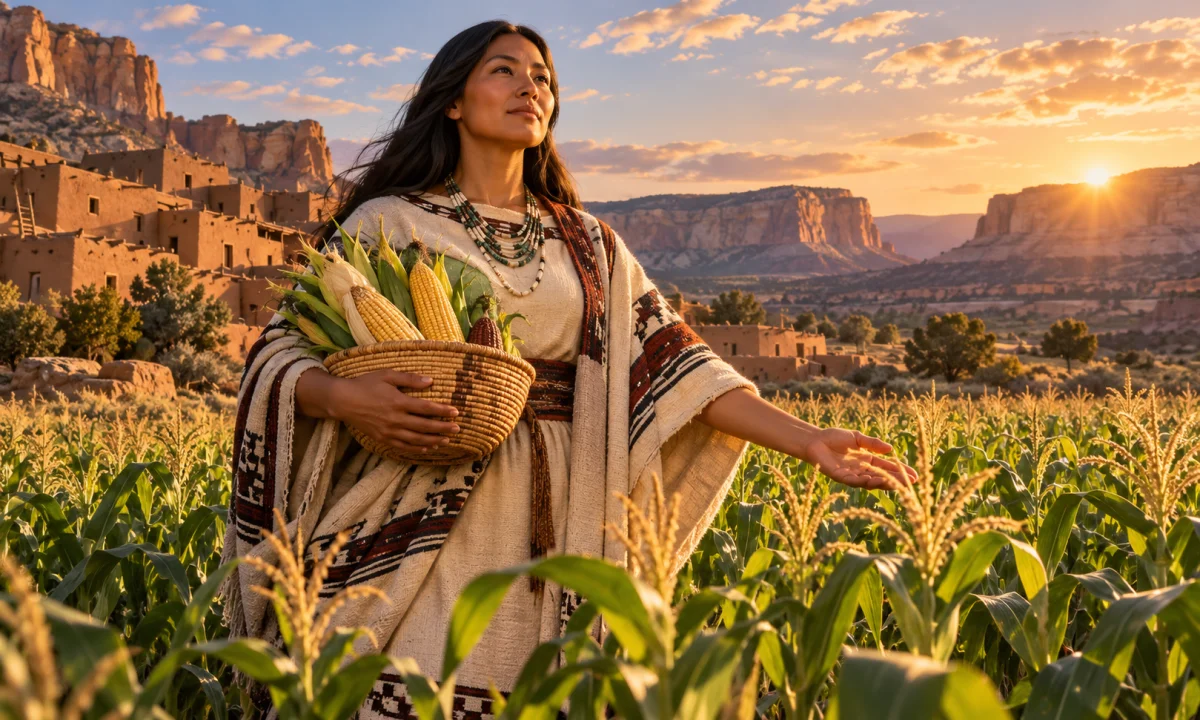
Utset is a name associated in some modern reference works with a female creator or earth-mother figure of the Pueblo peoples of the American Southwest. The identification is uncertain, however. “Pueblo” does not describe one single ancient religion, but a group of distinct Indigenous communities with different languages, histories and ceremonial traditions. There is no universally recognized pan-Pueblo mythology in which Utset has a fixed, standardized role.
Descriptions of Utset are usually brief. She is commonly labelled a creator goddess, Mother Earth or mother of divine beings, but these titles may reflect later classification rather than a name and identity consistently preserved across Pueblo communities. A careful account must therefore distinguish between what is repeated in modern summaries and what can be securely attributed to a particular traditional community.
Origins and cultural setting
The Pueblo peoples include communities such as the Hopi, Zuni, Acoma, Laguna, Taos, Isleta, and many others belonging to several language families. Their religious traditions developed in specific villages and regions rather than as a single system. Related themes can occur across Pueblo cultures—emergence from an underworld, the importance of maize, sacred directions, rain and clouds, ancestral beings, and obligations between humans and the more-than-human world—but similar themes do not necessarily indicate identical gods.
This distinction is especially important when interpreting names such as Utset. A short entry in a nineteenth- or twentieth-century compilation may group together figures from separate communities, translate a title as though it were a personal name, or assign a familiar European category such as “goddess” to a being whose traditional role is more complex. In Pueblo religious contexts, beings described in English as gods, spirits, ancestors or culture heroes may not fit neatly into those categories.
Pueblo knowledge has been preserved through oral transmission, ceremonial practice, community memory and, in some cases, written records made by outsiders. Published ethnographic accounts do not represent the whole of a tradition. Some ceremonies and teachings are private, restricted or not intended for public explanation. Consequently, the absence of a detailed account of Utset does not prove that no related local tradition exists; it does mean that confident claims about a single, universal Utset are not justified.
The name and identity of Utset
The spelling Utset is not associated with one universally agreed orthography. It appears mainly in generalized mythology references rather than in a large, clearly defined body of community-specific material. The name may represent a variant transcription, a rendering of a word from an Indigenous language, or a form that was detached from its original cultural setting during compilation.
Modern summaries generally place Utset within a broad Pueblo context and describe her as a female creative power. Some identify her with the earth or with the generative principle that makes life possible. Others present her as a mother of gods or as a primeval being connected with the formation of the world. These descriptions should be treated as attributions found in secondary summaries, not as evidence of a single doctrine shared by all Pueblo peoples.
It is also uncertain whether “Utset” was originally a personal name, a title, or a name that has been altered through translation and transcription. Without a securely identified community, language, storyteller or traditional text, the exact meaning of the name cannot be stated with confidence.
Attributes and traditional interpretation
Where Utset is described, her principal attribute is usually generative power. The earth-mother interpretation connects her with fertility, birth, nourishment and the continuation of life. Such associations are broadly compatible with the importance of the earth and maize in many Pueblo traditions, but they should not be used to impose one uniform image on every Pueblo religion.
References may also describe Utset as a creator or as an ancestral mother. The word “creator” can be misleading if it suggests creation from absolute nothingness in the manner of some Western theological systems. Many Indigenous creation traditions are concerned instead with emergence, transformation, ordering, separation of realms, the arrival of light, or the establishment of proper relationships. A figure called a creator in English may therefore be one participant in a larger process rather than an all-powerful maker of everything.
There is no securely documented, community-wide description of Utset’s physical appearance. Claims that she has a particular costume, animal form, weapon, dwelling or set of sacred objects should not be treated as traditional unless they can be connected to a specific Pueblo source. The same caution applies to claims about omnipotence, immortality, marriage, offspring or a fixed place in a divine hierarchy.
Stories and relationships
No single canonical story of Utset is consistently preserved in the available general accounts. In particular, there is no reliable basis for presenting one detailed creation narrative as the definitive “myth of Utset” for all Pueblo peoples. Stories labelled as hers may result from the combining of motifs or figures that belong to different traditions.
Several Pueblo traditions do contain important female ancestral or creative beings, but they are not automatically Utset. In Hopi religious tradition, for example, figures such as Spider Woman, Huruing Wuhti and other sacred beings have distinct roles within particular accounts. Hopi emergence narratives also involve beings such as Sotuknang and Taiowa. These names and relationships should not be reassigned to Utset merely because both sets of traditions concern creation or the earth.
Zuni traditions likewise include their own sacred beings and accounts of emergence, ancestry, maize and the ordering of the world. Keresan-speaking communities, including Acoma and Laguna, preserve distinctive traditions with their own names, genealogies and ceremonial contexts. Tewa, Tiwa and Towa communities also have different religious histories. A generalized label such as “Pueblo goddess” cannot replace those specific cultural identities.
- Hopi figures belong to Hopi religious and ceremonial traditions and should not be treated as interchangeable with a generalized Utset.
- Zuni sacred beings arise from Zuni language, history and ritual context and are not simply alternate names for a pan-Pueblo deity.
- Keresan, Tewa, Tiwa and Towa figures likewise have community-specific identities, even when their stories share broad themes.
- Earth-mother language may be an English interpretive label rather than a traditional name used by the community concerned.
Symbolism and cultural significance
The symbolic interpretation of Utset as an earth or mother figure reflects a common tendency to understand creation through birth, nourishment and reciprocity. In many Pueblo worldviews, the earth is not merely an inert substance or a backdrop for human history. Land, water, plants, animals, clouds, ancestors and human communities participate in networks of responsibility. Maize in particular is central to many Pueblo lifeways and religious understandings, although the meanings attached to it vary between communities.
Calling Utset “Mother Earth” can communicate something about generative imagery, but it can also flatten important distinctions. Pueblo traditions do not necessarily divide the world into a purely material earth and a separate supernatural realm. Sacred power may be encountered through places, weather, agricultural cycles, ancestral presence, ritual performance and relations with nonhuman beings. A female creator figure, where recognized, would need to be understood within those relationships rather than as an isolated goddess in a classical-style pantheon.
The limited evidence surrounding Utset also illustrates a wider problem in the study of Indigenous religions. Early collectors and later popular writers often searched for equivalents to familiar categories such as “chief god,” “sun god,” “goddess” or “mythological pantheon.” These categories can obscure systems in which sacred beings have multiple forms and roles, where stories vary by context, and where religious knowledge is inseparable from community obligations and ceremonial practice.
Utset and similar names
Utset should not be merged with every Indigenous figure described as an earth mother, creator, corn mother or first woman. Those descriptions occur across North American traditions but do not establish identity. A shared translation may conceal major differences in language, theology and history.
Nor should Utset automatically be equated with Spider Woman, Corn Mother, Changing Woman, Sky Woman, First Woman or other prominent female beings from Native North American traditions. These figures belong to different cultural settings, and their names, narratives and religious significance cannot be combined simply because modern reference works place them under the same heading.
Spelling variation also requires caution. A name that resembles Utset may be a transcription from another language, an unrelated word, or a modern typographical form. Similarity in English spelling is not evidence of a shared origin. Identifying a figure properly requires attention to the community, language, spelling system and context in which the name was recorded.
Historical evidence and uncertainty
The strongest conclusion available from the widespread modern descriptions is that Utset functions as a generalized label for a Pueblo-associated female creative or earth figure. The evidence is not sufficient to establish a detailed biography, a complete set of myths, or a universally accepted place in Pueblo religion.
Statements about Utset should therefore be qualified. It is reasonable to say that she is often described as a creator or earth mother in modern summaries. It is not reasonable to claim without further specification that all Pueblo peoples worshipped her, that she was the universal mother of every Pueblo god, or that one particular creation story belongs to every Pueblo community.
This uncertainty is not a defect in the traditions themselves. It reflects the limits of surviving documentation and the dangers of treating diverse living cultures as though they were chapters in one ancient mythology. Oral traditions can remain authoritative within a community without producing a single written canon, and sacred knowledge can be deliberately withheld from general publication.
Modern reception
Utset has little established presence in mainstream popular culture compared with better-known figures such as Coyote, Raven, Spider Woman or the Thunderbird. The name is more often encountered in mythology databases, lists of deities and generalized treatments of Native American religion. Such sources may repeat a compact description—usually “creator goddess” or “earth mother”—without identifying a nation, language or specific tradition.
Contemporary readers should therefore treat broad claims about Utset with care. Presenting her as a universally recognized Native American goddess turns a possibly local, variant or secondary classification into a pan-Indigenous identity. A more accurate approach is to preserve the uncertainty: Utset is a name associated with a Pueblo-related female creative figure in some modern accounts, but her precise origin, traditional name and relationship to particular Pueblo communities remain unclear.