WORLD
WORLD
Uncegila
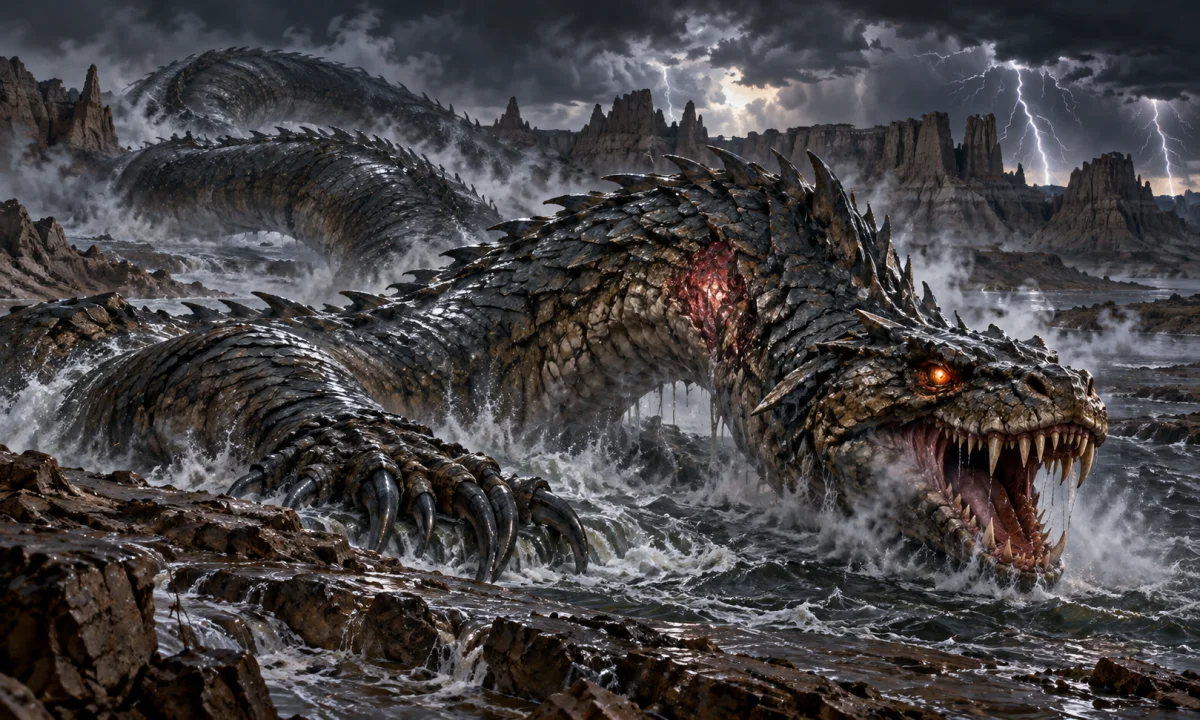
Uncegila, also written Unhcegila, is a great serpent or water monster found especially in Lakota traditional narratives. The name is often rendered in English as “the great serpent,” although translations and spellings vary because Lakota words have been represented in several different writing systems. Uncegila is generally associated with dangerous waters, floods, destructive powers and the primeval forces that exist beyond the human world.
Uncegila belongs primarily to the religious and mythological traditions of the Lakota people, one of the major divisions of the Oceti Sakowin, commonly called the Great Sioux Nation. Accounts recorded in English often describe Uncegila as a giant snake, but that description can make the being seem like an ordinary animal enlarged to monstrous size. In traditional contexts, Uncegila is better understood as a powerful supernatural being connected with water, the earth and the perilous forces of the cosmos.
Cultural setting and surviving traditions
Lakota religious traditions were preserved through oral teaching, sacred narratives, ritual knowledge and accounts given to outsiders by Lakota speakers. They do not form a single book or a universally fixed mythology. Stories could differ according to community, storyteller, purpose and the circumstances in which they were recorded. For that reason, there is no one authoritative version of Uncegila’s appearance, history or defeat.
Many older accounts were written down by non-Lakota observers, missionaries, ethnographers and collectors of folklore. Such records can preserve valuable information, but they may also simplify Lakota concepts, translate sacred beings into familiar European categories or omit the religious setting in which a story was told. English-language descriptions of Uncegila should therefore be treated as partial representations of a living Indigenous tradition rather than as a complete definition of the figure.
In Lakota thought, powerful beings are not necessarily “gods” in the narrow classical sense. A being may have agency, spiritual power and a place in the structure of the world without fitting neatly into categories such as deity, demon or monster. Uncegila’s frightening nature is important, but the figure is not simply a villain created for entertainment. The stories concern the relationship between human communities, water, weather, sacred power and forces that can sustain or destroy life.
Name and identity
The spelling Uncegila is common in English-language references, while Unhcegila and other forms also occur. These differences reflect attempts to represent Lakota sounds with English orthography. The pronunciation cannot be established perfectly from the spellings alone, and the name should not be treated as having one universally agreed English translation.
Uncegila is sometimes called a “water serpent,” “water monster” or “horned serpent.” The first two descriptions are broadly useful, although the exact nature of the being varies. The third can create confusion because horned serpents appear in the traditions of several different Indigenous peoples, and similar English labels do not prove that the figures are the same. An account of Uncegila should remain connected to the Lakota context rather than combining it with unrelated serpent beings from other nations.
Uncegila is also sometimes discussed alongside the Unktehi, a class or category of powerful water beings in Lakota religious tradition. The relationship between the names and concepts is not presented identically in every source. Some descriptions treat Uncegila as a particular great serpent; others place the being within a wider group of dangerous aquatic powers. It is therefore safer to say that Uncegila is closely associated with the water-monster complex than to insist that every Lakota account uses exactly the same classification.
Appearance and powers
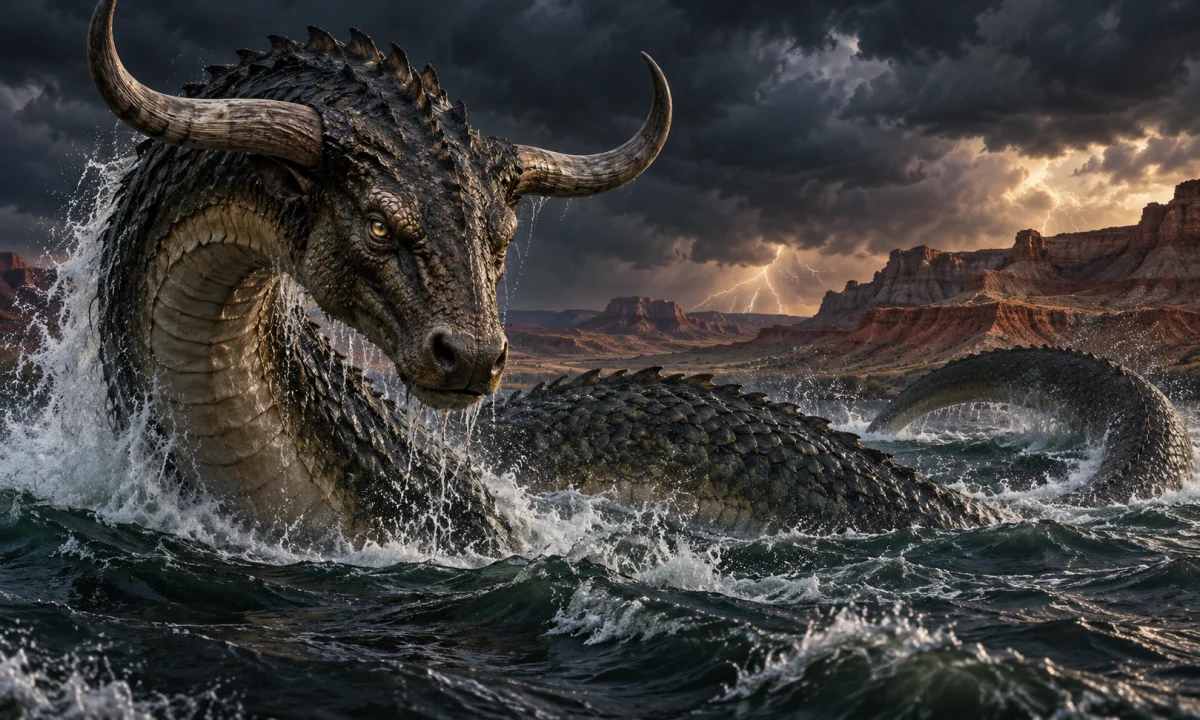
Descriptions of Uncegila usually emphasize enormous size and serpentine form. The being may be imagined as long enough to stretch across a large part of the landscape, or as living in deep water, underground places or other locations inaccessible to ordinary people. Some retellings give Uncegila horns, scales or other features associated with a supernatural serpent. These details are not consistent in all accounts.
Uncegila’s most important attribute is its connection with water. The monster may inhabit a lake, river or other body of water and threaten people who approach it. In stories where Uncegila is responsible for floods, the waters are not merely natural scenery: they represent a force capable of overwhelming settlements, disrupting the order of the world and challenging human survival.
The being’s powers are commonly described in terms of:
- living in or moving through deep water;
- attacking, swallowing or endangering human beings;
- causing floods, storms or other forms of widespread destruction;
- possessing a body or substance with dangerous spiritual power; and
- resisting ordinary human weapons or physical strength.
These attributes should not be read as a fixed catalogue of powers. They summarize recurring themes in English-language versions, not a universal Lakota description. In traditional storytelling, the significance of Uncegila may lie less in its “abilities” than in what the encounter reveals about sacred danger, imbalance and the limits of human control.
The conflict with the thunder beings
One of the most persistent themes associated with Uncegila is a conflict between the great serpent and the Wakíŋyaŋ, often translated as the Thunder Beings or Thunderbirds. Wakíŋyaŋ are powerful sky beings connected with thunder, lightning, storms and protection. Their relationship with dangerous water beings is represented in different ways, but the opposition between the forces of the sky and the forces of the deep is a recurring feature of Lakota cosmological storytelling.
In versions of the conflict, Uncegila’s presence brings flooding and destruction, while the Thunder Beings attack from above with lightning and thunder. The struggle may be portrayed as a cosmic contest rather than a simple battle between a hero and a monster. It reflects the dangerous interaction of major natural and spiritual powers: water can nourish life, yet uncontrolled water can destroy it, while storms can threaten people but also bring rain.
Some accounts describe the Thunder Beings as killing Uncegila, while other versions present the defeat in more complicated terms. The monster may be wounded, weakened, dried out or destroyed after a prolonged struggle. The exact agents and circumstances vary, and stories should not be harmonized into a single sequence without acknowledging those differences.
Floods, death and the landscape
Stories of Uncegila are sometimes linked with a primordial flood or with a time when the world was not yet arranged in its present form. The serpent’s movements or battles could disturb the waters and devastate human settlements. In this setting, Uncegila represents more than a threat to individual travelers. The being embodies the possibility that the boundaries separating land, water and human habitation can break down.
After Uncegila’s defeat, some retellings say that the body dried out or that its bones remained in the earth. These remains are sometimes connected in popular accounts with rugged formations, eroded ground or the landscapes of western South Dakota, including areas identified with the Badlands. Such associations are culturally significant in some retellings, but they are not a universal detail of every Lakota version.
Landscape stories should not automatically be treated as attempts to provide a literal geological explanation. They can express relationships between sacred history and place, giving unusual landforms a presence within a larger account of the world. The same landscape may carry historical, spiritual and ecological meanings at once. Modern retellings sometimes reduce this complexity to the claim that a monster’s skeleton “became” a particular landmark, even when the traditional material is more varied.
Symbolism and interpretation
Uncegila is often interpreted as a figure of uncontrolled natural power. Water is essential for life, but deep water can also conceal danger, carry away people and alter the land. The serpent’s enormous scale makes this tension visible: Uncegila is not simply an animal living in a river, but a being through which the terrifying power of water becomes imaginable.
The conflict between Uncegila and the Thunder Beings can also be read as an expression of cosmic balance. Neither water nor storms are merely evil. Both are necessary aspects of the world, and both can become destructive when their power exceeds the conditions in which life can endure. Interpretations using terms such as “good versus evil” may therefore be too simple for the stories.
The figure can additionally be connected with boundaries. Uncegila belongs to places where ordinary human rules are unreliable: deep water, remote landscapes and the border between the visible world and the spiritual realm. Encounters with such beings often teach caution and humility. They warn that the natural world is not an inert backdrop for human activity and that sacred power cannot be approached carelessly.
These interpretations are scholarly or comparative ways of discussing the narratives. They should not replace Lakota religious explanations or imply that there is only one symbolic meaning. A story may carry different meanings for different listeners, and some aspects of sacred knowledge may not be intended for unrestricted explanation outside the community.
Uncegila and related serpent beings
Uncegila is sometimes confused with other Indigenous serpent figures, especially when all of them are described in English as “water monsters” or “horned serpents.” Similar motifs occur across North America, but similarities do not establish a shared identity. Indigenous nations have distinct languages, histories, religious systems and relationships to particular places.
Uncegila should also be distinguished from the Uktena of Cherokee tradition. Uktena is a powerful horned serpent from a different cultural and linguistic tradition, with its own stories, attributes and religious significance. It is not another name for Uncegila. Likewise, Uncegila should not automatically be identified with every “lake monster,” dragon or giant snake in regional folklore.
The relationship between Uncegila and Lakota Unktehi requires similar care. English sources may use broad terms such as “water monster” for both, and some classifications may overlap. Nevertheless, the names are not interchangeable in every account. Uncegila is most consistently presented as a particular great serpent or exceptionally powerful aquatic being, while Unktehi may refer to a broader group or a different category of water beings depending on the source.
Later reception and popular culture
Uncegila has been adopted into modern books, websites, games, supernatural fiction and cryptid discussions. In those settings, the being is often presented as a prehistoric snake, a lake monster or a creature that could be encountered like a fictional animal. Such portrayals may borrow the name and a few motifs while removing the figure from Lakota religious context.
Cryptid treatments are especially likely to describe Uncegila as evidence for an undiscovered giant serpent. That is a modern speculative interpretation, not a historical conclusion established by Lakota tradition. Traditional accounts concern a supernatural power and the ordering of the world; they are not straightforward zoological reports.
Responsible modern retellings preserve the distinction between Indigenous tradition and fantasy invention. They identify Uncegila as a figure associated primarily with Lakota narratives, acknowledge variant spellings and versions, and avoid presenting a single dramatized story as the definitive account. Treating the name only as a monster label obscures its connection with sacred landscape, water, weather and the continuing cultural history of the Oceti Sakowin.