WORLD
WORLD
Txamsem
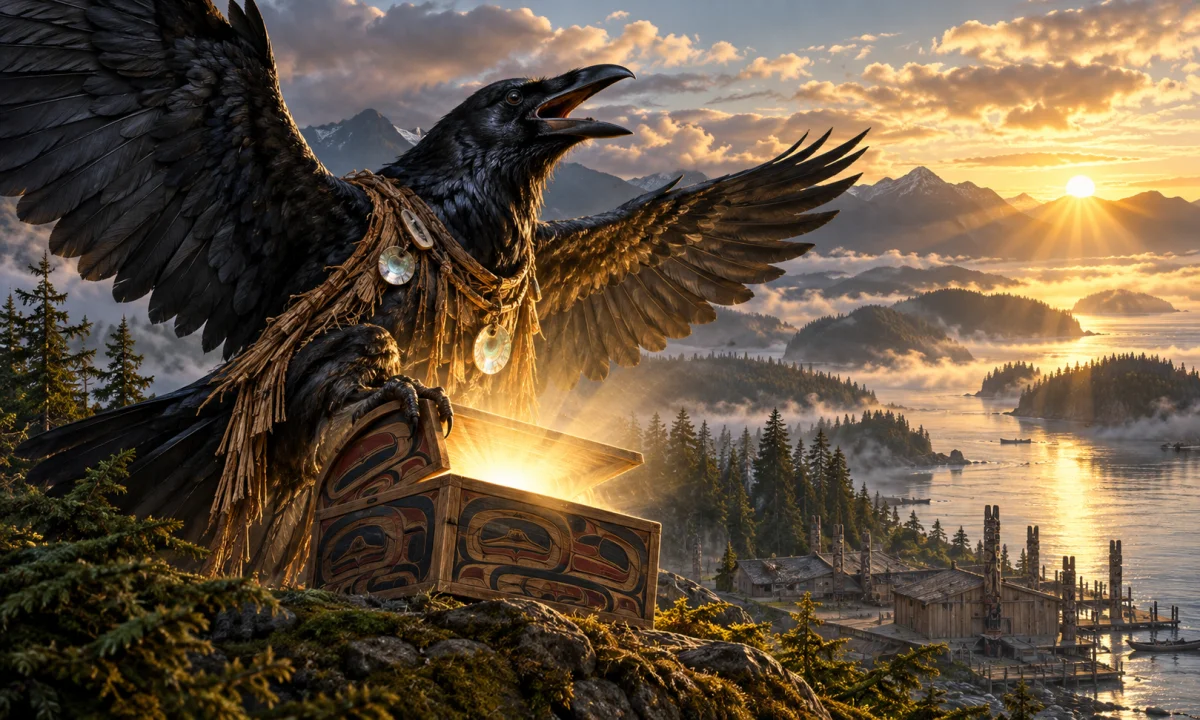
Txamsem is the Raven culture hero of Tsimshian tradition in the Pacific Northwest of North America. He is associated with the Tsimshian peoples of what is now coastal British Columbia and southeastern Alaska, especially traditions preserved in the Sm’algyax-speaking communities. In English, his name is often translated simply as “Raven,” although Txamsem is more than an ordinary bird. He is a powerful transformer, bringer of light, creator, trickster and cultural hero whose actions help establish the conditions of human life.
Txamsem belongs to a wider Northwest Coast tradition in which Raven appears as a central mythic figure. Haida, Tlingit, Tsimshian, Nisga’a and other neighbouring peoples all have important Raven traditions, but the Raven of one nation should not automatically be treated as the same character as the Raven of another. Their stories share themes because of long cultural contact and related ways of understanding the world, yet each community has its own languages, histories, ceremonial contexts and narrative authorities.
Cultural setting and traditional context
The Tsimshian peoples traditionally lived along the northern Pacific coast, including the Skeena River region, the coast and islands of British Columbia, and nearby areas of Alaska. Their societies were organized through extended families, hereditary names, house groups, crests and connections to particular territories. Animals, supernatural beings, ancestors and landscape features could all be part of these relationships.
Stories about Txamsem were not merely entertaining tales in the modern sense. They could explain the origins of light, fire, water, rivers, social customs and other features of the world. They could also affirm connections between families, places and hereditary privileges. In some Tsimshian terminology, important traditional narratives are described as adaawx, a category often translated as true histories or sacred histories. English labels such as “myth,” “legend” and “folktale” do not fully express the authority that such narratives may possess within their cultural setting.
Traditional knowledge was not necessarily open to every audience or detached from ceremony. The right to tell particular histories could be connected with family ownership, inherited names, rank or ceremonial responsibilities. Written versions recorded by outsiders therefore represent only part of a much larger oral tradition, and they should not be assumed to preserve every version or every meaning.
The name and identity of Txamsem
The spelling Txamsem reflects one modern way of representing the name in the Latin alphabet. Other spellings occur because Indigenous languages contain sounds that do not correspond neatly to English, and because different writers have used different systems of transliteration. Forms such as Txaamsm or other variant spellings may appear in older or non-standard accounts. The preferred spelling can also depend on the language community and the orthography being used.
Txamsem is commonly identified as Raven, but “Raven” should be understood as an English gloss rather than a complete equivalent. In many stories he behaves like a bird, while in others he speaks, plans, transforms himself and interacts with chiefs, spirits and other beings in ways that do not fit ordinary zoology. He may be called a god in popular reference works, but that term can be misleading if it suggests a sharply defined deity with a fixed domain like those found in some classical pantheons.
Txamsem is better described as a transformer and culture hero whose actions shape the world. He is also a trickster, although the word “trickster” covers only one aspect of his character. His cleverness can benefit human beings, but his motives are not always noble. He may be greedy, boastful, hungry, impatient or deceitful. The same qualities that make him comic or disorderly can also enable him to overcome powerful beings and obtain what the world needs.
Raven and the coming of light
The best-known group of stories associated with Txamsem concerns the release of light into a dark world. In these narratives, daylight, the sun, moon or stars are held by a powerful being, often described as a chief or wealthy supernatural person. Light is kept in containers or otherwise concealed as a possession rather than made available to everyone.
Txamsem devises a plan to gain access to it. Different tellings vary in the details of his transformation, the identity of the keeper and the sequence by which the light is released. In one widely circulated pattern, Raven takes on a vulnerable or appealing form in order to enter the household of the light’s owner. After obtaining the hidden objects, he escapes and opens or scatters them across the sky. The world is thereby changed from darkness into the ordered alternation of day and night.
This episode presents Txamsem as both a thief and a benefactor. From one perspective, he violates the authority of the being who controls the light. From another, he corrects an unjust condition in which a basic power is monopolized. The story does not require him to be morally pure. His appetite, cunning and opportunism are precisely the means by which he accomplishes something essential for the rest of creation.
The light story also illustrates why Raven cannot be classified only as a creator in the sense of making everything from nothing. Txamsem often works with things that already exist but are hidden, restricted or improperly arranged. He changes their distribution and makes them accessible. Creation in these stories can therefore involve transformation, release, rearrangement and the establishment of relationships as much as manufacture.
Other culture-hero roles
Raven stories on the Northwest Coast commonly connect the hero with the acquisition of necessities such as fire, fresh water, daylight or food. Tsimshian traditions include comparable themes, although individual episodes and their attribution vary among communities and recorded versions. A story told under the name of Raven in one region may have a different character, setting or conclusion in another.
Txamsem’s importance lies not only in what he obtains but in the consequences of his actions. Rivers, celestial bodies, fire and other features of the human environment can be understood through narratives in which a powerful being disrupts an earlier order. These accounts often explain why the world contains both opportunity and danger. The gifts that make human life possible may arrive through theft, deception or conflict rather than through a simple act of benevolence.
He is also associated with transformation. Raven may alter his appearance or use another form as part of a plan. Such changes reinforce the difference between a supernatural culture hero and an ordinary animal. They also reflect a world in which boundaries between human, animal and spirit are more fluid than modern Western categories usually allow. This does not mean that Tsimshian tradition treats all beings as interchangeable. Rather, it allows certain powerful beings to cross boundaries while retaining distinctive identities and relationships.
Character and symbolism
Txamsem’s character combines contradictory qualities. He can be generous and self-serving, creative and destructive, intelligent and foolish. His hunger and curiosity may lead him into trouble, yet they also drive him to act when others are passive. His success does not always make him admirable, and his failures do not make him powerless.
This ambiguity is important. A trickster is not simply a villain or a comedian. Trickster figures expose the weakness of rigid authority, reveal the consequences of selfishness and open possibilities that orderly characters cannot see. Txamsem may embarrass powerful figures, break rules or exploit a household’s trust, but the disorder he creates can result in a more livable world.
Raven’s black colour and scavenging habits have sometimes encouraged outsiders to interpret him through European ideas about darkness, death or bad omens. Such interpretations should not be imposed on Tsimshian tradition. His significance comes from the stories and relationships in which he appears, not from a universal symbolic meaning assigned to ravens in other cultures.
Txamsem’s stories can also be read as reflections on the distribution of power. Light, food, fire and knowledge are often controlled by someone who treats them as private property. Raven’s intervention challenges that arrangement, though his own conduct may remain ethically questionable. The result is not a simple lesson that deception is always good. Instead, the narratives invite attention to the circumstances in which rules are made, who benefits from them and what happens when essential resources are withheld.
Variants and limits of the surviving record
There is no single canonical biography of Txamsem accepted across all Tsimshian communities. Oral traditions change in wording and emphasis according to the teller, audience, language, locality and ceremonial purpose. A written retelling may combine elements that were distinct in oral performance or present one version as though it were universal.
Older English-language accounts also frequently used broad labels such as “Indian mythology” or “Tsimshian mythology” without identifying the specific community, speaker or context. Some records were made by missionaries, collectors or anthropologists working through translators. Their transcriptions can preserve valuable material, but they may omit performance, gesture, sacred restrictions, Indigenous explanations and the social authority attached to a narrative.
For these reasons, details sometimes repeated in reference works should be treated cautiously. Claims that Txamsem has one fixed parentage, one permanent residence or one complete sequence of adventures do not represent the whole tradition unless they can be tied to a particular telling. The safest general description is that he is a Tsimshian Raven transformer and culture hero whose stories explain major features of the world and the acquisition of essential powers.
Distinguishing Txamsem from other Raven figures
Txamsem is often compared with Yáahl of Haida tradition and Yéil of Tlingit tradition. These figures are also frequently translated as Raven and are associated with the release of light and other acts that shape the human world. The similarities are substantial, but the names belong to different languages and cultural traditions. They should not be collapsed into one pan-Indigenous character.
Raven figures may also appear in the traditions of neighbouring peoples, including Nisga’a and Gitxsan communities, whose languages and histories are related to those of the Tsimshian but are not identical to them. A shared plot motif may reflect regional exchange, ancient connections or parallel developments. It does not by itself prove that every Raven story concerns Txamsem.
Nor should Txamsem be confused with an ordinary raven, a clan crest in every context, or a universal symbol used by all Indigenous peoples of North America. The meaning of Raven depends on the nation, language, family history, artistic form and narrative setting involved.
Later representation and continuing significance
Txamsem has appeared in English-language books, museum displays, educational materials and general collections of Native American mythology. Such retellings often focus on the dramatic theft of light because it is accessible to a broad audience. They may also simplify the character into either a benevolent creator or a mischievous trickster. Both versions leave out the tension between those roles that gives the stories much of their force.
Contemporary Indigenous artists, writers, educators and cultural institutions continue to represent Raven in ways connected to living Northwest Coast traditions. A modern carving, painting or literary retelling is not automatically an unchanged survival from the ancient past, nor is it merely a decorative adaptation. Its meaning depends on the artist’s community, intentions and relationship to inherited cultural knowledge.
Txamsem is therefore best approached with attention to cultural specificity. He is Raven, but not simply “the Native American Raven”; a creator, but not a creator-god in a universally interchangeable sense; and a trickster, but not a figure whose actions can be reduced to comic mischief. Within Tsimshian tradition, his transformations help explain how a world of darkness, restricted power and supernatural rivalry became a world in which humans could receive light and other conditions of life.