WORLD
WORLD
Kalma
Kalma is a death-related figure or supernatural presence in Finnish mythology and folklore. The name is associated with death, graves, corpses and the smell of decay. In modern summaries of Finnish mythology, Kalma is often presented as a goddess or female spirit connected with the realm of the dead, sometimes described as a daughter of Tuoni and Tuonetar, the rulers of Tuonela. Finnish tradition, however, does not preserve one universally fixed biography for Kalma. The word has several related meanings, and some descriptions of Kalma as a clearly defined goddess rely on later systematization rather than on a single ancient myth.
The meaning of the name Kalma
The Finnish word kalma belongs to a group of terms connected with death and the dead. Depending on context and dialect, it may refer to death itself, a corpse, a grave, the atmosphere of a burial place, or the unpleasant smell associated with decomposition. Expressions formed from the word can therefore describe both a physical condition and a supernatural danger.
This range of meaning is important. Kalma is not always equivalent to a personal goddess with a human-like personality. In some contexts, the name denotes the presence or force of death: something perceived around graves, corpses and places where the dead are buried. In other contexts, folkloric and mythological writers have treated Kalma as a personified being. Both uses belong to the history of the name, but they should not be presented as though they were identical.
Finnish and related Finnic traditions often attach spiritual significance to words describing invisible forces. A smell, illness, chill, sound or sudden change in the landscape could be interpreted as evidence of an unseen power. The smell of a corpse was especially significant because it marked the boundary between ordinary life and the dangerous world of the dead. Kalma could consequently signify not only death but also the contamination, fear and supernatural potency associated with it.
Kalma and the Finnish idea of death
Traditional Finnish religious ideas did not form a single standardized creed. Before and alongside Christian influence, people in Finland maintained local beliefs about the soul, ancestors, spirits of places, illness, ritual pollution and the dead. These beliefs varied by region and changed over time. Much of what is called “Finnish mythology” today comes from oral poetry, charms, legends and customary beliefs recorded by collectors in the eighteenth and nineteenth centuries.
Within this setting, the dead were not simply absent. A dead person could remain spiritually significant to the household, the community and the landscape. Burial places were places of memory, but they could also be dangerous. The dead might be approached through ritual, remembered through offerings or feared as a source of illness and misfortune. Contact with a corpse or grave could require cleansing, protection or careful observance.
Kalma fits this religious and folkloric environment as a name for the power of the grave and the dead. Rather than functioning like a single supreme deity of death, Kalma is better understood as part of a network of ideas involving Tuonela, the realm of the dead; Tuoni, a death-related ruler or personification; the spirits of the deceased; and the dangerous force known as the power of the dead.
Kalma in relation to Tuonela and Tuoni
Tuonela is the underworld or land of the dead in Finnish epic poetry, especially in the form preserved in the Kalevala. It is often associated with a dark river that separates the living from the dead. Tuoni may refer to death itself, the ruler of the dead or a personification of the underworld. Tuonetar is commonly described in the epic tradition as Tuoni’s female counterpart or wife.
Later accounts frequently place Kalma within this family structure, calling her a daughter of Tuoni and Tuonetar. This relationship is widespread in modern presentations of Finnish mythology, but it should be treated with some caution. The surviving oral material does not provide one consistent genealogy for every death-related figure, and the role of Kalma is not as firmly defined across the tradition as the figures of Tuoni, Tuonetar and Tuonela.
The family relationships found in popular reference works can partly reflect attempts to organize a complex body of songs and beliefs into a pantheon resembling the better-defined mythologies of Greece or Scandinavia. Finnish tradition contains divine figures, spirits, personifications and poetic names, but they do not always operate as members of a fixed genealogical system. A relationship stated in one modern account may therefore be a literary or interpretive arrangement rather than a universally attested element of old Finnish belief.
Appearance and powers
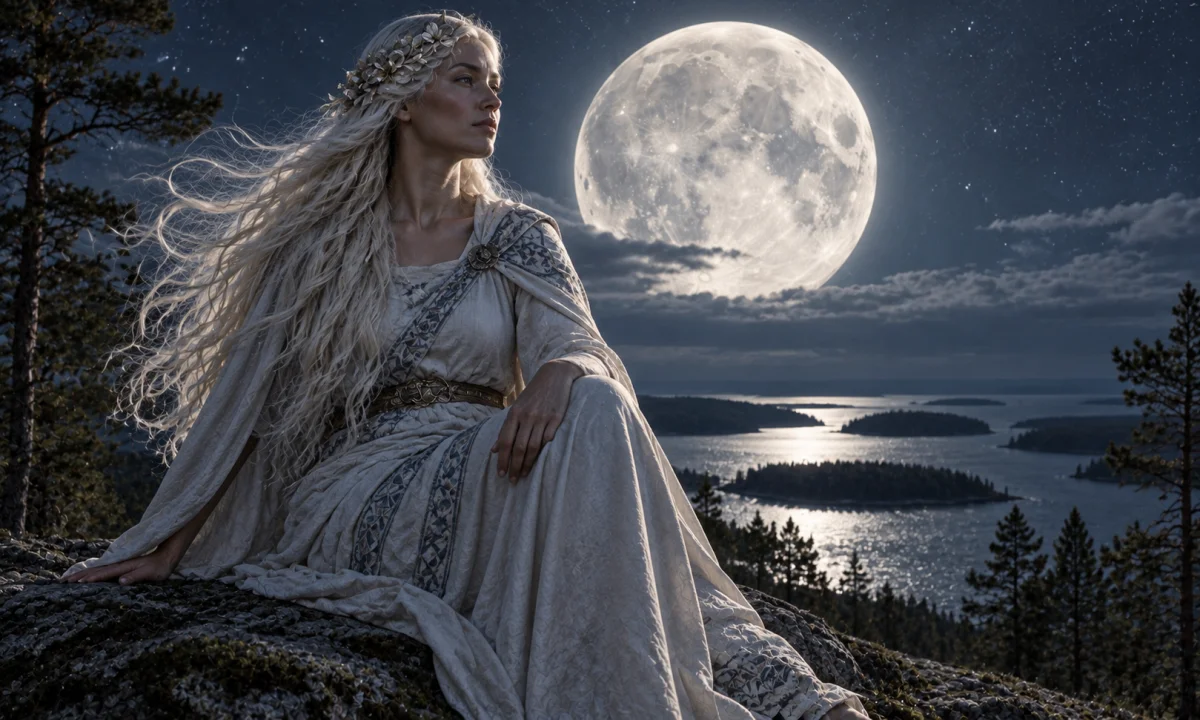
There is no stable traditional portrait of Kalma comparable to the familiar visual forms of many classical gods. Descriptions that show her as a young woman, a skeletal figure, a veiled spirit or a queen of corpses are generally artistic choices or modern reconstructions. They should not be assumed to represent a canonical Finnish appearance.
Modern retellings often give Kalma several powers:
- association with graves, cemeteries and the realm of the dead;
- control over the smell or influence of corpses;
- the ability to spread death, sickness or fear;
- power over the boundary separating the living from the dead;
- knowledge of burial places and the hidden world beneath the earth.
These attributes are compatible with the meanings of the word and with Finnish ideas about the supernatural force of death. They are not necessarily details from one continuous ancient narrative. In particular, claims that Kalma always rides a particular animal, carries a distinctive weapon or rules a clearly organized underworld should be regarded as uncertain unless the claim is tied to a specific local tradition or later literary source.
The most consistent “power” associated with Kalma is the power of deathly presence. The graveyard, the corpse and the smell of decay all signal a condition that humans cannot safely treat as ordinary. In this sense Kalma is less a warrior or active antagonist than a personification of an inevitable and spiritually hazardous state.
Kalma and the power of the dead
Finnish folklore includes the idea of väki, a force or population associated with a particular place, object or category of beings. The term can refer to the power belonging to fire, water, iron, forests, disease and other sources of supernatural influence. The dead likewise possess a dangerous force. Expressions related to kalma can describe the power of graves and corpses.
This concept helps explain why contact with the dead could be both useful and perilous. A person who handled a corpse, entered a burial place or encountered a death-related spirit might gain access to knowledge or power, but could also become ill or spiritually contaminated. In Finnish magic and healing traditions, ritual language was often used to identify the origin of an affliction and command it to leave. Death-related forces could thus appear in charms not merely as objects of fear but as powers that had to be named, controlled or redirected.
Graveyards were especially potent locations. They were connected with ancestors and memory, yet they also belonged to the dead and therefore demanded respect. The association of Kalma with such places reflects a broader traditional understanding in which the landscape was inhabited by forces that could not be reduced to physical geography.
Kalma in the Kalevala and related poetry
The Kalevala, compiled by Elias Lönnrot and first published in a complete form in the nineteenth century, is the best-known literary presentation of Finnish oral poetry. It is crucial for the study of Finnish mythology, but it is not a verbatim transcript of a single ancient epic. Lönnrot selected, rearranged and combined songs from different performers and regions. The resulting work has its own literary structure.
Tuonela and Tuoni have important roles in the Kalevala. Väinämöinen travels to Tuonela in search of knowledge and encounters the dangerous boundary between life and death. The underworld is presented as a place from which the living should not casually seek what they desire. Other episodes involve death, bodily destruction, illness and the recovery or loss of life.
Kalma is sometimes listed among the figures of the Kalevala tradition, but her status is less straightforward than that of Tuoni or Tuonetar. The name and its associated concepts belong to the wider Finnish mythological vocabulary, while particular genealogies and character descriptions may derive from later interpretation, regional material or modern mythographic summaries. It is therefore more accurate to say that Kalma is connected with the Kalevala world of death and Tuonela than to claim that the epic gives her a single, fully developed story of her own.
Distinguishing Kalma from related figures
Kalma is easily confused with several other Finnish or Finnic death-related beings. The distinctions are useful because the names often overlap in modern retellings.
- Tuoni: Tuoni is associated with death, the underworld and the ruler of the dead. Depending on the passage or interpretation, the name can function as a personification, a divine figure or a name for death itself.
- Tuonetar: Tuonetar is usually connected with Tuonela and is often described as Tuoni’s wife or the mother of underworld beings. She is not simply another name for Kalma.
- Loviatar: Loviatar is a separate figure in the Kalevala, associated with disease and the birth of afflictions. Some modern lists place many female supernatural figures together, but Loviatar and Kalma should not be merged.
- Kipu-Tyttö: Kipu-Tyttö, whose name is connected with pain, belongs to the group of figures associated with illness and suffering. She is distinct from the death-related meaning of Kalma.
- Death as a personification: Finnish folklore may use words for death as supernatural names without implying a separate goddess with a fixed personality. Kalma can function in this more abstract way.
Names and roles can vary between dialects, poems and modern classifications. A figure described as a “goddess” in an English-language list may have been a spirit, poetic personification or force in the older material. This difference is not merely terminological: it affects how confidently a complete mythology can be reconstructed.
Cultural significance
Kalma expresses a central tension in Finnish attitudes toward death. The dead remained part of the moral and emotional world of the living, but death itself was not harmless or easily approached. Burial places could preserve family memory while also holding an alien and dangerous power. The smell of decay made the invisible fact of death physically perceptible, turning an abstract idea into a sensory experience.
As a result, Kalma can be interpreted as a symbol of the boundary between the human community and the realm beyond it. She represents not only the end of life but also the signs by which death enters the world of the living: the grave, the corpse, the silence of a burial place and the unsettling odor that cannot be mistaken for ordinary life.
Her relative lack of a single detailed mythology is itself significant. Finnish traditional religion was preserved through local oral practices rather than through one canonical scripture or an officially fixed pantheon. Some supernatural powers were known through words, charms, ritual actions and recurring images rather than through long narrative biographies. Kalma belongs to this less sharply bounded part of the tradition.
Later interpretation and modern usage
In modern popular culture, Kalma is often turned into a fully individualized death goddess. Fiction, games, fantasy reference works and contemporary artwork may give her a dramatic appearance, a family tree and powers modeled on better-known European underworld deities. Such portrayals can draw inspiration from genuine Finnish vocabulary and folklore while still being creative adaptations.
Modern writers also sometimes use Kalma as though she were the Finnish equivalent of a universal “goddess of death.” That comparison is convenient but incomplete. Finnish tradition does not necessarily divide supernatural roles according to the same categories used in classical mythology or modern fantasy. Kalma’s strongest traditional associations are with the grave, decay and the force of the dead, not with a standardized throne, weapon or divine kingdom.
When Kalma appears in contemporary fiction, the most historically grounded interpretations preserve this ambiguity. She may be portrayed as a spirit of cemeteries, a personification of death’s odor, a guardian of the boundary to Tuonela or a name for the dangerous power surrounding the dead. These interpretations acknowledge the traditional meaning without claiming that Finnish folklore provides one definitive character design.