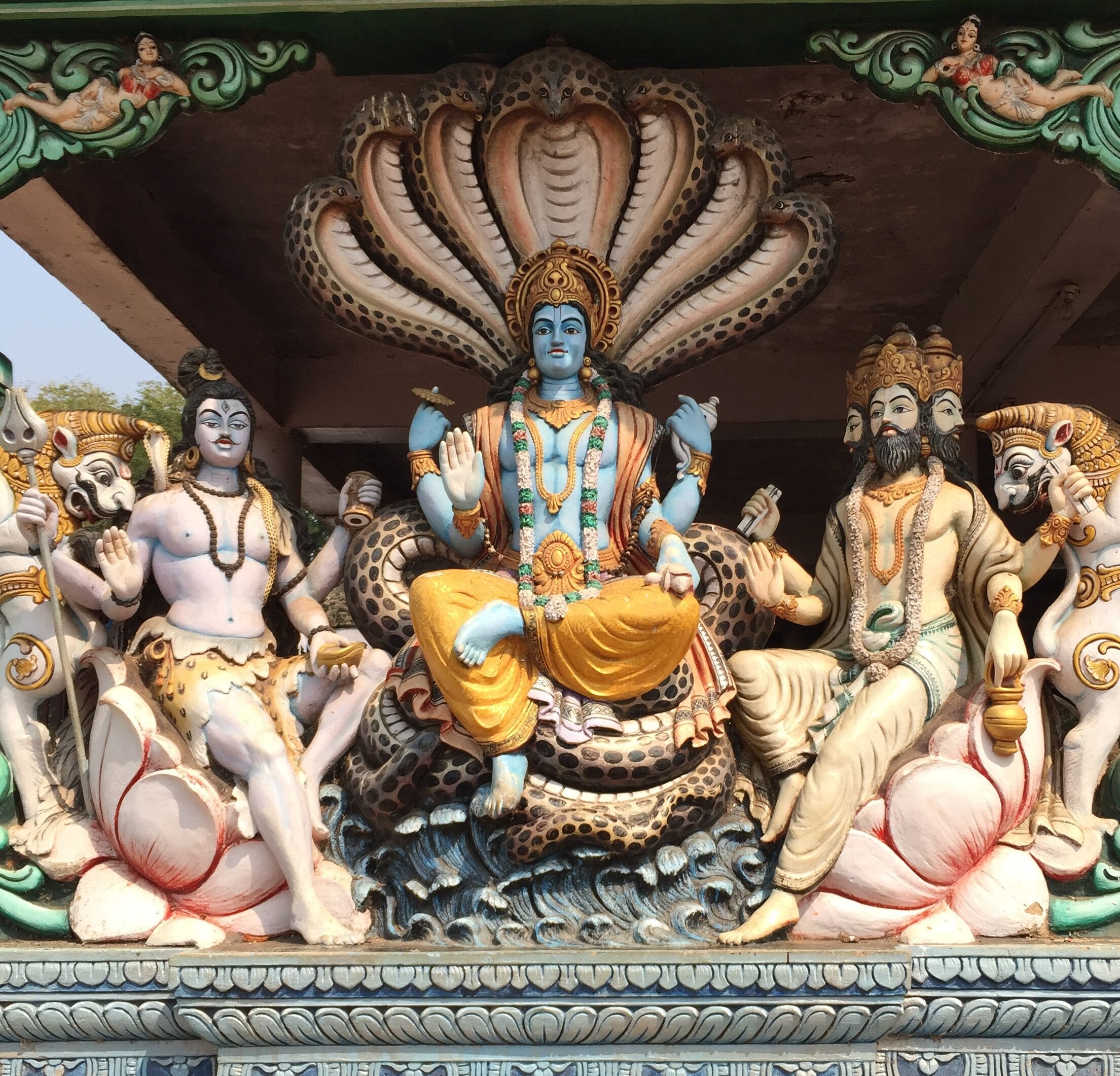
The concept of Trimurti is central to Hindu mythology, representing the three principal deities of Hinduism: Brahma, Vishnu, and Shiva. These three gods embody the cosmic functions of creation, preservation, and destruction, respectively. Together, they form a triad that illustrates the cyclical nature of the universe. Each deity plays a unique role in the maintenance of the cosmic order, and their interactions reflect the balance necessary for life. Understanding the Trimurti offers insights into the Hindu worldview, where every aspect of existence is interconnected and part of a greater whole.
Brahma: The Creator
Brahma is known as the creator god in the Trimurti. He is often depicted with four heads, each representing one of the four Vedas, which are the sacred texts of Hinduism. This symbolism highlights Brahma’s role as the source of all knowledge and creation. According to Hindu beliefs, Brahma emerged from the cosmic waters at the beginning of time and began the process of creation by forming the universe and all living beings within it. His creative power is immense, yet he is not widely worshipped compared to Vishnu and Shiva.
 Tilottama
Despite his significance in the act of creation, Brahma’s worship is limited, and there are very few temples dedicated to him. This phenomenon is often attributed to the belief that once he completed his task of creation, he became less relevant in the ongoing cycle of existence. Brahma’s role is crucial at the beginning of each cosmic cycle, but as life progresses, the focus shifts to Vishnu and Shiva, who maintain and ultimately dissolve the universe.
Symbols of Brahma
- Lotus Flower: Represents purity and the unfolding of creation.
- Vedas: Symbolizes knowledge and the wisdom necessary for creation.
- Swans: Often associated with Brahma, they symbolize the ability to discern between good and evil.
In many depictions, Brahma is shown seated on a lotus, symbolizing his purity and the divine origin of creation. The lotus flower, which grows in muddy waters but blooms beautifully, serves as a metaphor for the potential of life that can emerge from chaos. Furthermore, Brahma is often accompanied by swans, which are believed to possess the ability to separate milk from water, signifying the importance of discernment in creation.
Vishnu: The Preserver
Vishnu is revered as the preserver god in the Trimurti. His primary function is to maintain order and harmony in the universe. Vishnu is often depicted with a blue complexion, symbolizing his infinite nature, and is typically shown holding a conch shell, a discus, a mace, and a lotus flower. Each of these items has its significance, representing aspects of his divine authority and power. Unlike Brahma, Vishnu is widely worshipped and has numerous temples dedicated to him across India and beyond.
 Takshâka
Vishnu is known for his various avatars, which are incarnations he takes to restore cosmic order whenever it is threatened by chaos or evil. The most famous avatars include Rama and Krishna, both of whom have their own epic tales in Hindu scriptures. These stories not only highlight Vishnu’s role as a preserver but also emphasize the importance of righteousness and dharma (moral duty) in human life. The tales of his avatars inspire countless devotees, encouraging them to lead lives filled with virtue and compassion.
Symbols of Vishnu
- Conch Shell: Represents the sound of creation and the call to righteousness.
- Discus: Symbolizes the mind and the protection of dharma.
- Lotus Flower: Represents purity and the divine nature of existence.
Vishnu’s conch shell, known as Shankha, is often blown to signal the start of a new phase in life or to awaken spiritual consciousness. The discus, or Chakra, represents the power of the mind and the importance of using one’s intellect to discern right from wrong. The lotus flower, like in Brahma’s symbolism, signifies purity and the divine essence that permeates all of creation. Together, these symbols reflect Vishnu’s commitment to preserving the universe and guiding humanity toward a path of righteousness.
 Taraka
Shiva: The Destroyer
Shiva is known as the destroyer god within the Trimurti, but his role is often misunderstood. While he is associated with destruction, this destruction is not merely about ending life; it is about transformation and renewal. Shiva’s destructive nature paves the way for new creation, making him a vital part of the cosmic cycle. He is often depicted with a third eye, symbolizing his ability to see beyond the physical realm, and a serpent around his neck, which represents control over fear and death.
Shiva is also associated with asceticism and meditation. He is often shown in deep meditation atop Mount Kailash, reflecting his role as a source of inner strength and tranquility. His followers, known as Shaivites, believe that through meditation and devotion to Shiva, one can attain liberation from the cycle of birth and death (samsara). Shiva’s dual nature as both a destroyer and a benefactor makes him a complex and fascinating deity within Hinduism.
Symbols of Shiva
- Trident: Represents the three aspects of existence: creation, preservation, and destruction.
- Third Eye: Symbolizes higher consciousness and the ability to see beyond illusion.
- River Ganga: Represents the flow of life and purification.
The trident, or Trishula, held by Shiva signifies his mastery over the three fundamental aspects of existence: creation, preservation, and destruction. This triad reflects the interconnectedness of all things. His third eye, which is said to represent spiritual insight, is a powerful symbol of enlightenment and the ability to perceive the truth beyond ordinary perception. The River Ganga, which is often depicted flowing from his hair, symbolizes the purification of the soul and the importance of spiritual cleansing.
The Interconnectedness of the Trimurti
The Trimurti embodies the cyclical nature of existence, where creation, preservation, and destruction are intertwined. This interconnectedness illustrates the belief that one cannot exist without the other. Creation leads to preservation, and preservation ultimately leads to destruction, which in turn makes way for new creation. This cycle is often represented in Hindu philosophy as Shrishti (creation), Sthiti (preservation), and Samhara (destruction). The seamless flow of these processes highlights the dynamic and ever-changing nature of the universe.
In Hindu cosmology, time is viewed as cyclical, with each cycle known as a Yuga. There are four Yugas: Satyuga, Tretayuga, Dvapara Yuga, and Kaliyuga. Each Yuga represents a different phase of spiritual evolution and decline. The Trimurti plays a vital role in each Yuga, adapting their functions according to the needs of the universe at that time. This adaptability reflects the underlying principle of balance and harmony that is essential to Hindu beliefs.
Cycle of Yugas
- Satyuga: The age of truth and righteousness.
- Tretayuga: The age of virtue, but with the emergence of some decline.
- Dvapara Yuga: The age of duality, where good and evil coexist.
- Kaliyuga: The current age, characterized by darkness and moral decline.
During the Satyuga, Brahma’s creation flourishes, and Vishnu’s preservation is at its peak. As time progresses into Tretayuga, the balance begins to shift, with the emergence of conflict and moral dilemmas. In Dvapara Yuga, the duality of existence becomes evident, and the need for Shiva’s destructive power becomes apparent. Finally, we arrive at Kaliyuga, where chaos reigns, and the importance of seeking balance through the Trimurti is crucial for spiritual awakening and renewal.
The Worship of Trimurti
Worship of the Trimurti is an integral part of Hindu religious practices. Many devotees pay homage to the Trimurti through rituals, prayers, and offerings. Temples dedicated to the Trimurti often depict the three deities together, symbolizing their unity and interdependence. Each deity has specific festivals and celebrations, and their worship varies across different regions of India. However, the essence of their worship remains the same: to seek balance and harmony in life.
In many households, devotees create altars with images or idols of the Trimurti. Daily prayers, known as Puja, are performed to seek blessings and guidance from these deities. Festivals such as Mahashivaratri celebrate Shiva, while Vaikuntha Ekadashi honors Vishnu. Brahma, though less celebrated, is also acknowledged during certain rituals, particularly those that focus on creation and knowledge.
Rituals and Offerings
- Flowers: Symbolizing beauty and devotion.
- Fruits: Representing the abundance of creation.
- Incense: Purifying the space and inviting divine presence.
During worship, devotees offer flowers, fruits, and incense to the deities. Flowers symbolize beauty and devotion, while fruits represent the abundance of creation. Incense is burned to purify the worship space and invite the divine presence of the Trimurti. The act of offering is not merely a ritual but a way for devotees to express gratitude and seek guidance in their lives. These offerings are often accompanied by recitations of sacred texts and mantras that invoke the blessings of the Trimurti.
Philosophical Interpretations of Trimurti
The Trimurti is not only a representation of deities but also a profound philosophical concept in Hinduism. Various schools of thought interpret the Trimurti in different ways, offering deeper insights into the nature of existence. For instance, the non-dualistic school of Advaita Vedanta views the Trimurti as manifestations of a single ultimate reality, Brahman. This perspective emphasizes the unity of all existence, suggesting that the apparent diversity of deities is simply a reflection of the one true essence.
On the other hand, the dualistic school of Dvaita emphasizes the distinction between the divine and the individual soul. In this view, each deity retains its unique characteristics and functions, and devotees cultivate a personal relationship with them. This dualistic interpretation highlights the importance of devotion and the individual journey toward understanding the divine. Both perspectives enrich the understanding of the Trimurti, showcasing the depth and complexity of Hindu philosophy.
Trimurti in Literature and Arts
- Epics: Such as the Ramayana and Mahabharata highlight the roles of Vishnu and Shiva.
- Art: Depictions of the Trimurti can be found in sculptures and paintings throughout India.
- Poetry: Many poets have celebrated the Trimurti in their works, exploring their significance.
The Trimurti has inspired countless works of art, literature, and poetry throughout history. The great epics, such as the Ramayana and the Mahabharata, illustrate the roles of Vishnu and Shiva in human affairs, emphasizing their divine intervention in times of need. Sculptures and paintings in temples often depict the Trimurti, capturing the essence of their unity and interdependence. Poets and writers have also explored the significance of the Trimurti, reflecting on the themes of creation, preservation, and destruction in their works.
Modern Interpretations of Trimurti
In contemporary times, the Trimurti continues to hold relevance for many Hindus and spiritual seekers. As society grapples with issues such as environmental degradation, social injustice, and personal crises, the teachings of the Trimurti offer valuable insights. The balance between creation, preservation, and destruction serves as a guide for navigating the complexities of modern life. Many people draw inspiration from the Trimurti to advocate for sustainable practices and to promote harmony within communities.
Additionally, the Trimurti’s representation of the cyclical nature of existence resonates with those exploring concepts of renewal and transformation in their personal lives. The idea that destruction can lead to new beginnings encourages individuals to embrace change and to seek growth through challenges. This modern interpretation of the Trimurti highlights its enduring significance in providing guidance and wisdom for contemporary issues.
Trimurti in Global Context
- Interfaith Dialogues: The Trimurti is often discussed in the context of other religious traditions.
- Comparative Mythology: Scholars explore similarities with other triadic deities.
- Spiritual Practices: The principles of the Trimurti influence various spiritual movements.
The Trimurti is increasingly recognized in global contexts, where it is discussed in interfaith dialogues that explore common themes among different religious traditions. Scholars of comparative mythology examine the similarities between the Trimurti and triadic deities in other cultures, such as the Christian Holy Trinity or the ancient Egyptian gods. The principles of the Trimurti also resonate with various spiritual movements, emphasizing the interconnectedness of all beings and the importance of balance in life.
the Trimurti stands as a powerful symbol of the cyclical nature of existence in Hindu mythology. Through the roles of Brahma, Vishnu, and Shiva, we gain a deeper understanding of creation, preservation, and destruction, as well as the balance necessary for harmony in the universe. Whether through ancient texts, contemporary interpretations, or global dialogues, the Trimurti continues to inspire and guide individuals on their spiritual journeys.