WORLD
WORLD
Totem Poles
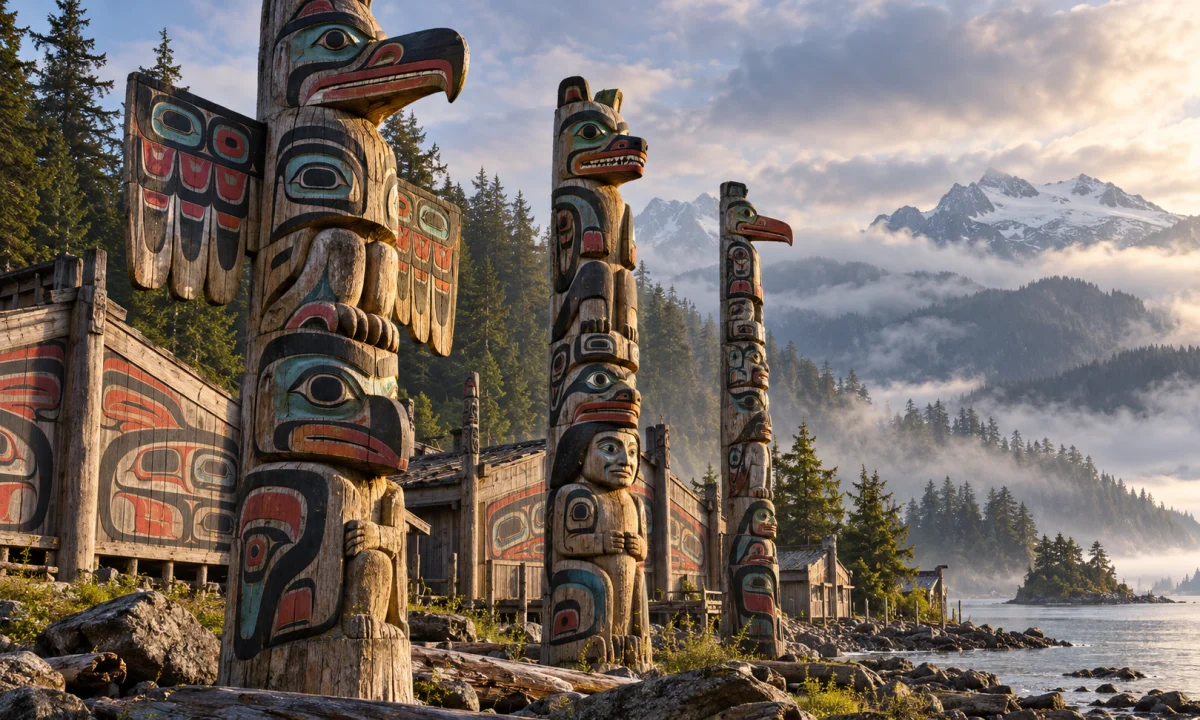
Totem poles are monumental carved posts associated mainly with Indigenous peoples of the Pacific Northwest Coast of North America. They are especially connected with Haida, Tlingit, Tsimshian, Gitxsan, Nisga'a, Haisla, Heiltsuk, Kwakwaka'wakw, Nuu-chah-nulth and neighbouring peoples in what is now coastal British Columbia, southeast Alaska and parts of Washington State. Although often grouped under the broad label “Native American mythology,” totem poles belong to particular nations, families and ceremonial traditions rather than to all Indigenous peoples of North America.
A pole may display animals, birds, supernatural beings, ancestors or human figures. These images are usually connected with inherited names, histories, rights, territories and stories. A carved figure is not automatically a god, and a pole is not simply an object of worship. Its meaning depends on the community that commissioned it, the occasion for which it was raised, and the relationships represented by its carvings.
Origins and cultural setting
Totem-pole traditions developed within the rich cultural world of the Northwest Coast, a region of large rivers, forests, islands and exceptionally productive marine environments. Communities maintained complex systems of rank, kinship, hereditary names, ceremonial privileges and ownership rights. Houses, villages, fishing locations, hunting grounds and ritual knowledge could all be connected with particular families or descent groups.
The tall poles commonly called totem poles are part of a broader carving tradition that also includes house posts, masks, rattles, boxes, screens, grave figures and canoe decorations. Monumental carving was supported by the abundance of western red cedar, a durable and workable wood found throughout much of the region. Carvers used stone, bone, antler and later metal tools, and they developed distinctive conventions of formline design, three-dimensional carving and painted colour.
It is difficult to assign a single beginning to the tradition. Wooden monuments decay, and archaeological evidence for early poles is therefore limited. Oral histories, surviving poles, house remains, colonial records and the continued knowledge of Indigenous communities all contribute to understanding the practice. Some historic poles may have replaced earlier examples, while others were raised in response to changing social and economic conditions. The absence of an ancient surviving pole does not prove that the practice did not exist earlier.
What the word “totem” means
The English word totem was derived through colonial and scholarly usage from an Ojibwe term often written as oodem or doodem, referring broadly to a kin group and its associated emblem or relationship. The word was later applied by European observers to many Indigenous traditions that were not identical to one another. As a result, “totem pole” is a widely established English expression, but it can obscure important differences among Northwest Coast nations.
In many communities, the relevant hereditary identities are described through local concepts such as clans, houses, lineages or crest groups. Their exact meaning varies. A crest is not merely a decorative logo: it can express ancestral history, inherited rights, ceremonial authority and connections between people and beings. The English word totem is therefore useful as a familiar label, but it should not be treated as a precise Indigenous religious category.
Forms and purposes of poles
There is no single type of totem pole. Common forms include:
- House posts: carved structural supports inside or at the entrance of a traditional house. They may represent ancestors, crest beings or figures that support the household both physically and symbolically.
- House-front poles: large carvings placed against or in front of a house, sometimes forming part of an entrance. They can identify the house and present its history or hereditary affiliations.
- Heraldic or lineage poles: monuments that display the crests and ancestry of a family, house or clan. The images may affirm rights to names, places, stories or ceremonial privileges.
- Memorial poles: raised to honour a deceased person or commemorate an important event. A memorial pole may be commissioned by relatives and presented publicly at a ceremonial gathering.
- M ortuary poles: associated in some regions with the remains or remembrance of the dead. Their form and use varied considerably among nations, and not every tall grave marker should be classified in exactly the same way.
- Welcome or entrance poles: placed at village entrances or other significant locations. They can greet visitors, identify the community and establish relationships between guests and hosts.
- Ridicule or shame poles: commissioned to publicize an unpaid debt, broken obligation or dispute. Their purpose was social and political rather than simply humorous, and the details differed by community.
Some poles served more than one purpose. A memorial could also display a family’s crests, while a house-front pole could communicate both ancestry and political standing. Modern poles may commemorate schools, cultural organizations, public events or Indigenous sovereignty, but their meanings are determined by the people who create and raise them.
Figures, crests and visual language
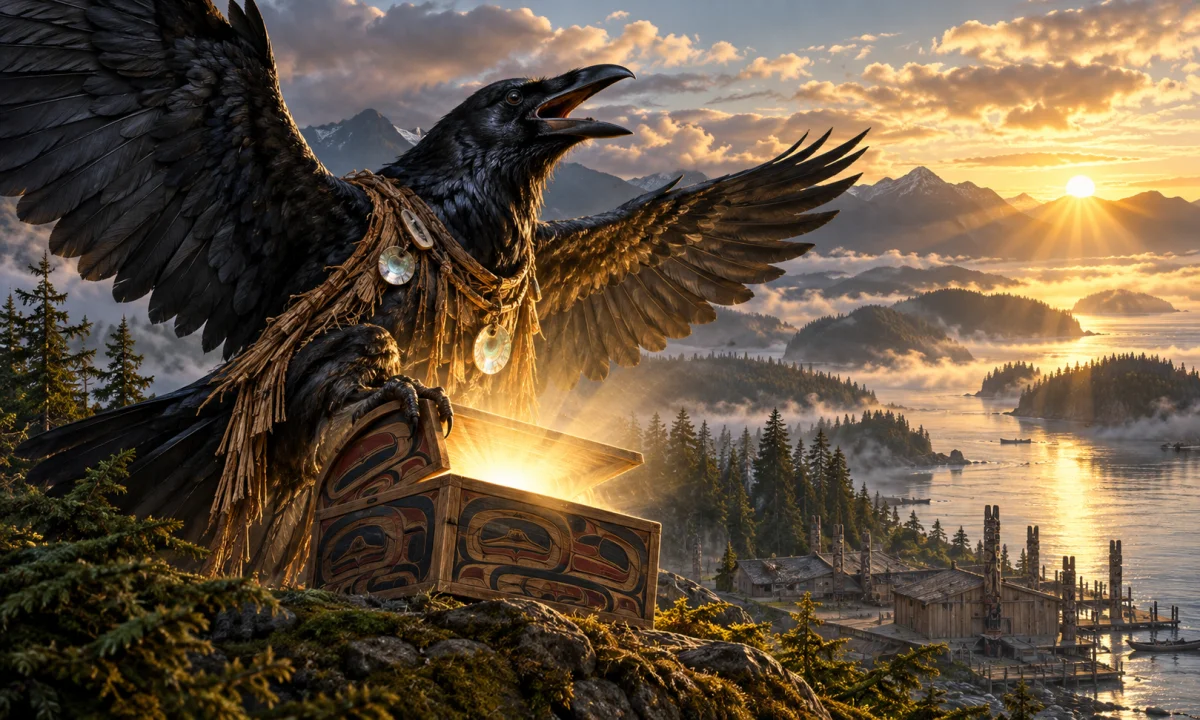
Commonly carved beings include ravens, eagles, bears, wolves, killer whales, beavers, frogs, salmon and other animals. Human figures and beings with combined human and animal features are also frequent. A figure may be shown partly concealed within another figure, emerging from a mouth, wearing a beak or displaying an unusual combination of features. These transformations reflect the visual conventions and narrative traditions of Northwest Coast art.
Animals should not be interpreted as having one fixed meaning everywhere. A raven may be a crest, an ancestor, a culture hero, a trickster or a powerful supernatural being depending on the nation and story involved. An eagle may be associated with a particular clan or house, but it is not universally a symbol of strength in the same standardized sense found in modern commercial imagery. Bears, whales and wolves likewise have different associations in different communities.
Many Northwest Coast peoples organize inherited crests through systems that are sometimes translated into English as moieties, clans or phratries. These systems are not identical. Among the Haida, for example, Raven and Eagle are major moieties; Tlingit society includes clans and houses associated with Raven and Eagle moieties; other nations use different systems and names. A pole’s carvings may identify these relationships, but a viewer cannot reliably determine a pole’s complete meaning from the animals alone.
The order of figures is also not governed by one universal rule. Popular explanations sometimes claim that the bottom figure represents the least important being and the top figure the most important. In practice, composition depends on the pole’s purpose, the available space, the story, the carver’s design and local conventions. The most prominent figure may be placed at the top, bottom or centre, and a small figure may be essential to the meaning of the whole carving.
Stories and supernatural relationships
Northwest Coast oral traditions include accounts of beings who move between human, animal and supernatural worlds. Raven stories are especially well known, but “Raven” is not one identical character across every nation. In some traditions Raven is a transformer, culture hero and trickster associated with bringing light to the world; in others, related stories have different emphases and names. A pole displaying a raven does not necessarily illustrate one specific Raven story.
Other important narratives concern encounters between humans and bears, whales, salmon, thunder beings, ancestors and powerful inhabitants of the sea or sky. Some stories explain the origin of a clan or house, while others establish the legitimacy of a name, a ceremonial dance or a right to use a particular emblem. These narratives were traditionally transmitted through oral performance, song, dance, regalia and public ceremony as well as through carving.
The carved image is therefore not always a complete picture of a story. It may be a reminder of knowledge that community members already possess, or a public statement about the rights and identity of a family. Certain stories, names and ceremonial privileges may be restricted or appropriate only for particular audiences. A pole seen in a museum or public place can consequently have meanings that are only partly accessible without the permission and explanation of the relevant community.
How poles were made and raised
The process of making a pole traditionally involved more than carving wood. A patron or family selected a carver, agreed on the purpose and imagery, and provided information about the histories or rights to be represented. The carver’s skill included knowledge of local design conventions, proportions, tools and ceremonial expectations. The work could take months or longer, particularly for a large monument.
Red cedar was commonly selected because it is relatively light, workable and resistant to decay. The trunk might be shaped with adzes and other tools before the design was carved into its surface. Paint, where used, could emphasize eyes, mouths, wings, fins and other features. Historic colours varied according to available pigments and local practice; the bold black, red, blue-green and white associated with Northwest Coast art are not a universal formula for every pole.
The raising of a pole could be a major public event involving feasting, speeches, songs, dances, gifts and the formal recognition of social relationships. Such gatherings were connected with systems often described in English through the word potlatch, although the ceremonies themselves differed among nations. A pole was not meaningful in isolation from these acts of public witnessing and reciprocal obligation.
Colonial disruption and cultural renewal
Missionaries, government officials, collectors and tourists often misunderstood or deliberately misrepresented Northwest Coast carvings. Some treated them as idols, while others removed them from villages for museums and private collections. In Canada, the federal government prohibited the potlatch and related ceremonial practices from 1885 until the ban was effectively ended in 1951. Comparable pressures in the United States included missionization, boarding-school policies, restrictions on Indigenous ceremonies and the appropriation of cultural objects.
These policies interrupted the transmission of knowledge and discouraged or criminalized public ceremonial life. They did not eliminate the traditions. Indigenous families and communities continued to preserve histories, names, designs and carving knowledge, sometimes privately or under severe pressure. From the late nineteenth century onward, non-Indigenous demand also encouraged the production of poles for museums, towns and private collectors, sometimes separating the objects from their original ceremonial context.
The twentieth and twenty-first centuries have seen strong cultural revitalization. Indigenous carvers, hereditary leaders, language workers, historians and community organizations have reclaimed and renewed carving practices. Contemporary poles may honour ancestors, mark the return of cultural belongings, celebrate political achievements, teach younger generations or assert the continuing presence and sovereignty of Indigenous nations. Their modern date does not make them less traditional; traditions can survive through adaptation, renewal and new commissions.
Distinguishing totem poles from similar objects
Totem poles should not be used as a general name for every Indigenous carved post. Some nations outside the Northwest Coast have carved poles or wooden figures with their own histories and purposes, but these should not automatically be absorbed into the totem-pole category. Plains peoples, Arctic peoples and Indigenous nations of the eastern woodlands have distinct artistic and ceremonial traditions that are not interchangeable with those of coastal British Columbia and Alaska.
A totem pole is also not the same as a totem animal in the simplified popular sense of a personal spirit animal. In Northwest Coast contexts, the relevant relationship is often collective and hereditary, involving a house, clan, lineage or family rather than an individual choosing an animal for personal guidance. Nor is a pole necessarily a literal genealogical chart. Some present family histories, but others commemorate events, display names or express relationships to supernatural beings.
Modern souvenir carvings and commercial logos can borrow the appearance of Northwest Coast figures without carrying the rights, responsibilities or community-specific meanings of a ceremonial pole. Museums, schools and public authorities increasingly consult Indigenous nations about interpretation, ownership and the appropriate display of poles. Respectful interpretation identifies the nation, carver, commission and purpose whenever that information is available, rather than treating all poles as anonymous symbols of a generalized “Native American” culture.
Contemporary significance
Today, poles continue to be carved and raised by Indigenous artists throughout the Northwest Coast. Some are traditional in form, while others address residential-school history, environmental protection, land rights, missing and murdered Indigenous women and girls, language revitalization or relations between nations. The carved forms may draw on inherited visual conventions while speaking directly to present circumstances.
For many communities, a pole is a public act of remembrance and relationship. It can make a family’s history visible, honour a person, welcome guests, teach cultural knowledge and affirm that the people represented by the carving remain connected to their lands and traditions. Its significance lies not only in the figures cut into the cedar, but also in the names, stories, ceremonies and obligations that give those figures meaning.