WORLD
WORLD
Mothman
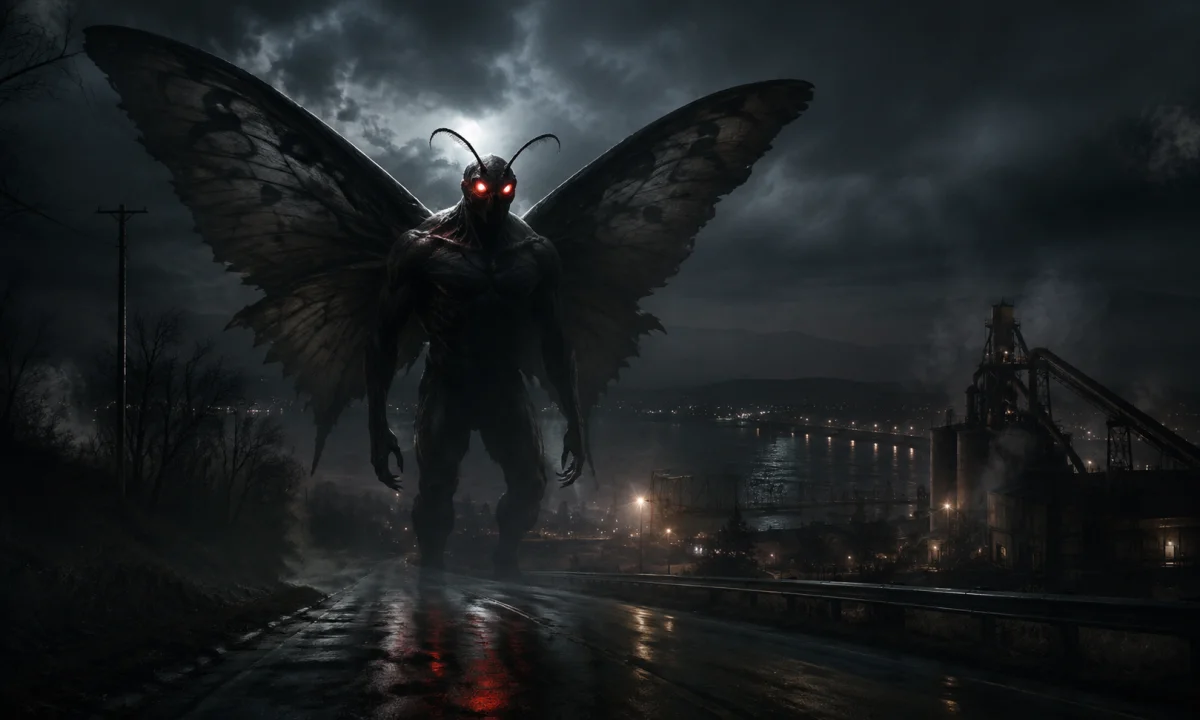
Mothman is a modern American legendary creature associated chiefly with Point Pleasant, West Virginia, and the surrounding Ohio River Valley. Reports of a large, winged humanoid with glowing red eyes began there in November 1966 and continued for about a year. Mothman is sometimes described as a cryptid or a mythical monster, but it does not belong to an ancient religious mythology or to a long-established body of traditional folklore. Its legend developed through eyewitness reports, newspaper coverage, local storytelling, paranormal literature and later popular culture.
The figure is best understood as a product of contemporary American legend. Its story combines an unusual creature report with abandoned industrial buildings, fears about unexplained events, rumours of UFOs and a later association with the Silver Bridge disaster. Some people treat Mothman as a warning spirit or supernatural omen, while others regard the sightings as misidentifications, embellished memories or an example of folklore forming in real time. No physical evidence has established that an unknown winged creature was present.
Origins in Point Pleasant
The first widely known reports appeared in the autumn of 1966 near Point Pleasant, a town on the Ohio River in Mason County, West Virginia. Several early encounters were connected with an abandoned military-industrial site commonly called the TNT area. During the Second World War, the site had been used for the manufacture and storage of explosives. By the 1960s, its concrete bunkers and overgrown roads formed an isolated landscape that easily encouraged rumours and nighttime exploration.
On the night of 15 November 1966, two young couples reported seeing a large figure near the former TNT facility. The witnesses were driving in the area when, according to their accounts, a creature emerged or was noticed near a building. They described it as roughly human-shaped, with broad wings and intensely bright red eyes. The figure was said to have followed or kept pace with their car as they drove away. Accounts differ in details, but the incident became the foundational story of the Mothman legend.
Local law-enforcement officers took statements from the witnesses, and newspapers reported the encounter. Further reports followed in the area during the succeeding weeks and months. Not every witness described exactly the same creature. Some reported a dark, winged form; others emphasized red eyes, great speed or a frightening presence. The reports varied in distance, lighting conditions and the creature's apparent shape.
In December 1966, a local woman reported seeing a large figure with red eyes near her home in the vicinity of Point Pleasant. Other accounts were attributed to residents, motorists and visitors to the TNT area. Some stories included a missing dog, strange noises or difficulty with telephones, although such details were not part of every early report and became more prominent in later retellings. The legend therefore consists of overlapping accounts rather than a single, stable narrative recorded in an ancient text.
The name “Mothman”
The name Mothman became established through local reporting and subsequent retellings. The exact circumstances in which the name was first coined are not entirely clear. Early witnesses did not necessarily use it themselves; they described a large bird, a man-like figure or an unidentified creature. Newspapers and commentators helped turn varied descriptions into a recognizable named entity.
Despite the name, Mothman is not traditionally described as an enormous moth. Witnesses generally reported a humanoid or bird-like figure with wings, rather than an insect with moth anatomy. The name may evoke darkness, nocturnal activity and the unsettling attraction of eyes or lights, but it has no known basis in an old mythological language or religious title. It should not be treated as evidence of a pre-existing moth spirit tradition.
Appearance and reported abilities
The most familiar image of Mothman is a tall, dark or grey humanoid with large wings and glowing red eyes. Some accounts say that the eyes were located where a human face might be, while others describe them as appearing without a clearly visible head. The creature is often said to have lacked a normal mouth or other recognizable facial features. These details are not consistent across all reports and should be understood as elements of the developing legend rather than a fixed traditional description.
- Wings: Mothman is usually described as having broad wings, sometimes compared with those of a bat or large bird.
- Eyes: Bright red eyes are the most repeated feature in popular accounts.
- Size: Witnesses commonly described a figure larger than a person, although estimates varied considerably.
- Movement: The creature was said to fly without visible flapping, rise vertically or move at extraordinary speed.
- Colour: Descriptions usually involve black, dark brown or grey colouring, often observed at night.
- Voice and behaviour: Some stories mention silence, strange cries or an overwhelming sense of fear, but there is no consistent account of speech.
Later versions also attribute unusual powers to Mothman, including invisibility, teleportation, foreknowledge and the ability to influence machines or communications. These abilities are not securely established in the earliest eyewitness reports. They belong mainly to later paranormal interpretations and literary treatments.
The Silver Bridge and the omen tradition
On 15 December 1967, the Silver Bridge connecting Point Pleasant with Gallipolis, Ohio, collapsed during evening traffic. Forty-six people died. The disaster was investigated as a structural failure, and the collapse was attributed to the failure of a suspension-chain eyebar under load, not to any supernatural cause.
Because Mothman sightings had occurred in the region during the preceding year, later storytellers connected the creature with the disaster. In this interpretation, Mothman was a prophetic warning, a harbinger of death or an observer of an approaching catastrophe. Some accounts claim that the creature appeared near the bridge or was seen by people connected with the disaster, but these claims are difficult to separate from later recollection and folklore development.
There is no reliable evidence that the creature caused the bridge collapse or that its reports predicted the engineering failure. The association became powerful because the dates were close and because omen stories give frightening events a memorable pattern. Mothman consequently shifted from being a strange local animal report to being a figure linked with catastrophe and foreknowledge.
UFOs, paranormal claims and later expansion
The Point Pleasant reports became connected with a wider series of stories involving unidentified lights, unusual telephone calls, mysterious visitors and alleged government or non-human agents. These elements were especially influential in the work of writer John Keel, whose 1975 book The Mothman Prophecies presented an expansive account of the events.
Keel's treatment did not simply preserve the earliest newspaper reports. It combined witness testimony with paranormal investigations, UFO accounts, folklore motifs and the author's interpretations. In the resulting narrative, Mothman became part of a much larger mystery involving warnings, strange communications and beings sometimes called the Men in Black. Later readers often encountered the legend through this book rather than through the original local reports.
The expanded story should therefore be divided into layers:
- Contemporary reports: accounts from 1966 and 1967 describing a large winged figure near Point Pleasant.
- Local folklore: stories repeated, modified and connected with other unusual events in the region.
- Paranormal interpretation: the idea that Mothman was linked with UFOs, psychic warnings or other unexplained forces.
- Popular fiction: novels, films, television programmes and games that reshape the legend for dramatic effect.
These layers are related, but they are not interchangeable evidence. A detail found in a later book or film should not automatically be presented as part of the original witness accounts.
Interpretations of the sightings
No single explanation accounts for every reported detail, particularly because the accounts differ and were collected under varying circumstances. A common skeptical interpretation is that at least some witnesses saw a large owl or another nocturnal bird at close range. Owls can appear unusually large in darkness, and their reflective eyes may seem to glow red or orange when illuminated. Other possibilities include cranes, large birds of prey, a person wearing unusual clothing or a combination of ordinary sights and fearful expectations.
The abandoned TNT area also provided conditions in which perception could be uncertain. Darkness, distance, moving vehicles and unfamiliar buildings can make an animal appear more humanoid than it is. Once newspapers had publicized the first reports, later witnesses may have interpreted ambiguous shapes through the developing Mothman image. This does not prove that every account was invented. It shows how observation, memory, media coverage and local expectation can interact in the creation of folklore.
Folklorists and cultural historians may also view Mothman as a symbol of unease during a period of social and technological change. The former explosives site represented a dangerous industrial past, while the bridge represented modern infrastructure and dependence on engineering. A silent winged figure appearing at the edge of town could embody anxieties about hidden dangers, sudden disaster and forces beyond ordinary understanding.
For believers, Mothman remains an unexplained entity that may appear before destructive events. For skeptics, the legend illustrates how extraordinary interpretations grow around ambiguous sightings and tragedies. Neither interpretation is an established religious doctrine, and Mothman has no universally accepted mythology, ritual system or sacred tradition.
Mothman and similar winged beings
Mothman is sometimes compared with figures from older folklore, but these comparisons should be made carefully. European traditions include witches, demons and supernatural night creatures that can fly or appear in animal form. Many cultures also have owl spirits, bird-headed beings or ominous aerial entities. However, there is no demonstrated historical continuity between those traditions and the Point Pleasant reports.
Mothman is also frequently compared with the Owlman, a separate modern British legend associated with alleged sightings near Mawnan Smith in Cornwall during the 1970s. Both figures are winged and humanoid or bird-like, but they arose in different places and cultural settings. Similarities may reflect recurring fears of large nocturnal birds and airborne humanoids rather than a shared creature.
The name can also cause confusion with fictional characters called Mothman, including comic-book villains and creatures created for horror stories. Those characters may borrow the appearance of the Point Pleasant legend, but they are not part of its original folklore. Likewise, an ordinary moth, a moth spirit in a particular indigenous tradition and the modern American Mothman should not be treated as the same being without specific evidence.
Public memory and modern popular culture
Mothman has become a prominent part of Point Pleasant's public identity. The town contains a large metal statue of the creature and hosts an annual festival dedicated to the legend. A museum and local businesses also preserve and promote Mothman-related stories. These activities do not demonstrate the creature's existence, but they show how folklore can become part of civic heritage, tourism and community memory.
The legend reached a wider audience through Keel's book and the 2002 film The Mothman Prophecies. The film uses the Point Pleasant story as inspiration but changes characters, chronology and events for dramatic purposes. Television documentaries, paranormal programmes, podcasts, novels and games have further expanded the image of Mothman as a mysterious supernatural warning figure.
In contemporary culture, Mothman can represent several different ideas at once: an unexplained cryptid, a disaster omen, a guardian who attempts to warn humans, or a darkly comic regional mascot. Those meanings belong to modern interpretation rather than to a settled ancient tradition. The historical core remains the cluster of reported sightings around Point Pleasant in 1966 and 1967, followed by the powerful but unproven association with the Silver Bridge collapse.