WORLD
WORLD
Tepeyollotl
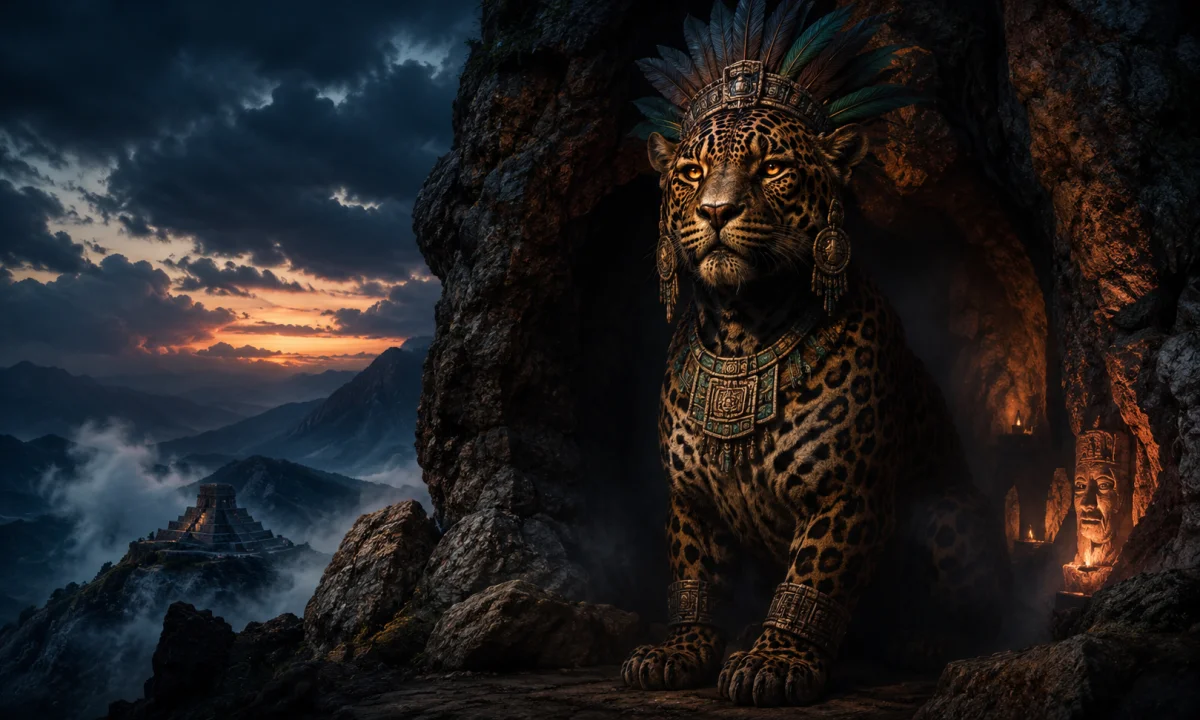
Tepeyollotl is a deity of Nahua religious tradition in central Mexico, commonly translated as “Heart of the Mountain.” He is strongly associated with jaguars, mountains, caves, echoes and the hidden powers of the earth. In surviving colonial-era descriptions and painted manuscripts, Tepeyollotl is not always presented as a completely separate god with a single fixed biography. He may appear as a mountain deity in his own right, as a jaguar lord, or as a manifestation of the powerful god Tezcatlipoca.
Name and meaning
The name Tepeyollotl comes from Nahuatl elements usually understood as tepetl, “mountain,” and yollotl, “heart.” The resulting expression, “Heart of the Mountain,” can refer to the inner or vital essence of a mountain rather than to a literal organ. Mountains were not merely geographical features in Nahua thought. They were living, powerful places that contained water, fertility, caves, springs, precious materials and entrances into the earth.
Spelling varies because the earliest alphabetic records were written by Europeans attempting to represent Nahuatl sounds with Latin letters. Forms such as Tepeyollotl, Tepeyóllotl and other orthographic variants may therefore be encountered. These differences do not necessarily indicate different deities.
Cultural and religious setting
Tepeyollotl belongs to the religious world of the Nahua peoples of central Mexico, including the Mexica, often called the Aztecs. The best-known evidence comes from the late Postclassic period and the early colonial period, especially the sixteenth century. Important materials include painted manuscripts, archaeological images and alphabetic accounts recorded in Nahuatl or Spanish by Indigenous informants and colonial writers.
These sources do not provide a single standardized mythology comparable to a modern encyclopedia of gods. Religious knowledge was expressed through ritual calendars, songs, visual signs, priestly traditions, local cults and stories that could vary from one community to another. Colonial accounts also translated Nahua concepts into European categories such as “god,” “idol” and “devil.” As a result, Tepeyollotl’s identity must be reconstructed from several kinds of evidence rather than taken from one complete ancient narrative.
Mountains held an especially important place in central Mexican religion. They were connected with rain, clouds and the storage of water inside the earth. Many were treated as sacred beings or as the residences of supernatural powers. Caves could be understood as entrances to the underworld, places of emergence and sources of fertility. The mountain in Tepeyollotl’s name therefore suggests a complex sacred landscape: solid and enduring, but also full of concealed movement, sound and life.
Identity and classification
Tepeyollotl is frequently described as a jaguar deity. His name and imagery also connect him with mountains, echoes and the wilderness. In some interpretations, he is an embodiment or aspect of Tezcatlipoca, the “Smoking Mirror,” one of the most important and complex powers in Nahua religion.
The relationship with Tezcatlipoca is not simply a matter of two unrelated gods being confused. Tezcatlipoca could appear through different names, forms and manifestations. He was associated with night, rulership, conflict, sorcery, fate, sexuality, the invisible wind and the dangerous forces beyond ordinary human control. The jaguar was one of the principal forms through which his power could be represented. Tepeyollotl’s mountain-and-jaguar identity fits naturally within this broader religious pattern.
At the same time, identifying Tepeyollotl only as “another name for Tezcatlipoca” can obscure the distinctive features attached to him. The surviving evidence emphasizes a particular combination of mountain, jaguar, echo and subterranean power. Some scholars therefore treat him as a specialized aspect of Tezcatlipoca, while others emphasize his independent function as a local or landscape deity. The sources do not support a single universally accepted classification.
Tepeyollotl is also commonly included among the Nine Lords of the Night, a group of deities associated with the ninefold cycle used in Mesoamerican calendrical systems. In lists derived from colonial sources, he is often placed as the eighth Lord of the Night. These deities did not rule the night in the same sense as a modern clock-based division of time. Their cycle gave days particular ritual qualities and helped frame time as a succession of divine influences. Assignments and visual identifications can vary between manuscripts and scholarly reconstructions.
Appearance and symbols
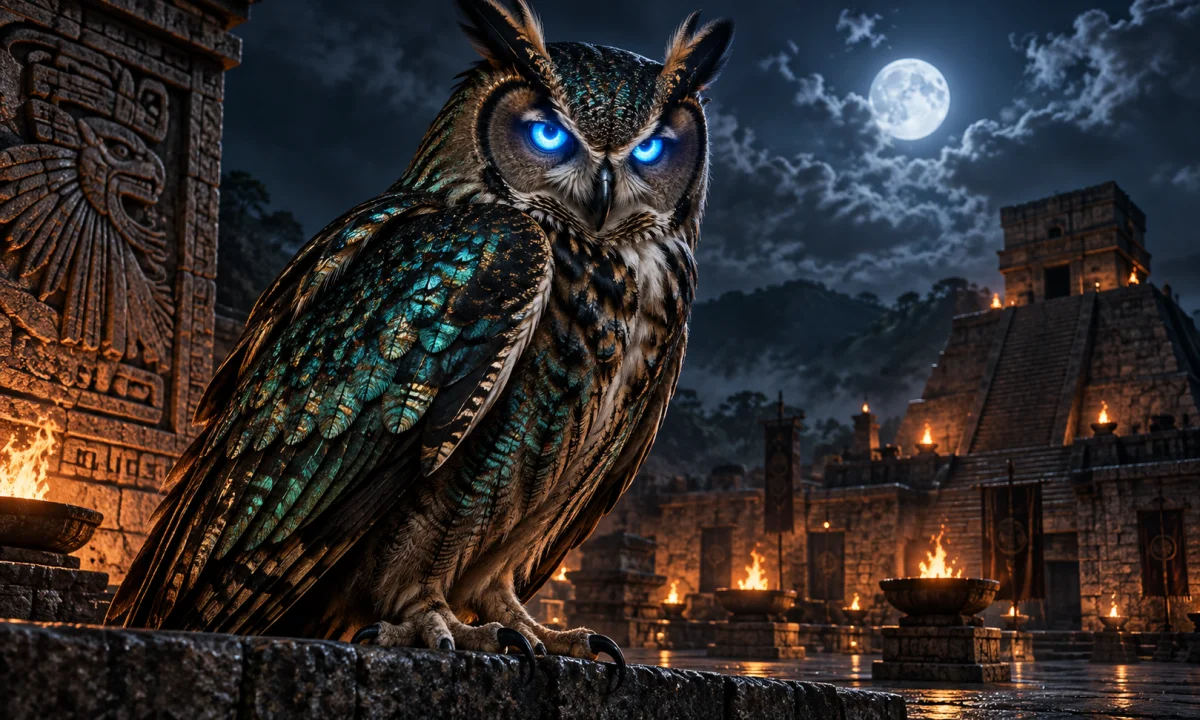
The most recognizable form of Tepeyollotl is a jaguar or a human figure with prominent jaguar features. He may be shown with a spotted feline body, a jaguar head or a mask displaying the animal’s teeth and muzzle. In Mesoamerican art, these traits are not merely decorative. They identify a being with the strength, stealth, nocturnal activity and dangerous independence of the jaguar.
Jaguars occupied a powerful symbolic position throughout ancient Mesoamerica. They were associated with the night, caves, rulers, warriors and the untamed forest. Their ability to move silently and hunt in darkness made them appropriate symbols of hidden power. A jaguar could also represent elite authority and supernatural transformation. Tepeyollotl’s jaguar form thus links him both to the wild landscape and to the authority of gods and rulers.
Mountains and caves are equally important symbols. The mountain is a visible form of permanence, but its “heart” is concealed. Caves suggest interior space, darkness, origins and the realm beneath the surface. Nahua ideas of sacred geography often connected mountains with water and fertility, while caves could be associated with ancestral emergence or contact with other levels of the cosmos.
Tepeyollotl is also linked with echoes. An echo is an unseen voice returned by a mountain. It comes from a hidden place, resembles an original sound and yet cannot be physically grasped. This makes it an apt symbol for a deity whose power belongs to the interior of the earth and to the mysterious forces that answer human actions from beyond ordinary sight.
Some modern descriptions call Tepeyollotl a god of earthquakes. The association is understandable because mountains, subterranean movement and the dangerous force of the earth are closely related in interpretation. However, “earthquake god” should not be treated as an uncontested or complete definition. The most consistent descriptions emphasize mountains, jaguars and echoes, while the exact range of his powers varies according to the source and the interpreter.
Calendar and ritual associations
Tepeyollotl’s connection with the ritual calendar reflects the wider Nahua understanding of time as sacred and active. Days were not neutral units. Their names and numerical combinations carried qualities that could affect ceremonies, personal destinies and political or agricultural decisions. Jaguar imagery appears within this calendrical world, although the precise relationship between Tepeyollotl, particular day signs and trecena patrons is not identical in every source.
The jaguar sign, ocelotl, was one of the twenty day signs of the tonalpohualli, the 260-day ritual calendar. A day sign should not automatically be treated as the name of a deity. “Jaguar” was a calendrical symbol with its own associations, while Tepeyollotl was a divine figure who could be represented through jaguar imagery. The two concepts overlap, but they are not interchangeable.
Mountain-related ceremonies were also part of the broader ritual environment in which Tepeyollotl can be understood. The festival known as Tepeilhuitl, often translated as the “Feast of the Mountains,” honored sacred mountains and beings connected with rain and water. Colonial descriptions place this festival within a wider network of mountain and rain cults, especially those associated with Tlaloc and the Tlaloque. It is not always possible to determine from the surviving accounts exactly how Tepeyollotl was represented or worshipped in every local celebration. His mountain identity nevertheless belongs to the same religious landscape.
Stories and relationships
Unlike Quetzalcoatl, Huitzilopochtli or Tezcatlipoca, Tepeyollotl does not possess a large, widely preserved cycle of independent myths. The surviving material is richer in names, images, calendar associations and descriptions of divine identity than in narrative episodes. There is no single ancient story that explains all of his attributes or presents him as the central actor in a complete creation myth.
His most important relationship is with Tezcatlipoca. In religious terms, this relationship illustrates how Nahua deities could have multiple forms and titles. A power connected with night, rulership and transformation could be expressed through the figure of a jaguar dwelling in the mountain. Tepeyollotl gives that power a specific landscape and animal body.
His relationship with Tlaloc is more one of overlapping domains than simple identity. Tlaloc was associated with rain, storms, mountain water and agricultural fertility, while Tepeyollotl was associated with the mountain’s inner being, jaguars and echoes. Because mountains were central to rain religion, their spheres could meet. They should nevertheless not be merged. Tlaloc is not simply another name for Tepeyollotl, and Tepeyollotl is not merely a jaguar version of the rain god.
Other jaguar figures and symbols in Mesoamerican traditions should also be distinguished from him. The jaguar was a widespread sacred animal, not an exclusive emblem belonging to one deity. A jaguar image in a manuscript or sculpture may represent Tepeyollotl, Tezcatlipoca, a ruler, a warrior, a supernatural animal or a broader idea of transformation. Identification depends on the surrounding signs, costume, context and manuscript tradition.
Religious significance
Tepeyollotl expresses the idea that the natural world is inhabited by forms of agency that humans cannot fully control. A mountain may hold water, shelter dangerous animals, answer with an echo or tremble beneath the ground. Its visible surface conceals a living interior. The deity’s name turns that interior vitality into a divine person.
His jaguar form adds a second dimension. Jaguars were not symbols of harmless nature. They represented predatory force, darkness, independence and the possibility of crossing boundaries between human and animal worlds. Tepeyollotl therefore stands at the meeting point of cultivated society and untamed land, daylight and night, surface and depth, human speech and the voice returned by the mountain.
The connection with Tezcatlipoca also gives Tepeyollotl a moral and political dimension. Tezcatlipoca could test rulers, expose weakness, distribute fortune and bring sudden reversals. When this power is expressed through Tepeyollotl, the mountain and jaguar become signs of hidden judgment and unstable fate. The deity is not simply a benevolent protector of nature; like many powerful beings in Nahua religion, he could be respected precisely because his favor was never entirely safe or predictable.
Colonial records and interpretation
Knowledge of Tepeyollotl comes mainly through records made after the Spanish invasion, although many of those records preserve Indigenous information and older visual traditions. The Florentine Codex, other colonial manuscripts and painted codices provide valuable evidence, but they were produced in circumstances of religious persecution and cultural change. Some native terms were translated into Christian or European categories, and local differences were sometimes compressed into neat lists of gods.
For this reason, claims about Tepeyollotl should be treated with care. It is reasonable to describe him as a Nahua mountain-and-jaguar deity associated with echoes and connected in important traditions with Tezcatlipoca. It is less secure to give him a rigid hierarchy, a fully independent mythology or a fixed set of powers that appears identically in every community. Interpretations based on visual symbolism can be persuasive, but they remain interpretations when the accompanying Indigenous explanation has not survived.
Tepeyollotl today
Modern popular and online treatments often reduce Tepeyollotl to a simple label such as “Aztec jaguar god.” That description captures one important aspect of his imagery but leaves out the mountain, cave, echo and Tezcatlipoca associations that make the figure distinctive. Contemporary fantasy art and fictional adaptations may also give him a detailed personality, weaponry or mythic biography not found in the surviving Nahua evidence.
Modern Indigenous communities, artists and cultural educators may engage with Nahua deities in ways that differ from both colonial descriptions and academic reconstructions. Such living interpretations should not be treated as identical to the religious practices of the Mexica state in the fifteenth or sixteenth centuries, but neither should the subject be confined to a museum label. Tepeyollotl remains a powerful image of the sacred mountain: a jaguar presence in the darkness, with the hidden heart of the earth answering from within.