WORLD
WORLD
Te Tuna
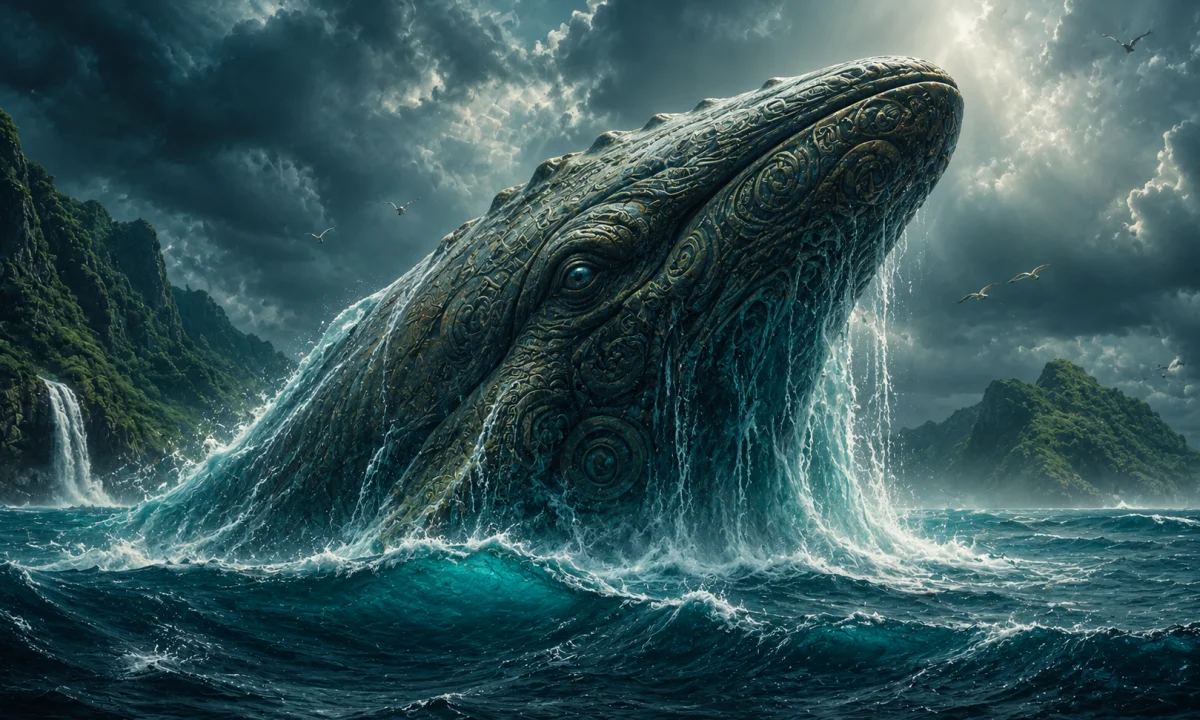
Te Tuna is a name associated with powerful eel figures in Polynesian mythology, especially traditions from Aotearoa New Zealand and Samoa. The expression is not always the name of one universally defined being. In Māori, tuna means “eel,” while te tuna means “the eel”; in some accounts, a giant or ancestral eel is identified simply as Tuna, or by the extended name Tuna-roa. In Samoan tradition, Tuna is the great eel in the story commonly known as Sina and the Eel. These traditions are related through wider Polynesian cultural connections, but they should not automatically be treated as versions of a single pan-Polynesian deity.
The meaning of the name
The word tuna is used in several Polynesian languages for an eel or eel-like creature. The form Te Tuna is particularly suggestive of Māori usage because te is the singular definite article, meaning “the.” As a result, the phrase may function either as a descriptive title or as a personal name, depending on the tradition and the way an individual account has been recorded.
This distinction matters. Polynesian oral traditions often preserve names in several forms, and a word that begins as a common noun can become the name of an ancestral being, a supernatural guardian or a legendary ruler. A reference to “the eel” does not always indicate a separate god with a fixed biography. Some accounts describe Tuna as an enormous eel, some as an ancestor of eels, and others as a being whose death explains the origin of an important plant or natural feature.
Modern retellings sometimes present Te Tuna as though the figure had one standardized appearance and one official mythology. The surviving traditions are more varied. Details differ between islands, language communities, tribal traditions and later written versions.
Cultural setting: eels in Polynesian life
Eels occupy an important place in the environments and food systems of many Polynesian communities. In Aotearoa New Zealand, the longfin eel, or tuna kuwharuwharu, is a major native freshwater species. Eels live in rivers, lakes, swamps and streams, and their movements connect inland waters with the sea. Their great size, concealed habits and ability to survive in difficult conditions have contributed to their importance in Māori environmental knowledge and symbolism.
Traditional Māori relationships with waterways were shaped by ideas of mauri, the life force or living essence of a place, and tapu, the condition of sacred restriction. Particular rivers, pools and wetlands could be associated with ancestors, guardian beings or dangerous presences. A large eel might be understood not merely as an animal but as a sign of the character and power of its waterway.
This does not mean that every eel was worshipped as a god. Māori religious and cultural categories are not equivalent to a simple division between “ordinary animals” and “supernatural animals.” An animal could have practical, genealogical, spiritual and symbolic significance at the same time. Stories about Tuna therefore belong within a wider understanding of waterways as living ancestral landscapes.
In Samoa and other parts of Polynesia, eels likewise appear in stories connected with chiefs, lovers, ancestors, fertility and the origin of plants. The eel’s ability to move between water and land makes it a particularly effective figure for stories about transformation and the crossing of boundaries.
Te Tuna in Māori-associated traditions
In Māori-associated mythology, Tuna or Tuna-roa is sometimes described as a giant eel or a chief among eels. The details of his identity and relationships are not uniform. In some traditions, a great eel is an independent supernatural being connected with a particular stream or pool. In others, Tuna appears in a narrative involving Māui, the culture hero known for feats such as fishing up land, slowing the sun and obtaining fire.
Stories of Māui and a great eel exist in differing forms. A common pattern has Māui confronting or killing a powerful eel. The encounter may be presented as a contest between a human hero and a dangerous creature, as the defeat of a threatening guardian, or as an episode explaining the origin of eels and other features of the natural world. The exact sequence, names and consequences vary between accounts.
Because many Māori traditions were transmitted orally and later written down by different collectors, it is unsafe to treat one published version as the definitive form. Some narratives use Tuna, while others use Tuna-roa or describe a giant eel without giving it a fully developed personal identity. The element roa means “long” or “great,” so Tuna-roa can be understood as “long eel” or “great eel,” although the name’s precise significance depends on context.
In these stories, the struggle with Tuna can be read at several levels. It may represent the danger of deep water and uncontrolled natural power. It may also express the transformation of a wild landscape into a place where human communities can live, travel and obtain food. As with many Māui narratives, the hero’s victory is not necessarily a purely moral triumph. Māui is often clever, disruptive and ambitious, and his actions create both benefits and new conditions of responsibility.
The Samoan story of Sina and Tuna
The best-known Polynesian tradition involving a named Tuna is the Samoan story of Sina and the Eel. In this tale, Tuna is a huge eel and a powerful figure associated with a watery domain. He falls in love with Sina, a human woman. Versions differ in the reasons for his desire and in the events that follow, but the relationship is generally impossible because Tuna belongs to another form of existence.
In many versions, Tuna’s love becomes a source of fear or trouble. Sina and her people cannot accept the eel as an ordinary suitor, and Tuna eventually recognizes that he cannot remain with her in his current form. He asks Sina to arrange his death or to have him killed. His final request is that his head be planted in the ground.
From Tuna’s head grows the first coconut palm. The coconut then becomes a gift to Sina and to humanity. The story connects the plant’s physical features with Tuna’s continuing presence: the marks on a coconut may be interpreted as resembling a face, while the coconut’s water and flesh provide nourishment. The precise imagery differs between tellings, but the central transformation remains the same: the eel’s death produces a plant that sustains human life.
The story is not simply an explanation of where coconuts came from. It also concerns love, sacrifice, bodily transformation and the continuing relationship between human beings and the natural world. Tuna does not vanish entirely when he dies. His identity is transferred into a plant that becomes useful, familiar and generative. Death is therefore represented as a change of form rather than an absolute end.
The Samoan tale is often told in connection with the village and island landscapes of Samoa, though its wider circulation means that details can shift between communities. Related stories of a woman and a great eel occur elsewhere in Polynesia, sometimes with different names, motivations and endings. Similarity does not prove that every version preserves one original story; it may reflect ancient cultural connections, later movement of stories, or recurring themes arising from the significance of eels and coconuts.
Attributes and supernatural character
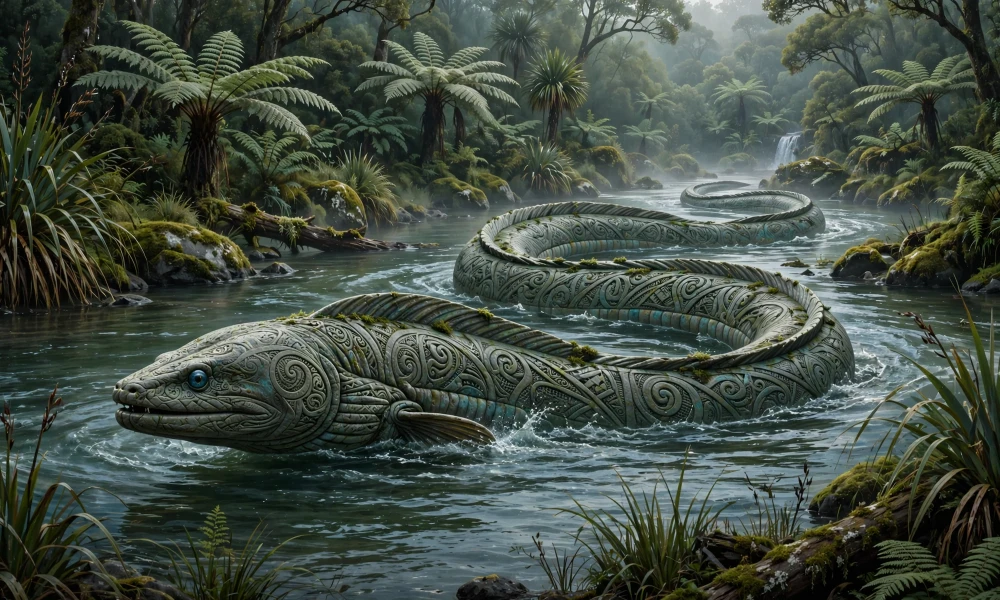
Te Tuna is most often imagined as an enormous eel, but size alone does not define the figure. The eel may possess speech, intelligence, human emotions or the status of a chief. In some accounts, Tuna can move between animal and human social worlds. This capacity gives the figure a liminal quality: Tuna belongs to water, yet interacts with people on land; he is an animal, yet behaves as a person; he dies, yet continues as a plant.
Water is the central environment associated with Tuna. Rivers, pools, lagoons and underground or secluded places can all serve as settings for encounters with a great eel. Such places are often understood as potentially dangerous because their depths conceal what human beings cannot see. A giant eel represents the unseen life of the water and the possibility that a familiar landscape has an agency of its own.
Where Tuna is treated as a guardian or chief, his power may be protective as well as threatening. A guardian of a waterway can punish disrespect, but the same being may also embody the fertility and abundance of the place. This dual character is common in traditional stories about powerful natural beings. The figure is not necessarily “evil”; danger may arise when human beings ignore the proper relationships and restrictions associated with a place.
In the Sina story, Tuna’s most important power is transformative rather than destructive. His body becomes the source of the coconut palm, one of the most useful plants in many tropical Pacific societies. The story consequently gives the coconut a personal and ancestral dimension. Food, drink, shelter and material resources are connected with the memory of a being who gave himself to the human world.
Relationships with other figures
The relationship between Tuna and Sina is central to the Samoan tradition. Sina is not merely a passive recipient of Tuna’s gift. She is the human person through whom the transformation is witnessed, remembered and made meaningful. Depending on the version, she may be Tuna’s beloved, the person who carries out his final request, or the representative of the community that receives the coconut.
In Māori-associated stories, Tuna’s most notable relationship is often with Māui. Their encounter follows a familiar mythic pattern in which a culture hero challenges a being connected with a powerful natural realm. Māui’s victory may explain why eels are found in their present form or how a dangerous supernatural presence was overcome. However, the Māui and Tuna narratives should not be combined automatically with the Samoan story of Sina and Tuna. The names may be related through Polynesian language and tradition, but the characters and narrative functions are different.
There is also a risk of confusing Tuna with taniwha. Taniwha are powerful beings in Māori traditions associated with waterways, caves, mountains and other locations. Some can appear as enormous aquatic creatures, and an eel-like form is possible in particular traditions. Nevertheless, Tuna is not simply another word for taniwha. “Tuna” identifies an eel or a figure named for an eel, while “taniwha” refers to a broader class of powerful beings whose identities and roles are tied to specific traditions and places.
Interpretations of the figure
One interpretation sees Te Tuna as an embodiment of the eel itself: secretive, resilient, powerful and closely connected with water. The figure gives human form to the experience of living beside rivers, lakes and wetlands whose depths cannot be fully controlled. The mythic eel is therefore both a natural animal and a way of expressing the spiritual character of its habitat.
Another interpretation emphasizes transformation. In the Samoan story, the movement from eel to coconut joins water, land and vegetation in a single chain of life. The tale can be understood as an origin story for a vital food plant, but it also presents generosity as something that survives the death of the giver. Tuna’s identity is preserved through the useful and recognizable form of the coconut.
The stories may also be read through the idea of boundaries. Tuna crosses the boundary between animal and human, water and land, danger and nourishment, desire and sacrifice. These crossings are not presented as simple changes without consequences. The relationship between Tuna and Sina ends in separation, and Māui’s victory over a great eel may involve the destruction of an older power. Mythic transformation can therefore be creative while still carrying loss.
It is important not to impose a single symbolic meaning on every tradition. Māori and Samoan communities have distinct histories, languages and cultural frameworks. A story may function as genealogy, an explanation of a natural feature, a teaching about conduct, a performance for children, a sacred tradition or a combination of these. Interpretations should remain attentive to the particular community and version in which the figure appears.
Oral tradition and variation
Much of the material concerning Tuna was preserved through oral transmission before being recorded in writing. Oral traditions are not defective versions of written myths; variation is part of how such traditions remain alive. A storyteller may adjust an episode for a particular audience, emphasize a local landscape or use a name familiar to the community.
Written retellings can also alter the presentation. Collectors may translate names inconsistently, combine material from different informants or present a local narrative as though it represented an entire people. Later educational, literary and tourist versions may simplify the story further. For that reason, claims that Te Tuna has one fixed genealogy, one official appearance or one single religious status should be treated cautiously unless they are clearly tied to a particular tradition.
Religious and cultural significance
Te Tuna belongs to a world in which animals, plants, ancestors and landscapes may be connected through genealogy and spiritual relationship. The figure should not be reduced to a “monster” in the modern fantasy sense. A giant eel may be frightening, but fear is only one part of its significance. Tuna can represent ancestral power, the hidden life of water, the risks of violating sacred boundaries and the sources of food that sustain a community.
In the Samoan tradition, the coconut grown from Tuna’s head expresses a continuing exchange between a supernatural being and human society. In Māori-associated traditions, the great eel’s connection with rivers and with Māui places it within stories about the shaping of the inhabited world. Both patterns show how Polynesian mythology can treat natural resources as beings with histories rather than as lifeless commodities.
Contemporary retellings may present Te Tuna in children’s literature, cultural education, performances or general discussions of Polynesian mythology. Such versions can help preserve awareness of the stories, but they may also merge Māori, Samoan and other Polynesian material under a single label. A careful account keeps the traditions distinct, identifies uncertainty about the name, and recognizes that the eel figure has different meanings in different cultural settings.