WORLD
WORLD
Tailtiu

Tailtiu is a figure from Irish mythology and early Irish tradition, best known as a goddess or divine ancestress associated with the land, sovereignty, clearing of territory, and the funeral games that later gave their name to the festival of Lughnasadh. She appears in medieval Irish literary sources rather than in surviving pagan inscriptions or archaeological remains, so her profile comes through a mix of mythic narrative, learned medieval tradition, and later interpretation.
Tradition and sources
Tailtiu belongs to the world of the mythological cycle and related early Irish narrative tradition preserved in medieval manuscripts. The most important references place her in connection with the Tuatha Dé Danann, the pre-Christian supernatural people of Irish myth, and with the inauguration of a great assembly or fair at Tailtiu, now associated with Teltown in County Meath. The material is not uniform, and some details differ from text to text, which is typical of Irish mythological tradition as it was recorded by Christian scribes working with older oral and literary material.
In surviving sources, Tailtiu is not presented as a neatly fixed deity with a single consistent role. She appears as a powerful female figure linked to kingship, cultivation, mourning, and memorial rites. In some accounts she is a foster-mother figure; in others she is associated more directly with the landscape itself. Modern scholarship often treats her as a goddess-like being, though the medieval texts can also frame her in human or semi-divine terms. That uncertainty should be kept in view: the tradition preserves importance, but not a single unambiguous category.
Name, identity and classification
The name Tailtiu is usually associated with the place-name Teltown, and the two are closely linked in tradition. Her name appears in the context of an eponymous explanation for the location and its assembly. This does not prove that the place was literally named after a historical individual; rather, it shows how medieval Irish tradition explained landscape and ritual through mythic ancestry.
Tailtiu is commonly described as a goddess in modern discussion, but the medieval evidence is more varied. She can be understood as:
- a divine or semi-divine mother figure connected with the land,
- a foster-mother of the god Lugh in some traditions,
- the remembered name behind a major seasonal gathering,
- a figure of sacrifice and labour who prepares the land for human use.
Because early Irish literature often blends myth, genealogy, and place lore, Tailtiu is best approached as a figure whose identity is shaped by several overlapping roles rather than by one simple function.
Role in the landscape and agricultural tradition
One of the most distinctive traditions about Tailtiu describes her as clearing the land of Ireland for cultivation. In this account, she performs an immense and exhausting labour, cutting back woods and preparing the ground for settlement and farming. This makes her a symbolic figure of transformation: wild land becomes habitable land through effort, sacrifice, and loss.
The story is significant because it reflects an important theme in Irish mythological writing: the relationship between sovereignty, fertility, and the land itself. Tailtiu is not merely a local ancestor; she embodies the cost of creating an ordered world. Her labour is remembered not as ordinary work but as a quasi-sacred act whose consequences are still marked in ritual and place-name.
Her connection to cultivation also helps explain why she is associated with a harvest-time assembly. In Irish tradition, seasonal festivals were not only religious or ceremonial occasions but also moments for law, trade, competitions, and social gathering. Tailtiu’s memory is tied to that wider cultural setting.
Tailtiu and Lughnasadh
Tailtiu is most widely known for her connection with Lughnasadh, the early August festival associated with the god Lugh. In medieval narratives, Lugh establishes funeral games or an assembly in honour of Tailtiu after her death. These games are said to commemorate her labour and to mark the time of harvest and community gathering.
In this tradition, Tailtiu’s death is important. She is said to die or be exhausted after her great labour in clearing the land, and Lugh’s games function as a memorial feast and ritual observance. The festival thus combines mourning, athletic competition, public assembly, and seasonal thanksgiving. That combination is characteristic of Irish mythic material, where one event can carry several meanings at once.
The association between Tailtiu and Lughnasadh has made her central to interpretations of the festival as both an agricultural celebration and a mythic commemoration. The festival itself has had a long life in Irish cultural memory, though its later popular forms do not always preserve the older narrative details. The medieval texts, however, make clear that Tailtiu’s story was part of the explanatory framework for the assembly at Teltown.
Relationship with Lugh
Tailtiu is closely associated with Lugh, one of the most prominent figures in Irish mythology. Depending on the source and interpretation, she may appear as his foster-mother, his adoptive mother, or the person whose death prompts his memorial games. The relationship is not always stated in the same way, and it is best to avoid imposing a single rigid genealogy on the tradition.
The fosterage motif is especially meaningful in Irish storytelling. Fosterage was a major social institution in early Irish society, and myth often elevates it into a symbolic relationship of loyalty, nurture, and obligation. If Tailtiu is understood as Lugh’s foster-mother, then her role extends beyond biological or divine motherhood into the broader cultural ideal of care and formation. If she is understood more generally as the honoured dead whose memory Lugh preserves, the relationship still emphasizes reciprocity and remembrance.
Either way, Tailtiu is not a background figure. She stands in a relationship of deep significance to one of the central mythic heroes of Ireland, and her memory helps explain why Lugh is linked to a seasonal festival of public gathering and display.
The tale of her death
In the surviving mythic tradition, Tailtiu’s death is linked with exhaustion after her immense labour. The broad outline is relatively stable even if details vary: she has worked to clear land for the people of Ireland, and the effort kills or fatally weakens her. This is a striking mythic pattern, in which creative work is inseparable from sacrifice.
The death of Tailtiu is not presented merely as a personal tragedy. It becomes the basis for a public rite. Lugh orders games or a commemorative assembly in her honour, and the ritual memory of her death is transformed into a seasonal institution. In this way, the story links mortality, kingship, and communal celebration. The dead are not forgotten; instead, their loss shapes social and ritual life.
Because the texts are medieval and literary, the story should not be read as straightforward history. It is better understood as a mythic explanation for ritual practice and place significance. The precise form of the tale depends on the manuscript tradition, and modern retellings sometimes simplify it. Even so, the core idea remains clear: Tailtiu is a figure whose labour and death are memorialized through festival.
Tailtiu and sovereignty
Irish mythology often links female figures with sovereignty, the symbolic legitimacy of rule over a territory. Tailtiu fits this broader pattern in a flexible way. She is associated with land, its transformation, and the social order that grows from it. She is not always described in the exact form of a sovereignty goddess, but her significance overlaps with that tradition.
Her role in clearing the land can be read as a foundational act. The land is made available for settlement and cultivation, and the memory of that act is preserved in the landscape and in public ritual. In mythological terms, this gives Tailtiu a relationship to territorial identity: she helps establish the world in which human society can exist.
Such themes are common in Irish myth, where divine or semi-divine women frequently mediate between land and people. Tailtiu’s importance lies in her combination of nurturance, labour, and memorial power. She does not simply personify the earth; she represents the effort required to make the earth fruitful and socially meaningful.
Appearance, attributes and symbolism
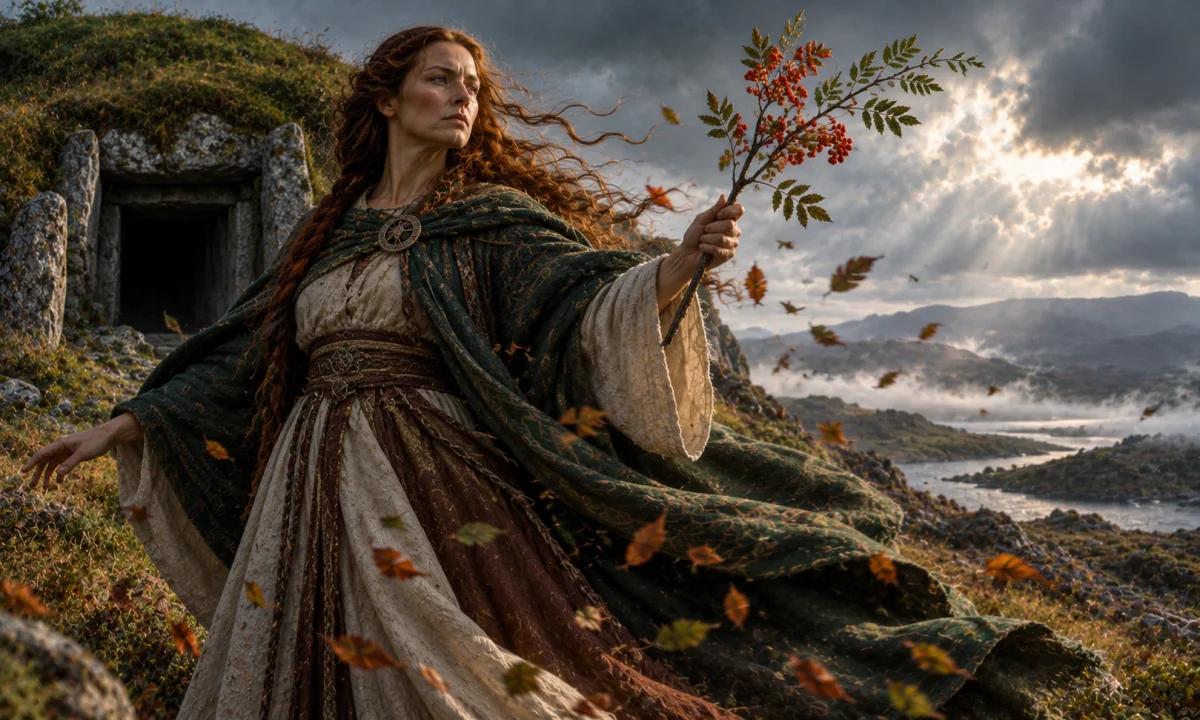
The surviving sources do not give a detailed physical description of Tailtiu. There is no consistent iconography from the ancient period that securely identifies her. Her “appearance” is therefore mainly literary and symbolic rather than visual.
Her attributes are best understood through the actions associated with her:
- Land-clearing and cultivation, symbolizing ordered settlement and agricultural labour.
- Fosterage or motherhood, symbolizing care, transmission, and social formation.
- Death remembered through games, symbolizing the transformation of loss into communal ritual.
- Connection to a seasonal festival, symbolizing the harvest and the gathering of people.
In symbolic terms, Tailtiu embodies a paradox familiar in myth: she is both creator and victim of creation. The land becomes habitable because she suffers for it. The community flourishes because her work is remembered. That paradox gives her story enduring emotional force.
Place-name and local tradition
Tailtiu is strongly associated with Teltown in County Meath, an area long connected with the Tailteann assembly in tradition. The place-name relationship is one of the clearest links between myth and landscape in Irish cultural memory. Early Irish texts often explain notable places by attributing them to important ancestral or divine figures, and Tailtiu is a prominent example of that practice.
The Tailteann gathering is remembered as a major fair or assembly, and later historical references to athletic contests at Teltown have helped keep the association alive. However, it is important to distinguish between the mythic Tailtiu of medieval tradition and later historical or antiquarian uses of the site. The association is genuine in tradition, but later interpretations may amplify or romanticize it.
Local tradition also keeps alive the sense that Tailtiu belongs not only to mythic narrative but to a specific Irish place. That grounding in landscape is one reason she remains more than an abstract figure. She is tied to ground, memory, and communal practice.
Interpretation in scholarship
Scholars have approached Tailtiu in different ways. Some interpret her primarily as a goddess whose features were partially historicized or reframed by medieval authors. Others stress the literary and explanatory nature of the surviving texts, cautioning against assuming a direct line from medieval narrative to pre-Christian cult without evidence. Both views acknowledge that she occupies a significant mythic position, but they differ in how confidently they reconstruct earlier religion.
Her story is often discussed in relation to:
- the ritual and agricultural meaning of Lughnasadh,
- the importance of female land figures in Irish tradition,
- the transformation of older myth into medieval literary explanation,
- the relation between myth, memory, and place-name lore.
Because direct pre-Christian evidence is lacking, claims about Tailtiu’s original cult must remain cautious. What can be said with confidence is that medieval Irish tradition treated her as an important figure whose labour, death, and memorialization mattered deeply within the mythic imagination.
Distinction from similar names and figures
Tailtiu should not be confused with other Irish figures whose names or functions may sound similar. The tradition around her is distinct from that of the major gods, warrior heroes, or later saintly figures. She is also not simply interchangeable with generic harvest goddesses from other European mythologies. While comparative interpretation can be useful, it should not erase the specifics of the Irish sources.
Her role is particularly tied to the Tailteann landscape and to the Lughnasadh festival. That locality and festival connection sets her apart. When modern retellings present her merely as a “harvest goddess,” they may capture part of the symbolism but miss the full narrative shape: labour, death, memorial games, fosterage, and the social meaning of the assembly are all central.
Modern reception and cultural presence
Tailtiu appears in modern Irish cultural revival, neo-pagan interpretation, folklore collections, and occasional literary or artistic retellings. In these settings she is often emphasized as a goddess of the land, labour, and harvest, or as a maternal figure linked to seasonal celebration. Such modern uses are understandable, but they are interpretations rather than direct continuations of an ancient cult.
Popular and revivalist depictions sometimes simplify the medieval material by making Tailtiu a straightforward earth mother or harvest deity. That framing can be suggestive, but it should be separated from the more complex traditional record. In the sources themselves, Tailtiu is most clearly a memorial figure whose significance is inseparable from sacrifice, place, and public ritual.
Her name continues to be relevant in discussions of Irish myth because it connects story, ceremony, and landscape in a memorable way. The endurance of her memory shows how deeply the medieval Irish tradition valued the idea that the land itself carries the trace of those who shaped it.
Key themes in the Tailtiu tradition
- Labour and sacrifice as the cost of making the land habitable.
- Memory through ritual, especially the games and assembly associated with Lughnasadh.
- Land and sovereignty, linking a female figure to territory and community.
- Fosterage and kinship, reflecting an important Irish social institution.
- Mythic explanation of place, especially the association with Teltown/Tailteann.
Tailtiu remains one of the most evocative figures in Irish mythology because her story joins cosmic, social, and local meanings. She is remembered as the one who made the land usable, whose death became a festival, and whose name is preserved in the landscape of Ireland.