WORLD
WORLD
St. Romaric

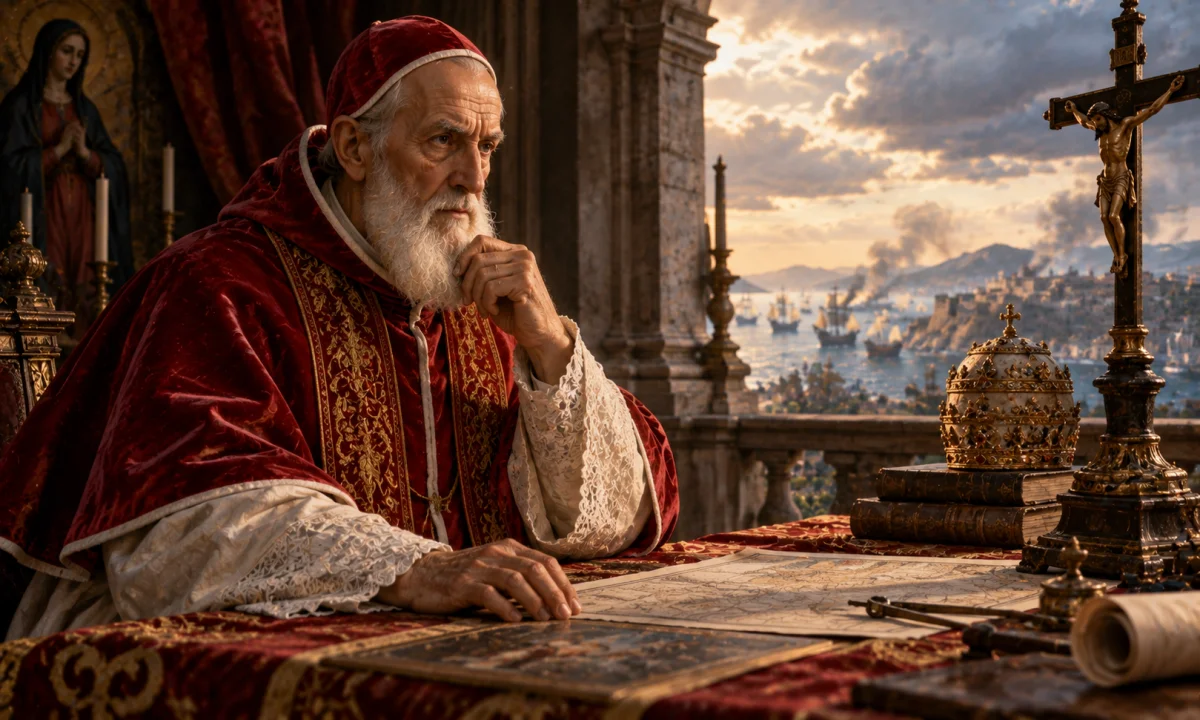
Saint Romaric, also known as Romary or Romaricus, was a seventh-century Frankish nobleman who became a monk and an important founder of religious life in the Vosges region of north-eastern Gaul. He is especially associated with the monastery of Remiremont, in present-day Lorraine, France. His life belongs to the Christian history of Merovingian Gaul, a period when aristocratic families, royal courts and newly established monasteries were closely connected.
Identity and historical setting
Romaric is generally placed in the late sixth and early seventh centuries. He lived in Austrasia, the eastern part of the Frankish kingdoms, whose territories included much of present-day north-eastern France, Belgium, Luxembourg and western Germany. The region was Christian, but its religious institutions were still developing. Bishops, aristocratic households and monasteries all played major roles in organising society and extending Christian practice.
According to the traditional account, Romaric came from a wealthy and influential family. Medieval sources connect him with the Merovingian court, although the precise details of his rank and service are not equally secure. He is sometimes described as a court official or member of the royal administration. Such a background matters to his story because his conversion was presented not as an escape from poverty but as a deliberate renunciation of power, wealth and worldly status.
The main narrative tradition about him is preserved together with the life of Saint Amatus, the monk and bishop who became Romaric’s spiritual companion. This early medieval material combines historical memory with the conventions of Christian hagiography. It offers valuable evidence for the ideals and institutions of the period, but individual episodes should not automatically be treated as independently verified facts.
The name Romaric and its variants
The saint’s name appears in several forms. Romaric is common in English-language accounts, while Romary is especially associated with French usage. Latin texts may use forms such as Romaricus. These names refer to the same Frankish saint in the tradition of Remiremont.
The name is Germanic in form and is often interpreted as combining elements associated with fame or renown and power or authority. The exact linguistic explanation is not completely certain, and the meaning should not be used as evidence for specific features of Romaric’s life. He should also not be confused with Saint Romuald, the eleventh-century founder of the Camaldolese reform, or with unrelated figures whose names have been Latinised in similar ways.
From aristocratic life to religious renunciation
Romaric’s traditional biography describes him as a man who possessed social influence and material wealth before entering religious life. The narrative presents the instability and violence of Merovingian politics as part of the background to his conversion. Rivalries among royal families and aristocratic factions could affect the security of noble households, while the obligations of court life often involved military and political service.
In the story, Romaric was drawn toward Christianity in a more demanding form through his meeting with Amatus. Amatus is said to have challenged him to abandon attachment to wealth and status. Romaric subsequently distributed or surrendered much of his property and embraced monastic discipline. The account follows a familiar Christian pattern: a powerful person recognises the temporary nature of earthly rank, gives away riches and seeks a life directed toward prayer, repentance and service.
The exact chronology of these events is uncertain. Later devotional retellings can make the change appear sudden and perfectly ordered, whereas real conversions and transfers of property were often gradual. It is nevertheless likely that Romaric’s social position helped make the foundation of a major monastery possible. His religious vocation and his aristocratic resources were not separate aspects of his life; together they shaped the institution with which his name became associated.
Amatus and the foundation of Remiremont
Romaric and Amatus established a monastery on a mountain known in Latin as Habendum or Mons Habendi, in the Vosges. The settlement later became known as Remiremont, a name traditionally connected with Romaric’s name and with the mountain monastery. The site developed into one of the most significant religious centres in the region.
The foundation is commonly described as a double monastery. In early medieval Christianity, this term could refer to a religious complex in which communities of men and women lived under related arrangements, often in separate buildings and with distinct forms of administration. The precise organisation of the early foundation is not fully recoverable, and later descriptions may project the institution’s developed customs back onto its earliest period.
Amatus is traditionally regarded as the first spiritual leader of the foundation. Romaric later succeeded him and became the monastery’s principal abbot. The partnership between the two saints became central to the identity of Remiremont: Amatus represented the experienced ascetic and religious guide, while Romaric represented the convert whose wealth, authority and leadership helped establish the community.
The monastery was not simply a place of private withdrawal. Monastic foundations offered prayer for benefactors and the wider Christian community, preserved religious learning, provided hospitality and created stable centres of landholding and administration. In a region where Christian institutions were still consolidating their influence, Remiremont had both spiritual and social importance.
Romaric as abbot
As abbot, Romaric is remembered as a leader who combined strict religious commitment with practical responsibility. Medieval accounts emphasise his humility, generosity and devotion to prayer. These qualities reflect the virtues expected of a Christian abbot, but they also suggest the kind of leadership required to govern a community whose members depended on organised work, land management and relationships with local rulers.
His earlier life at court gave him experience of aristocratic society, while his monastic vocation required him to reject the pursuit of honour for its own sake. This contrast became one of the principal themes of his cult. He was not portrayed merely as a nobleman who retired from politics; he was presented as someone who transformed social privilege into support for religious life.
The tradition also associates Romaric with care for the poor and with the proper use of wealth. Such stories belong to a broader Christian teaching found in the lives of many saints: possessions are morally dangerous when treated as private status, but they can become instruments of charity, worship and communal support when given to God and to those in need.
Death and commemoration
Romaric is traditionally said to have died around 653, although medieval chronology is not always precise. His death marked the end of the founding generation of Remiremont, but not the end of his influence. The monastery continued to preserve his memory, and his name became closely tied to the religious community and the surrounding settlement.
His principal feast is generally observed on 8 December in Western Christian calendars. Local calendars and historical liturgical uses can differ, particularly when the commemoration of a saint is connected with the customs of a specific monastery or diocese. The feast is therefore best understood as part of the regional cult of Remiremont rather than as evidence of a single universally uniform observance.
As with many early medieval saints, devotion to Romaric developed through the preservation of his memory at the institution he founded. Monasteries maintained anniversary celebrations, prayers, readings and traditions about their founders. These practices helped establish continuity between the present religious community and its earliest generation.
Sources and the character of the tradition
The principal written material about Romaric is found in early medieval accounts associated with the lives of Amatus and Romaric. These texts are hagiographic: their purpose was not to provide a modern chronological biography, but to show how Christian holiness appeared in the lives of particular people and communities.
Such narratives often include conversations, moral tests, dramatic encounters and carefully shaped conversions. Some details may preserve genuine memories of people and institutions, while others express standard literary patterns. The existence of Romaric, Amatus and the monastery of Remiremont is supported by the enduring historical tradition of the foundation, but the exact wording of speeches, the order of events and the motives assigned to individuals cannot always be established with certainty.
The sources also need to be read within the culture of Merovingian Christianity. A saint’s life could serve several purposes at once: it could edify monks and laypeople, defend the prestige of a monastery, explain the institution’s ownership or privileges and strengthen local identity. This does not make the tradition worthless or deliberately false. It means that religious memory and institutional history are woven together.
Religious symbolism
Romaric’s central symbol is the renunciation of worldly power. His story reflects the Christian conviction that social rank, wealth and proximity to kings are temporary, while holiness is measured by the direction of a person’s life. The noble convert became a model for aristocratic Christians who wished to support monasteries or enter religious life themselves.
He also represents the transformation of wealth into communal religious purpose. In early medieval Europe, monasteries often depended on donations from rulers and nobles. The story of Romaric gave this practice a powerful spiritual interpretation: property could be relinquished, redistributed and placed at the service of prayer, charity and a stable Christian community.
His association with Amatus adds another important theme. Religious foundations frequently emerged through cooperation between a charismatic ascetic and a lay patron or noble convert. The ascetic supplied spiritual authority and monastic experience, while the patron supplied protection, land and access to influential networks. The partnership of Amatus and Romaric illustrates how Christian institutions were built through both personal devotion and social organisation.
Remiremont after the founding period
Remiremont continued to develop long after Romaric’s death. Its early history as a monastery was followed by institutional changes, and in the later medieval period it became particularly famous as a community of noble canonesses. These women were not cloistered nuns in exactly the same way as members of a strictly enclosed convent. The chapter had its own traditions, privileges and social structure, which evolved over centuries.
The later identity of Remiremont should not be projected without qualification onto the seventh-century foundation. The original community and the later chapter belonged to different historical phases. Even so, the later institution preserved the memory of Romaric and Amatus as its founding figures, linking the prestigious religious house to its early ascetic origins.
The monastery’s history was also affected by the wider political and religious changes of Lorraine and France. Its buildings, possessions and forms of community changed over time, while the cult of its founders remained an important part of local heritage. Romaric’s significance therefore lies not only in the events traditionally attributed to his lifetime but also in the continuing way Remiremont used his memory to define its origins.
Depiction and local devotion
Romaric is normally represented as a monk or abbot, often with the signs of ecclesiastical authority such as a staff or a book. In some settings he may also be shown with features recalling his noble birth, but there is no single universally fixed iconography for him. Artistic details can reflect local custom, the resources of a particular church or the broader visual language used for founders and abbots.
His cult has been especially strong in the Vosges and Lorraine, where place names, churches, historical commemorations and local traditions preserve his association with Remiremont. The survival of a saint’s name in regional culture does not imply that every later story is equally ancient. Local legends often accumulate around an established sacred figure, and their dates and origins must be distinguished from the earliest written tradition.
Distinguishing Romaric from similar figures
Saint Romaric should not be confused with Saint Romuald, the Italian-born reformer who founded the Camaldolese tradition several centuries later. The names can look similar in abbreviated lists or poorly preserved texts, but the two men belonged to different periods and religious contexts.
Nor should Romaric be merged with every saint named Romary, Romaricus or a related Germanic form. Medieval names could vary in spelling as they passed between local languages and Latin records, but similar names do not by themselves prove that two figures were identical. The Romaric honoured at Remiremont is specifically the Merovingian nobleman, convert and abbot associated with Amatus and the Vosges foundation.
Place in Christian tradition
Romaric belongs to the tradition of founder saints: Christians remembered not only for personal holiness but also for establishing institutions that shaped the religious life of a region. His importance is therefore both devotional and historical. He stands at the meeting point of Merovingian aristocracy, monastic Christianity, local identity and the growth of organised religious communities in Gaul.
His story is most accurately understood neither as a complete modern biography nor merely as a legend detached from history. The broad outline—a nobleman associated with the Austrasian court, a conversion influenced by Amatus, the foundation of a monastery in the Vosges and leadership at Remiremont—belongs to a persistent early medieval tradition. The finer details remain dependent on hagiographic sources and later remembrance, and should be treated with appropriate caution.