WORLD
WORLD
Shadipinyi
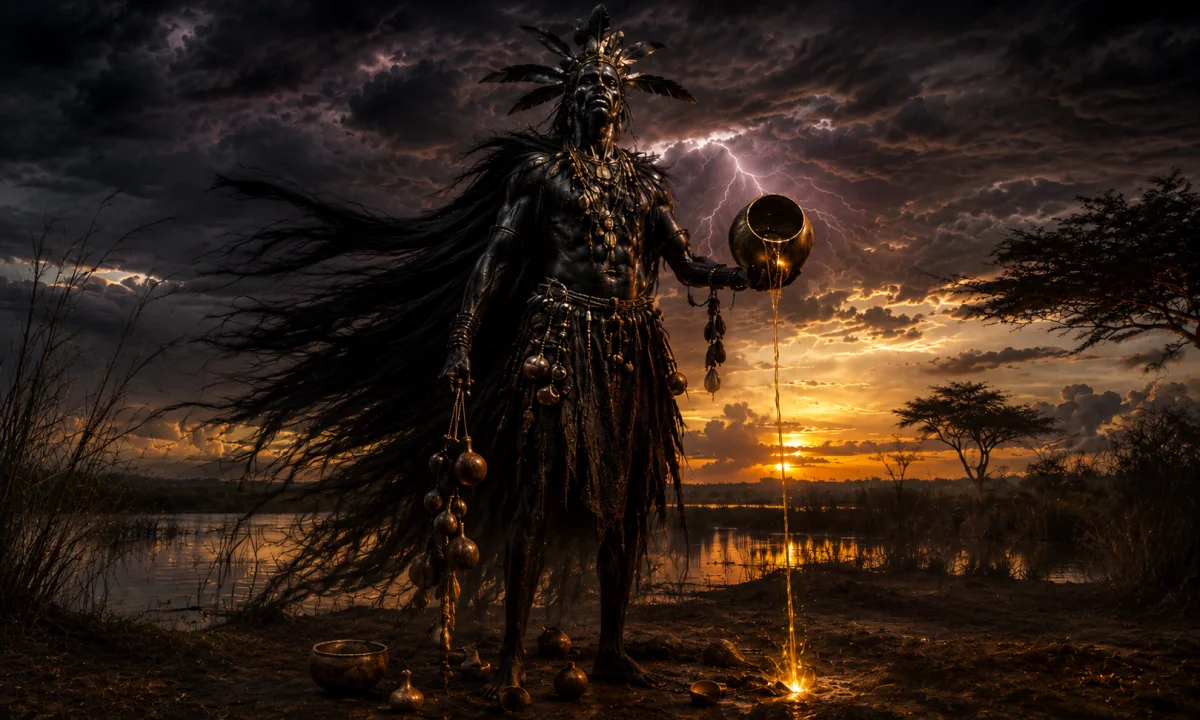
Shadipinyi is a little-documented water-being associated in modern English-language accounts with the Kavango River region of southern Africa. It is usually described as a large, dangerous, snake-like creature believed to inhabit deep water. The name and the traditions connected with it are not documented in a single, widely known sacred text or standardized mythology. Accounts differ in spelling, description, location and cultural attribution, so Shadipinyi is best treated as a regional folkloric figure whose surviving presentation is fragmentary rather than as a clearly defined pan-African deity or monster.
Origins and cultural setting
The name Shadipinyi is most often linked with the Kavango River and the settlements along its course. The river rises in Angola and flows through the Kavango regions of northern Namibia before reaching the Okavango Delta in Botswana. It is central to the lives of many communities, providing water, fish, transport routes, fertile floodplains and places of social and ritual importance.
The cultural setting is therefore significant. A river is not simply a geographical feature in communities that depend on it. Deep channels, seasonal floods, sudden currents, crocodiles, hippopotamuses and hidden underwater hazards can all give the river an unpredictable and dangerous character. Stories of powerful beings in such places may express respect for the water, warn people away from particular areas and preserve knowledge about risks that cannot easily be explained or seen.
Shadipinyi is sometimes assigned broadly to “African mythology,” but that label can obscure more than it explains. Africa contains thousands of distinct cultural traditions, and a being associated with the Kavango region should not automatically be presented as representative of the continent as a whole. The available material does not establish one universally accepted Shadipinyi tradition shared by all Kavango-speaking peoples, nor does it show that every community along the river uses the name in the same way.
Several peoples live in the wider Kavango area, including communities speaking Kavango languages as well as neighbouring populations in Angola, Namibia and Botswana. Oral traditions may be transmitted in local languages and may not be preserved in written form. English-language descriptions can consequently flatten differences between local accounts, translated terms, travel narratives and recent internet retellings.
The name and the question of identity
The spelling Shadipinyi is the form most commonly encountered in general discussions of the creature, but spelling variation is possible when a name is transferred from an African language into English. A different spelling does not necessarily indicate a different being, while similar-looking names should not be assumed to refer to Shadipinyi without evidence from the relevant language or community.
Its classification is also uncertain. Some descriptions call Shadipinyi a monster, while others treat it as a water spirit or an animal-like supernatural being. These categories are not interchangeable. A monster is often understood as a dangerous creature that can be hunted or feared; a spirit may belong to a wider religious or cosmological system and may have relationships with places, ancestors, ritual specialists or moral rules.
Because detailed traditional accounts are not readily available in a common written record, it is safer to describe Shadipinyi as a folkloric water-being. This wording recognizes the recurring association with a river creature without claiming that all communities place it in the same religious category.
Appearance and habitat
In popular descriptions, Shadipinyi generally has a serpentine or snake-like form and is said to live in deep parts of the river. Some retellings portray it as exceptionally large, far beyond the size of an ordinary snake. Other accounts use the language of a “river monster” without offering a precise physical description.
There is no securely established canonical image of Shadipinyi. Claims that it has horns, multiple heads, unusual colours, a human face or a particular set of limbs should be treated cautiously unless they can be traced to a specific local account. Such details are often added by later illustrations, monster encyclopedias or online summaries rather than by a documented body of traditional narratives.
The deep water of the river is the creature’s most consistent setting. This location gives the figure much of its meaning. A being that remains below the surface occupies a boundary between the visible and invisible worlds: people can see the river but cannot see everything within it. The hidden depth makes ordinary environmental danger appear as the activity of an intentional presence.
Role and powers in folklore
Shadipinyi is usually portrayed as dangerous to people who enter its territory. Stories and brief descriptions commonly connect it with attacks, drownings or the disappearance of people in deep water. However, the surviving material does not provide a stable list of powers comparable to the attributes of a major god. It would be misleading to claim that Shadipinyi universally controls storms, grants wishes, changes shape or commands other spirits.
The creature’s most consistent supposed ability is its capacity to remain concealed beneath the water and to threaten people from an unseen location. In this respect, Shadipinyi belongs to a broad class of water-dwelling beings found in many parts of the world. The danger may be supernatural in a story, but the story can also communicate practical knowledge: deep channels are hazardous, river conditions change quickly and people should not approach unfamiliar water carelessly.
Whether Shadipinyi is regarded as an intentional guardian of the river is less certain. Some modern descriptions imply that the creature protects a sacred or restricted place, but this is not a firmly established feature across accounts. A warning about a dangerous river pool should not automatically be interpreted as evidence of a formal water cult or a single religious doctrine.
Stories and narrative variants
Unlike figures supported by extensive written myth cycles, Shadipinyi does not have a widely recognized set of canonical stories. Short accounts tend to focus on the creature’s presence in the river and the danger of encountering it. These accounts may be told as warnings, local legends, explanations for disappearances or reports of something seen in the water.
The absence of a fixed story cycle is important. It means that descriptions of Shadipinyi as the child, enemy, spouse or servant of another named being should not be accepted as universal unless the relationship is tied to a clearly identified tradition. There is no reliable basis for assigning Shadipinyi a standard genealogy, divine companion or legendary adversary.
Oral traditions naturally vary between tellers and places. A river being may be described differently upstream and downstream, or the same name may be used for a general danger rather than for a character with a consistent personality. A storyteller may emphasize a creature’s size, another its location, and another the consequences of ignoring a warning. These differences do not necessarily represent contradictions; they may reflect the flexible nature of folklore.
Modern retellings also tend to turn a brief local belief into a complete monster profile. A short statement that a dangerous serpent lives in the river can become an account containing a precise length, colour, diet, magical powers and a dramatic history. Unless those details are supported by identifiable traditional testimony, they belong to later elaboration rather than securely documented folklore.
Cultural significance
Shadipinyi can be understood as part of the imaginative and social life surrounding a major river. Folklore about dangerous water beings may perform several functions at once:
- Environmental warning: Stories discourage children, travellers or inexperienced swimmers from entering deep or fast-moving water.
- Respect for place: The river is represented as a powerful environment rather than as a passive resource available without limits.
- Explanation of danger: A supernatural account gives meaning to drownings, disappearances and frightening sounds or movements beneath the surface.
- Transmission of local knowledge: A memorable creature can help preserve warnings about particular pools, channels or seasonal conditions.
- Recognition of mystery: The being represents what remains unseen or uncontrolled in a landscape that people know intimately.
These interpretations should not be treated as mutually exclusive. A story can be spiritually meaningful, socially useful and entertaining at the same time. Nor should every river legend be reduced to a practical warning. For the people who tell or hear such stories, the being may have a reality that cannot be captured by describing it merely as a metaphor for drowning.
It is also important to avoid assuming that all traditional African water beings have the same significance. Some are associated with fertility, healing, wealth, sexuality, ancestors or divine power; others are primarily dangerous creatures. Shadipinyi’s commonly reported association with a hidden river monster does not by itself place it within the same religious framework as water spirits from West, Central or southern Africa.
Distinction from similar figures
Shadipinyi is sometimes grouped with other famous African water beings because they are all described in English as river monsters or spirits. Such comparisons can be useful, but they should not erase their separate origins.
Mami Wata is a broad and diverse complex of water-spirit traditions found especially in western, central and parts of southern Africa, with historical connections to wider Atlantic and global imagery. Mami Wata is often represented as a beautiful human or mermaid-like figure and may be associated with wealth, healing, danger and spiritual power. Shadipinyi is not simply a serpentine form of Mami Wata, and the two names should not be substituted for one another.
Inkanyamba is a storm-associated serpent or dragon-like being in Zulu and related southern African traditions, particularly in accounts connected with waterfalls and violent weather. Its attributes and cultural setting differ from the river-monster descriptions associated with Shadipinyi.
Grootslang is a later South African legend about a gigantic serpent, often said to inhabit a cave and to possess or guard treasure. It is not the same figure as Shadipinyi, even though both may be pictured as enormous snakes.
Descriptions of Shadipinyi should also be kept separate from reports of ordinary large snakes, crocodiles or unidentified animals in the Kavango and Okavango regions. A folklore tradition can coexist with observations of real wildlife, but the existence of large local reptiles does not prove the existence of a supernatural creature, and a reported animal sighting does not by itself define the tradition.
Sources, transmission and uncertainty
The main difficulty in discussing Shadipinyi is not a lack of imaginative descriptions but a lack of accessible, consistent documentation. Much information circulating in English appears in short folklore lists, travel material, cryptid discussions and repeated online summaries. These formats often omit the name of the community, the original language, the location of the account and the circumstances in which the story was recorded.
For that reason, statements about Shadipinyi should be separated into levels of certainty. It is reasonable to say that the figure is commonly presented as a snake-like water creature associated with the Kavango region. It is less secure to claim that every local community believes in it, that the name has one agreed translation, or that it possesses a detailed and ancient mythology. Claims about exact physical measurements, supernatural abilities or a continuous history from precolonial times require specific evidence and should not be presented as established facts.
Oral tradition is not less important because it is difficult to document in English. It does mean that respectful description requires attention to language, community and context. A translated name and a short internet account cannot stand in for the full range of local ways in which a river, its dangers and its unseen inhabitants may be understood.
Shadipinyi in modern popular culture
Shadipinyi has a limited presence in global popular culture compared with better-known figures such as Mami Wata or the African dragon-serpent of modern fantasy. Its main modern visibility comes from websites and publications that catalogue legendary creatures, cryptids and regional monsters. In these settings, it is often presented as an African equivalent of a lake or river monster.
This treatment can make the figure easier to recognize internationally, but it can also change its character. A local water legend may be reframed as a zoological mystery, accompanied by speculative drawings and claims about an undiscovered giant reptile. That cryptid framing is a modern interpretation, not proof that the traditional meaning of Shadipinyi was concerned with searching for an unknown species.
Contemporary artwork, fiction or games may freely expand the creature’s appearance and powers. Such adaptations can introduce Shadipinyi to new audiences, but they should be identified as creative reinterpretations rather than confused with the limited and variable folkloric record. The most responsible portrayals retain its association with the Kavango waters while acknowledging that its identity, spelling, cultural ownership and traditional details remain uncertain.