WORLD
WORLD
Ruadán
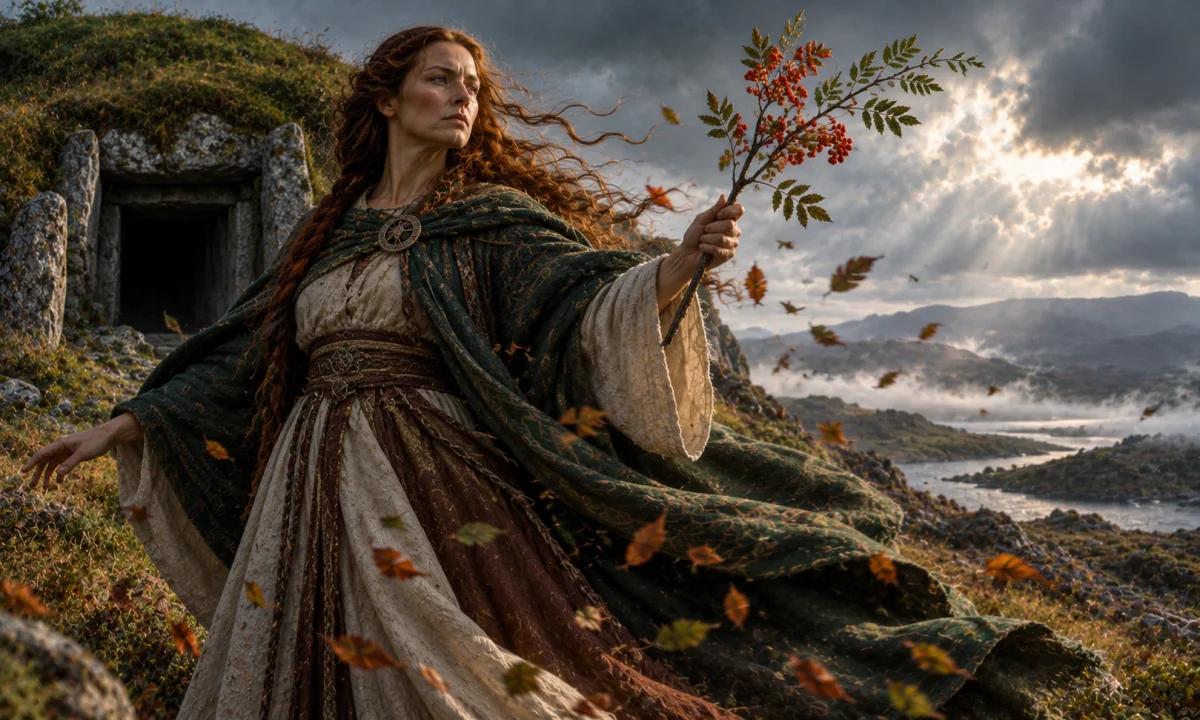
Ruadán, usually known as Saint Ruadán of Lorrha, is a sixth-century Irish religious figure associated with the early Christian monastery at Lorrha in County Tipperary. He belongs more properly to Ireland’s early medieval ecclesiastical tradition than to pre-Christian mythology, although stories about him entered the wider body of Irish legend and folklore. His best-known episode is the so-called curse of Tara, in which Ruadán is said to have condemned the ancient royal centre after a conflict with Diarmait mac Cerbaill, a king of Tara.
Origins and historical setting
Ruadán is traditionally remembered as the founder or principal patron of a monastery at Lorrha, an important early Christian centre in the region now known as north Tipperary. The monastery was probably established during the sixth century, when Christian communities were spreading throughout Ireland under the leadership of abbots, bishops and monastic teachers.
The historical Ruadán is difficult to reconstruct in detail. Medieval Irish religious writing preserves several accounts of his life, but these texts were written after the period in which he lived and combine local memory, ecclesiastical ideals and miracle stories. His death is traditionally placed around 584, although early medieval dates are not always secure and should not be treated as exact biographical evidence.
Later tradition places Ruadán among the group sometimes called the Twelve Apostles of Ireland. This expression does not refer to the apostles of the New Testament. It is a retrospective description for a group of influential Irish churchmen associated with the Christianisation and monastic development of Ireland. The membership of the group varies in different accounts, and the title reflects later religious tradition rather than a single contemporary historical record.
Ruadán is also connected in tradition with Finnian of Clonard, one of the most important teachers of the early Irish Church. Some accounts describe Ruadán as a student or associate of Finnian. Such relationships may preserve a memory of links between monastic communities, but the surviving sources do not provide enough evidence to reconstruct a certain chain of teaching or personal contact.
The name Ruadán
The name appears in several spellings, including Ruadán, Ruadhan, Ruadhán and Rodan. Differences arise from the representation of Irish sounds in medieval manuscripts, later changes in Irish spelling and the use of Latin forms in ecclesiastical texts.
The name is generally associated with the Old Irish word ruad, meaning “red” or “reddish”, with the ending suggesting a diminutive or personal-name formation. The exact force of the name is uncertain. It may have meant something like “little red one”, but the name should not automatically be taken as a literal description of Ruadán’s hair, clothing or appearance. Medieval personal names often preserve older linguistic elements whose original significance was no longer clear to later storytellers.
“Ruadán” was not an entirely unique name. Other Irish religious figures and individuals may bear similar forms, and spellings can make identification difficult. The figure most strongly associated with the famous story of Tara is Ruadán of Lorrha. He should not be merged with every saint or legendary person called Ruadán or Ruadhan.
Ruadán as an early Irish saint
In the religious tradition of early medieval Ireland, a saint was not simply a virtuous individual in an abstract sense. Saints were understood as founders of sacred communities, guardians of church lands, teachers, miracle workers and powerful intercessors. Their authority could rival or challenge that of kings, especially when a king interfered with a church’s people, property or right of sanctuary.
Ruadán’s traditional identity reflects this world. He is presented as an ascetic and monastic leader whose holiness gives him authority beyond the walls of Lorrha. His importance comes not from warfare, royal descent or heroic strength, but from his relationship with the church, his community and the sacred protection associated with his monastery.
Accounts of Irish saints’ lives commonly describe miracles, prophecies and confrontations with rulers. These stories were not written as modern biographies. They expressed religious ideas about the power of prayer, the danger of violating sacred protection and the belief that rulers remained subject to divine judgement. Consequently, miraculous episodes in Ruadán’s tradition are best treated as elements of hagiography and religious folklore rather than independently verified historical events.
The curse of Tara
Ruadán’s most famous story concerns a conflict with Diarmait mac Cerbaill, traditionally regarded as a high king of Ireland. Diarmait is a semi-historical figure who appears in early Irish annals and later narrative traditions. His reign is generally placed in the sixth century, but the stories told about him contain both historical material and legendary development.
According to medieval accounts, Diarmait or his representatives violated the sanctuary of Ruadán’s church at Lorrha. The precise cause differs between versions. Some forms of the story describe the removal or seizure of a person who had sought protection within the church’s sanctuary; others present the conflict more generally as an unlawful intrusion by royal power into ecclesiastical territory. The central issue is consistent: the king is said to have ignored the sacred protection claimed by Ruadán.
Ruadán responded by going to Tara, the ancient ceremonial and political centre of the kings of Ireland. There he pronounced a curse against the royal site. In the traditional narrative, Tara was thereafter abandoned as a royal residence, and the authority of the high kings was damaged or transferred elsewhere.
The tale is significant because it dramatizes a contest between monastic authority and kingship. Ruadán does not defeat Diarmait through physical force. Instead, the saint invokes a spiritual sanction capable of affecting the king, his realm and the symbolic centre of his power. The story therefore presents the church as possessing a form of authority that even a high king could not safely disregard.
The curse should not be confused with a straightforward historical explanation for Tara’s decline. Tara’s changing importance resulted from complex political, economic and social developments, and its use as a royal centre had already changed over time. The story gives that historical change a religious interpretation: Tara ceased to function as a royal seat because a saint had condemned it. This is a characteristic feature of medieval sacred history, in which the fate of places is linked to the actions of saints and kings.
Tara, sanctuary and royal power
The story has a wider cultural meaning within Irish tradition. Early Irish society recognised various forms of protection and legal privilege, including the special status of churches and ecclesiastical lands. A person who reached a sanctuary could claim protection, although the exact legal operation of sanctuary varied according to circumstance and period.
By portraying Ruadán as defending sanctuary, the tale affirms a principle important to medieval church communities: secular rulers were not entitled to treat sacred spaces as ordinary territory. The saint’s curse functions as the narrative consequence of a king’s abuse of power. It also protects the prestige of Lorrha, presenting its founder as powerful enough to confront the highest ruler in Ireland.
The story may also reflect competition between religious centres. Monasteries preserved traditions that celebrated their founders and explained the special status of their lands, relics and communities. A tale in which a saint causes the abandonment of Tara elevates Lorrha’s spiritual importance, even though it does not establish that the event occurred as described.
Miracles, relics and local devotion
Like other early Irish saints, Ruadán became the focus of local devotion. His monastery at Lorrha remained the principal setting for his cult, and later tradition connected his name with church objects, relics and sacred places. Medieval and post-medieval communities often preserved such associations through place names, local stories and material remains.
Details about individual relics and objects associated with Ruadán are not equally reliable. A bell, staff or other ecclesiastical object may be attributed to a saint by local tradition without providing secure evidence that the object belonged to that historical person. Such items are nevertheless important for understanding how communities maintained a saint’s presence across generations.
Miraculous accounts connected with Ruadán should likewise be read in their proper context. Hagiographic stories often describe healing, prophecy, divine punishment or supernatural protection. Their purpose was to reveal the saint’s holiness and the consequences of respecting or violating sacred authority. They are not a consistent catalogue of magical powers in the manner of a fantasy character.
Surviving traditions and medieval sources
Knowledge of Ruadán comes from a combination of Irish and Latin ecclesiastical writings, saints’ lives, martyrologies, annalistic notices and local tradition. These materials were compiled over a long period, and the earliest surviving form of a story may be considerably later than the events it claims to describe.
The medieval lives of Irish saints often preserve valuable information about churches, political relationships, place names and religious customs. At the same time, they use conventional literary patterns. A saint may be shown confronting a king, predicting the future, cursing an unjust ruler or demonstrating miraculous control over nature. These motifs do not necessarily prove that every episode was invented, but they make it difficult to separate historical memory from theological storytelling.
Ruadán’s tradition is therefore best understood on several levels. He may preserve the memory of a real sixth-century monastic founder. The account of his dispute with Diarmait may reflect genuine tensions between church communities and rulers. The curse of Tara, however, is a developed religious legend whose historical meaning cannot be established simply by accepting its narrative literally.
Symbolism and interpretation
Ruadán’s story is especially associated with the power of sacred speech. His curse changes the fate of Tara, not because he commands an army, but because words spoken by a holy person are treated as effective within the moral structure of the story. This reflects an older Irish respect for formal speech, prophecy, praise and condemnation, transformed within a Christian framework.
The narrative also presents the saint as a guardian of boundaries. The king crosses a physical and legal boundary by entering or interfering with a sanctuary. Ruadán answers by placing a spiritual boundary around the church and by declaring that royal power has exceeded its legitimate limits.
Tara itself carries symbolic weight. It was remembered as a centre of kingship and ceremony, so its legendary abandonment represents more than the loss of one settlement. It signifies the vulnerability of political authority when it acts without justice. In the story’s Christian interpretation, a ruler’s legitimacy depends partly on respecting the sacred order represented by the church.
Distinguishing Ruadán from other figures
Ruadán is sometimes treated as though he were a pagan god, a druid or a supernatural being from the pre-Christian mythology of Ireland. The surviving tradition does not support that classification. He is a Christian saint and monastic founder whose stories were preserved by Christian communities.
His supernatural authority should also not be confused with the powers of figures from the Ulster Cycle or the Mythological Cycle, such as Lugh, Manannán mac Lir or the Morrígan. Ruadán does not belong to the same mythological category as those figures. His curse, prophecies and miracles operate within a Christian narrative about holiness, sanctuary and divine justice.
Nor should Ruadán be confused with every person named Ruadhan in Irish genealogies, saints’ calendars or local tradition. “Ruadán of Lorrha” is the designation that identifies the saint connected with the famous Tara legend and the monastery at Lorrha.
Later reception
Ruadán has had less presence in international popular culture than better-known Irish figures such as Cú Chulainn, Brigid or the Tuatha Dé Danann. His importance remains primarily religious, historical and local. He survives in the name and traditions of Lorrha, in accounts of Ireland’s early monastic culture and in the enduring story of a saint who challenged a king.
When Ruadán appears in modern retellings, he is sometimes recast as a wizard-like holy man or as a character in a generalised “Celtic mythology” setting. Such portrayals may be imaginative adaptations, but they should not be mistaken for the traditional identity of the saint. The older material presents him as an early Irish Christian leader whose authority rests on sanctity, ecclesiastical protection and the power of religious judgement.
The legend of Ruadán and Tara remains valuable not because it offers a simple factual account of the site’s history, but because it reveals how medieval Irish communities understood the relationship between sacred places and political power. In that tradition, even the most prominent king could be challenged by the guardian of a monastery.