WORLD

Purson
Purson is a demon and infernal king described in European grimoire tradition, especially in the Ars Goetia, the first part of the Lesser Key of Solomon. He is listed as the twentieth spirit among the seventy-two demons summoned and constrained by a magician. His unusual form combines a lion-faced human figure, a bear, a viper, and the sound of trumpets. In the tradition that presents him, Purson is associated chiefly with hidden knowledge, divination, treasure-finding, and the revelation of secrets.
Origins in European demonology
Purson belongs to the learned demonology of early modern Europe rather than to a clearly documented ancient religion. His best-known description appears in the Ars Goetia, a ritual handbook concerned with the names, ranks, appearances, abilities, seals, and conjurations of spirits. The work survives in manuscripts and later printed editions associated with the broader Lesser Key of Solomon, a compilation that took shape in the seventeenth and early eighteenth centuries.
The Ars Goetia is not a single ancient text preserved unchanged from antiquity. It draws on several earlier streams of Christian magical and demonological writing, including catalogues of spirits, lists of angels and demons, ritual manuals, and older accounts of planetary and astrological magic. Its attribution to King Solomon reflects a common literary convention in Western esotericism: Solomon was portrayed as a divinely favoured ruler who possessed authority over spirits. The historical origins of every name and description in the catalogue are not known.
An important earlier parallel appears in Johann Weyer’s Pseudomonarchia Daemonum, published in 1583. In that work, the name is generally given as Curson rather than Purson, although the description is recognisably the same. The relationship between the two texts is complex, but the appearance of this figure in both demonstrates that Purson or Curson was part of a circulating demonological tradition before the most familiar printed editions of the Ars Goetia.
These works were written within a Christian intellectual environment in which demons were commonly understood as fallen spirits, deceptive powers, or illicit entities opposed to divine order. The grimoires nevertheless treat them in a highly organized manner. Spirits receive titles such as king, duke, marquis, president, or earl, and are assigned legions of subordinate spirits. This hierarchy resembles a political or military administration, but it should not be mistaken for a universally accepted religious system. It is a literary and ritual structure developed within particular strands of Christian occultism.
Name and identity
The spelling Purson is the form most familiar from modern editions of the Ars Goetia. Curson is an important variant found in earlier demonological material. Other minor spelling differences can occur through manuscript copying, translation, and editorial practice. There is no securely established etymology that explains the name’s original meaning.
Some modern writers have attempted to connect Purson with names or figures from older religious traditions, but these proposals are speculative unless supported by historical evidence. The name does not have a securely demonstrated identity with a specific deity from ancient Mesopotamia, Egypt, Greece, Rome, or another pre-Christian culture. Similarities in titles, animals, or magical functions are not by themselves proof of direct descent.
Purson is classified as a king in the Ars Goetia. The text states that he commands twenty-two legions of spirits. Such numbers are part of the catalogue’s formal system and should not be treated as historical evidence for an independently documented supernatural army. They indicate how the grimoire organizes its spirit hierarchy.
Appearance and signs
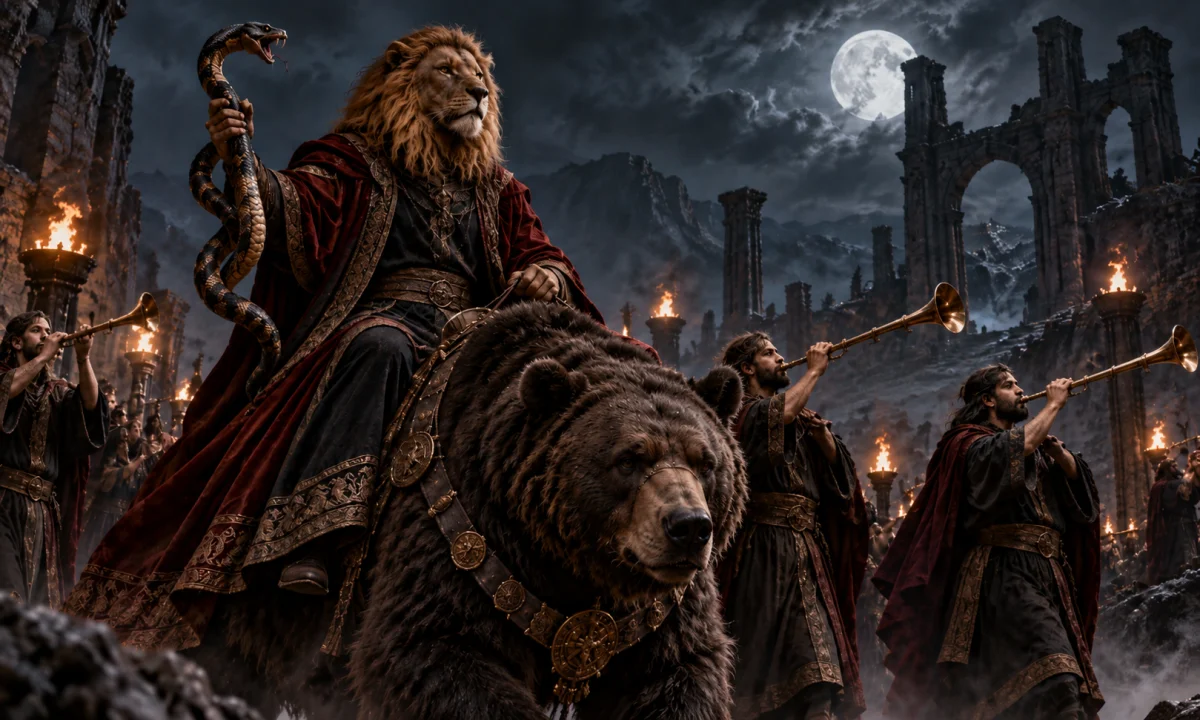
Purson is described as appearing in the form of a man with a lion’s face. He carries a viper in his hand and rides upon a bear. Before him, many trumpets sound. This is one of the more elaborate visual descriptions in the Ars Goetia, combining human, animal, serpentine, and ceremonial elements into a single emblematic manifestation.
The lion’s face can be read as a conventional symbol of power, majesty, courage, or ferocity. Lions had long been associated in European art and religious symbolism with kingship and authority. The presence of a lion-like face therefore suits Purson’s rank as a king, although the grimoire does not provide a formal explanation of the image.
The bear functions as Purson’s mount. Bears appear in many European traditions as symbols of physical strength, wilderness, danger, and untamed authority. In the specific demonological description, however, the bear is not given an independent myth or named as a separate being. It is part of Purson’s prescribed apparition.
The viper is another traditional symbol with several possible associations. In Christian contexts, serpents are often connected with temptation, deception, hidden knowledge, and danger. In other symbolic systems, snakes can represent renewal, healing, or concealed wisdom. The text does not specify which interpretation should be applied to Purson’s viper, so any symbolic reading remains interpretive rather than a stated doctrine of the grimoire.
The trumpets create a public and ceremonial atmosphere. Rather than approaching as a silent or concealed spirit, Purson is imagined as arriving with a retinue and a proclamation of status. The sound may reinforce his royal rank, but the source does not explain whether the trumpets have a particular theological or astrological meaning.
Abilities and functions
Purson is chiefly a spirit of revelation. The Ars Goetia says that he can answer questions about hidden and secret matters. He is also said to discover treasures and to tell of things past, present, and future. These abilities place him within the broader tradition of ritual divination, in which a spirit is summoned to provide information unavailable through ordinary human means.
His attributed knowledge extends beyond personal fortune-telling. The description says that Purson can answer about earthly and divine matters and about the creation of the world. This gives him an unusually wide intellectual scope. He is not limited to locating buried wealth or predicting events; he is presented as a spirit capable of discussing cosmological and theological questions.
The wording of the traditional description also states that Purson can assume either a human or an aerial body. In grimoire language, an “aerial” body generally refers to a subtle, spirit-like, or non-material form rather than a physical body made of ordinary flesh. The statement reflects the period’s interest in how spirits might manifest during ritual encounters. It does not establish a consistent physical theory shared by all occult traditions.
Purson is further said to provide good familiars. In early modern magical vocabulary, a familiar was a spirit believed to serve, assist, or accompany a practitioner. The word does not necessarily mean an animal companion in the modern fantasy sense. Within ceremonial magic, a familiar could be understood as a subordinate spiritual helper entrusted with particular tasks.
These powers make Purson a figure associated with access to information rather than with a single destructive function. He is not primarily described as a demon of plague, warfare, lust, or bodily torment. His danger, from the perspective of Christian demonology, lies in the possibility that secret knowledge and supernatural assistance might be obtained through forbidden dealings with a spirit.
Purson in the hierarchy of the Ars Goetia
The Ars Goetia presents its spirits as members of a structured infernal court. Purson’s title of king places him among the highest-ranking figures in the catalogue, although the work does not offer a complete political history of his kingdom or a narrative account of his relationships with other demons.
He is not given a major mythological story comparable to the legends of figures such as Lucifer, Satan, Beelzebub, or Astaroth. Instead, his identity is defined through a compact catalogue entry: his name, rank, appearance, number of legions, powers, and a ritual seal. This distinction is important. Purson is a grimoire spirit, known primarily through technical demonological description, rather than a central character in a large body of narrative folklore.
The catalogue also assigns each spirit a seal or sigil used in ritual practice. Purson’s seal is reproduced in editions of the Ars Goetia, but the design can vary slightly according to manuscript tradition, engraving, typography, or modern redrawing. The sigil is not an ancient archaeological emblem with a securely documented pre-Christian origin. It belongs to the ritual system of the grimoire tradition.
Religious and cultural context
Early modern Christian demonology often treated illicit magic as a form of spiritual danger. A magician might attempt to command a spirit using divine names, sacred symbols, ritual purification, conjurations, and protective circles. From the theological standpoint of many Christian authorities, such operations were condemned even when the magician claimed to seek useful information or beneficial assistance.
This context helps explain the tension in Purson’s description. He is credited with giving truthful answers and useful knowledge, yet he is still classified as a demon. The text does not present his abilities as morally neutral in the modern sense. Contact with him belongs to a prohibited or hazardous form of spiritual practice, and the ritual framework assumes that the operator must control the encounter rather than approach the spirit as an ordinary teacher or ally.
The catalogue’s language also reflects a period in which knowledge of the past, future, hidden treasure, the natural world, and the creation of the universe could overlap within occult thought. Divination, theology, cosmology, astrology, and ritual magic were not always treated as sharply separate fields. Purson’s broad portfolio reflects that intellectual environment.
There is no substantial body of independent popular folklore about Purson comparable to the folklore surrounding demons such as the Devil, incubuses, succubi, or certain regional household spirits. Most information about him comes from written occult catalogues and later interpretations of those catalogues. Claims that he was widely worshipped in antiquity or that he possessed a large pre-Christian cult are unsupported by reliable evidence.
Distinction from similar figures
Purson should not be automatically identified with every lion-headed, serpent-bearing, or animal-riding figure in mythology. Many cultures have deities, heroes, spirits, and monsters associated with lions, bears, or snakes, but resemblance in imagery does not establish identity. Purson’s particular combination of a lion-faced man, a bear, a viper, and trumpets belongs to the demonological catalogue in which he is described.
He should also be distinguished from Marbas, another spirit in the Ars Goetia who is associated with a lion-like appearance and with knowledge, although Marbas is primarily linked with illness, healing, mechanical arts, and transformation. The two figures share an animal feature but are separate entries with different ranks and attributed functions.
Purson is likewise distinct from Sabnock, a marquis depicted with a lion’s head, and from Bael, a king who is described with multiple heads including those of a cat, toad, and human. These spirits belong to the same catalogue but are not alternate names for Purson. Confusion can arise because the Ars Goetia repeatedly uses animal imagery and titles of nobility.
The variant name Curson should generally be understood as a historical spelling or textual form of the same grimoire spirit, not as a separate demon. Nevertheless, because manuscript traditions can vary, it is best to identify the source and spelling when discussing the figure in detail.
Interpretation and significance
Purson’s imagery can be interpreted as a dramatization of authority over hidden realms. The lion suggests sovereignty, the bear suggests force and wilderness, and the viper suggests concealed or dangerous knowledge. The trumpets frame the whole apparition as a royal procession. Taken together, these elements portray a spirit who is powerful, difficult to approach, and capable of revealing what ordinary people cannot see.
His role also illustrates a recurring theme in demonological literature: forbidden knowledge is attractive precisely because it promises to overcome human limits. Purson can reveal buried treasure, report on distant or hidden matters, and speak about the past, present, future, and creation itself. The breadth of these claims gives him an intellectual and divinatory character rather than making him merely a monster.
At the same time, modern readers should separate historical description from literal verification. The grimoire records what its tradition attributes to Purson; it does not provide independent evidence that such a being objectively appeared, answered questions, or delivered treasure. The historical fact is that Purson was described and classified in early modern demonological literature.
Later occult and popular reception
Purson continued to appear in later editions, translations, and studies of the Ars Goetia. Modern ceremonial magicians, occultists, artists, and writers have reinterpreted his appearance and powers in different ways. Some emphasize his connection with divination and hidden knowledge, while others focus on the striking visual image of the lion-faced rider surrounded by trumpets.
In contemporary popular culture, Purson may appear in fantasy fiction, role-playing games, illustrations, music, and other media alongside spirits drawn from the same grimoire. These adaptations often alter his rank, personality, powers, or appearance for narrative purposes. A fictional Purson should therefore be distinguished from the figure described in early modern demonological sources.
The traditional Purson is best understood as a named spirit of the Western grimoire tradition: an infernal king with a lion’s face, a viper, a bear, and a ceremonial retinue of trumpets, associated above all with hidden knowledge, treasure, divination, and cosmological secrets.