WORLD
WORLD
Marbas
Marbas is a demon in the ceremonial-magical tradition associated with the Ars Goetia, the first section of the early modern grimoire commonly known as The Lesser Key of Solomon. He is traditionally described as a powerful president of Hell who first appears as a great lion and can assume human form when commanded by the magician. His stated powers include causing and curing illness, revealing hidden matters, teaching mechanical arts, and changing human appearance. These descriptions belong to European demonological and occult literature rather than to an ancient mythology with an independent, continuous cult.
Origins in European demonology
Marbas belongs to a catalogue of spirits arranged according to ranks, names, seals, legions and magical functions. The best-known version of this catalogue is the Ars Goetia, which became widely available in print in the early twentieth century but preserves material found in earlier manuscript traditions. Its contents draw on several streams of Christian demonology and ritual magic, including lists of spirits transmitted and adapted over generations.
The Ars Goetia is not an ancient pagan source. It reflects a Christian European worldview in which supernatural beings are classified as demons and placed within a hierarchical Hell. The title “president” is therefore a rank within a particular occult system, not evidence that Marbas was worshipped as a political ruler or deity in an older religion. The hierarchy resembles other early modern attempts to organize demons according to offices, titles and numbers of subordinate spirits.
Marbas also appears in related demonological material attributed to Johann Weyer, a sixteenth-century physician and critic of witch persecution. Weyer’s Pseudomonarchia Daemonum contains a similar entry, although the wording, ordering and spelling of demonic names vary across editions and manuscripts. The Marbas tradition is consequently best understood as part of a textual lineage rather than as the surviving record of a single, uniformly described being.
Name and identity
The name is most commonly written Marbas. Some related texts give the form Barbas, and the relationship between the two forms is not entirely certain. In some presentations, Barbas is treated as an alternative name for Marbas; in others, spelling differences arise from the copying, translation or rearrangement of magical catalogues. There is no secure ancient-language etymology that explains the name or establishes an origin outside these demonological texts.
Attempts to connect Marbas with a specific pre-Christian god, animal spirit or Near Eastern demon are speculative. The lion imagery may invite comparisons with traditions in which lions symbolize kingship, ferocity, protection or solar power, but the surviving descriptions do not identify Marbas with any such deity. A visual resemblance is not sufficient evidence of historical continuity.
Marbas is also distinct from similarly named figures. Barbatos, another spirit in the Ars Goetia, is a separate entry with different attributes and is associated with knowledge of animal speech, hidden treasures and the signs of hunters. Marchosias is another distinct demon whose name can be confused with Marbas in casual modern lists. Similar spelling does not demonstrate a shared identity.
Rank and place in the Ars Goetia
In the standard Ars Goetia sequence, Marbas is listed as the fifth spirit. He is called a “great president,” a title that places him among the administrative or governing spirits of the infernal hierarchy. The text states that he commands thirty-six legions. Such numbers are part of the catalogue’s formal structure. They should not be treated as historical information about an independently verifiable supernatural army.
Titles such as king, duke, marquis, earl, president and prince organize the spirits into a hierarchy modeled partly on European political and aristocratic institutions. The arrangement reflects the cultural setting of the grimoires, which often imagined the demonic world through the social language of courts, military command and bureaucratic authority. Different manuscripts and later occult systems do not always agree on every title or ordering.
As with other Goetic spirits, Marbas is associated with a particular seal or sigil used in ritual magic. The form of the sigil can vary between manuscripts, printed editions and modern occult reproductions. The seal is a feature of the ritual system surrounding the name; it is not an archaeological emblem known from ancient temples or an established symbol from a separate religious tradition.
Appearance
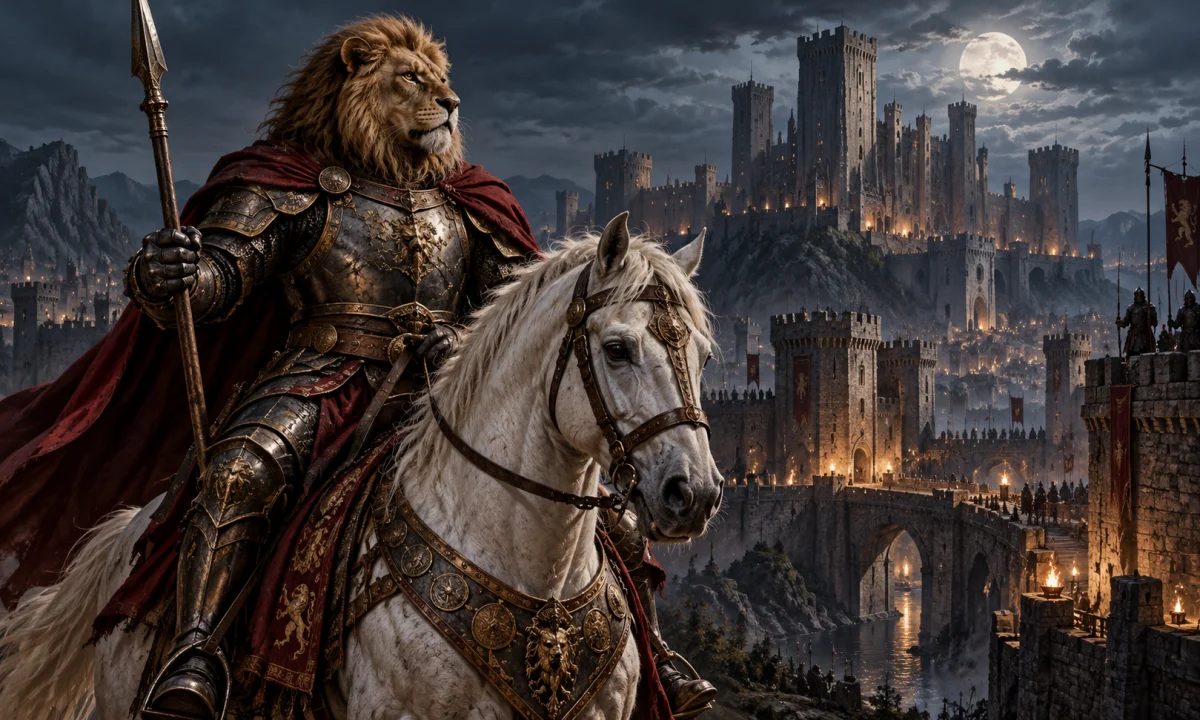
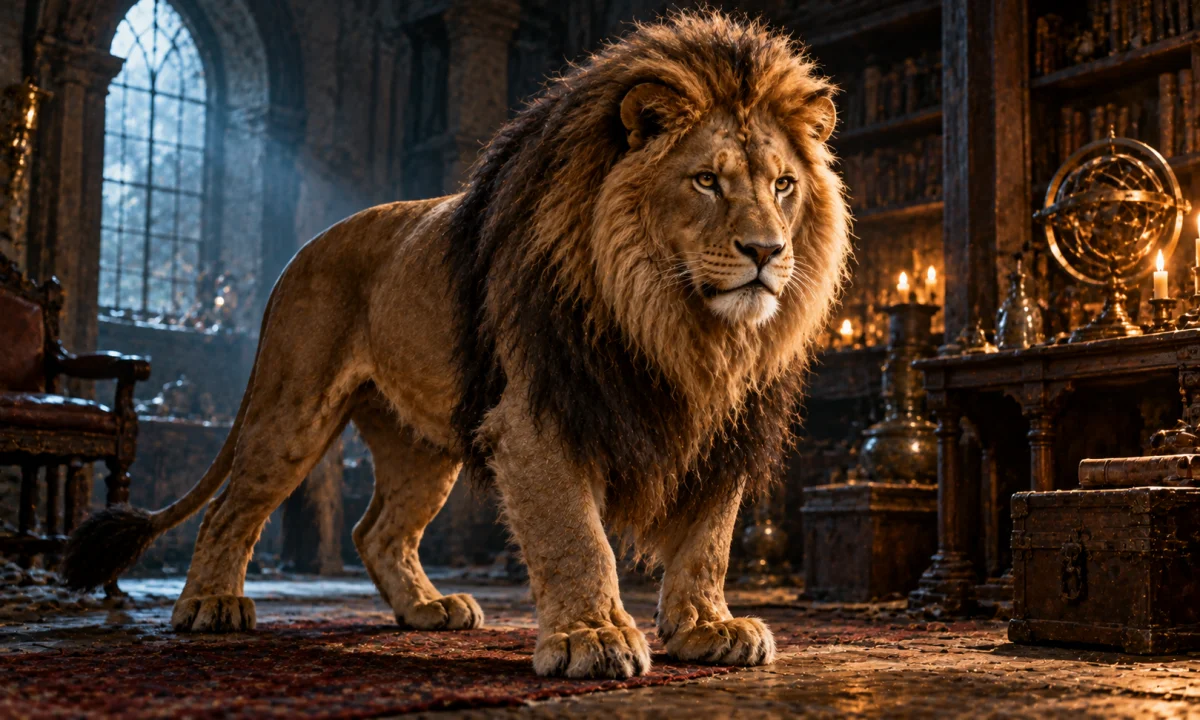
Marbas is traditionally said to appear first as a large or great lion. At the magician’s request, he takes on human form. This two-stage appearance is one of the most recognizable features of his description.
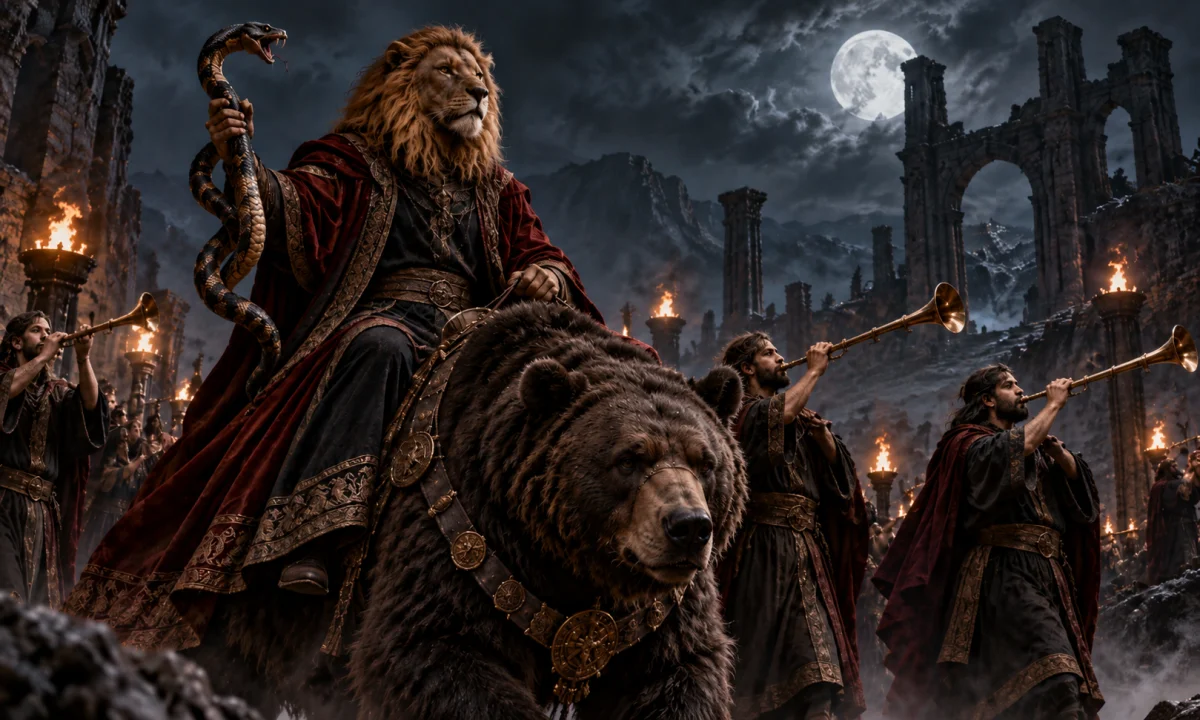
The texts do not provide a detailed account of the lion’s colour, age, mane, clothing or facial features, nor do they establish a single human appearance. Later artists and occult writers have therefore filled in these details according to their own preferences. Images of Marbas may show a lion-headed figure, a fully animal lion, a human with leonine features or a dignified human spirit accompanied by a lion. These are later visual interpretations rather than fixed details preserved by the original catalogue.
The transition from animal form to human form serves several functions within the ritual imagination of the grimoires. The lion presents power, danger and authority, while the human form makes conversation and instruction possible. The change also demonstrates that the spirit can be compelled to alter its outward shape. It should not be assumed that the text is describing a stable biological species or a creature from a folklore tradition with a fixed natural history.
Attributes and powers
Marbas is credited with a combination of destructive, healing, divinatory and technical abilities. The most prominent is control over illness. He is said to be able to cause diseases and also to cure them. This pairing reflects an old pattern in supernatural and religious thought: a being associated with sickness may also possess the knowledge or authority needed to remove it.
The description does not identify particular diseases, symptoms or methods of treatment. It should not be read as medical advice or as evidence of a historical healing practice. In the context of the grimoire, the power belongs to a summoned spirit and forms part of a magical claim about control over hidden forces. Modern medical concepts should not be projected backward onto the text.
Marbas is also said to answer truthfully about things that are hidden or secret. This places him among spirits used for forms of divination, revelation or magical inquiry. The wording suggests knowledge of concealed matters, but it does not provide a narrative explaining how he acquired that knowledge or what limits apply to his answers. The claim is part of the standardized catalogue description rather than a story about a particular prophecy.
Another attributed power is the ability to change people into other shapes. The text gives no detailed examples and does not explain whether the transformation is physical, illusory or temporary. In a broader folkloric context, transformation is a familiar supernatural motif, but Marbas’s entry presents it as one item in a list of services rather than as the subject of a developed legend.
Finally, Marbas is said to give wisdom and knowledge in mechanical arts. In the early modern context, this phrase broadly concerns practical crafts, devices, engineering, construction and the workings of machines. It does not necessarily refer to modern mechanical engineering as a formal academic discipline. The attribute is notable because it places Marbas not only among spirits of illness and revelation but also among those associated with technical knowledge and human invention.
Stories and ritual role
Marbas has no substantial mythic biography in the principal demonological catalogues. He is not given a childhood, genealogy, kingdom, war narrative or account of rebellion in which he plays a distinctive role. The entry is primarily functional: it identifies his rank, appearance, powers and number of legions.
In the ritual framework of the Ars Goetia, a spirit such as Marbas is approached through ceremonial procedures involving names, prayers or conjurations, protective boundaries and the presentation of a seal. The exact procedures differ among manuscripts and later editions. The texts generally assume that the magician seeks information, healing, knowledge or a practical result rather than that the spirit will become a character in an extended narrative.
These instructions should be understood as products of historical occult literature. They document how certain writers imagined the structure of magic and the relationship between human practitioners and spirits. They do not establish that the rituals were universally practiced, that the procedures were consistent, or that Marbas was recognized outside the communities and texts that transmitted this material.
Symbolism and interpretation
Marbas brings together several symbolic oppositions: lion and human, sickness and healing, concealment and revelation, natural force and technical knowledge. The lion can signify sovereignty, courage and violence, while the human form represents speech, reason and social interaction. His medical powers place him in the ambiguous position of a spirit who may harm or restore the body.
The pairing of disease and cure can also be read as an expression of anxiety about specialized knowledge. A person who understands illness may be imagined as capable of causing it as well as treating it. In demonological literature, dangerous knowledge is often represented as morally double-edged: it may benefit the petitioner, but it remains connected with forbidden or suspect power.
His association with mechanical arts reflects the early modern fascination with hidden causes, instruments and technical skill. Grimoires frequently assign practical knowledge to supernatural beings, especially when that knowledge seems difficult, secret or beyond the ordinary reach of the petitioner. Marbas therefore embodies not only brute or animal power but also the mastery of mechanisms and useful crafts.
Scholars and historians of religion generally approach such figures as products of textual, theological and cultural processes rather than as straightforward survivals of pagan gods. Marbas’s identity was shaped by cataloguing, copying, translation and the assimilation of older demonological motifs. Because the sources are late and variant, interpretation must remain cautious. There is no single authoritative account that settles every detail of his name, form or powers.
Marbas in modern occultism and popular culture
Marbas continues to appear in modern occult writing, online demonology, ritual manuals and visual art. Contemporary practitioners may reinterpret him as a spirit connected with healing, transformation, medical knowledge, technology or personal change. These associations may be meaningful within a particular modern magical system, but they are expansions or reinterpretations of the older catalogue, not universally established traditional attributes.
Modern illustrations often make Marbas more visually elaborate than the early descriptions do. Lion-headed humanoids, armoured figures, doctors, engineers and regal animal spirits all occur in contemporary representations. Such imagery reflects current artistic and esoteric interests rather than a consistent historical iconography.
He may also appear under variant spellings in games, fiction, music, internet horror and other forms of popular culture. These works can give him new personalities, powers, relationships or origins. Those inventions should be kept separate from the limited information supplied by the Ars Goetia and related demonological texts. In the historical tradition, Marbas is chiefly a lion-form president of Hell associated with illness, healing, hidden knowledge, transformation and mechanical arts.