WORLD

Sabnock
Sabnock is a demonological spirit described in early modern European grimoires, especially the Ars Goetia, the first section of the Lesser Key of Solomon. He is presented as the forty-third spirit in a catalogue of seventy-two entities and is given the rank of a “mighty great marquis.” Sabnock is not a figure from the Bible, nor is he a universally recognised demon in Jewish or Christian religious tradition. His identity belongs primarily to the learned occult literature of the Renaissance and early modern period.
Origins in European demonological literature
The name Sabnock appears in manuscript and printed traditions associated with ceremonial magic and Christian demonology. The best-known account occurs in the Ars Goetia, a work preserved in manuscripts of the Lesser Key of Solomon, a compilation that took shape during the seventeenth century. The catalogue itself draws on older material, including demon lists circulated in the sixteenth century.
One important predecessor is Johann Weyer’s Pseudomonarchia Daemonum, published in 1577. Weyer presented a list of spirits and demons as part of a critique of magical claims and the people who used them. Although later occult writers treated such catalogues as practical manuals, Weyer’s work emerged within a Christian intellectual culture that generally regarded demonic magic as deceptive, dangerous or heretical.
The Ars Goetia rearranged and expanded material found in earlier sources. Its descriptions combine a hierarchy resembling a royal or aristocratic court with claims about spirits’ appearances, powers and ritual functions. Sabnock’s title as a marquis reflects this structure. It should not be understood as evidence of an ancient religious office. “Marquis” is a European noble rank, and its use belongs to the organisational language of later demonological texts.
No secure ancient mythology establishes Sabnock as an independent god, monster or demon. The name has sometimes encouraged speculative attempts to connect him with older Near Eastern or biblical beings, but no widely accepted historical identification has been demonstrated. His documented identity begins with grimoire tradition rather than with a known ancient cult.
Name and spelling variants
The most familiar spelling today is Sabnock, but the name appears in several forms. Sabnac is especially common, and other versions include Sabnach and Savnok. Differences result from manuscript transmission, copying practices, typesetting and the transliteration of unfamiliar names.
There is no generally agreed etymology for the name. Some occult writers have proposed links with words or names from older languages, but these suggestions remain uncertain and are not sufficient to establish a proven pre-Christian origin. A variant spelling should not automatically be treated as a different being. In most discussions of the Ars Goetia, Sabnock and Sabnac refer to the same grimoire spirit.
At the same time, similar-looking names in unrelated mythological or religious traditions should not be merged with Sabnock. The name does not provide a reliable basis for identifying him with a biblical demon, a Mesopotamian deity or any particular figure from medieval folklore.
Rank and classification
In the Ars Goetia, Sabnock is classified as a marquis, specifically a “great marquis” or “mighty great marquis” in translations and editions of the text. The catalogue assigns different spirits titles such as kings, dukes, princes, marquises, presidents and counts. These ranks create an infernal hierarchy modelled partly on the social and political structures familiar to early modern European readers.
Sabnock is also counted as the forty-third spirit of the Goetic sequence. This number identifies his position in that particular catalogue; it does not indicate a universal ranking among demons. Different demonological books use different lists, titles and orders, and the hierarchy of the Ars Goetia should not be assumed to represent all Christian views of the demonic world.
In religious terms, Sabnock is best described as a figure of grimoire demonology. This distinguishes him from demons named in scripture, saints’ lives or popular legends, and from spirits belonging to established religious systems with continuous communal worship. The text presents him within a magical system rather than as part of a broad, independently documented folk tradition.
Appearance
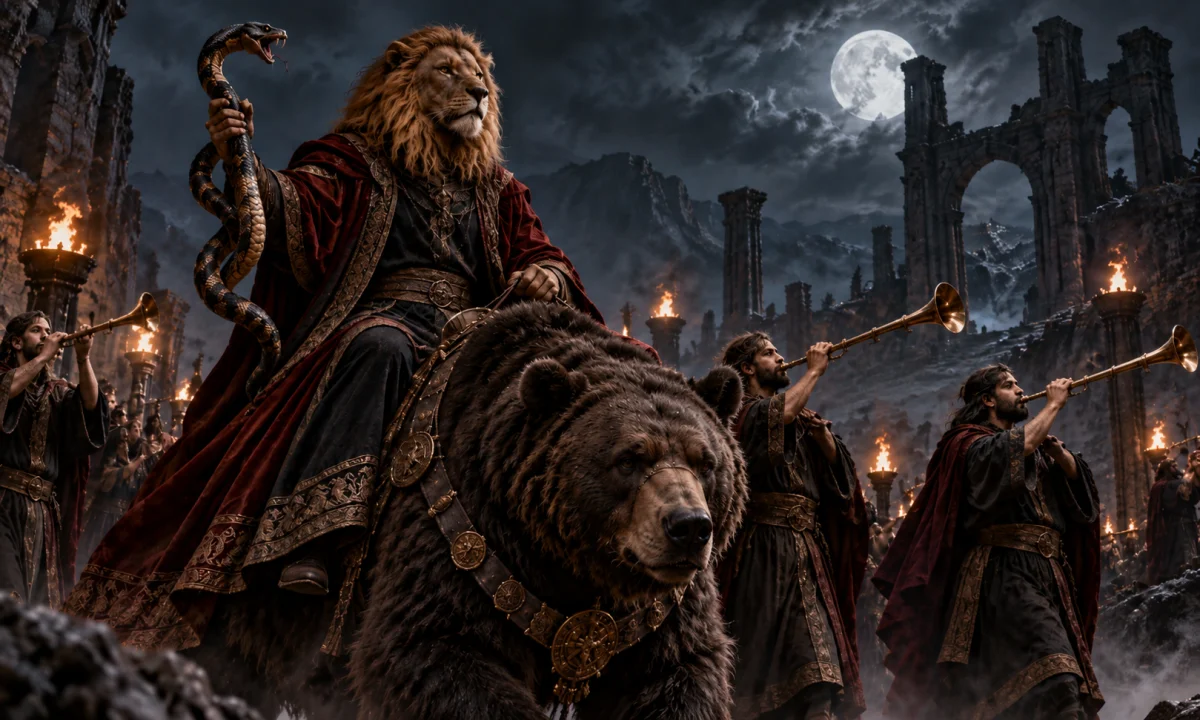
The Ars Goetia describes Sabnock as an armed soldier with the head or face of a lion, riding a pale horse. This image combines several signs of power: military equipment, an imposing animal head and a mounted position associated with authority and warfare.
The wording can vary between editions and translations. Some versions emphasise an “armed man” or “armed soldier,” while others describe the leonine feature as a lion’s head or face. The pale horse is a consistent and distinctive part of the familiar description, although the exact phrasing depends on the textual tradition being followed.
The source does not provide a developed biography explaining why Sabnock has this appearance. Nor does it connect him explicitly with the Four Horsemen, the lion-headed deities of ancient religions or a particular legendary warrior. Readers may notice echoes of wider religious and artistic imagery, but resemblance is not proof of direct descent. The safest interpretation is that the description uses recognisable emblems of ferocity, martial authority and supernatural status within the grimoire’s symbolic language.
Abilities and attributed functions
Sabnock is credited with two notably different kinds of power. First, he is said to build high towers, castles and cities and to equip them with weapons, ammunition and other defences. This makes him a spirit associated with fortification and military construction. His powers concern not only the creation of buildings but also their preparation for armed conflict.
Second, the text states that he can afflict people for many days with wounds, sores and rotting or worm-infested ulcers. This aspect places him among spirits associated with prolonged bodily suffering and disease. The description is deliberately alarming and reflects the grimoires’ frequent presentation of demons as beings who can cause physical or emotional harm.
The account also says that Sabnock gives “good familiars.” In the language of ceremonial magic, a familiar is a spirit believed to serve or assist a magician. The word does not necessarily mean a witch’s animal companion in the later popular sense, although the two ideas became related in European folklore and occult writing. The text offers no detailed explanation of what Sabnock’s familiars look like or how they operate.
These powers are not presented as part of a coherent mythology about Sabnock’s personal history. The catalogue gives short functional descriptions: a spirit may construct, reveal, teach, protect, attack or provide assistance. Such entries resemble an inventory of magical specialities more than narrative legends. As a result, there are few traditional stories in which Sabnock acts as an individual character with named allies, enemies or descendants.
Symbolism and interpretation
Sabnock’s description brings together protection and destruction. Castles, towers and armed cities suggest defence, permanence and control over territory. The sores and wounds attributed to him represent the opposite condition: the breakdown of the human body and the loss of physical security. This contrast may help explain why the entry combines construction with affliction, although the source does not explicitly state that the two functions are symbolically connected.
The lion-headed soldier can be read as an image of ferocity and command. Lions were widely used in European heraldry and religious art as signs of strength, courage or rulership, while military clothing signals organised force rather than uncontrolled violence. These associations are reasonable observations about the imagery, but they should remain distinct from claims about the author’s exact intentions.
The pale horse may also invite comparison with other ominous horsemen in religious art and literature. However, the Goetic description does not identify Sabnock with the horseman of the Book of Revelation or with any member of the Four Horsemen tradition. The shared presence of a pale horse is an image-level resemblance, not a documented genealogical relationship.
Sabnock and Christian demonology
Although the grimoires use Christian terms, symbols and references to Solomon, Sabnock is not a demon named in the Bible. The association with Solomon comes from the pseudepigraphical idea that King Solomon possessed authority over spirits and compelled them to work or reveal knowledge. The Ars Goetia places its catalogue within that legendary framework, but the work itself is a later magical compilation rather than a text from Solomon’s historical period.
Christian demonology developed through several overlapping traditions, including biblical interpretation, theological writing, accounts of possession, medieval legends, magical texts and learned classifications of spirits. These sources do not all agree about the number, names or ranks of demons. A spirit appearing in a grimoire therefore should not automatically be treated as part of official Christian doctrine.
Many early modern religious authorities condemned ceremonial magic and the invocation of spirits. From that perspective, the instructions and descriptions in grimoires were not neutral accounts of supernatural beings. They could be viewed as dangerous attempts to negotiate with demons, or as fraudulent systems designed to mislead practitioners. This historical setting is important because the text’s description of Sabnock reflects both fascination with occult knowledge and anxiety about demonic contact.
Texts, manuscripts and transmission
The Ars Goetia survives through manuscript and printed forms that are not perfectly identical. Spelling, numbering, titles and descriptive details can vary. Modern editions often regularise the language, add seals and present the spirits in a standard order, which can make the tradition seem more uniform than it was historically.
Sabnock’s entry belongs to a genre in which names were copied across languages and writing systems by people who did not necessarily understand their origins. This helps explain why forms such as Sabnac and Sabnach exist. It also means that proposed meanings for the name should be treated cautiously. A mysterious name in a magical catalogue is not automatically a survival of an ancient language.
The seal associated with Sabnock in modern editions is a graphic emblem used in ritual and occult contexts. Its precise form can differ according to the edition or magical handbook. Like the spirit’s rank and appearance, the seal belongs to the grimoire tradition and should not be confused with an archaeological symbol proven to have been used in antiquity.
Relationships and traditional stories
Sabnock has no substantial cycle of myths comparable to the stories of figures such as Lucifer, Lilith, Astaroth or the demons named in medieval saints’ legends. The Goetic catalogue does not give him a family, a place of origin, a personal conflict with a hero or a narrative explaining his fall.
His main relationships are structural. He belongs to the ordered company of spirits listed in the Ars Goetia, where his title and number distinguish him from the other entries. Some later occult systems place the spirits within additional planetary, astrological or angelic correspondences, but these arrangements are not uniform and should not be presented as part of Sabnock’s earliest description.
Likewise, claims that Sabnock commands a fixed number of legions or serves a particular infernal monarch require attention to the specific edition or occult system making the claim. Such details are sometimes repeated in modern demonology reference lists, but they are not necessarily present in every historical version of the text.
Distinguishing Sabnock from similar figures
Sabnock is sometimes confused with other lion-associated or horse-riding supernatural beings. The resemblance to the Christian Four Horsemen is limited to the motif of a rider on a horse, and the Goetic entry does not identify him with them. He is also not the same as a lion-headed deity from ancient Egypt or the Near East, even if modern illustrations borrow visual elements from those traditions.
The name should also be kept separate from unrelated figures whose names begin with “Sab-” or end in similar sounds. Ancient gods, regional spirits, fictional demons and occult entities may appear together in modern lists, but shared spelling patterns do not establish a common origin. Sabnock’s clearest identity remains the marquis described in early modern Goetic demonology.
Later reception
Interest in Sabnock increased during the nineteenth- and twentieth-century occult revivals, when writers, magical organisations and artists revisited the grimoires as sources of ritual symbolism. In these settings, he could be treated as a named spirit for meditation, ceremonial work or artistic interpretation. Such uses represent later occult reception rather than evidence of an unbroken ancient cult.
Modern fantasy, horror and occult-themed popular culture also draws on the names of Goetic spirits. Sabnock may appear in games, novels, comics, animation and other fictional media, often with redesigned powers or a different appearance. These adaptations commonly emphasise his lion-like features, armour, horse or association with fortresses. They should be distinguished from the much shorter description preserved in the historical grimoires.
Within the documented tradition, Sabnock remains a compact but striking example of early modern demonological classification: a marquis depicted as a lion-faced mounted soldier, credited with building fortified places, causing prolonged bodily affliction and providing familiars. Beyond those catalogue functions, the historical sources offer little evidence for a fuller mythology or an older independent religious identity.