WORLD
WORLD
Popocatepetl
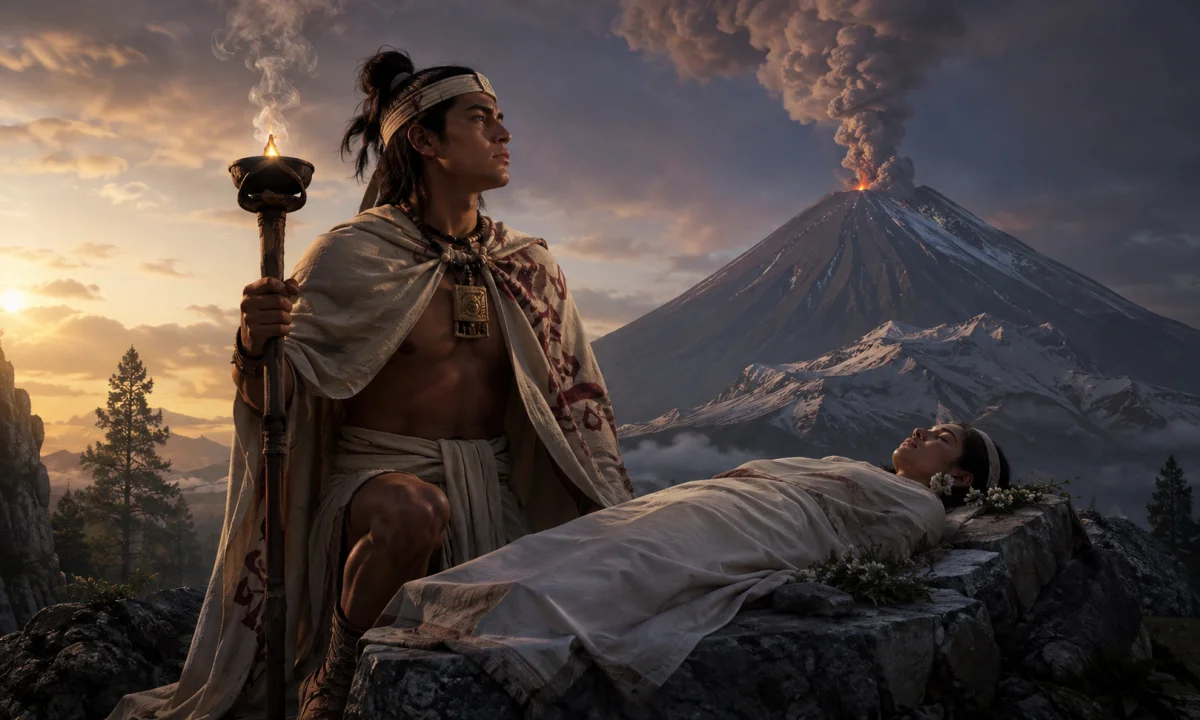
Popocatépetl is an active volcano in central Mexico and one of the most recognisable sacred mountains of the Nahua-speaking world. Its name comes from Nahuatl and is commonly translated as “Smoking Mountain.” Although it is often listed under Aztec mythology, Popocatépetl is not best understood as a clearly defined Aztec god with a fixed biography. Rather, it is a powerful landscape being: a mountain associated with fire, smoke, rain, fertility, danger and the presence of supernatural forces.
The volcano stands southeast of present-day Mexico City, near the volcano Iztaccíhuatl. Its location placed it within the cultural world of the Mexica, commonly called the Aztecs, as well as other Nahua communities. Religious ideas about sacred mountains continued beyond the Aztec period and remain important in local traditions today. The famous story in which Popocatépetl becomes a grieving warrior is widely known, but that romantic narrative should be distinguished from better-attested Mesoamerican beliefs about mountains and from modern literary retellings.
Name and identity
The name is usually written Popocatépetl in Spanish, while forms closer to Nahuatl may be written Popōcatepētl or with other scholarly spelling conventions. Nahuatl spelling varies because colonial writers and modern scholars have represented its sounds in different ways. The name is generally analysed as a combination of words meaning “to smoke” or “smoking” and tepetl, “mountain.” It is therefore commonly rendered as “Smoking Mountain.”
Popocatépetl is sometimes described as an Aztec fire god, but this classification is misleading. The volcano itself was sacred and could be approached as a living or spiritually powerful presence, yet surviving evidence does not establish a single, standardised deity named Popocatépetl with the same kind of defined cult profile as Tlaloc, Huitzilopochtli or Quetzalcoatl. The mountain could participate in religious relationships without being a god in a narrowly anthropomorphic sense.
Its identity also overlaps with wider Mesoamerican ideas about sacred peaks. Mountains were not merely geographical features. They could be imagined as places where clouds formed, water was stored and supernatural beings lived. The Nahuatl concept of a mountain was closely connected with springs, agricultural fertility and the arrival of rain. A smoking volcano combined these life-giving and destructive qualities in a particularly striking way.
Popocatépetl in Nahua religious thought
For Nahua communities, mountains were important parts of the sacred environment. They were associated with the sources of rain and with the tlaloque, rain beings connected to Tlaloc. In central Mexican religious thought, rain was essential to maize agriculture, but storms, hail, lightning and drought could also threaten human life. The mountain’s clouds, springs and eruptions therefore belonged to a wider system of powers that could sustain or damage communities.
Popocatépetl’s smoke and fire made its presence visible from a great distance. An erupting or smoking summit could be interpreted as a sign of activity within the sacred landscape rather than as an inert geological process. This does not mean that every historical observer understood the volcano in exactly the same way. Religious interpretations varied between communities and changed over time, especially after the Spanish conquest.
Colonial descriptions of central Mexican religion, together with Indigenous accounts recorded in the colonial period, show that mountains could receive offerings and ceremonial attention. Such evidence must be read carefully. Spanish writers sometimes imposed European categories such as “idols,” “devils” or “gods” on Indigenous practices, while Christian authorities often suppressed or reinterpreted local ceremonies. The surviving record consequently does not provide a complete or neutral account of how Popocatépetl was understood before the conquest.
Archaeological discoveries on high mountains in central Mexico demonstrate that elevated places were used for ritual purposes. Offerings, shrines and human sacrifices have been found on some mountain summits, particularly in contexts associated with rain and fertility. Such findings support the importance of mountain worship in the region, but they do not by themselves prove that every offering belonged specifically to Popocatépetl or that the mountain had one uniform cult.
Attributes and symbolism
Popocatépetl’s most obvious attribute is smoke. The smoking summit made the mountain appear alive, breathing or communicating through the landscape. Fire and ash could represent danger and destruction, while volcanic soil and the mountain’s role in the weather system connected it with fertility and renewal. These opposing qualities are central to the mountain’s symbolic power.
- Smoke and fire: The visible activity of the volcano made it a powerful sign of transformation, threat and supernatural presence.
- Rain and water: Like other major mountains of central Mexico, Popocatépetl was associated with clouds, springs and the forces necessary for agriculture.
- Fertility: Its connection with rain linked the mountain to maize cultivation and the survival of human communities.
- Danger: Eruptions, ash and earthquakes reminded people that sacred powers could not be treated as harmless or fully controllable.
- Endurance: The mountain’s permanence and visibility made it a prominent witness to political, religious and environmental change.
These associations should not be treated as a fixed list of personal powers belonging to a single deity. They describe the symbolic and ritual significance that a volcano could possess within Nahua and broader Mesoamerican religious traditions.
The story of Popocatépetl and Iztaccíhuatl
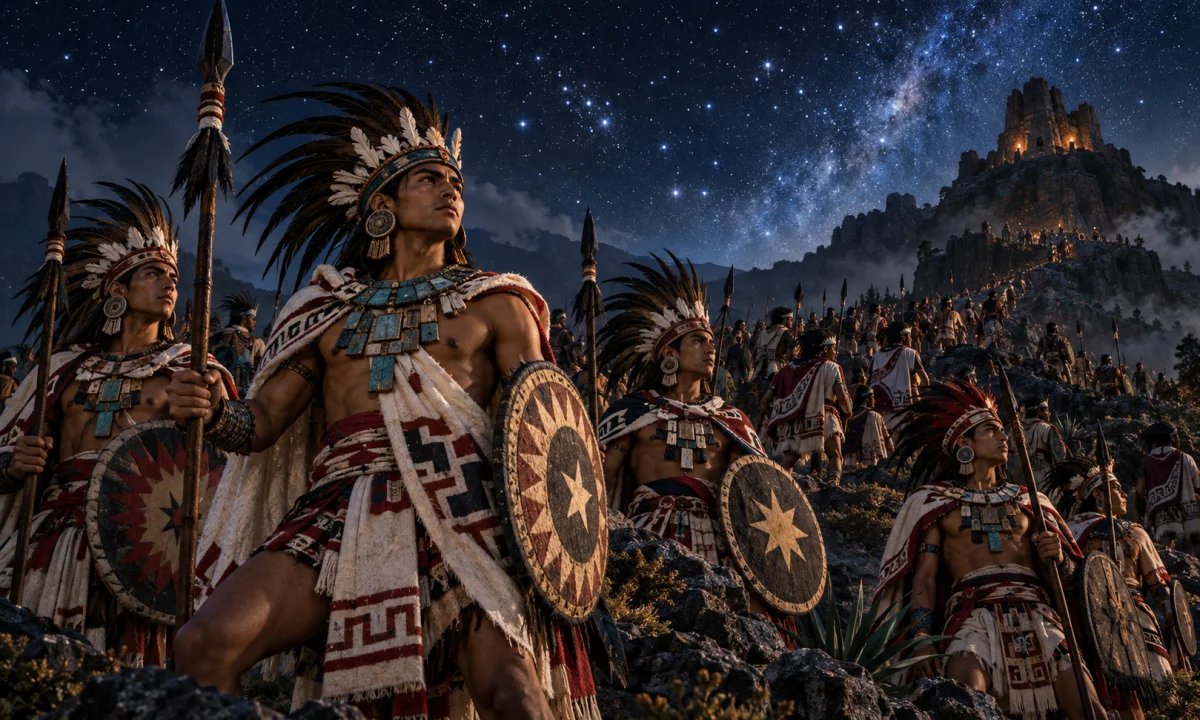
The best-known narrative presents Popocatépetl and Iztaccíhuatl as human lovers. In the common version, Popocatépetl is a warrior who loves Iztaccíhuatl, the daughter of a ruler. He goes to war after being promised her hand in marriage. While he is away, a false report reaches Iztaccíhuatl saying that he has been killed. Overcome with grief, she dies.
When Popocatépetl returns and learns what has happened, he carries her body into the mountains. He places her on a high peak and remains beside her with a smoking torch or fire. The gods then transform the two lovers into mountains. Iztaccíhuatl becomes the neighbouring snow-covered peak, whose profile is often said to resemble a sleeping woman, while Popocatépetl remains nearby as the smoking mountain, eternally watching over her.
Many versions add details about a battle, a jealous rival, the anger of a ruler or the origin of the volcano’s continuing eruptions. Others portray Popocatépetl as a warrior who keeps vigil rather than as a figure literally transformed by a named group of gods. The narrative is emotionally powerful, but its form is not securely documented as a pre-Hispanic Aztec myth.
The famous romance is better treated as a folkloric legend associated with the two volcanoes. It has circulated in changing forms through oral tradition, schoolbooks, tourism, literature and popular storytelling. Its precise age and origin are uncertain. There is no single authoritative ancient text that preserves the story exactly as it is commonly told today, and the names of the lovers in the romantic narrative should not automatically be assumed to represent an ancient divine couple.
Iztaccíhuatl and the neighbouring mountain
Iztaccíhuatl is a real volcano and mountain range located near Popocatépetl. Its Nahuatl name is commonly translated as “White Woman,” referring to its snow-covered appearance or the shape associated with a woman lying down. In the popular legend, Iztaccíhuatl is the beloved who dies and becomes the mountain.
That narrative should be distinguished from other religious meanings attached to the mountain. Iztaccíhuatl may be personified in local traditions, and the mountain has its own cultural history, but the available evidence does not justify treating every reference to the White Woman as part of one ancient, standardised myth. The romantic pairing of the two volcanoes is especially prominent in modern Mexican cultural memory, where their silhouettes encourage human interpretation of the landscape.
Relationship to Tlaloc and the rain powers
Because Popocatépetl is a major mountain associated with clouds and water, it is often discussed alongside Tlaloc, the central Mexican rain deity. Tlaloc was a major religious figure whose powers included rain, storms, agricultural fertility and the dangerous forces of lightning and drought. The tlaloque, commonly understood as subordinate or associated rain beings, were also linked with mountains and the distribution of rain.
Popocatépetl should not, however, be identified with Tlaloc. Nor is there clear evidence that the volcano was simply Tlaloc’s physical body. A sacred mountain could be a dwelling place, manifestation or ritual partner of rain powers without being identical to the principal rain deity. This distinction matters because modern summaries sometimes turn a complex landscape religion into a simple statement that “Popocatépetl was the Aztec god of volcanoes.” The historical evidence supports a more cautious interpretation.
Evidence from the Aztec and colonial periods
The Mexica state expanded across central Mexico before the Spanish conquest, bringing many regions into political and economic relationships with Tenochtitlan. The volcano’s location near important routes and settlements made it a conspicuous feature of the imperial landscape. Nahua-speaking communities living around it would have had their own local practices, memories and explanations, which were not necessarily identical to those of the Mexica elite.
Information about pre-Hispanic religious traditions comes from several incomplete sources: archaeological remains, place names, Indigenous pictorial manuscripts, Nahuatl-language records and accounts written by Spanish missionaries or colonial officials. These sources preserve valuable evidence but do not offer a complete biography of Popocatépetl. They also represent different periods and viewpoints.
After the conquest, Christian missionaries attempted to end Indigenous ceremonies at mountains and other sacred locations. Some practices were driven underground; others were adapted to Christian festivals, saints and prayers. The resulting traditions can contain pre-Hispanic concepts, colonial reinterpretations and later local developments at the same time. It is therefore difficult to label a present-day ritual as either wholly “Aztec” or wholly “Christian.”
Living traditions and Don Goyo
Popocatépetl remains culturally important to communities around the volcano. In some local traditions, the mountain is personified as Don Goyo or Don Gregorio. People may speak of him as a powerful male presence and make offerings or conduct ceremonies intended to maintain a respectful relationship with the volcano. Ritual specialists sometimes known as tiemperos—people associated with weather knowledge and ceremonies for rain—have been reported in traditions around central Mexican mountains.
These living practices are not simply unchanged survivals from the Aztec period. They belong to communities with long histories of adaptation, and they may combine Indigenous concepts with Catholic names, symbols and calendars. Don Goyo is a modern local personification and should not be confused with an ancient Aztec deity whose existence is uniformly attested in pre-Hispanic sources.
The continuing activity of Popocatépetl gives these traditions an immediate practical dimension. Communities must live with ashfall, evacuations, changing weather and the possibility of eruption. Respect for the mountain can therefore involve both ritual attention and practical knowledge of environmental risk. The volcano is simultaneously a sacred presence, a cultural landmark and a serious geological hazard.
Geological reality and cultural meaning
Popocatépetl is an active stratovolcano and one of Mexico’s highest mountains, rising to roughly 5,426 metres above sea level. Its activity has included eruptions, ash emissions and periods of heightened danger in the modern era. Scientific monitoring describes these events through geology and volcanology, while local religious traditions may interpret the mountain through relationships, offerings and signs.
These explanations do not need to be treated as interchangeable. Volcanology provides evidence-based accounts of magma, gases, ash and eruption patterns. Myth and ritual express cultural relationships with a powerful place and help communities interpret danger, obligation and belonging. Confusing the two can distort both the science and the religious tradition.
Popocatépetl in modern culture
The image of Popocatépetl standing beside Iztaccíhuatl has become an important symbol in Mexican art, education, tourism and national imagery. Paintings, poems, children’s books and public narratives frequently use the lovers’ legend to give emotional meaning to the two mountains. Modern retellings often simplify or embellish the story, presenting it as an ancient Aztec myth even though its precise pre-Hispanic documentation is uncertain.
Popular culture also sometimes portrays Popocatépetl as a giant warrior, a sleeping hero or a literal volcano god. These images can be compelling, but they belong to modern representation rather than securely established ancient doctrine. The older and broader religious context is less like a single character biography and more like a network of relationships among mountains, rain, fire, agriculture, communities and divine powers.
Popocatépetl is therefore best understood on several connected levels: a real active volcano, a sacred mountain within Nahua religious geography, a focus of continuing local practice, and the central figure in a widely circulated love legend. Keeping those levels distinct preserves both the complexity of Mesoamerican traditions and the living significance of the Smoking Mountain.