WORLD
WORLD
Pihuechenyi
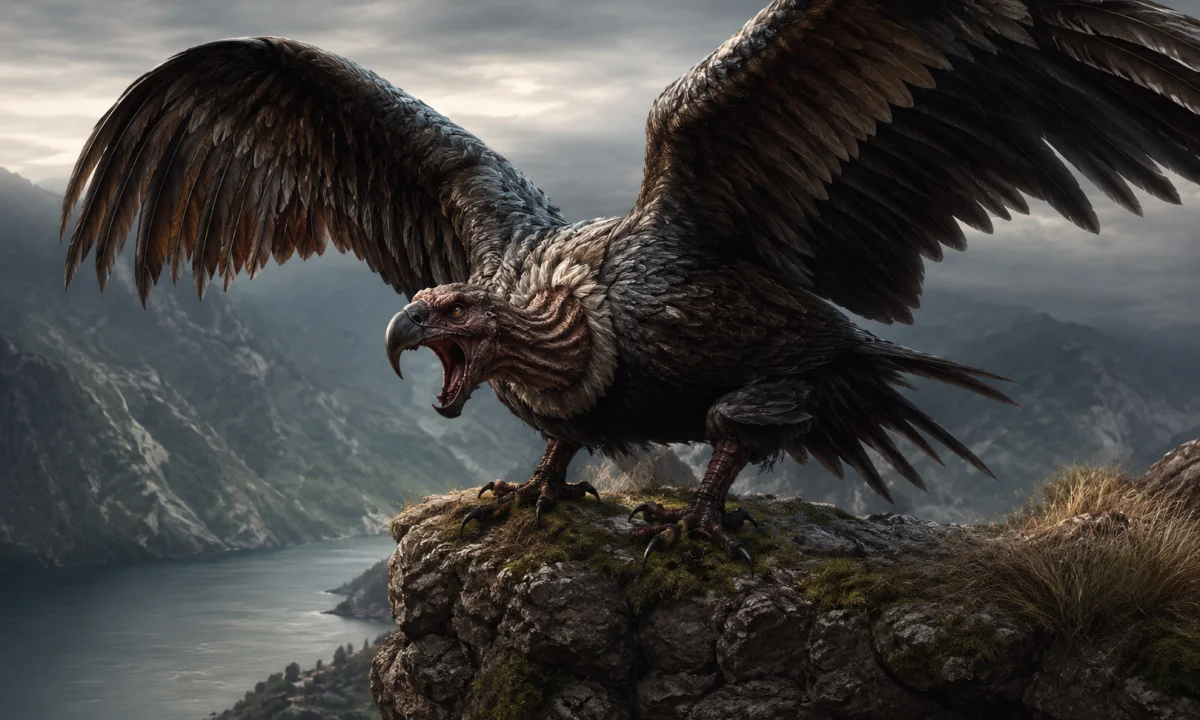
Pihuechenyi is a frightening flying creature associated with Mapuche and wider Chilean folklore. It is commonly described as a nocturnal, blood-drinking being that inhabits remote forests, caves or other secluded places. Accounts differ considerably, however, and the name appears in several spellings, including Pihuechen, Pihuechén, Piuchen and Pihuychen. These variations reflect the movement of an Indigenous name into Spanish-language writing rather than a single universally fixed spelling or definition.
Origins and cultural setting
The Pihuechenyi belongs to the legendary world of southern South America, especially traditions connected with the Mapuche cultural area of south-central Chile and adjacent parts of Argentina. Mapuche communities have maintained rich oral traditions concerning spirits, dangerous beings, enchanted animals and other forces encountered in the landscape. These traditions cannot always be separated into neat categories equivalent to the modern English words “monster,” “ghost” or “god.” A being may be understood through its behaviour, habitat, effects on people and relationship with the living environment rather than through a formal mythology with one authoritative version.
Traditional knowledge about beings such as the Pihuechenyi was transmitted primarily through oral storytelling and local memory. Much of what is now written about it comes from later Spanish-language collections of Chilean folklore, regional histories, dictionaries and popular accounts. Such records often preserve valuable details, but they may also alter Indigenous names, combine local variants or describe Mapuche beliefs using European ideas about demons and monsters. For that reason, no single modern summary should be treated as a definitive account shared by every Mapuche community.
The wider landscape associated with the Pihuechenyi is important. Forests, ravines, caves and isolated rural areas occupy a prominent place in southern Chilean folklore. Such locations can be imagined as zones where ordinary human control is limited and where unusual beings may be encountered. The creature’s nocturnal habits and association with hidden places reinforce its role as a warning against travelling alone or entering dangerous environments without care.
Name and identity
The form Pihuechenyi is not the only name used for this being. Spanish-language sources and folklore websites frequently employ forms such as Pihuechén, Pihuechen or Piuchen. Diacritics, vowels and final syllables vary because Mapudungun names have been represented through Spanish spelling conventions, and because oral terms were recorded by different writers at different times.
The meaning of the name is not securely established in a way that would settle all questions about the creature’s nature. Some popular explanations connect it with ideas of flying, movement or a monstrous animal, but proposed translations should be treated cautiously unless they are supported by specialist linguistic evidence. The spelling Pihuechenyi should therefore be understood as a traditional or folkloric name variant, not as proof of a precise etymology.
There is also uncertainty about whether every account using a similar name refers to exactly the same being. In some descriptions, the Pihuechenyi is a winged serpent or reptile. In others, it resembles a large bat, a flying lizard or an animal with a snake-like head. Local storytelling can use one name for a family of related dangers rather than for a creature with a single standardized appearance.
Appearance
The most common image presents the Pihuechenyi as a large flying animal with features belonging to more than one species. Serpentine and reptilian elements are especially frequent. It may be described as having a long body, a snake-like head, scales or a lizard-like form, combined with wings or the ability to fly. Other accounts give it a bat-like appearance, sometimes emphasizing leathery wings and nocturnal movement.
These descriptions should not be reduced to a single official design. Some modern illustrations depict a dragon-like monster, but the traditional accounts preserved in folklore are often less visually consistent. A creature may be recognized less by a detailed anatomy than by its habits: it appears at night, moves through the air or darkness, avoids ordinary human contact and harms people or animals by drawing blood.
The Pihuechenyi is generally imagined as larger and more threatening than a normal snake or bat. Its size is sometimes exaggerated in retellings, as is common with oral legends, but exact measurements are not part of a stable tradition. Claims that it always has a particular colour, a fixed number of wings or a standardized body shape belong mainly to later popular descriptions rather than to a universally attested traditional form.
Behaviour and powers
The being’s most widely repeated characteristic is its supposed appetite for blood. Stories describe it as attacking humans or livestock and sucking blood from the victim. In some versions, unexplained weakness, illness or death is attributed to such an attack. This association makes the Pihuechenyi a supernatural predator rather than merely an unusual flying animal.
Its ability to fly is another central feature. The creature is often said to travel silently or to emerge from concealed places after dark. It may pass over settlements, approach isolated houses or hunt in forested areas. The combination of flight, darkness and blood-drinking gives the legend a strong atmosphere of vulnerability: a person may be endangered without hearing or seeing the creature until it is too late.
Some accounts attribute supernatural stealth or a capacity to remain hidden during the day. Others say that it lives in caves, hollow trees, dense woodland or inaccessible mountain country. These details vary by locality, and there is no firm evidence that all versions share one established dwelling place.
Popular retellings sometimes add powers such as shapeshifting, magical invisibility or an ability to cause disease at a distance. Such features should not automatically be treated as old or specifically Mapuche elements. They may result from the blending of several South American monster traditions or from modern attempts to make the creature resemble internationally familiar vampires and dragons.
Stories and local variations
There is no single canonical myth of the Pihuechenyi comparable to a long, fixed epic narrative. Instead, it appears mainly in brief reports, warnings and encounters. A story may explain the unexplained death of an animal, a strange sound heard at night or the danger of a remote location. The emphasis is often on testimony and caution rather than on a detailed biography, genealogy or sequence of adventures.
In some versions, the creature is believed to attack domestic animals, especially when they are left outside or kept in isolated places. In others, its victims are human travellers. The lack of a consistent target reflects the broader nature of the legend: it represents a predatory presence that may threaten both people and animals beyond the protection of the household.
Accounts also differ over whether the Pihuechenyi is a natural-looking animal with supernatural qualities or a transformed person. A few modern summaries describe it as a sorcerer, witch or person changed into a monstrous form. That interpretation may reflect the tendency of folklore writers to connect frightening beings with witchcraft, but it is not a detail that can be safely assigned to every version of the tradition.
Because the surviving record is fragmented, it is difficult to determine which details are ancient, which are local developments and which were added by twentieth- and twenty-first-century popularizers. The safest description is therefore a qualified one: the Pihuechenyi is a South American folkloric predator, usually associated with Mapuche tradition, whose appearance and exact supernatural powers vary from account to account.
Meaning and cultural significance
The Pihuechenyi can be interpreted as a figure of danger at the edge of settled life. Its habitats—dark forests, caves, mountains and isolated rural spaces—are places where people may be physically exposed and where ordinary explanations are difficult to apply. The story gives a supernatural form to fears connected with predators, sudden illness, unexplained animal deaths and travel after nightfall.
Its blood-drinking behaviour also links it with ideas of depletion and loss. A victim does not merely suffer an attack; the creature removes vitality. This makes the Pihuechenyi an effective symbol for a danger that weakens a household or community without being easily seen. Such interpretations are useful for understanding the emotional power of the legend, but they should not replace the tradition itself with an invented symbolic system. Communities may tell or understand the story in different ways.
The creature’s hybrid body is significant as well. A serpent, a bat and a flying reptile occupy different parts of the natural world, and their combination creates something that violates ordinary categories. Many folkloric beings are memorable because they cross boundaries between animal types, earth and sky, or familiar nature and the supernatural. The Pihuechenyi’s unusual form helps mark it as a being that does not belong safely within the everyday world.
It is important to avoid presenting the Pihuechenyi as representative of all Mapuche religion. Mapuche spiritual traditions include complex understandings of ancestors, spirits, ritual specialists, sacred powers and relationships with the land. A frightening folkloric creature is only one element within a much broader cultural and religious context. Treating it as a “Mapuche vampire” without qualification can flatten that context and impose a European category on an Indigenous tradition.
Distinction from similar beings
The Pihuechenyi is sometimes confused with other figures from Chilean and South American folklore, but the similarities do not establish that they are the same being.
- The Chonchon or Tue-Tue: In Chilean and southern South American folklore, the Chonchon is commonly described as a detached human head with wings, often associated with a sorcerer or witch. It is linked to nighttime flight and ominous cries, but its usual form and stories differ from those of the reptilian or bat-like Pihuechenyi.
- The Camahueto: The Camahueto is a powerful, horned creature of Chilean folklore, especially associated with Chiloé. It is generally imagined as a bull-like or calf-like animal connected with water and magical growth, not as a flying blood-drinker.
- The Basilisco chilote: The Basilisco of Chiloé is a serpent-like or reptilian monster whose powers and appearance vary in local accounts. It is sometimes confused with other snake beings, but it belongs to a different cluster of Chilean legends and should not automatically be identified with the Pihuechenyi.
- The Mapuche witranalwe: The Witranalwe, also spelled in other ways, is a dangerous supernatural figure in Mapuche tradition, often associated in later descriptions with a skeletal or mounted being and the protection of hidden wealth. It is not simply another name for the Pihuechenyi.
- European vampires and dragons: The Pihuechenyi’s blood-drinking and winged form invite comparisons with vampires and dragons. These comparisons can help readers visualize certain modern descriptions, but they do not prove European origins or make the beings equivalent.
Later reception
In modern Spanish-language folklore writing, the Pihuechenyi is often presented as a cryptid-like monster. Drawings may give it a dramatic dragon, bat or giant-serpent appearance, while short retellings emphasize blood, nocturnal attacks and remote habitats. These presentations have helped the name circulate beyond the communities and regions where related stories were originally recorded.
Modern horror fiction, online lists of legendary creatures and fantasy-inspired artwork may adapt the Pihuechenyi as a generic South American vampire or flying monster. Such adaptations are contemporary uses of the figure, not evidence that every added power or visual feature belongs to Mapuche tradition. The older folkloric material is better understood as varied regional storytelling, preserved imperfectly through oral transmission and later written collection.
For WorldMythos, the name is most accurately treated as a variant-rich figure of Mapuche-associated and Chilean folklore: a concealed, nocturnal, flying predator whose descriptions often combine serpent, reptile and bat-like traits. Its uncertain spelling, changing appearance and fragmentary documentation are part of its history, not problems to be concealed behind a single definitive monster profile.