WORLD
WORLD
Chonchon
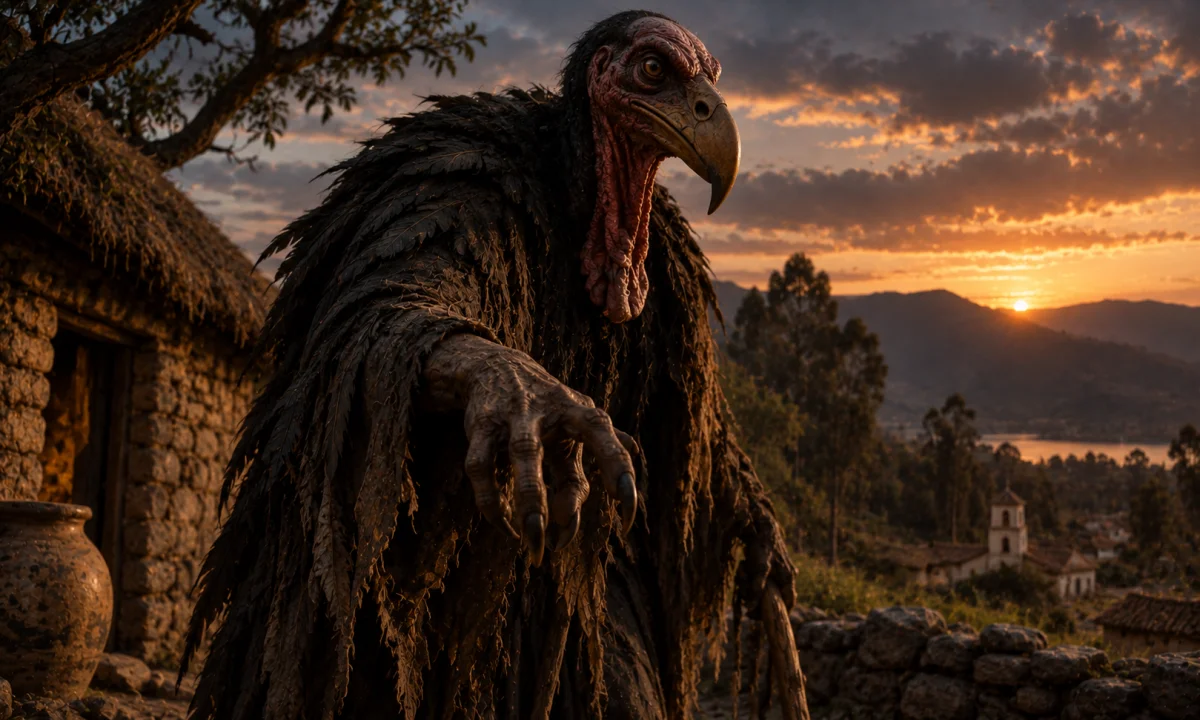
Chonchon is a supernatural being associated chiefly with Mapuche and Chilean folklore. It is commonly described as a human head that separates from the body and flies through the night, using enlarged ears as wings. In many accounts, the Chonchon is connected with a kalku—a person regarded in Mapuche tradition as a practitioner of harmful or dangerous magic—and its appearance may be treated as an omen of illness, death or other misfortune.
The figure is best understood within the cultural history of the southern Andes rather than as a single, fixed creature with one universally accepted story. Accounts differ according to region, language, period and the relationship between Indigenous tradition and later Chilean folklore. Some descriptions present the Chonchon as a transformed sorcerer; others describe it more generally as a nocturnal flying head or as a mysterious being identified by its cry. The spelling, pronunciation and relationship of the name to similar figures also vary.
Origins and cultural setting
The Chonchon is most strongly associated with the traditional cultural world of the Mapuche, an Indigenous people whose historical territories extend across south-central Chile and parts of neighbouring Argentina. Mapuche religious thought includes a complex understanding of relations among people, ancestors, spiritual powers, animals, the landscape and forces that can bring health or harm. Within this setting, stories about dangerous magical specialists are not simply tales of monstrous creatures. They can express concerns about illness, social conflict, hidden hostility and the misuse of spiritual knowledge.
Spanish colonial observers and later folklorists recorded beliefs about Mapuche ritual specialists using terms that do not always correspond neatly to Mapuche categories. The word kalku, for example, is often translated into Spanish or English as “sorcerer” or “witch”, but those translations can flatten important distinctions within Mapuche understandings of spiritual authority and harmful magic. Historical descriptions were also shaped by Christian assumptions, colonial suspicion and the vocabulary available to outside observers. Consequently, claims that the Chonchon has one precise ancient origin should be treated with caution.
Much of the material concerning the Chonchon has survived through oral tradition, regional storytelling and folkloric writing rather than through one authoritative sacred text. There is no single canonical myth that defines the being for all Mapuche communities or all Chilean regions. Stories have been retold in Spanish as well as in Mapudungun, and details have changed as they have moved between Indigenous contexts, rural communities, newspapers, popular books and contemporary media.
Name and identity
Chonchon is the spelling most often used in Spanish-language discussions, although chonchón may also appear with an accent. The origin and exact linguistic meaning of the name are not entirely certain. It is frequently connected in popular explanations with the sound attributed to the creature, but that interpretation should not be treated as a settled etymology. Names used in oral traditions may also be adapted when they pass between languages.
The Chonchon is sometimes called tue-tue or tué-tué in Chilean folklore, especially because of the cry associated with a nocturnal flying being. However, these names do not necessarily identify exactly the same figure in every account. In some traditions, the tue-tue is a witch or magical person in transformed form; in others, it is a supernatural bird-like presence or a distinct folkloric being. Regional usage is inconsistent, so the terms should not automatically be treated as synonyms.
Descriptions may also overlap with stories of witches who remove their heads, or with broader Latin American traditions about disembodied heads and night-flying sorcerers. Similar motifs do not prove that all such beings share one origin. The Chonchon belongs particularly to the cultural and folkloric history of the Mapuche and Chilean south, even though later retellings may place it within a much wider catalogue of “flying head” legends.
Appearance and transformation
The most recognisable image of the Chonchon is a severed or detached human head flying through the darkness. Its ears are said to become large wings, allowing it to travel above houses, roads and fields. Some accounts describe the ears as unusually long even before transformation, while others portray the supernatural change as the enlargement or magical use of ordinary human ears.
The creature is generally not imagined as a flesh-eating monster. Its disturbing quality comes from the violation of ordinary bodily order: a living head travels without its body, sees and hears while separated from it, and returns before daybreak. This transformation links the Chonchon to ideas about hidden identity and the dangerous power of people who appear ordinary during the day but become harmful at night.
In stories that connect the Chonchon with a kalku, the transformation is usually accomplished through magic. Popular retellings often say that the practitioner applies a special ointment or performs a ritual before the head leaves the body. The exact ingredients, words and procedure vary widely, and no single formula should be presented as a universal feature of Mapuche tradition. In some versions, the person’s body remains hidden while the head travels; in others, the transformed being is described without a detailed account of how the change occurs.
The Chonchon’s flight is often accompanied by a repeated cry resembling “chon-chon” or “tue-tue”. This sound is one of the main ways people are said to recognise it. The cry may be heard overhead or in the distance, and its presence at night can generate fear even when the being is not seen. As with many oral traditions, the sound itself may be represented differently in Spanish spelling, and the written forms do not reproduce an original supernatural language.
Abilities and behaviour
The Chonchon is commonly believed to fly at night and to move quietly apart from its cry. Its separation from the body gives it access to places that would be difficult or impossible for an ordinary person to reach. It may watch people, enter or pass over dwellings, carry out harmful magical activity, or visit someone who is sick. These details differ substantially between accounts.
Some Chilean stories associate the Chonchon with death. Hearing its call may be interpreted as a warning that someone nearby will become seriously ill or die. Other narratives treat the sound as evidence that a witch is active in the area, without assigning a definite outcome. Such beliefs should be described as elements of folklore rather than as a single religious doctrine accepted by all Mapuche people or all Chileans.
There are also traditions about preventing or interrupting the creature’s return. A person may attempt to confuse the flying head, hide the body, or use a protective prayer or object. One familiar pattern in later Chilean retellings involves saying a religious formula, particularly a Christian prayer, so that the Chonchon cannot find its way back. The presence of such elements reflects the blending of Indigenous, colonial and Catholic storytelling environments. Their distribution and importance vary, and they should not be projected backward as unchanged pre-colonial practice.
Relationship to the kalku
The strongest interpretive link in many accounts is between the Chonchon and the kalku. In simplified descriptions, the Chonchon is the night form of a witch. A more careful explanation is that some traditions portray a harmful magical specialist as capable of becoming, or sending forth, a flying head. The being can therefore function as an outward sign of occult activity rather than as an independent species of monster.
Mapuche concepts of spiritual power cannot be reduced to a simple opposition between “good priests” and “evil witches”. Terms translated as shaman, healer, sorcerer or witch have been used inconsistently by outsiders, and the social meanings of ritual specialists are more complex than modern fantasy categories suggest. A machi, for instance, is generally associated with healing and religious authority, whereas a kalku is often presented in ethnographic and folkloric accounts as a person involved in harmful magic. Even this distinction requires care because historical descriptions, community perspectives and scholarly interpretations are not identical.
Within stories about the Chonchon, fear often concerns the suspected human agent behind the apparition. The threatening question is not merely “What creature is flying overhead?” but “Who in the community possesses hidden power, and whom might that power harm?” The legend can consequently reflect social tensions, accusations and uncertainty about the causes of sickness or misfortune.
Stories and regional variations
There is no universally recognised Chonchon narrative comparable to a single epic or foundational myth. Instead, the figure appears in short accounts, warnings, personal experiences and local tales. A typical story may describe a strange cry heard at night, a shape crossing the moon, or a head seen above a roof. Another may explain that a suspected witch has left the house in supernatural form and must return before sunrise.
Some narratives focus on a person who learns that a neighbour is a Chonchon. Others tell of someone who hears the cry and follows it, only to discover a hidden body or encounter a being unable to complete its return. These plots are not stable across the tradition, and many circulated as frightening tales rather than as formal religious instruction.
Geography also affects the image. In rural southern Chile, the Chonchon may be imagined over forests, farms, roads or isolated houses. In coastal and island communities, night sounds and unfamiliar birds can become part of the story’s atmosphere. In urban retellings, the creature may survive mainly as a name for a frightening nocturnal presence. The core image remains recognisable, but its social setting changes.
Symbolism and interpretation
The detached head is a powerful symbol because it separates perception, intention and speech from the rest of the body. The Chonchon can therefore represent concealed knowledge or a person whose thoughts and actions are believed to operate outside ordinary social life. Its flight gives it an unsettling freedom: it can observe without being easily recognised, while its human identity remains hidden on the ground.
The creature’s ears are especially significant in the visual tradition. They are organs of hearing transformed into instruments of movement. This unusual image connects the Chonchon with the importance of overheard sounds, secret speech and the interpretation of unexplained noises. The repeated cry also turns the night environment into a source of uncertainty. A bird, wind or distant animal may become evidence of supernatural activity when heard within a community already familiar with the legend.
Illness and death are frequent themes because traditional communities, like all societies, have sought explanations for suffering that seemed sudden or difficult to understand. Stories about harmful magic can provide a language for suspicion and grief, but they may also intensify accusations against individuals. The legend should therefore be approached as part of a social and religious world, not merely as an entertaining monster story.
Scholars and cultural historians may interpret the Chonchon as evidence of cultural continuity, adaptation or exchange. Indigenous concepts were recorded under colonial conditions, then reshaped by Catholic categories, national folklore projects and commercial publishing. A modern description may preserve an older motif while also adding details from unrelated supernatural traditions. Distinguishing these layers is necessary when discussing what is traditional, what is documented historically and what is a later embellishment.
Distinction from similar beings
The Chonchon should not automatically be identified with every flying head, witch or nocturnal bird in South American folklore. A similar physical motif can arise in different traditions and acquire different meanings. Nor should the Chonchon be confused with an ordinary owl, nightjar or other bird whose call may have inspired particular local stories. Folklore often transforms familiar animals and sounds, but the supernatural interpretation belongs to the narrative context.
The relationship with the tue-tue deserves particular caution. Many popular accounts use the two names interchangeably, especially when describing a flying witch whose cry repeats a short syllable. Other accounts distinguish them. The safest description is that they overlap in parts of Chilean folklore but are not universally identical.
The Chonchon is also distinct from named beings in other Mapuche traditions, including powerful serpent figures and other spirits associated with water, land or cosmic conflict. Similarity in being supernatural does not make these figures interchangeable. The Chonchon’s defining features are its nocturnal flight, human-head form and frequent connection with harmful magic.
Later reception and popular culture
In modern Chile, the Chonchon remains part of regional folklore and the broader national memory of supernatural stories. It appears in collections of legends, children’s retellings, illustrated books, educational material and occasional references in horror or fantasy. Such adaptations often emphasise the striking image of the winged head while simplifying the cultural context in which the figure was understood.
Contemporary fiction may portray the Chonchon as a fully independent monster, give it powers not found in older accounts, or combine it with the generic idea of a witch who flies at night. These creative uses belong to modern popular culture rather than automatically representing Mapuche belief. The traditional figure is better approached through the varied oral and folkloric contexts that connect it with night sounds, spiritual danger, social suspicion and the troubling transformation of a human being.