WORLD

Pichana Gobeche
Pichana Gobeche is a name associated in some modern lists with Zapotec mythology, but its identity is uncertain. Unlike better-documented Zapotec figures such as Cocijo, Pitao Cozobi, or Pitao Pezelao, Pichana Gobeche does not have a clearly established body of surviving colonial descriptions, Indigenous-language prayers, or recorded myths that would allow her—or him—to be described confidently as a single traditional deity. The name appears mainly in modern secondary presentations, where it is sometimes classified as a goddess connected with fertility, childbirth, or the earth. Those associations should be treated cautiously rather than presented as securely documented features of ancient Zapotec religion.
Zapotec cultural setting
The Zapotec peoples are Indigenous peoples of southern Mexico, especially the state of Oaxaca. Zapotec communities have lived in the region for many centuries, and their history includes the urban centre of Monte Albán, which flourished long before the Spanish conquest. “Zapotec mythology” is therefore not the mythology of one uniform society with a single canonical set of gods. It refers to traditions belonging to numerous related but distinct Zapotec communities and languages.
Zapotec religious ideas changed over time. The beliefs of the inhabitants of ancient Monte Albán cannot simply be equated with the practices recorded in the sixteenth and seventeenth centuries, and colonial descriptions were written by outsiders, often for Christian missionary or administrative purposes. Later oral traditions also developed under changing social and religious conditions. A name that appears in a modern list may therefore represent an older deity, a local tradition, a transcription of an Indigenous name, a scholarly reconstruction, or a much more recent attempt to organize scattered information.
This background is especially important for Pichana Gobeche. The available information does not establish a widely recognized Zapotec myth cycle centred on this figure. Nor does it provide a stable description of appearance, family relationships, sacred animals, temples, festivals, or characteristic stories. Claims about such details require stronger evidence than is presently evident in commonly circulated accounts.
Name and identity
The spelling Pichana Gobeche is not sufficiently standardized to make its linguistic meaning certain. Zapotec languages have substantial regional variation, and colonial writers used inconsistent spelling systems when recording Indigenous words. A name written in one source may therefore have several possible spellings, pronunciations, or interpretations in another. Without a clearly identified original-language form and a reliable explanation from speakers or specialists in the relevant Zapotec language, translating the name as “earth mother,” “mother of fertility,” or a similar expression would be speculative.
The gender of the figure is also not securely established by the name alone. Many modern websites call Pichana Gobeche a goddess, usually assigning her a maternal or agricultural role. That classification may reflect a modern interpretation rather than a conclusion supported by an early Zapotec record. It is safer to describe Pichana Gobeche as a figure attributed to Zapotec mythology in some modern sources, while noting that the traditional identity and gender remain uncertain.
There is no generally accepted evidence that Pichana Gobeche was one of the principal deities worshipped throughout the Zapotec world. The name should not automatically be placed alongside figures whose presence is more securely documented in colonial accounts or archaeological interpretation.
What modern accounts claim
Where Pichana Gobeche is mentioned, she is commonly described as a female power associated with fertility, birth, motherhood, agriculture, or the productive earth. These themes are plausible within a Mesoamerican agricultural religious context, in which rain, maize, soil, seasonal cycles, human reproduction, and community survival were deeply connected. They are not, however, enough to prove that a distinct deity with this exact name possessed all of those functions in historical Zapotec religion.
Some summaries portray the figure as a protective mother or as a spirit who assists women during pregnancy and childbirth. Others treat her more generally as a goddess of nature or abundance. Such accounts often provide no Indigenous-language text, locality, date, oral-history record, or colonial passage to support the description. As a result, they may be repeating one another rather than preserving an independently attested tradition.
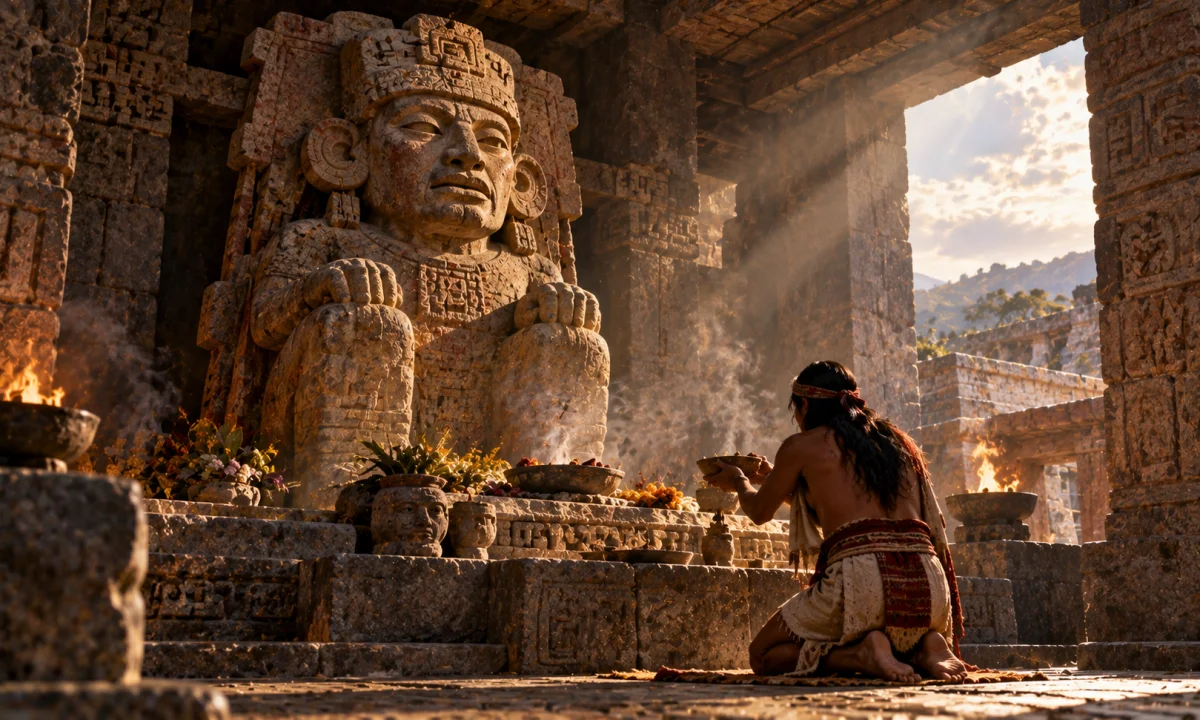
No securely documented traditional image of Pichana Gobeche is known from the major corpus of Zapotec art. It is therefore not possible to state responsibly that she had a particular costume, headdress, body colour, animal companion, agricultural implement, or emblem. Images made for modern books, websites, games, or educational projects should not be mistaken for archaeological representations of this figure.
Fertility and the Zapotec religious world
Even though the specific evidence for Pichana Gobeche is limited, fertility was an important concern in Zapotec life and religion. Communities depended on the successful cultivation of maize and other crops, while rain, springs, rivers, soil, and seasonal weather all affected subsistence. Human fertility and agricultural fertility could also be understood through related ideas of nourishment, renewal, ancestry, and reciprocity.
These broad themes help explain why modern writers may have associated Pichana Gobeche with childbirth or the earth. They do not demonstrate that she was the principal Zapotec fertility goddess. A general religious theme should not be confused with a securely identified divine personality.
Zapotec religious practice historically involved offerings, ceremonies, divination, reverence for ancestors, and relationships with powerful beings connected to natural forces and places. In Indigenous traditions, a sacred power may not fit neatly into the categories used by modern reference works. A being connected with rain, maize, a mountain, a community, or a lineage might have overlapping functions rather than belonging to one exclusive “department” such as fertility or agriculture.
Better-documented Zapotec figures
Pichana Gobeche is sometimes presented in lists beside several well-known Zapotec deities. The similarities in subject matter can create confusion, but the figures should not be merged.
- Cocijo is a major Zapotec rain and storm deity, often associated with lightning, thunder, and the life-giving power of rain. His importance is supported by archaeological imagery and colonial descriptions, although interpretations of his symbols and history remain complex.
- Pitao Cozobi is commonly identified as a maize or agricultural deity. The name and role occur in discussions of colonial-period Zapotec religion, but exact interpretations vary among scholars and sources.
- Pitao Pezelao is generally associated with death and the underworld. His name is also rendered in different ways, including forms related to Peze(e)lao, and his relationship to other death-related figures is not identical in every account.
- Xonaxi Queculla is described in some colonial and later discussions as a female figure connected with death, the dead, or the afterlife. She should not be treated as another name for Pichana Gobeche merely because both may be described using feminine religious language.
- Coquihani is often associated with the sun or light in modern summaries, although the interpretation and historical evidence surrounding Zapotec divine names require care.
These comparisons show why a simple list of “Zapotec gods” can be misleading. Some names come from colonial records, some from later scholarship, some from local traditions, and some from modern compilations whose sources are unclear. Similar associations with life, death, nature, or agriculture do not establish identity or kinship.
Sources and evidentiary problems
Knowledge of precolonial and early colonial Zapotec religion comes from several kinds of evidence: archaeological remains, carved monuments, painted manuscripts, colonial vocabularies and descriptions, Indigenous communities’ oral traditions, and comparative study of Zapotec languages. Each type of evidence has limitations.
Archaeological images can show that a symbol or ritual theme was important, but they do not always preserve a deity’s name or a complete myth. Colonial writers sometimes recorded Indigenous words and ceremonies, yet their descriptions were shaped by European categories and missionary objectives. Some works also used broad terms such as “idol,” “devil,” or “god” for concepts that may not have had exact Christian or classical equivalents.
Oral traditions are valuable, but they are not frozen records of an ancient religion. Stories change through transmission, and different communities may preserve different names and interpretations. A modern account should identify the locality and community involved if it makes a specific claim about oral tradition.
In the case of Pichana Gobeche, the central difficulty is the absence of a clearly traceable chain of evidence. It is not enough for several unsourced websites to repeat that the figure is a fertility goddess. Until the name can be connected to a documented Zapotec-language source, a recorded community tradition, a colonial text, or an identifiable scholarly interpretation, the details remain provisional.
Possible modern construction of the figure
The name may represent a local or poorly documented tradition, a variant spelling that has become detached from its original context, or a modern synthesis based on general knowledge of Zapotec agriculture and female sacred figures. It is also possible that the name has been copied inaccurately from an older source. At present, the evidence does not justify choosing among these possibilities with confidence.
This uncertainty does not make the name meaningless. Modern Indigenous communities and writers may use traditional names in ways that reflect continuing cultural identity, local memory, or renewed interest in ancestral religion. At the same time, a modern cultural use should be distinguished from proof that the figure had the same form and role in precolonial Zapotec society.
Descriptions of Pichana Gobeche as a universal Zapotec mother goddess, an exact equivalent of an Aztec earth goddess, or a deity with a fixed set of powers should therefore be regarded as interpretations rather than established historical facts. Zapotec religion should not be reduced to a single pan-Mesoamerican system in which every culture possesses interchangeable gods.
Representation and cultural significance
The most responsible way to discuss Pichana Gobeche is to acknowledge both the limited evidence and the importance of the themes attached to the name. Fertility, birth, maize, soil, rain, and continuity are central concerns in many agricultural societies, including Zapotec communities. They are also subjects through which modern people seek to understand Indigenous ideas about interdependence between humans, land, ancestors, and seasonal forces.
Yet cultural significance should not be manufactured by supplying unsupported myths. There is currently no securely attested story that explains Pichana Gobeche’s origin, marriage, conflict, death, descent into an underworld, or role in the creation of the world. Nor is there reliable evidence for a standard festival or ritual devoted specifically to this figure. Such stories and practices should not be presented as traditional simply because they fit familiar patterns in mythology.
For reference purposes, Pichana Gobeche is best identified as an uncertain or weakly documented name associated with modern accounts of Zapotec mythology. The frequently assigned themes of fertility, motherhood, childbirth, and agricultural abundance may preserve a local interpretation, but they cannot currently be treated as universally Zapotec or historically verified. Further clarification would require identifiable sources in the relevant Zapotec language, detailed community-based documentation, or careful scholarly analysis of the name and its context.