WORLD
WORLD
Paricia
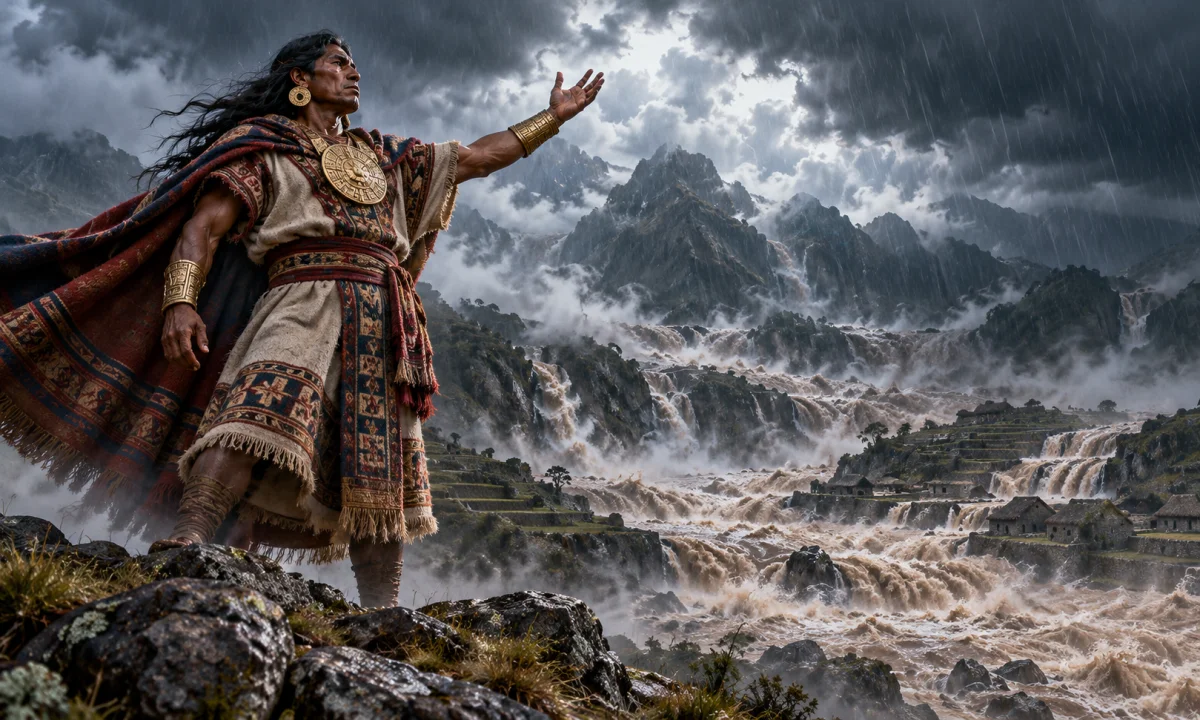
Paricia is a little-known figure associated in some modern accounts with Inca mythology, particularly with rain, floods and the destruction of an early human age. The evidence for Paricia is limited, however. Unlike better-documented Andean deities such as Viracocha, Inti or Illapa, Paricia does not have a clearly established, extensive mythology preserved in the principal colonial accounts of Inca religion. The name may represent a variant spelling, a compressed version of a flood tradition, or a confusion with another Andean water deity.
Origins and cultural setting
The Inca state ruled a large part of the Andes during the fifteenth and early sixteenth centuries, incorporating communities with older religious traditions of their own. What is commonly called “Inca mythology” therefore includes several layers: state religion centred on Cusco, local cults adopted or subordinated by the empire, and traditions belonging to peoples who were never fully integrated into the Inca system.
Knowledge of these traditions comes mainly from records written after the Spanish conquest. Colonial chroniclers gathered information from Indigenous informants, translated Quechua names and concepts into Spanish, and often interpreted Andean religion through Christian categories. Their accounts differ in detail and sometimes preserve several regional traditions as though they formed a single, unified mythology. Oral transmission, changes in spelling and the loss of Indigenous religious specialists have made the identity of some minor figures particularly difficult to establish.
Paricia belongs to this uncertain area of the tradition. The name appears in later mythological catalogues and summaries as that of a being connected with a devastating flood. It is not securely documented as a major imperial deity with a standard temple cult, genealogy or widely agreed iconography. Claims about Paricia should therefore be treated more cautiously than descriptions of prominent figures such as Viracocha or the sun god Inti.
Name and identity
The spelling Paricia is not stable across English-language reference works. Variations may result from different attempts to represent Quechua or other Andean words in Spanish and English. A short name in a modern list can also conceal a much longer regional tradition or an interpretive mistake made by a compiler.
Paricia is sometimes described simply as an Inca god of rain or floods. In other summaries, the figure is said to have sent a flood against an early human population as punishment. These descriptions are related, but they do not necessarily demonstrate that a fully defined deity named Paricia was worshipped throughout the Inca Empire. The available evidence does not establish a universally accepted genealogy, gender, physical form or place in the Inca pantheon.
The name is especially easy to confuse with Pariacaca, also written in forms such as Pariya Qaqa or Paryaqaqa. Pariacaca was an important deity in traditions from the central Andes, especially those recorded in the work commonly known as the Huarochirí Manuscript. That deity is associated with rain, storms, mountains and acts of transformation, and has a substantially richer surviving narrative tradition. Similar spellings and shared associations with water have encouraged some modern writers to treat Paricia and Pariacaca as the same figure. That identification is not certain and should not be presented as established fact.
Paricia and the flood tradition
The central story attached to Paricia in later summaries concerns a great flood. Paricia is said to have released or caused the waters that destroyed an earlier generation of people. The flood functions as a divine punishment, usually explained by the failure of human beings to honour or respect the gods.
This account resembles a broad class of destruction myths found in many parts of the world, but its Andean setting gives the theme a particular environmental significance. Mountain communities depended on a delicate balance among rainfall, rivers, springs, irrigation channels and highland wetlands. Water could sustain crops and herds, yet sudden rains, overflowing rivers and landslides could destroy settlements. A flood story could therefore express both the life-giving and dangerous power of the sacred landscape.
The details of the Paricia narrative are not consistent enough to support a single authoritative version. Some retellings place the flood at the beginning of human history; others present it as one episode in a sequence of creations and destructions. In certain accounts, the flood is connected with a creator god who later restores or remakes humanity. Such versions may reflect the tendency of modern compilers to combine motifs from different Andean creation traditions rather than a single surviving myth told in exactly that form.
It is consequently safer to describe Paricia as a figure associated in later accounts with a punitive or world-renewing flood than to assign a detailed canonical story to the name. There is no universally agreed text equivalent to a scripture that preserves Paricia’s deeds, speeches or relationships.
Attributes and powers
Paricia’s reported sphere is water, particularly rain and catastrophic flooding. If the traditions attached to the name are accepted as evidence of a distinct figure, Paricia would belong to the broad class of Andean powers governing weather and fertility. Such beings were not merely “nature gods” in a modern sense. Rain, agricultural production, livestock, human health and political stability were connected through reciprocal relationships among communities, ancestors, sacred places and divine beings.
The flood association gives Paricia a more destructive aspect than that of a simple rain-bringer. The same water that nourishes fields can erase homes, drown animals and alter river courses. A deity who controls rain may therefore be approached with reverence and caution, receiving offerings intended to secure favourable conditions rather than unrestricted abundance.
No reliable traditional description establishes Paricia’s appearance. Images sometimes assigned to the figure in modern compilations are likely borrowed from better-known Andean deities or from generalized representations of Inca gods. There is no firm basis for claiming that Paricia had a particular animal companion, weapon, costume, number of faces or bodily form.
Nor is there strong evidence for a distinct shrine, priesthood or festival dedicated specifically to Paricia. The absence of such evidence does not prove that no local cult existed, since many religious practices were not recorded by colonial writers. It does mean that claims portraying Paricia as one of the principal gods of the entire Inca Empire go beyond what can presently be established.
Relationship to other Andean water deities
Viracocha
Viracocha is the best-known creator figure in many accounts of Inca religion. Several colonial narratives describe a primordial age, acts of creation, and the transformation or destruction of early beings. Flood imagery is sometimes connected with these creation traditions. Because of this overlap, Paricia is occasionally presented as an agent of Viracocha or as an alternative name for a power operating within a Viracocha flood story. That relationship is not consistently supported by the sources.
Viracocha’s identity itself varies across colonial accounts, and the existence of a flood motif in a story about him does not demonstrate that Paricia was his servant, child or associate. Those relationships should be treated as later reconstruction unless a particular tradition clearly states them.
Illapa
Illapa, also written Illapu or associated with the name Apu Illapa, was a major Inca weather deity. Colonial descriptions connect him with thunder, lightning and rain, sometimes imagining his weapons or movements as the causes of storms. Illapa had a much clearer place in accounts of state religion than Paricia.
Because both figures are linked with rain, some modern lists blur their identities. They should not automatically be merged. Illapa represents a well-attested imperial weather cult, while Paricia is a far less securely documented name associated primarily with flood tradition.
Pariacaca
Pariacaca is the most important possible source of confusion. In the Huarochirí traditions, he is a powerful regional deity connected with storms, water, mountains and struggles against rival beings. His stories include transformations, contests and the reshaping of the landscape. These traditions belong to the central Andes and should not be casually relabelled as standard beliefs of every Inca community.
Pariacaca and Paricia may have been confused because of similar spellings, their shared association with water, or the simplification of Quechua names in later reference works. At present, the similarity of names alone is not enough to prove that they are identical.
Religious significance of flood imagery
Flood narratives in the Andes can be understood within a wider religious view in which landscapes were active and sacred. Mountains, springs, stones and fields could possess spiritual power or serve as places of contact with nonhuman beings. The wellbeing of a community depended on maintaining appropriate relationships through offerings, ritual observance and respect for local sacred places.
A destructive flood could thus signify more than a punishment for an abstract moral offence. It could represent a breakdown in reciprocity between human communities and the powers that governed the environment. The story may warn that social disorder, neglect of ritual obligations or arrogance toward sacred forces has consequences in the material world.
At the same time, destruction and renewal are not always opposites in Andean traditions. The ending of one age can make possible the emergence of another order. Floods may erase an old population, transform the land and prepare the world for a new creation. This does not make Paricia a benevolent creator, but it places the figure within a pattern in which catastrophe and renewal can be closely connected.
Historical evidence and limits of interpretation
There is no securely identified pre-conquest text written by Inca religious authorities that defines Paricia. The Inca used systems of record-keeping, including khipu cords, but the surviving evidence does not provide a straightforward mythological dictionary or complete account of every local divinity. Much of what is known about Andean religion was recorded through Spanish alphabets and colonial literary conventions.
For that reason, Paricia may represent several possibilities:
- a regional water or flood being whose tradition was only briefly recorded;
- a variant spelling or altered form of another Andean divine name;
- a name extracted from a larger creation narrative and later treated as an independent deity;
- or a modern synthesis based on overlapping accounts of floods, creation and rain gods.
These possibilities cannot presently be reduced to one certain answer. Describing the figure as “the Inca flood god” is convenient, but it gives a level of certainty and uniformity that the evidence does not warrant. A more precise description is that Paricia is a poorly documented name associated by later sources with rain, flooding and the destruction of an early human age.
Paricia in modern reference works
Paricia occasionally appears in encyclopedias, mythology websites and lists of Inca gods as a flood deity or rain god. Such entries often repeat a short formula without distinguishing colonial testimony from modern classification. They may also place Paricia beside Viracocha, Illapa and Pariacaca without explaining that these figures come from different layers or regions of Andean religious tradition.
There is no prominent, widely recognized modern literary, cinematic or gaming tradition centred on Paricia. When the name appears in contemporary fantasy, it is generally free adaptation rather than a continuation of a clearly documented cult or narrative. Modern portrayals should therefore be identified as creative uses of an uncertain mythological name, not as evidence for additional ancient attributes.