WORLD
WORLD
Pariacaca
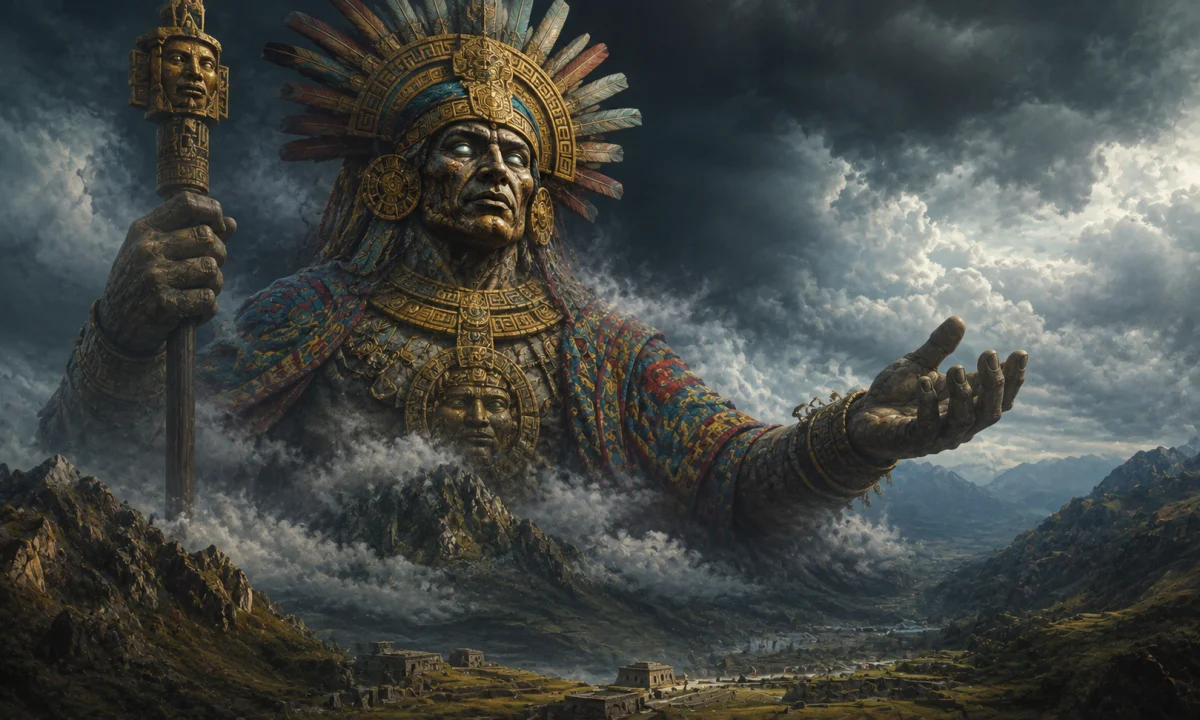
Pariacaca is a major deity in the religious traditions of the Huarochirí region of the central Peruvian Andes. He is especially well known from the Huarochirí Manuscript, a Quechua-language collection of Indigenous traditions recorded during the early colonial period. In these narratives, Pariacaca is associated with mountains, rain, storms, rivers, fertility and the ordering of the landscape. He is also a powerful ancestral huaca—a sacred being, place or object with spiritual force—rather than simply a personified mountain or a god in the same sense as figures from classical Mediterranean mythology.
Origins and cultural setting
Pariacaca belongs to the religious world of the central Andes, particularly the communities historically associated with Huarochirí, east of present-day Lima. This region contains steep valleys, high mountain passes, agricultural terraces and seasonal water systems. Rainfall, snowmelt and the control of irrigation were essential to survival, so sacred beings connected with mountains and weather held great practical and religious importance.
The most important surviving record of Pariacaca's traditions is the Huarochirí Manuscript. It was written in Quechua in the late sixteenth or early seventeenth century, probably by an Indigenous author or authors working in a colonial Christian environment. The manuscript preserves local accounts of huacas, ancestors, ritual practices, conflicts between communities and the origins of important places. A Spanish priest, Francisco de Ávila, was involved in the investigation and suppression of local religions, and this history affects how the material must be read.
The manuscript is not a single, systematic mythology. It is a collection of narratives that were transmitted within particular communities and ritual contexts. Its stories sometimes present different versions of events, emphasize local loyalties or explain why a specific shrine, mountain or community possessed authority. Consequently, descriptions of Pariacaca may vary in detail. The text is extremely valuable, but it should not be treated as a complete or uniform statement of all Andean belief.
Name and identity
The name Pariacaca is also written in forms such as Pariyaqaqa or Pariacaca, depending on the spelling system used for Quechua and Spanish. Its exact etymology is not entirely secure. Some interpretations connect elements of the name with ideas such as reddish colour and rock or cliff, but these explanations are not universally accepted. A proposed translation should therefore be treated cautiously rather than presented as a definite meaning.
Pariacaca is best understood as a powerful local or regional huaca whose identity includes several dimensions. He is a sacred ancestor, a mountain power, a weather deity and a force capable of transforming the land. These categories were not sharply separated in Andean religion. A mountain could be an ancestor; an ancestor could act through a mountain; and water, thunder and agricultural abundance could all be expressions of the same sacred power.
In some modern descriptions, Pariacaca is called a creator god. That label reflects important elements of his stories, since he helps establish the shape and order of the world known to the people of Huarochirí. However, he should not automatically be identified with a universal creator or with every Andean creation deity. His importance is especially rooted in the regional traditions preserved in the Huarochirí material.
Birth from the eggs
One of Pariacaca's most distinctive stories concerns his birth from eggs. In the account preserved by the Huarochirí tradition, eggs appear on the mountain of Condorcoto, and from them Pariacaca emerges with his brothers or companion powers. The precise number and arrangement of the eggs can be described differently in translations and interpretations, but the central image is consistent: Pariacaca does not have an ordinary human birth. He comes from a sacred highland place in a form that marks him as more than human.
The egg motif presents him as a being generated directly by the sacred landscape. His origins are not linked to a human family in the ordinary sense, even though the narratives later describe him through relationships, rivalries and descendants. The mountain birth also connects his identity with the high Andes, where clouds, snow, rock and rainfall meet.
In the manuscript, Pariacaca's emergence is part of a wider sequence of transformations in which powerful beings shape communities and territories. The stories do not describe creation as a single event completed at the beginning of time. Instead, the world becomes ordered through contests, journeys, floods, marriages, punishments, transformations and the establishment of ritual obligations.
Weather, water and the landscape
Pariacaca's most important powers concern water and atmospheric forces. He is associated with rainstorms, torrents and the movement of water through the mountain environment. His actions explain or sacralize features of the landscape, while also expressing the dependence of agriculture on forces that human beings could not fully control.
Like many Andean mountain powers, Pariacaca is not simply benevolent. Rain can nourish crops, fill irrigation channels and sustain herds, but excessive rain can cause floods, erosion and destruction. A storm deity therefore embodies both protection and danger. Communities had to maintain proper relationships with their huacas through offerings, ritual observance and respect for local sacred places.
The association between mountains and water is especially significant in the Andes. High peaks were understood as sources of life-giving waters, and the visible presence of snow, cloud and rainfall made them powerful religious landmarks. Pariacaca's identity reflects this ecological reality without reducing it to a simple “nature god” concept. He is an active sacred personage who acts within a moral and social universe, not merely a symbol invented to explain the weather.
The conflict with Huallallo Carhuincho
The best-known episode involving Pariacaca is his conflict with Huallallo Carhuincho, another powerful being in the Huarochirí traditions. Huallallo is associated with fire, heat and a destructive order of the world. The narratives portray him as a tyrannical power who demanded severe offerings and harmed human communities. The exact details differ across translations and readings, but the conflict is commonly understood as a contest between Pariacaca's rain and Huallallo's fire.
Pariacaca attacks or overwhelms Huallallo with storms and water. The struggle is not merely a battle between two supernatural individuals. It represents a transformation in the organization of the world and a change in the relationship between divine powers and human beings. Pariacaca's victory establishes his authority over the region and limits the power of his rival.
Some versions describe Huallallo being forced away or retreating toward the eastern side of the Andes. Other details concern the reshaping of mountains and the consequences of the contest. Because the surviving text preserves oral traditions rather than a standardized scripture, it is safer to speak of a group of related episodes than of one fixed canonical version.
The story can be interpreted in several connected ways. At a basic level, it dramatizes the opposition between destructive heat and life-giving rain. It may also preserve memories of political or cultural conflicts among groups whose ancestral huacas were placed in competition. Scholars have sometimes connected such stories with broader Andean ideas about successive eras or transformations of humanity, although the precise meaning of each episode remains debated.
Pariacaca and Chaupiñamca
Pariacaca is closely associated with Chaupiñamca, a major female huaca in the same body of traditions. She is often described as his sister, although the nature of their relationship depends on the narrative context. Chaupiñamca is connected with fertility, sexuality, women, agricultural abundance and the powers of the cultivated landscape. Her traditions include transformations and ritual practices that differ from those surrounding Pariacaca.
The relationship between Pariacaca and Chaupiñamca illustrates that Huarochirí religion contained several important sacred centers rather than one simple hierarchy. Pariacaca's power is strongly expressed through rain, storms and high mountains, while Chaupiñamca's is more closely tied to fertility and the life of communities. The two figures should not be collapsed into a single deity or treated as interchangeable versions of one another.
Some accounts speak of other beings as children, brothers or companions of Pariacaca. These relationships are not always presented consistently, and names may vary between translations. They should be understood within the flexible kinship language of Andean sacred traditions, where beings may be related as ancestors, founders, local powers or members of a ritual community.
Huacas, ancestors and ritual authority
The word huaca was used by Andean peoples for a wide range of sacred realities, including mountains, springs, stones, mummies, shrines, ancestors and powerful beings. A huaca was not necessarily an idol or an image in the European sense. It could be a living presence located in a landscape and connected with a community's origin, territory and obligations.
Pariacaca's status as a huaca helps explain why his stories include both cosmic events and local concerns. His actions affect the structure of the world, but his worship is also tied to particular mountains, routes, settlements and agricultural systems. A community's relationship with its huaca could involve offerings, festivals, pilgrimages and the maintenance of sacred places.
Colonial religious officials often described such practices as idolatry and attempted to destroy huacas and suppress their ceremonies. The manuscript itself was produced in this environment of investigation and religious persecution. Its descriptions may therefore reflect both Indigenous knowledge and the pressures imposed by Christian authorities. The survival of Pariacaca's stories is evidence of the resilience of local traditions, but it does not mean that the manuscript records them in an untouched precolonial form.
Symbolism and interpretation
Pariacaca can be interpreted through several overlapping themes:
- Water and agricultural survival: Rain and mountain water sustain crops, animals and human settlements, making Pariacaca a power of life as well as danger.
- Mountain ancestry: His birth from a highland site expresses the close relationship between sacred beings, territory and ancestral origin.
- Transformation: His stories belong to a world continually reshaped by divine conflict, movement and changes in the landscape.
- Ritual dependence: Communities are not independent of the sacred powers around them. Their prosperity depends on maintaining appropriate relationships with huacas.
- Regional identity: Pariacaca's importance is strongly tied to Huarochirí and should not be detached from the communities and places that preserved his traditions.
It is tempting to reduce the conflict between Pariacaca and Huallallo to a universal myth of “rain defeating fire.” Such a reading captures part of the imagery but leaves out the social and territorial dimensions of the narratives. The stories also concern who has authority, which communities are protected, how the landscape acquired its present form and why ritual obligations exist.
Distinguishing Pariacaca from other Andean figures
Pariacaca is sometimes confused with Viracocha, the creator figure known from Inca and colonial-era accounts. Both may be described in broad terms as powerful creators or civilizing beings, but they belong to different narrative traditions and should not be treated as the same deity. Viracocha is associated with traditions centered in the wider Inca religious world, while Pariacaca's best-attested stories come from Huarochirí.
Pariacaca should also be distinguished from the apu concept. In many Andean contexts, an apu is a powerful mountain spirit or sacred mountain, but terminology and religious practice vary by region. Pariacaca has mountain-associated characteristics and may be discussed in relation to mountain powers, yet calling him simply “an apu” can obscure the specific narratives, relationships and historical setting attached to his name.
He is not the same as Huallallo Carhuincho, his adversary, nor is he identical to Chaupiñamca, his female counterpart or relative in the Huarochirí traditions. Nor should the name be used for every mountain deity in Peru. Similar features—rain, rock, ancestry and fertility—appear widely in Andean religion, but shared themes do not prove that different figures are one being.
Later reception
Pariacaca is now known mainly through translations and scholarly studies of the Huarochirí traditions. Modern writers sometimes present him as a “god of storms,” a “creator god” or a heroic mountain deity. These descriptions can be useful introductions, but each highlights only part of a more complex identity. The traditional material presents him as a sacred power embedded in place, community, ritual and history.
His presence in modern discussions of Andean mythology also reflects wider efforts to recover Indigenous intellectual and religious traditions that colonial authorities attempted to suppress. Contemporary interpretations may use Pariacaca to explore Indigenous environmental knowledge, mountain worship, water politics and cultural memory. Such uses are modern interpretations and should be kept distinct from the traditions recorded in the Huarochirí Manuscript.
Pariacaca's significance ultimately lies in the way his stories connect divine power with the lived Andean landscape. He is born from the mountains, commands rain, contests destructive heat and participates in the establishment of a world in which human communities remain dependent on sacred places and forces beyond ordinary human control.